

15 Best Synonyms of ‘Please Note’ (With Examples) show how choosing the right words when sharing information or updates can make your communication feel clear, respectful, and thoughtful. While “Please Note” is widely used, employing alternatives can make your message feel more personal, professional, and engaging.
Short emails, reports, or conversations can help convey important points while maintaining warmth and clarity, ensuring your communication resonates effectively with anyone receiving it. Exploring 15 synonyms gives the flexibility to vary your phrasing and keep updates fresh.
From my experience, the right words transform ordinary updates into meaningful communication that reaches colleagues, clients, or teams alike, keeping every message personal, thoughtful, and naturally engaging.
What Does “Please Note” Mean?
Please note is a polite phrase used to draw attention to important information. It signals that the recipient should pay attention, acknowledge, or act on the content. Using alternatives allows you to maintain professionalism while adjusting tone, formality, and engagement for your audience.
When to Use “Please Note”
Use it in emails, memos, reports, or any communication where highlighting key details is necessary. This phrase ensures the recipient understands the importance of the information, instructions, or updates, and alternatives can make it sound more thoughtful or approachable depending on context.
Is It Professional/Polite to Say “Please Note”?
Yes. It is professional and polite, but overuse can feel repetitive or impersonal. Alternatives such as “Kindly be aware” or “Do take note” offer varied tones, from formal to friendly, while keeping your message clear and courteous.
What Can I Say Instead of “Please Note”?
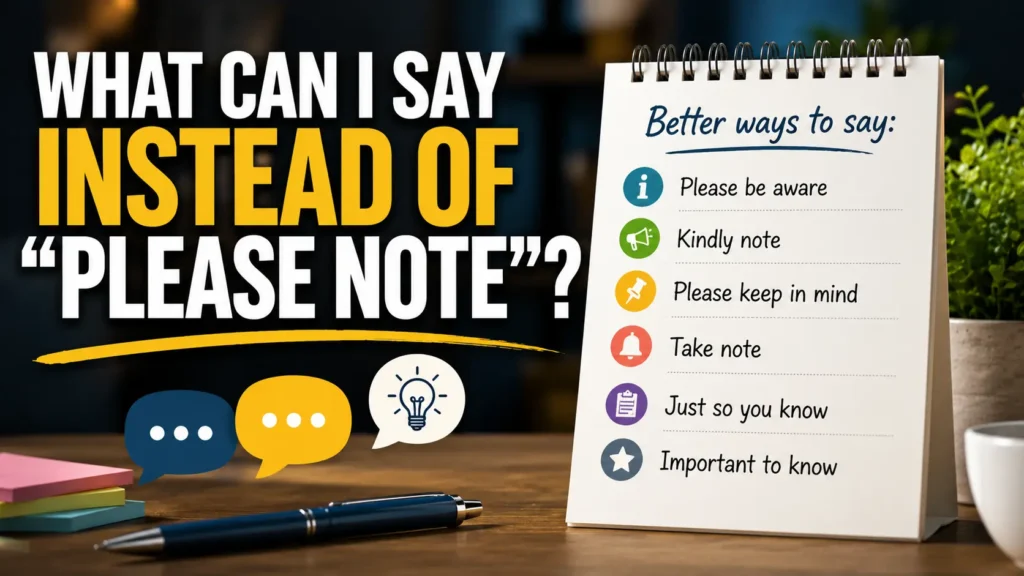
Here are 15 useful alternatives:
| Alternative | Best For | Tone | Action Required? |
| Kindly Be Aware | Professional emails | Polite, formal | Sometimes |
| Do Take Note | Important updates | Formal, direct | Usually |
| Please Be Informed | Official notices | Formal | Sometimes |
| For Your Attention | Documents and reports | Professional, direct | Often |
| Kindly Note | Emails and announcements | Polite, professional | Sometimes |
| Be Advised | Warnings and official notices | Formal, authoritative | Often |
| Take Note | Team communication | Direct, clear | Usually |
| Let Me Highlight | Presentations and emails | Friendly, professional | Not always |
| I’d Like to Point Out | Explanations | Polite, conversational | Not always |
| For Your Information (FYI) | Sharing updates | Neutral | Usually no |
| Attention Please | Notices and announcements | Direct, commanding | Often |
| Kindly Be Advised | Formal communication | Formal, respectful | Sometimes |
| Do Remember | Reminders | Friendly, professional | Usually |
| Allow Me to Inform | Formal announcements | Courteous, formal | Sometimes |
| Please Be Aware | Important information | Polite, professional | Sometimes |
Pros or Cons
Pros:
Draws attention to key information, maintains politeness, works across professional and casual settings.
Cons:
Can feel repetitive or overly formal if used too often, may sound impersonal in some contexts
Please Note Synonyms:
- Kindly Be Aware
- Do Take Note
- Please Be Informed
- For Your Attention
- Kindly Note
- Be Advised
- Take Note
- Let Me Highlight
- I’d Like to Point Out
- For Your Information (FYI)
- Attention Please
- Kindly Be Advised
- Do Remember
- Allow Me to Inform
- Please Be Aware
Kindly Be Aware
Meaning:
Politely asks the reader to acknowledge the information.
Explanation:
Formal and respectful, suitable for professional emails.
Example:
Kindly be aware that the meeting has been rescheduled to 3 PM.”
Best Use:
Emails, client communication, and formal notices.
Worst Use:
Casual messages or informal chats.
Tone:
Polite, professional, respectful.
Do Take Note
Meaning:
Directs attention to important information.
Explanation:
Professional, slightly more formal than “please note,” adds emphasis.
Example:
“Do take note of the changes in the project timeline.”
Best Use:
Official updates, reports, and internal memos.
Worst Use:
Casual conversations.
Tone:
Formal, clear, assertive.
Please Be Informed
Meaning:
Signals that the recipient should be aware of the information.
Explanation:
Common in professional correspondence, particularly official notifications.
Example:
Please be informed that the office will remain closed on Friday.”
Best Use:
Formal emails, company announcements.
Worst Use:
Casual chats or informal notes.
Tone:
Formal, professional, polite.
For Your Attention
Meaning:
Highlights that the information is important and requires consideration.
Explanation:
Suitable for emails and memos where acknowledgment is needed.
Example:
“For your attention: The quarterly report is attached for review.”
Best Use:
Professional correspondence, internal reports.
Worst Use:
Friendly texts.
Tone:
Professional, direct, polite.
Kindly Note
Meaning:
Polite way to ask someone to observe or acknowledge information.
Explanation:
Combines courtesy with clarity; widely used in formal communication.
Example:
Kindly note the new deadline for submissions is next Monday.”
Best Use:
Emails, formal requests, announcements.
Worst Use:
Informal messages.
Tone:
Polite, professional, respectful.
Be Advised
Meaning:
Indicates important information or guidance is being provided.
Explanation:
Often used in formal, legal, or official notices.
Example:
“Be advised that policy changes will take effect from next week.”
Best Use:
Legal correspondence, formal notifications.
Worst Use:
Casual team messages.
Tone:
Formal, authoritative, professional.
Take Note
Meaning:
A directive to pay attention to specific information.
Explanation:
Slightly informal, works well in meetings or team communications.
Example:
“Take note of the new workflow for the marketing campaign.”
Best Use:
Team meetings, collaborative emails.
Worst Use:
Highly formal client emails.
Tone:
Clear, direct, professional.
Let Me Highlight
Meaning:
Used to emphasize important points.
Explanation:
Friendly yet professional, ideal for drawing attention without sounding commanding.
Example:
“Let me highlight that the deadline is approaching quickly.”
Best Use:
Presentations, emails, informal professional messages.
Worst Use:
Strictly formal or legal notices.
Tone:
Friendly, professional, engaging.
I’d Like to Point Out
Meaning:
Draws attention to specific details politely.
Explanation:
Slightly conversational, adds personal touch.
Example:
“I’d like to point out that the figures in the report have been updated.”
Best Use:
Emails, presentations, internal communications.
Worst Use:
Legal or highly formal correspondence.
Tone:
Polite, personal, professional.
For Your Information (FYI)
Meaning:
Shares details for awareness without expecting immediate action.
Explanation:
Common in business emails; neutral and professional.
Example:
For your information, the office parking rules have changed.”
Best Use:
Informative emails, updates.
Worst Use:
Formal legal notices.
Tone:
Neutral, professional, clear.
Attention Please
Meaning:
Calls attention to important details.
Explanation:
Slightly commanding, suitable for notices or instructions.
Example:
“Attention please: Submit all forms by Friday.”
Best Use:
Notices, announcements, memos.
Worst Use:
Casual texts.
Tone:
Direct, professional, commanding.
Kindly Be Advised
Meaning:
Formal way to inform the recipient of important details.
Explanation:
Polite, professional, and often used in official communication.
Example:
“Kindly be advised that the training schedule has been updated.”
Best Use:
Formal notices, official emails.
Worst Use:
Casual conversation.
Tone:
Professional, respectful, polite.
Do Remember
Meaning:
Reminds the reader to take note of information.
Explanation:
Friendly reminder, less formal but still professional.
Example:
Do remember to submit your reports by Friday.”
Best Use:
Team emails, reminders.
Worst Use:
Legal documents.
Tone:
Friendly, clear, professional.
Allow Me to Inform
Meaning:
Polite phrasing to share important details.
Explanation:
Adds formality while maintaining a courteous tone.
Example:
“Allow me to inform you that the meeting has been moved to 4 PM.”
Best Use:
Emails, official announcements.
Worst Use:
Casual notes.
Tone:
Polite, professional, courteous.
Please Be Aware
Meaning:
Requests acknowledgment of important information.
Explanation:
Polite, professional, and emphasizes attention to detail.
Example:
Please be aware of the updated guidelines before submitting your report.”
Best Use:
Professional emails, internal updates.
Worst Use:
Informal texting.
Tone:
Polite, professional, respectful.
Best Alternatives to “Please Note” for Emails
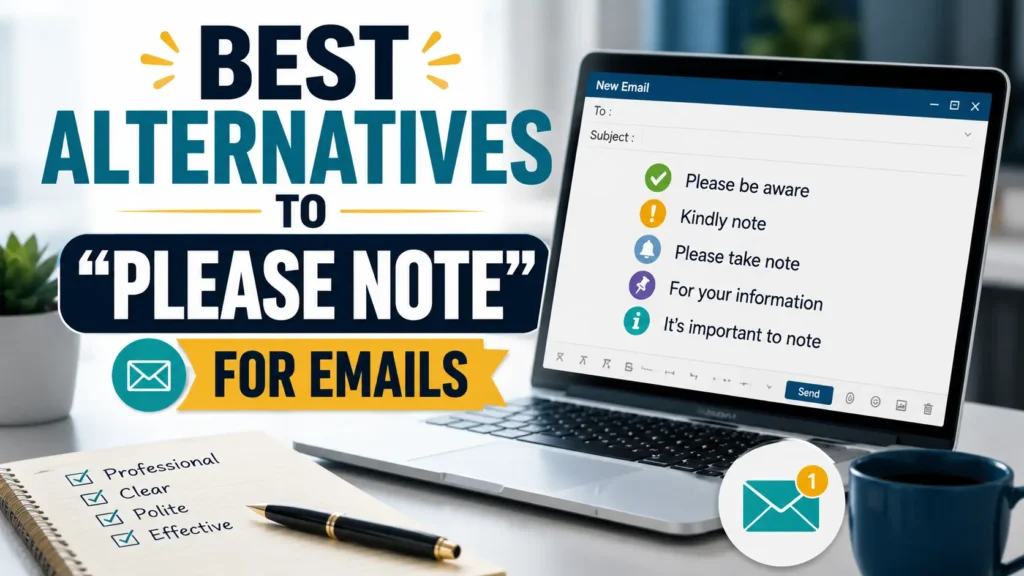
The best alternative depends on what you want your email recipient to do.
When you want to sound formal
Use:
- Please Be Informed
- Kindly Be Advised
- Be Advised
- Allow Me to Inform
Example:
Please be informed that the office will close at 2 PM on Friday.
When you want to sound polite and professional
Use:
- Kindly Note
- Please Be Aware
- Kindly Be Aware
- For Your Attention
Example:
Kindly note that the deadline has been extended until Monday.
When you simply want to share information
Use:
- For Your Information (FYI)
- Let Me Highlight
- I’d Like to Point Out
Example:
For your information, the client has approved the revised proposal.
When you need someone to remember or act
Use:
- Do Remember
- Take Note
- Do Take Note
Example:
Do remember to attach the completed form before sending your application.
Formal Alternatives to “Please Note”
If you are writing an official announcement, business notice, or formal email, these options are particularly appropriate:
- Please Be Informed
- Kindly Be Advised
- Be Advised
- Kindly Note
- For Your Attention
- Allow Me to Inform
However, formal does not always mean better. In modern professional writing, a simple phrase such as “Please be aware” may sound more natural than a highly formal expression such as “Allow me to inform.”
Polite and Friendly Alternatives to “Please Note”
For internal communication or professional messages that should feel less stiff, consider:
- Please Be Aware
- Let Me Highlight
- I’d Like to Point Out
- Do Remember
- For Your Information
For example:
Let me highlight one important change before we finalize the schedule.
This sounds more conversational than:
Be advised that the schedule has changed.
Both sentences can communicate important information, but their tones are different.
Alternatives to “Please Note” When Action Is Required
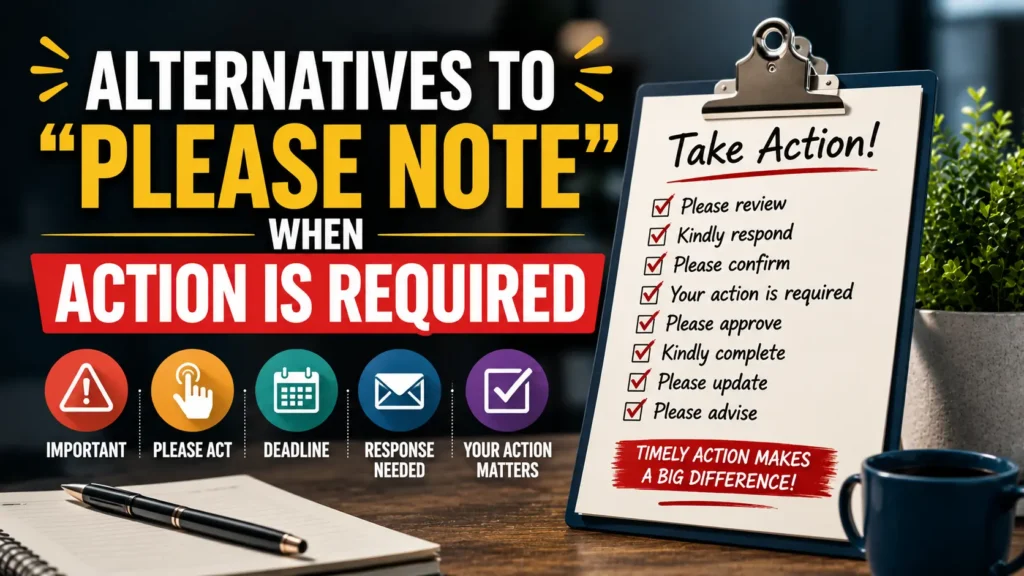
“Please Note” mainly draws attention to information. If you actually need the reader to do something, a more specific phrase may be better.
Consider:
- Please Review
- Please Confirm
- Please Remember
- Please Take Action
- Please Ensure
- Kindly Complete
- Please Respond By
For example, instead of:
Please note that the form must be completed by Friday.
You could write:
Please complete the form by Friday.
The second sentence is clearer because it directly tells the reader what action is required.
“Please Note” vs. “Kindly Note”
“Please Note” and “Kindly Note” have very similar meanings. Both politely direct attention to important information.
The main difference is tone.
| Phrase | Tone | Example |
| Please Note | Neutral, polite | Please note that the deadline has changed. |
| Kindly Note | Slightly more formal | Kindly note that the deadline has changed. |
“Please Note” is generally the more natural choice for everyday professional communication. “Kindly Note” can work well in formal emails and notices, but it may sound slightly more formal depending on the context.
Comparison Table of Top Alternatives
| Alternative | Best Use | Worst Use | Tone |
| Kindly Be Aware | Emails, client communication | Casual chats | Polite, professional |
| Do Take Note | Official updates, internal memos | Casual messages | Formal, clear |
| Please Be Informed | Company announcements, emails | Informal notes | Formal, professional |
| For Your Attention | Internal reports, emails | Casual texting | Professional, direct |
| Kindly Note | Emails, requests | Informal messages | Polite, respectful |
| Be Advised | Legal notices, formal emails | Casual conversation | Formal, authoritative |
| Take Note | Team meetings, collaborative emails | Highly formal letters | Direct, professional |
| Let Me Highlight | Presentations, emails | Legal documents | Friendly, engaging |
| I’d Like to Point Out | Emails, presentations | Legal correspondence | Polite, personal |
| For Your Information (FYI) | Updates, informative emails | Formal legal documents | Neutral, professional |
| Attention Please | Notices, memos | Casual chats | Direct, commanding |
| Kindly Be Advised | Official emails, formal notices | Casual messages | Polite, professional |
| Do Remember | Team emails, reminders | Legal documents | Friendly, clear |
| Allow Me to Inform | Official announcements, emails | Informal notes | Polite, courteous |
| Please Be Aware | Internal updates, emails | Informal texting | Polite, respectful |
Which Alternative to “Please Note” Should You Use?
There is no single best synonym for every situation. Choose the phrase according to your purpose and audience.
- Use “Kindly Note” when you want a close, polite alternative to “Please Note.”
- Use “Please Be Aware” when you want to make someone conscious of a condition or important detail.
- Use “For Your Information” when you are simply sharing information and do not expect action.
- Use “For Your Attention” when something needs careful review.
- Use “Do Remember” when you are reminding someone about a task or deadline.
- Use “Be Advised” for formal warnings, policies, or official notices.
- Use “Let Me Highlight” when you want a friendlier and more conversational tone.
- Use “Please Be Informed” for formal announcements or notifications.
- Use “Take Note” when you want to give a clear and direct instruction.
The most natural choice is usually the one that clearly communicates your purpose without adding unnecessary formality.
Final Thoughts
Using alternatives for Please Note allows you to communicate important information thoughtfully and professionally. While the phrase itself is polite, varying your wording can make your message feel more personal, respectful, and engaging. Choosing the right phrasing ensures your audience acknowledges the information while keeping your tone friendly, professional, and clear.
Employing these 15 synonyms also enhances clarity and strengthens relationships in professional settings. From formal emails to team updates, these phrases help you convey key points without sounding repetitive or impersonal. Thoughtful language shows attention to detail, respect for your recipient, and ensures that your communication is both effective and well-received.
FAQs
What does “Please Note” mean?
Please note is a polite phrase used to draw attention to important information. It signals that the recipient should acknowledge, consider, or act on the content being shared.
When should I use “Please Note”?
It is ideal for emails, reports, memos, and professional communication where highlighting key details is necessary, and you want to ensure the recipient pays attention.
Can I use “Kindly Be Aware” instead of “Please Note”?
Yes, Kindly Be Aware is a polite and professional alternative suitable for formal emails or official notices while maintaining respect and clarity.
Is “Do Take Note” formal enough for business emails?
Yes, Do Take Note is slightly formal, emphasizes attention to important details, and works well in business correspondence or internal updates.
What is the difference between “Please Be Informed” and “For Your Information (FYI)”?
Please Be Informed is more formal, suitable for official announcements, while FYI is neutral and often used in internal, casual, or semi-formal communications.
Can these alternatives make messages feel more engaging?
Absolutely. Using thoughtful alternatives like Let Me Highlight or I’d Like to Point Out personalizes your message and draws attention respectfully without sounding repetitive.
Are all alternatives appropriate for formal settings?
Most are professional, but some, such as Take Note or I’d Like to Point Out, are better suited for team emails or presentations rather than legal or highly formal documents.
Which alternatives are best for casual professional communication?
Do Remember, Let Me Highlight, or FYI are friendly yet professional options that maintain clarity while keeping a conversational tone.
Can using these alternatives improve team collaboration?
Yes, thoughtful phrasing encourages clarity, prevents miscommunication, and shows respect for your team, fostering better understanding and smoother workflow.
How do I choose the right synonym for my message?
Consider context, audience, and tone. Use formal alternatives for official announcements, polite professional options for emails, and friendly variations for internal communications or presentations.
