

If you’ve ever stopped while writing or speaking and wondered whether it’s “she has” or “she have,” you’re not alone. Many English learners and even fluent speakers get confused by this common grammar rule. Understanding the correct form can improve your writing, speaking, and overall communication skills.
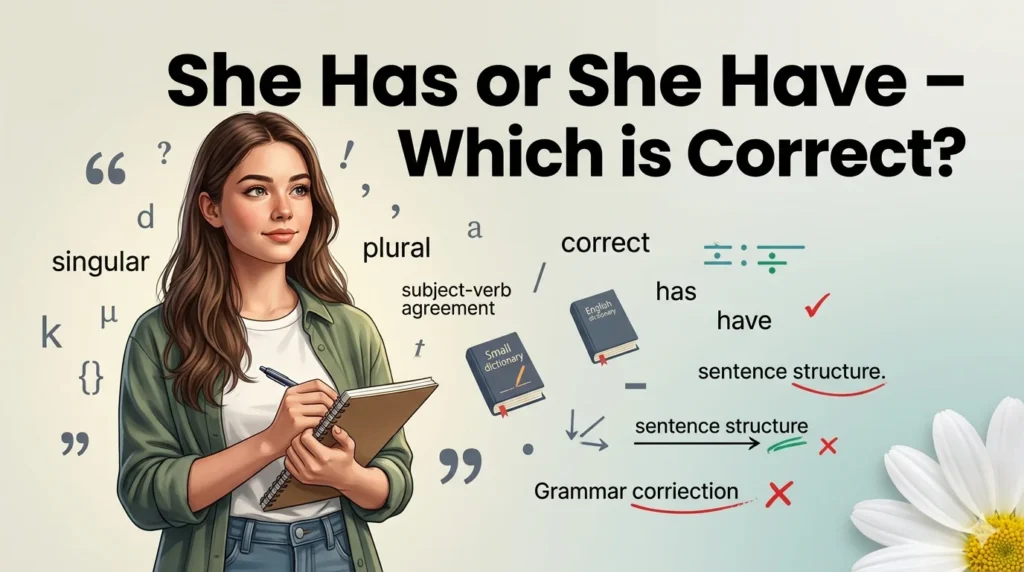
The correct phrase is “she has.” In English grammar, the verb must agree with the subject. Since she is a third-person singular subject, it always takes has, not have. That’s why we say, “She has a book,” instead of “She have a book.”
This rule also applies to other singular subjects like he and it. For example, we say, “He has a car” and “It has four legs.” Meanwhile, have is used with I, you, we, and they.
Learning this simple grammar pattern makes your sentences clearer and more professional. It also helps you avoid common mistakes in emails, conversations, exams, and workplace writing. Once you practice the rule regularly, using “she has” will start to feel natural and effortless.
Understanding “Has” vs. “Have”: The Grammar Foundation
The verbs “has” and “have” are both forms of the verb “to have”, which means to possess, own, or experience something. They are used based on the subject in the sentence.
- “Has” is used with third person singular subjects.
- “Have” is used with I, you, we, they, and all plural nouns.
Example:
- She has a new car.
- They have three children.
So the key difference lies in the subject, not the object.
Subject-Verb Agreement: The Core Rule
Subject-verb agreement is a cornerstone of English grammar. Verbs must agree with their subjects in both number and person.
| Subject Type | Correct Verb | Example |
| Singular (he, she) | has | She has a bright smile. |
| Plural (they, we) | have | They have good manners. |
| First-person (I) | have | I have a headache. |
| Second-person (you) | have | You have two emails. |
In this case, “she” is a third-person singular subject, so it always takes “has.”
Why “She Has” Is Correct: Third Person Singular Rule
The third-person singular rule in English says that verbs in the present simple tense must end with -s when the subject is he, she, or it.
- He has a meeting.
- She has a dream.
- It has wings.
The form “she have” does not follow standard grammar rules and is considered incorrect in formal writing and speech.
Quick tip: If the subject is “she,” always use “has” in the present tense.
When Do You Use “Have”?
While “she has” is correct, “have” still plays a big role in English. You use “have” when the subject is plural or when it’s I or you.
| Subject | Example |
| I | I have a plan. |
| You | You have great energy. |
| We | We have two dogs. |
| They | They have been there before. |
Also, “have” is used after modal verbs like should, would, could, etc.
Using “Has” and “Have” in Real Sentences
Understanding these words in theory is useful. But using them in actual sentences cements your knowledge.
Correct usage:
- She has a cold.
- They have a lot of experience.
- I have seen that movie.
Incorrect usage:
- She have a cold. ❌
- He have an idea. ❌
Quote: “Good grammar is credibility.” — William D. Lutz
Modal Verbs: Why “She Should Have” Is Correct
Modal verbs (should, would, could, might, etc.) are followed by the base form of the verb, not the conjugated form.
That’s why we say:
- She should have arrived by now.
- He could have helped us.
Never:
- She should has arrived.
- He would has gone.
These are not only incorrect but immediately noticeable to native speakers.
Perfect Tense with “Has” and “Have”
The present perfect tense is formed by using “has” or “have” followed by the past participle.
| Subject | Present Perfect Example | Past Perfect Example |
| She | She has eaten breakfast. | She had eaten before leaving. |
| They | They have traveled far. | They had gone by 5 p.m. |
Use “has” for third-person singular in the present perfect. Use “had” for all subjects in past perfect.
Special Grammar Cases to Watch
Questions in the Past:
- Correct: Did she have a problem?
- Incorrect: Did she has a problem? ❌
Negatives with Auxiliaries:
- Correct: She doesn’t have a clue.
- Incorrect: She doesn’t has a clue. ❌
These examples illustrate how “have” follows auxiliary verbs like did and does.
Proper Nouns and Collective Nouns
Proper nouns like “Maria,” “Jessica,” or “The President” follow the same rule:
- Maria has a great memory.
- The CEO has a bold strategy.
Collective nouns can be tricky:
- The team has a new coach. (considered a single unit)
- The staff have arrived. (if viewed as individuals)
Case study: In British English, collective nouns often take plural verbs. In American English, they’re usually singular.
Common Mistakes with “Has” and “Have”
Many ESL learners confuse “has” and “have” due to:
- Translating from native language structures
- Listening to informal speech where errors are more tolerated
- Not mastering third-person singular rules
Fact: According to a 2023 Cambridge Learner Corpus report, misuse of subject-verb agreement is among the top five grammar errors in intermediate learners.
How to fix it:
Memory Hacks and Tricks
Here are some mnemonics and quick tips to keep things simple:
- SHI = She, He, It → Always use has
- After “does,” “did,” or modals → Use have
- Use sound rhythm:
- “She has” flows better than “She have”
Acronym: “SHIP” (She-He-It-Person) = Has
Expressions, Idioms, and Phrasal Verbs with “Has” and “Have”
Here are some real expressions you’ll encounter:
With “Has”:
- She has a point.
- He has it coming.
- It has to be now.
With “Have”:
- Have fun!
- Have a go.
- Have your say.
Some expressions are fixed and don’t follow standard grammar rules—they’re idiomatic. But they still align with proper subject-verb use.
Clarifying Other Confusions Around “Has” and “Have”
“It’s Me” vs. “It Is I”
Technically, “It is I” is correct. But “It’s me” is more common and accepted in informal settings.
“Did You Have” vs. “Did You Had”
Always say “Did you have.”
- ✅ Did you have a good time?
- ❌ Did you had a good time?
Hyphen confusion:
- Student-athlete (hyphenated as a compound noun)
These issues often get lumped together in learner questions.
Real-World Examples and Usage Cases
Look at how “she has” is used in real contexts:
New York Times: “She has built a career on transparency.”
LinkedIn profile: “She has 10+ years of experience in digital marketing.”
Instagram bio: “She has big dreams and a small camera.”
These show how widespread the usage is in professional, personal, and informal settings.
Quick Reference Table: “Has” vs. “Have”
| Subject | Correct Verb | Example |
| I | have | I have an idea. |
| You | have | You have the answer. |
| He/She/It | has | She has good taste. |
| We/They | have | They have arrived on time. |
This chart is handy for fast recall.
Test Yourself: Quick Quiz with Answers
Fill in the blank:
- She ___ a dog.
- They ___ two cats.
- I ___ a question.
- He ___ an appointment.
- Does she ___ a license?
Answers:
- has
- have
- have
- has
- have
🟨 Conclusion:
Understanding the difference between “she has” and “she have” can instantly improve your English grammar and make your writing sound more natural. In standard English, “she has” is the correct form because the verb changes when used with third-person singular subjects like she, he, and it. While “she have” may occasionally appear in informal speech, song lyrics, or dialect-based expressions, it is considered grammatically incorrect in formal writing and everyday standard communication.
Learning this simple grammar rule helps you avoid common mistakes in emails, essays, conversations, and professional writing. The more you practice subject-verb agreement, the more confident your English becomes. Whether you are a student, writer, English learner, or content creator, mastering phrases like “she has” strengthens both clarity and credibility. Small grammar improvements often create the biggest impact in communication.
FAQs
Is “she has” grammatically correct?
Yes, “she has” is grammatically correct in standard English. The verb “has” is used with third-person singular subjects such as she, he, and it. For example, “She has a new book” is correct and natural in both spoken and written English.
Why is “she have” considered incorrect?
“She have” is incorrect because the verb does not agree with the singular subject “she.” In present tense grammar, singular third-person subjects require “has” instead of “have.” Standard English grammar rules always favor “she has” in formal communication.
When should I use “have” instead of “has”?
Use “have” with subjects like I, you, we, and they. For example, “They have a meeting” and “I have homework” are correct. Use “has” only with singular third-person subjects such as she, he, or it.
Can “she have” ever be used informally?
In some regional dialects, songs, or casual speech, people may say “she have.” However, it is not considered correct in formal English. For school, business, academic, or professional writing, always use “she has.”
Is “she has got” correct English?
Yes, “she has got” is correct and commonly used, especially in British English. It has the same meaning as “she has.” For example, “She has got a car” and “She has a car” are both correct.
What is subject-verb agreement in English?
Subject-verb agreement means the verb must match the subject in number and person. Singular subjects take singular verbs, while plural subjects take plural verbs. That is why “she has” is correct but “she have” is not.
Do native English speakers ever say “she have”?
Some native speakers may use “she have” in regional dialects or informal conversation. However, standard English grammar still considers it incorrect. Most educational, professional, and published writing uses “she has.”
How can I remember the rule easily?
A simple trick is to remember that he, she, and it usually take verbs ending in “s” in the present tense. That is why we say “she has,” “he runs,” and “it works.” This rule helps improve grammar accuracy quickly.
Is “she has” used in both speaking and writing?
Yes, “she has” is correct in both spoken and written English. It appears in everyday conversations, academic writing, books, emails, and professional communication. It is the standard and widely accepted grammatical form.
What are examples of correct sentences with “she has”?
Some correct examples include: “She has a beautiful voice,” “She has completed her work,” and “She has many friends.” These sentences follow proper subject-verb agreement and sound natural in English communication.
