
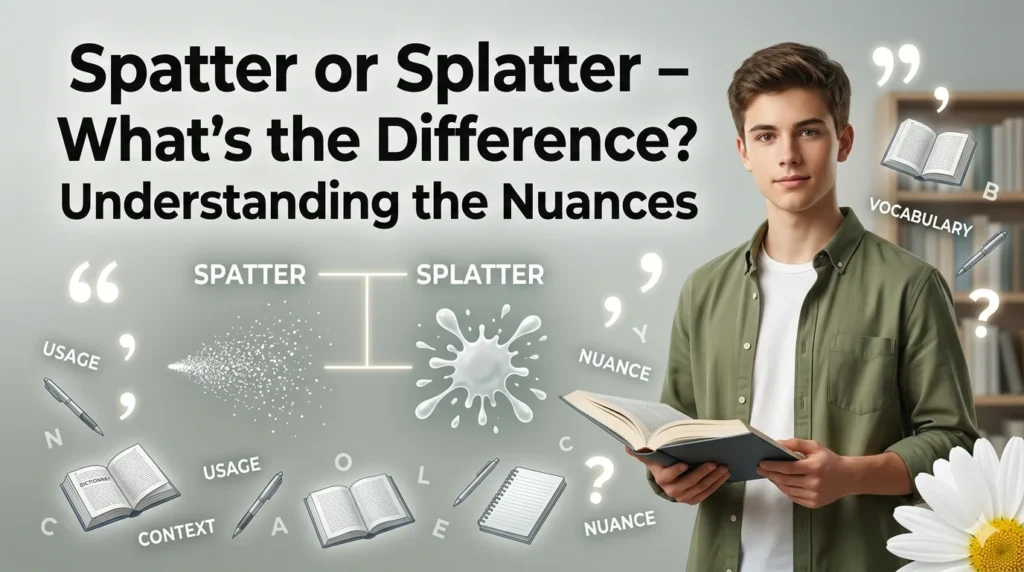

During a late-night cooking session, I found myself battling a chaotic kitchen while a storm raged outside. Hot oil was flying everywhere, the sauce was bubbling, and I suddenly wondered: spatter or splatter? Though these words sound similar, they describe different kinds of messes. Understanding “Spatter vs. Splatter” helps add clarity and detail to both writing and everyday conversation.
From experience, spatter usually refers to small drops scattering lightly, like rain hitting a window or tiny oil spots on a stove. Splatter, however, feels more dramatic and forceful – like dropping a bowl of sauce and watching it explode across the floor. The difference may seem small, but the right word creates stronger imagery and emotional impact.
In storytelling, grammar, and casual conversation, choosing between spatter and splatter adds precision and vivid detail. Whether describing a kitchen disaster, an action scene, or a messy accident, the correct word helps readers and listeners picture the moment more clearly.
Spatter vs. Splatter – Why the Confusion?
From crime scene dramas to art studios and kitchen mishaps, you’ll hear both spatter and splatter tossed around. These words describe the chaotic scattering of liquid or semi-liquid substances, often in sudden or violent ways. But while they may share themes, they carry distinct visual, linguistic, and technical nuances.
So what’s the real difference between spatter and splatter? Let’s break it down.
Core Definitions: Breaking Down ‘Spatter’ and ‘Splatter’
| Term | Definition | Common Uses | Intensity |
| Spatter | To scatter small drops of a liquid or sticky substance | Blood spatter, oil spatter, ink spatter | Low to medium |
| Splatter | To splash or scatter liquid with force, often leaving large, messy marks | Paint splatter, mud splatter, horror film gore | Medium to high |
Spatter is more controlled and often lighter. Think of droplets.
Splatter implies a messier, more chaotic, and often larger-scale mess.
“Spatter is what hits your shirt from a sizzling frying pan. Splatter is what happens when that whole pan flips over.”
Etymology: Where Do These Words Come From?
Spatter: A Medieval Mess
The word spatter dates back to the 15th century, with roots in the Middle English “spateren,” which itself may stem from Low German influences like “spatten” (to burst or crack). Early usage always implied light scattering, especially of liquids.
Splatter: Born from Sound and Drama
Splatter, by contrast, is a relative newcomer. It emerged in the 20th century, likely as a blend of “splash” and “spatter.” It’s also onomatopoeic – it sounds like the action it describes.
- First recorded use: 1930s
- Rise in popularity: 1960s horror films and **”splatter films”
Semantic Nuances: What Really Sets Them Apart?
While the two words might overlap visually, they diverge semantically in tone, force, and context.
Spatter
- Suggests small droplets or flecks
- Often random but not violent
- Associated with science, cooking, and forensics
Splatter
- Suggests a dramatic splash or messy explosion
- Implies force, chaos, or violence
- Common in media, art, and horror genres
“A surgeon studies blood spatter patterns. A horror director loves blood splatter scenes.”
Visual Comparison: Spatter vs. Splatter in Imagery
| Type | Description | Visual Effect | Example |
| Spatter | Fine droplets scattered over a surface | Light, minimal coverage | Ink droplets on a notebook |
| Splatter | Forceful dispersion of thick liquid | Bold, chaotic marks | Tomato sauce thrown at a wall |
Visual Aid:
- Spatter: Like a toothbrush flicked with paint
- Splatter: Like a balloon full of paint exploding on impact
Usage in Sentences: Everyday English and Literary Examples
Spatter in Sentences
- “The crime scene had a fine spatter of blood on the floor.”
- “Be careful not to spatter grease when cooking bacon.”
Splatter in Sentences
- “He slipped, and the contents of the bucket splattered across the floor.”
- “The horror movie featured gory splatter scenes that shocked the audience.”
Literary Examples
“His hands were spattered with ink.” – Charles Dickens
“Mud splattered the windshield as they drove through the storm.” – Contemporary fiction
In Practice: Choosing the Right Word in Real Scenarios
When to Use Spatter
- Forensics: Blood spatter analysis
- Cooking: Hot oil spatter
- Printing: Ink spatter effects
- Weather: Raindrops spattering a window
When to Use Splatter
- Art: Abstract paint splatter techniques
- Accidents: Mud splattering on clothes
- Entertainment: Splatter horror films
- Construction: Cement splatter from mixers
Tip: If it’s small, scattered, or scientific, it’s likely spatter. If it’s big, messy, or dramatic, go with splatter.
Forensic Science: The Technical Use of ‘Spatter’
In forensic analysis, the word spatter is used with specific intent.
Why Not Splatter?
Forensic professionals consistently use “blood spatter” rather than “blood splatter” to describe patterns that arise when blood is expelled due to force.
Key Forensic Terms
- Back spatter: Blood directed back toward the source of energy
- Cast-off spatter: Blood thrown from a moving object
- Impact spatter: Caused by blunt force or gunshot
“In courtrooms and crime labs, the term spatter isn’t just preferred – it’s precise.”
Sources: U.S. Department of Justice | Bloodstain Pattern Analysis Manual (NIJ.gov)
Common Mistakes: Why People Interchange the Two
People confuse these terms because:
- Both describe messy events
- They sound nearly identical
- Media and informal speech often misuse them
Examples of Misuse
- “There was blood splatter on the wall” ❌ (should be spatter in a forensic context)
- “Oil splattered the pan” ✓ (correct in a dramatic cooking context)
Social media and even journalists sometimes blur the lines. But if accuracy matters, the distinction is key.
Memory Trick: How to Never Confuse Them Again
Mnemonic Device:
“Spatter is scatter. Splatter is splurge.”
- Spatter = smaller, scattered drops
- Splatter = larger, exaggerated mess
Another trick:
- Think Spatter = Subtle
- Think Splatter = Sloppy
Corpus and SEO Data: Which Word is Used More?
| Term | Monthly Google Searches (Global) | Usage in Books (per Ngram) |
| Spatter | ~3,600 | More common in forensic/scientific literature |
| Splatter | ~6,100 | Dominates pop culture and art contexts |
Google Trends also shows splatter peaks during Halloween months, tied to horror film content.
Spatter and Splatter in Pop Culture and Media
- Splatter Films: Popularized in the 1960s-70s. These include gore-heavy films like Dead Alive, Saw, and Evil Dead. The term “splatter film” itself helped cement the word’s identity.
- TV Shows: CSI, Dexter, and Mindhunter often refer to blood spatter patterns with clinical precision.
- Art Movements: Jackson Pollock’s drip techniques are often called paint splatter art, though technically, they show spatter methodology.
“The word you choose paints a picture. Choose the one that makes the right mess.”User Confessions and Misuses on Social Media
Real examples from Twitter and Reddit:
- “I just splattered ketchup on my shirt.”
- “There was blood splatter everywhere in the episode last night.”
- “The police were talking about blood splatter – isn’t it spatter?”
Reddit Grammar Thread Example:
User1:I always thought it was blood splatter.” User2: “In forensics, it’s actually spatter. Splatter just sounds cooler.”
Conclusion:
The difference between “spatter” and “splatter” may seem small at first, but each word creates a slightly different image in English. Generally, spatter refers to small drops scattered lightly, while splatter suggests a larger, messier, or more forceful spread of liquid or substance. Understanding this distinction can make your writing more vivid, accurate, and expressive.
These words often appear in cooking, painting, weather descriptions, crime stories, and everyday conversations. For example, oil may spatter gently from a pan, while mud can splatter across a car during heavy rain. Choosing the correct word helps readers picture the scene more clearly.
Learning subtle vocabulary differences like “spatter” and “splatter” strengthens both spoken and written English. It also improves storytelling, descriptive writing, and overall communication skills. The more attention you pay to word choice, the more natural and polished your English becomes in real-life situations.
FAQs
What is the difference between spatter and splatter?
“Spatter” usually refers to small droplets spreading lightly, while “splatter” suggests a bigger, noisier, or messier splash. Both involve liquid scattering, but “splatter” often creates a stronger visual image than “spatter.”
Is “spatter” a real English word?
Yes, “spatter” is a correct English word. It is commonly used as both a noun and a verb to describe small spots or droplets scattered across a surface.
What does “splatter” mean?
“Splatter” means to splash or scatter liquid, paint, mud, or another substance messily or forcefully. It is often used to describe dramatic or chaotic spreading.
Which word is more common in cooking?
Both words are used in cooking, but “spatter” is more common when describing small drops of oil popping from a frying pan. “Splatter” is often used for bigger kitchen messes.
Can “spatter” and “splatter” be used interchangeably?
Sometimes they can be used interchangeably in casual conversation. However, “splatter” usually sounds stronger and messier, while “spatter” feels lighter and more controlled.
Is “blood spatter” or “blood splatter” correct?
Both terms appear in English, but “blood spatter” is more commonly used in forensic science and crime investigation terminology. It refers to patterns created by blood droplets.
Are these words verbs or nouns?
Yes, both “spatter” and “splatter” can function as verbs and nouns. For example, “Oil spattered everywhere” uses the verb form, while “a paint splatter” uses the noun form.
What are examples of spatter in a sentence?
Examples include: “The bacon began to spatter in the hot pan” and “Raindrops spattered against the window during the storm.” These examples show light scattering.
What are examples of splatter in a sentence?
Examples include: “Mud splattered across the truck” and “The artist splattered paint on the canvas.” These sentences show a larger or more dramatic spread.
Why is it important to know the difference?
Knowing the difference improves descriptive writing and communication. Choosing the right word helps readers better imagine the size, intensity, and appearance of a scene or action.
