
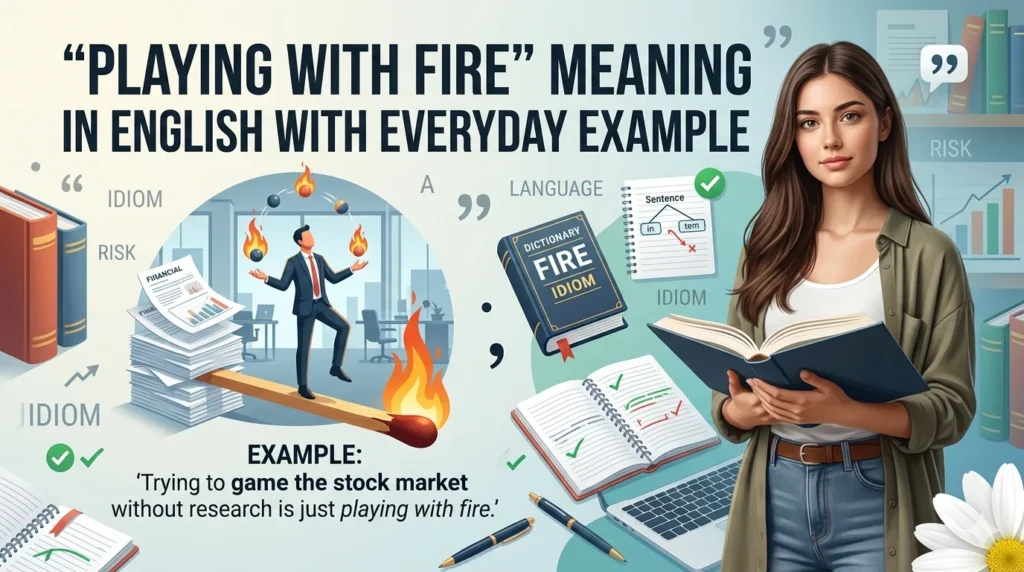

The “Playing with Fire” idiom teaches us that risky actions, like holding a lit match near a curtain, can lead to serious and harmful consequences. This idiom paints a vivid picture of dangerous choices where the risk is real, and the outcome could cause damage or serious problems. It serves as a warning to consider possible consequences before we act recklessly.
In daily life, many people play with fire by making risky decisions without fully understanding the potential dangers. For example, someone might secretly use their boss’s computer to play games during work hours, thinking it’s harmless. However, this dangerous move can lead to bad results, such as losing a job if someone finds out. This situation shows that playing with fire literally means risking much more than one realizes – you might get burned by your own actions.
From my experience, the phrase playing with fire fits many moments when the thrill hides the true threat. It reminds us to weigh risks carefully, especially when the consequences could be serious or harmful. Understanding this idiom’s definition helps avoid unnecessary trouble.
When someone says you’re playing with fire, they’re not just talking about literal flames. This idiom packs a powerful punch in everyday language, warning of risk, danger, and the consequences that come from tempting fate. But what does playing with fire really mean? Where did it come from, and how can understanding this phrase help you avoid trouble in life?
In this comprehensive guide, you’ll discover everything about the playing with fire idiom definition– from its literal and figurative meanings to its rich history and cultural significance. Along the way, you’ll find examples, real-world case studies, and practical tips on using the idiom correctly to add impact and color to your language.
What Does “Playing with Fire” Mean?
At its core, playing with fire means taking unnecessary risks that could lead to harm or trouble. This idiom blends a straightforward literal sense with a powerful figurative warning.
Literal Meaning: Handling Fire Dangerously
On the surface, playing with fire describes someone who physically handles fire carelessly. Fire, an elemental force, demands respect. When you hold a lit match close to something flammable, you’re literally playing with fire. The risk of burns, injury, or destruction is immediate and obvious.
For example:
“The kids were playing with fire in the backyard, lighting small twigs and almost setting the fence ablaze.”
This literal meaning emphasizes the danger of recklessness when dealing with a volatile force.
Figurative Meaning: Risking Trouble or Harm
More commonly, playing with fire is a metaphor for engaging in risky behavior that could lead to serious consequences. This might involve relationships, finances, career moves, or any situation where poor choices could backfire.
For instance:
“He’s playing with fire by ignoring the company’s safety protocols during the construction project.”
Here, the phrase warns against tempting fate through careless or reckless actions.
How Context Shapes Meaning
The idiom’s power lies in context. Depending on tone, setting, and audience, playing with fire might be a stern caution or a light-hearted tease. It signals potential danger that demands attention.
The Real-Life Consequences of “Playing with Fire”
Risk-taking can be thrilling but dangerous. The idiom warns us about the downside of risky behavior.
Unintended Negative Outcomes
Often, those “playing with fire” don’t expect trouble- until it hits. Whether it’s gambling too much, bending rules, or ignoring warnings, consequences can spiral quickly.
Consider the following real-life examples:
- Financial Risk: Investors chasing “get-rich-quick” schemes without research often lose significant money. The 2008 financial crisis was fueled partly by risky mortgage lending- banks were literally playing with fire.
- Health Risks: Ignoring health advice or engaging in dangerous activities like extreme sports without proper safety can cause injuries or worse.
- Relationship Fallout: Betraying trust or pushing boundaries can damage friendships and families permanently.
Psychological and Social Effects
Risk-taking can trigger stress, anxiety, and guilt. Socially, it can lead to isolation or conflict when others suffer from reckless decisions.
Table: Examples of “Playing with Fire” in Real Life
| Situation | Risk Involved | Potential Consequence |
| Ignoring traffic laws | Car accidents | Injury or legal penalties |
| Mixing volatile chemicals | Explosions or poisoning | Serious injury or death |
| Betraying a friend’s trust | Broken relationships | Social isolation or conflict |
| Cybersecurity negligence | Data breaches | Financial and reputational loss |
Historical Origins and Evolution of the Idiom
Understanding where playing with fire comes from helps us appreciate its deep cultural roots.
Earliest Known Uses
The phrase dates back several centuries, appearing in English literature as early as the 16th and 17th centuries. The connection between fire and danger is timeless- fire can warm or destroy.
Early uses often literally referenced fire, but over time, the phrase grew into a metaphor warning against reckless behavior.
Ancient Myths and Fire Symbolism
Fire has featured prominently in myths worldwide, symbolizing creation, destruction, and transformation. Consider:
- Prometheus (Greek mythology): Stole fire from the gods, empowering humanity but inviting punishment.
- The Fire God Agni (Hindu tradition): Represents both purifier and destroyer.
These stories highlight fire’s ambivalent nature– a source of power and peril, mirroring the idiom’s warning.
Linguistic Evolution
By the 19th century, “playing with fire” became a common metaphor in English-speaking cultures, often linked with “tempting fate” and other warnings about danger.
Usage in Literature and Popular Culture
“Playing with fire” isn’t just a phrase- it’s a cultural motif appearing in books, movies, music, and everyday speech.
Classic Literature Examples
- William Shakespeare hinted at fire as a symbol of dangerous passion and ambition in plays like Macbeth.
- In Nathaniel Hawthorne’s works, fire often represents both destruction and purification, reinforcing the idiom’s dual meaning.
Modern Media
- Movies like The Hunger Games use fire imagery to symbolize rebellion and risk.
- Songs by artists like Katy Perry (“Firework”) tap into fire as both danger and empowerment.
This idiom frequently pops up in headlines and dialogue, capturing attention with its vivid imagery.
Cross-Cultural Perspectives on Risk and Fire-Related Idioms
The concept behind playing with fire isn’t unique to English. Many cultures express similar ideas about risk and danger.
| Language | Idiom or Saying | Literal Translation | Meaning |
| Spanish | Jugar con fuego | To play with fire | To take dangerous risks |
| Chinese | 玩火自焚 (wán huǒ zì fén) | Playing with fire, self-burning | Risking harm by dangerous acts |
| German | Mit dem Feuer spielen | To play with fire | Taking reckless risks |
| Arabic | يلعب بالنار (yal‘ab bialnaar) | Playing with fire | Acting dangerously |
Universal Human Attitudes Toward Danger
The prevalence of similar idioms shows a shared human understanding: fire is both a useful tool and a deadly threat.
Cultural Nuances
Some cultures emphasize restraint; others celebrate daring. These differences influence how the idiom is used and understood socially.
Common Mistakes and Misunderstandings
People often misuse idioms, and playing with fire is no exception.
What It Does NOT Mean
- It’s not about literally having fun with fire safely (like cooking or campfires).
- It doesn’t mean casual risk-taking without serious consequences.
- Avoid confusing it with idioms like “playing with matches,” which can be less common or have different nuances.
Overuse and Cliché
When repeated too often, the phrase loses impact. Use it selectively to preserve its warning power.
Differences from Related Idioms
| Idiom | Meaning | Difference from “Playing with Fire” |
| Tempting fate | Risking bad outcomes intentionally | More about daring fate, less about careless risk |
| Walking on thin ice | Being in a risky or delicate situation | More about fragile situations, less about active risk-taking |
How to Use “Playing with Fire” Effectively
Want to add some zing to your writing or conversation? Here’s how to use the idiom without sounding stale.
Tone and Context
- Use it for serious warnings: “Don’t ignore those signs- you’re playing with fire.”
- Or playful teasing: “Trying to sneak out past curfew? You’re really playing with fire!”
Sample Sentences
- She was playing with fire by investing all her savings in a risky startup.
- Ignoring your health symptoms is like playing with fire- you could end up hospitalized.
- He knows he’s playing with fire whenever he lies to his boss.
Variations to Avoid Cliché
- Swap with “risking disaster” or “courting danger” to keep things fresh.
- Use metaphors tied to fire: “Dancing too close to the flame.”
Related Idioms and Expressions Worth Knowing
Understanding similar idioms enriches your language toolkit.
| Idiom | Definition | When to Use |
| Tempting fate | Risking disaster by daring the unknown | When consequences feel inevitable |
| Walking on thin ice | Being in a precarious situation | When danger is due to fragile conditions |
| Playing with matches | Taking risky, dangerous actions | Similar but less common |
| Playing with dynamite | Taking extremely hazardous risks | Use for very serious situations |
Visual Summary Table: Playing with Fire Idiom at a Glance
| Aspect | Details |
| Literal Meaning | Handling an actual fire dangerously |
| Figurative Meaning | Taking serious, unnecessary risks |
| Origins | Roots in ancient fire symbolism and 16th-century English usage |
| Common Uses | Warnings about reckless behavior |
| Cultural Equivalents | Similar idioms in Spanish, Chinese, German, Arabic |
| Related Idioms | Tempting fate, walking on thin ice, playing with matches |
Conclusion
The idiom playing with fire captures something timeless and universal: the tension between risk and caution. Whether you take it literally or figuratively, it warns us about the dangers of reckless behavior that can lead to serious consequences. This phrase draws from humanity’s deep-rooted respect and fear of fire- an element that can warm, illuminate, and destroy. Over centuries, it evolved from literal caution to a powerful metaphor for tempting fate.
Understanding this idiom helps you recognize when actions cross the line from bold to foolhardy. In everyday life, whether it’s in relationships, finances, or health, “playing with fire” signals a need to pause and reconsider before things spiral out of control. Its presence in literature, culture, and even different languages shows how fire symbolizes both potential and peril across societies.
By knowing how to use the idiom effectively and recognizing its meaning in context, you can communicate warnings or playful teases with precision and impact. Avoid overusing it to keep its vividness alive. Remember, idioms like this aren’t just colorful phrases- they offer insights into human nature and shared experiences.
Next time you hear someone say they’re playing with fire, you’ll understand the weight behind those words. It’s a reminder that some risks aren’t worth taking, and sometimes, the smartest choice is knowing when to step away from the flame before you get burned.
FAQs
What does “Playing with Fire” mean?
“Playing with Fire” means taking part in a risky activity that could lead to serious trouble or negative consequences. The phrase is commonly used when someone ignores warnings or acts recklessly despite knowing the possible risks involved.
Is “Playing with Fire” an idiom?
Yes, “Playing with Fire” is a well-known English idiom. It does not refer to actual fire in most cases. Instead, it symbolically describes risky behavior, dangerous decisions, or actions that may cause harm emotionally, financially, socially, or physically.
How do you use “Playing with Fire” in a sentence?
You can use the phrase when talking about risky actions. For example: “Ignoring safety rules at work is like playing with fire.” The sentence suggests that careless behavior could result in serious consequences or problems.
Is “Playing with Fire” positive or negative?
The phrase usually carries a negative meaning because it warns about danger, poor judgment, or harmful consequences. It is often used to advise someone to stop taking unnecessary risks before things become worse.
Can “Playing with Fire” be used in professional writing?
Yes, it can be used in professional or formal writing when discussing risky decisions, controversial actions, or dangerous situations. However, it works best in conversational, journalistic, or creative contexts rather than extremely formal academic writing.
Where did the phrase “Playing with Fire” come from?
The idiom likely developed from the literal danger of handling fire carelessly. Since fire can quickly become destructive, the phrase evolved into a metaphor for risky actions that may lead to trouble or disaster.
Is “Playing with Fire” commonly used in English?
Yes, it is a very common expression in both spoken and written English. Native speakers frequently use it in conversations, movies, books, news articles, and social media to describe dangerous or reckless behavior.
What are some synonyms for “Playing with Fire”?
Common alternatives include “taking a risk,” “walking on thin ice,” “courting danger,” and “risking it all.” These phrases share a similar meaning and describe situations where someone may face harmful consequences.
Can children understand the meaning of “Playing with Fire”?
Yes, the idiom is generally easy for children to understand because the image of fire naturally suggests danger. Teachers and parents often use it to explain why risky behavior should be avoided.
Why is “Playing with Fire” popular in storytelling?
Writers and speakers use the phrase because it creates a strong emotional image. It instantly communicates danger, suspense, and possible consequences, making stories, conversations, and articles more engaging and memorable.
