
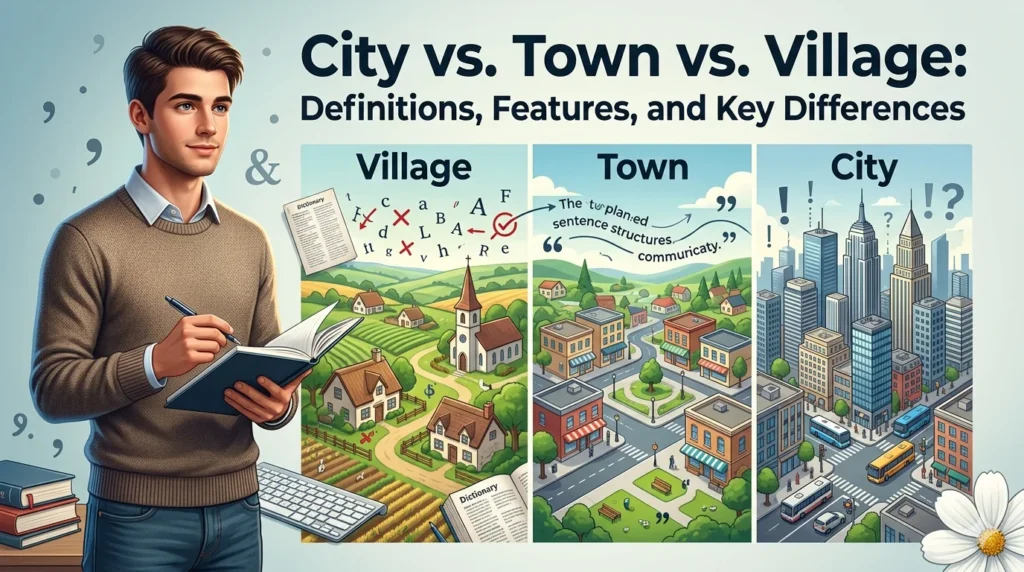

Understanding the difference between cities, towns, and villages goes far beyond population size. While the number of people matters, these places are also shaped by governance, infrastructure, culture, history, and daily lifestyle. Each type of settlement has its own identity and plays a unique role in how communities grow and function.
A village is usually the smallest type of settlement. Villages often have close-knit communities, fewer public services, and a quieter lifestyle connected to farming or local businesses. A town is larger than a village and usually offers more schools, shops, transportation, and local government services. A city is generally the largest and most developed, with major infrastructure, larger populations, business districts, hospitals, universities, and broader economic opportunities.
Although these categories can vary by country, understanding city vs. town vs. village helps make geography and community structures easier to understand. Whether you are learning about places, planning a move, or simply curious, knowing what makes each settlement unique gives you a clearer picture of how people live and connect around the world.
Why It Still Matters: City vs. Town vs. Village in Modern Context
In an increasingly globalized and digital world, we often blur the lines between urban and rural. But cities, towns, and villages still serve vastly different roles in national development, cultural preservation, and individual lifestyles.
- Travel decisions often depend on knowing the character of a place.
- Governments allocate resources based on settlement classification.
- Urban planning relies on understanding growth patterns and density.
“Understanding the difference between a village and a city is key to understanding how people live, work, and govern themselves across the world.” – National Geographic Society
Definitions at a Glance: What Is a City, Town, or Village?
While definitions vary across countries, here’s a global snapshot that helps frame the basic distinctions:
| Feature | Village | Town | City |
| Population | < 10,000 | 10,000 – 100,000 | 100,000+ |
| Density | Low | Medium | High |
| Services | Basic (schools, clinics) | Moderate (hospitals, courts) | Advanced (universities, airports) |
| Governance | Local councils or panchayats | Municipal councils or town boards | City councils or metropolitan bodies |
| Main Economy | Agriculture, small trades | Retail, services, manufacturing | Corporate, finance, tech |
Note: In the U.S., “city” and “town” designations are often legal rather than size-based.
Historical Origins: The Roots of Human Settlements
Village Origins: Where It All Began
Villages were the first organized human settlements. Around 10,000 BCE, with the rise of agriculture, humans began forming small, permanent communities. These early villages were built near water sources and fertile land.
- Earliest known village: Çatalhöyük, Turkey (~7500 BCE)
- Functioned on shared labor, food storage, and barter economy
Towns: The Trading Centers of Ancient Times
Towns emerged as the population grew and people began trading. Many ancient towns started as market settlements located on trade routes or rivers.
- Example: Pompeii (Italy) flourished as a Roman town with distinct zones for living, worship, and trade.
- Towns held regular markets and were often protected by walls.
Cities: Complexity and Centralization
The rise of cities signaled advanced civilization. Cities were centers of governance, religion, and military power.
- First known city: Uruk (modern Iraq) in 4000 BCE, home to over 50,000 people.
- Required complex infrastructure like sewage, roads, and zoning.
Governance: Who Runs What?
Village Governance: Grassroots and Localized
Villages are often governed by local councils, elders, or a panchayat system (in India). These bodies manage water use, land disputes, and local development.
- Decision-making is communal.
- Funds are often limited and rely on state aid or self-taxation.
Towns: Semi-Urban Governance Structures
Towns operate under a municipality or town board, which oversees schools, healthcare centers, roads, and local policing.
- Mayors or commissioners are typically elected.
- Budget allocations come from both local taxes and regional governments.
City Governance: Bureaucracy and Complexity
Cities are administered by city councils, mayors, and numerous departments (transport, housing, sanitation).
- Example: New York City has 59 community boards and multiple borough councils.
- Cities manage high-level infrastructure, zoning laws, and public safety systems.
Infrastructure and Services: Comparing the Realities
| Service Type | Village | Town | City |
| Roads | Dirt roads, few paved | Local streets, some highways | Complex road grids, expressways |
| Transport | Bikes, buses | Local buses, taxis | Subways, airports, ride-share |
| Healthcare | Basic clinics | Hospitals with emergency care | Specialized care, medical colleges |
| Education | Primary schools | High schools, junior colleges | Universities, research institutions |
| Public Utilities | Limited access | Moderate | Full digital grids, smart tech |
A 2023 UN report noted that 80% of cities now offer full broadband, while over 60% of villages in developing countries lack consistent electricity.
Population and Density: A Visual Breakdown
- Village: Less than 500 people per square km
- Town: 500 – 4,000 per square km
- City: Over 4,000+ per square km
Diagram (Population Density Comparison):
| Village | Town | City |
| 👤 👤 | 👤👤 👤 | 👤👤👤👤👤 |
Economy and Work Opportunities
Village Life
- Main jobs: Farming, fishing, pottery, weaving
- Payment may still be barter-based or seasonal
Town Worklife
- Jobs in education, small industries, and local businesses
- Growing gig economy and remote work trend
City Economy
- Major industries: IT, finance, media, government
- International employment hubs
- Example: San Francisco has over 800,000 tech jobs in its metro region
Culture, Community, and Daily Life
| Aspect | Village | Town | City |
| Community | Strong, familial | Connected, more diverse | Fragmented but multicultural |
| Traditions | Rooted in rituals and farming cycles | Regional festivals, local holidays | International events, niche subcultures |
| Safety | High, close-knit monitoring | Moderate, local policing | Varies; some areas are very secure, others are risky |
Education and Healthcare Access
Village Limitations
- Limited to primary schools and basic clinics
- Often, students travel miles for high school or university
Town Access
- Secondary schools, technical institutes, and general hospitals
City Excellence
- Global universities (e.g., Columbia, Oxford)
- Research hospitals and specialized medicine
Cost of Living: Village vs. Town vs. City
| Item | Village | Town | City |
| Rent (2BR/month) | $150 | $450 | $2,000 |
| Groceries (monthly) | $100 | $200 | $500 |
| Transportation | $20 | $60 | $200 |
| Utilities | $30 | $80 | $250 |
According to Numbeo (2024), urban dwellers pay up to 5x more in rent compared to villagers.
Environment & Sustainability
- Villages: Often environmentally sustainable; low carbon footprint
- Towns: Mixed-use zones allow a balance between nature and development
- Cities: High pollution levels, but also hubs for green tech
The EPA reports that urban areas generate over 70% of carbon emissions, but also lead in solar energy adoption.
Technology & Connectivity
| Tech Access | Village | Town | City |
| Internet Speed | <10 Mbps | 20–50 Mbps | 100 Mbps+ (fiber, 5G) |
| Smart Services | Rare | Moderate (public WiFi) | IoT, smart grids, AI apps |
The digital divide is shrinking, though governments are investing in rural broadband.
Case Studies: Real-World Places Compared
USA
- Village: Talkeetna, Alaska – 1,000 people, tourism & fishing
- Town: Sedona, Arizona – 10,000 people, spiritual tourism, artists
- City: Chicago, Illinois – 2.7M people, finance, art, tech
India
- Village: Mawlynnong, Meghalaya – Titled “Cleanest Village in Asia”
- Town: Nashik, Maharashtra – Wine capital of India
- City: Mumbai – 21M+ metro population, financial capital
UK
- Village: Bibury, Cotswolds – Known for historical cottages
- Town: St. Andrews – Famous for the university and golf
- City: Manchester – Major industrial hub, over 550,000 residents
Common Misconceptions
- Not all large places are cities: Some towns are bigger than small cities
- Villages aren’t outdated: Many are adopting eco-tourism and tech
- Towns aren’t just in-between: They often play critical political and cultural roles
Summary Table: Village, Town, and City Differences
| Feature | Village | Town | City |
| Population Range | <10,000 | 10k–100k | 100k+ |
| Main Activity | Agriculture, crafts | Trade, services | Industry, global commerce |
| Gov. Structure | Local (panchayat, elders) | Elected board, municipality | City council, mayor’s office |
| Pace of Life | Slow, serene | Balanced | Fast, high-stress |
| Cost of Living | Low | Moderate | High |
Conclusion:
The difference between a city, town, and village may seem simple at first, but each word carries its own meaning, identity, and cultural feel. A city is usually larger, busier, and filled with more services and opportunities. A town often feels like a balance between urban life and community living. A village is typically smaller, quieter, and known for close-knit neighborhoods and a slower pace of life.
Even though these definitions can vary from country to country, the basic idea stays familiar: size, population, services, and lifestyle usually separate one from another. That is why people may describe one place as a growing town while another feels like a peaceful village or a crowded city.
Understanding cities, towns, and villages helps improve vocabulary and makes everyday conversations more accurate. Whether you are talking about geography, travel, or where you live, knowing the right word adds clarity and makes your English feel more natural and confident.
FAQs
What is the difference between a city, a town, and a village?
The main difference between a city, town, and village is usually size, population, and available services. A city is larger and more developed, a town is medium-sized with local services, and a village is smaller with fewer facilities and a stronger community-centered lifestyle.
What makes a place a city?
A city is generally a larger area with more people, businesses, transportation, and public services. Cities often include government offices, hospitals, universities, and commercial centers. In some countries, official legal rules also decide whether a place can be called a city.
What is considered a town?
A town is usually bigger than a village but smaller than a city. It often has schools, shops, neighborhoods, and local businesses while still feeling less crowded than a city. Many towns offer a mix of convenience and community.
What defines a village?
A village is typically a smaller settlement with fewer people and fewer public facilities than a town or city. Villages are often known for peaceful surroundings, close community relationships, and a slower daily routine.
Is a town always bigger than a village?
In most cases, yes. A town usually has a larger population and more services than a village. However, definitions can vary by country, and some places may use these terms differently based on history or local government rules.
Can a town become a city?
Yes, a town can become a city over time. Population growth, economic development, new infrastructure, and legal recognition often lead a town to gain city status. Many major cities started as small towns before expanding.
Are villages always rural?
Villages are often rural, but not always. Most villages are surrounded by farmland or natural landscapes, yet some are located near larger urban areas. The defining feature is usually size and community rather than exact location.
Which is better: city, town, or village?
That depends on lifestyle and personal preference. Some people enjoy city life because of opportunities and convenience. Others prefer towns for balance or villages for peace and strong community connections. Each place offers something different.
Do all countries define city, town, and village the same way?
No, definitions are different around the world. One country may officially classify a place by population, while another may base it on history, government structure, or infrastructure. The general idea remains similar, but local rules can change details.
Why is it useful to know the difference?
Knowing the difference between city, town, and village improves vocabulary and makes conversations clearer. It helps when talking about geography, travel, maps, communities, and everyday life. Using the correct term also makes writing more accurate and natural.
