
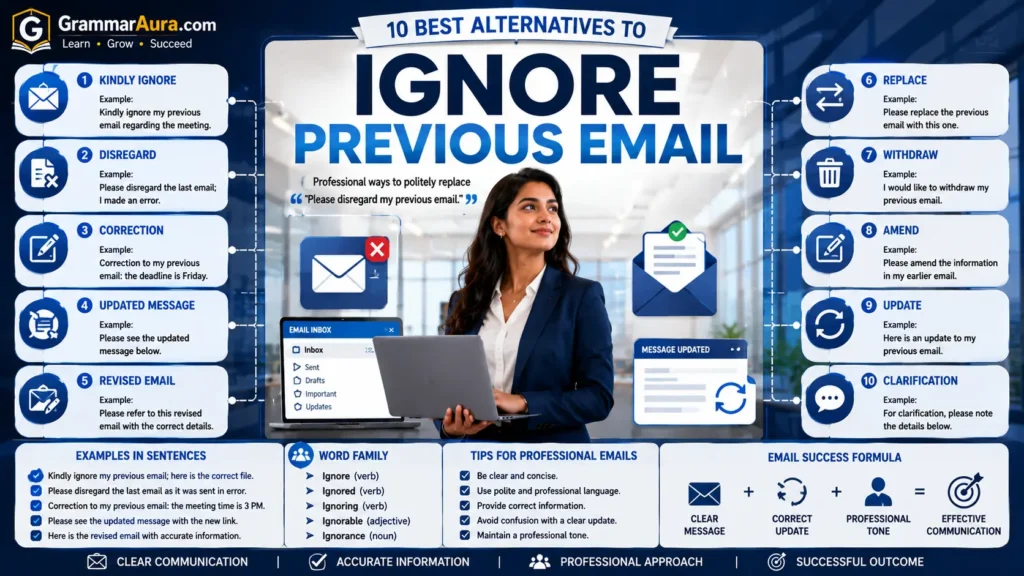

This guide of “15 Best Synonyms of ‘Please Disregard My Previous Email’ (With Examples)” helps professionals write clearer emails daily.
In my experience with professional communication, sending a correction, update, or email is very common in every business and workplace setting. The phrase “Please Disregard My Previous Email” is a standard choice, but exploring alternative ways to convey the same message can sound more polished, thoughtful, and empathetic. While working in corporate and office writing, I noticed that carefully choosing the right words always helps maintain professionalism and build respect for the recipient’s time, making every interaction feel more personal and considerate.
Using proper email etiquette, a professional tone, and strong communication skills also improves every formal response, clarification, revision, apology, or follow-up after a misunderstanding. A clear, updated notice, accurate wording, or polite resend message creates a smoother and better understanding in daily communication. This guide shares 15 useful synonyms, alternative phrases, and practical examples that help create more respectful and effective daily emails.
What Does “Please Disregard My Previous Email” Mean?
It’s a polite request asking the recipient to ignore, overlook, or disregard an earlier message due to errors, updates, or changes. Professional, polite, and neutral. “Please disregard my previous email regarding the meeting schedule. The updated information is below.”
When to Use “Please Disregard My Previous Email”
- When correcting errors in a previous email
- Sending updated information or attachments
- Avoiding confusion caused by conflicting instructions
- In professional, formal, or semi-formal communication
Is It Professional/Polite to Say “Please Disregard My Previous Email”?
Yes. It is polite, professional, and widely accepted. Adding a brief explanation or updated information shows attentiveness and ensures clarity.“Please disregard my previous email. The correct meeting time is 2 PM.”
Pros and Cons of Using “Please Disregard My Previous Email”
Pros:
- Clear and professional
- Avoids confusion
- Polite and neutral tone
Cons:
- Can feel repetitive if overused
- Slightly impersonal or formal for casual communication
Please Disregard My Previous Email. Synonyms:
- Kindly Ignore My Earlier Message
- Please Note the Correct Information
- Disregard My Previous Email
- Please Ignore the Earlier Email
- Correction: Previous Email
- My Earlier Email Contained an Error
- Updated Information Below
- Apologies for the Previous Email
- Please See the Corrected Message
- Kindly Refer to This Email Instead
- Previous Message Can Be Disregarded
- Updated Details for Your Reference
- Kindly disregard the earlier message
- Please Note the Correction
- Apologies and Updated Information
Kindly Ignore My Earlier Message
Meaning:
A polite alternative requesting the recipient to ignore a prior email.
Explanation:
Emphasizes courtesy with the word “kindly”, making the request softer.
Example:
“Kindly ignore my earlier message about the project deadline. Here’s the updated schedule.”
Best Use:
Professional colleagues, clients, team members
Worst Use:
Very casual texts to friends
Tone:
Polite, professional, courteous
Please Note the Correct Information
Meaning:
Directs attention to updated or corrected information while politely addressing the previous error.
Explanation:
Focuses on providing the correct details rather than emphasizing the error.
Example:
“Please note the correct information regarding the event date below.”
Best Use:
Professional emails, clients, colleagues
Worst Use:
Casual messaging contexts
Tone:
Professional, neutral, informative
Disregard My Previous Email
Meaning:
Concise and widely used, similar to the original phrase.
Explanation:
Neutral phrasing focuses purely on asking the recipient to ignore the prior message.
Example:
Disregard my previous email regarding the report submission.”
Best Use:
Professional, semi-formal emails
Worst Use:
Informal or personal emails to friends
Tone:
Neutral, professional
Please Ignore the Earlier Email
Meaning:
Another polite variation emphasizing ignoring a previous message.
Explanation:
Clear, professional, and courteous alternative suitable for most business communication.
Example:
Please ignore the earlier email. The correct attachment is included below.”
Best Use:
Colleagues, clients, team emails
Worst Use:
Casual text messages
Tone:
Professional, polite, clear
Correction: Previous Email
Meaning:
Direct and concise, immediately signaling correction or update.
Explanation:
Often used in subject lines to alert recipients that a previous message contained an error.
Example:
“Correction: Previous email – The meeting will now be held at 3 PM.”
Best Use:
Professional emails, corporate communication
Worst Use:
Informal or casual texts
Tone:
Professional, concise, clear
My Earlier Email Contained an Error
Meaning:
Explicitly admits the previous message had a mistake.
Explanation:
Shows accountability while providing updated information.
Example:
“My earlier email contained an error regarding the report deadline. Please see the corrected details below.”
Best Use:
Professional colleagues, supervisors, and clients
Worst Use:
Overly casual or playful communication
Tone:
Professional, accountable, courteous
Updated Information Below
Meaning:
Directly shifts focus from the previous message to the new, correct details.
Explanation:
Avoids repeating the error and emphasizes the updated content.
Example:
Updated information below: The venue has been changed to Conference Room B.”
Best Use:
Team emails, professional communication
Worst Use:
Personal texts or informal emails
Tone:
Neutral, professional, clear
Apologies for the Previous Email
Meaning:
Adds a polite acknowledgment of the mistake while requesting the recipient’s attention to the correct message.
Explanation:
Combines apology with updated information, softening the tone.
Example:
“Apologies for the previous email. Here’s the corrected version of the report.”
Best Use:
Clients, colleagues, and formal settings
Worst Use:
Casual text messages among friends
Tone:
Polite, professional, empathetic
Please See the Corrected Message
Meaning:
Shifts focus to the corrected content, maintaining professionalism.
Explanation
Suggests the prior message should be ignored while highlighting the update.
Example:
“Please see the corrected message below regarding the new meeting time.”
Best Use
Professional emails, corporate communication
Worst Use
Informal contexts
Tone:
Professional, neutral, courteous
Kindly Refer to This Email Instead
Meaning:
Polite alternative directing recipients to the correct email.
Explanation:
Softens the request, keeping a courteous tone while clarifying updates.
Example:
“Kindly refer to this email instead of my previous one for the finalized schedule.”
Best Use:
Professional, polite emails
Worst Use:
Casual texting
Tone:
Courteous, professional, respectful
Previous Message Can Be Disregarded
Meaning:
Neutral and concise, clearly signaling that the previous email is no longer relevant.
Explanation:
Appropriate for professional or corporate communication.
Example
“Previous message can be disregarded. The correct information is attached.”
Best Use:
Team emails, corporate updates
Worst Use:
Casual conversation
Tone:
Neutral, professional, clear
Updated Details for Your Reference
Meaning:
Focuses on providing correct information, subtly implying prior details were incorrect.
Explanation:
A polite and professional way to share updates while reducing emphasis on the mistake.
Example:
“Updated details for your reference regarding the client meeting are listed below.”
Best Use:
Professional emails, clients, colleagues
Worst Use:
Informal messaging
Tone:
Professional, courteous, informative
Kindly disregard the earlier message
Meaning:
A courteous variation of the standard phrase, emphasizing politeness.
Explanation:
Keeps tone professional and respectful, suitable for corporate emails.
Example:
“Kindly disregard the earlier message. Please refer to this updated schedule.”
Best Use
Professional colleagues, clients
Worst Use
Informal personal emails
Tone:
Polite, professional, respectful
Please Note the Correction
Meaning:
Signals that a correction is being made without repeating the error.
Explanation:
Useful in both subject lines and body text to direct attention to the update.
Example:
“Please note the correction regarding the meeting agenda.”
Best Use:
Professional emails, formal communication
Worst Use:
Casual texts or social media
Tone:
Professional, concise, polite
Apologies and Updated Information
Meaning:
Combines apology with updated content, making it both polite and informative.
Explanation:
Shows accountability and directs attention to the correct information.
Example:
“Apologies and updated information: The revised report is attached for your reference.”
Best Use:
Clients, colleagues, and formal professional settings
Worst Use:
Informal texting
Tone:
Professional, polite, empathetic
Comparison Table of Top Alternatives
| Alternative | Tone | Best Use | Formality |
| Kindly Ignore My Earlier Message | Polite, courteous | Colleagues, clients | Semi-formal |
| Please Note the Correct Information | Professional, informative | Clients, colleagues | Formal |
| Disregard My Previous Email | Neutral, professional | Team emails | Semi-formal |
| Please Ignore the Earlier Email | Polite, clear | Colleagues, clients | Semi-formal |
| Correction: Previous Email | Concise, formal | Corporate emails | Formal |
| My Earlier Email Contained an Error | Accountable, professional | Clients, supervisors | Formal |
| Updated Information Below | Neutral, informative | Team emails | Semi-formal |
| Apologies for the Previous Email | Polite, empathetic | Clients, colleagues | Formal |
| Please See the Corrected Message | Professional, courteous | Corporate emails | Semi-formal |
| Kindly Refer to This Email Instead | Courteous, professional | Clients, colleagues | Formal |
| Previous Message Can Be Disregarded | Neutral, clear | Corporate emails | Semi-formal |
| Updated Details for Your Reference | Professional, informative | Clients, colleagues | Formal |
| Kindly disregard the earlier message | Polite, respectful | Professional emails | Formal |
| Please Note the Correction | Professional, concise | Formal communication | Formal |
| Apologies and Updated Information | Polite, empathetic | Clients, formal emails | Formal |
Final Thoughts
Finding the right alternative to “Please Disregard My Previous Email” is a small detail that makes a big difference in professional communication. The words you choose shape how your message feels — whether it sounds polite, confident, apologetic, or simply clear. Using thoughtful phrasing not only corrects mistakes gracefully but also shows respect for your recipient’s time and attention.
No matter which alternative you pick, the key is to stay clear, courteous, and concise. A well-phrased correction prevents confusion, maintains professionalism, and strengthens trust. With these alternatives, you can handle follow-up emails smoothly while keeping your tone warm, respectful, and professional.
FAQs
Is it necessary to apologize when asking someone to disregard a previous email?
Not always, but adding a brief apology can soften the tone. If the mistake caused confusion or inconvenience, saying “Apologies for the earlier email” shows accountability. However, in minor corrections, a simple “Please disregard my previous email” is polite and professional enough without an apology.
Can I use “Disregard my previous email” in formal business settings?
Yes. “Disregard my previous email” is direct, neutral, and widely accepted in professional communication. For extra politeness, add “please” or “kindly.” This small adjustment makes the phrase sound more courteous while remaining fully appropriate for formal business emails.
What is the most polite alternative to “Please disregard my previous email”?
Phrases like “Kindly disregard my earlier message” or “Apologies for the previous email” are among the most polite alternatives. They sound respectful, warm, and professional, making them ideal for client communication, workplace correspondence, or any situation requiring extra courtesy.
Can I use these alternatives in subject lines?
Yes. Short alternatives like “Correction: Previous Email”, “Updated Information”, or “Please Note the Correction” work especially well in subject lines. They quickly signal an update and help recipients identify that the earlier message should be ignored.
How do I sound less formal when correcting an email?
To sound less formal, use simple phrases like “Quick correction below” or “Updated details here”. These keep the message friendly and natural while still making it clear that your previous email should be disregarded.
Is it rude to say “Ignore my previous email”?
Not necessarily, but “Ignore my previous email” can sound abrupt. Adding “please” or switching to “Please disregard my earlier message” makes it sound more polite and professional, especially in workplace communication.
Should I explain why I’m correcting my email?
It’s helpful but not always required. A short explanation like “My earlier email contained an error” or “The attachment was incorrect” builds clarity and trust. Keep explanations brief so the focus stays on the corrected information.
What if I sent multiple incorrect emails?
If several emails are confusing, acknowledge it clearly: “Please disregard my previous messages and refer only to this email.” This ensures recipients know exactly which message contains the correct information.
Are these alternatives suitable for customer service emails?
Yes. In customer service communication, polite alternatives like “Apologies for the earlier message” or “Updated information below” help maintain professionalism and show care, which strengthens customer trust and satisfaction.
What’s the safest phrase for professional use?
The safest and most universally accepted option is “Please disregard my previous email.”
