
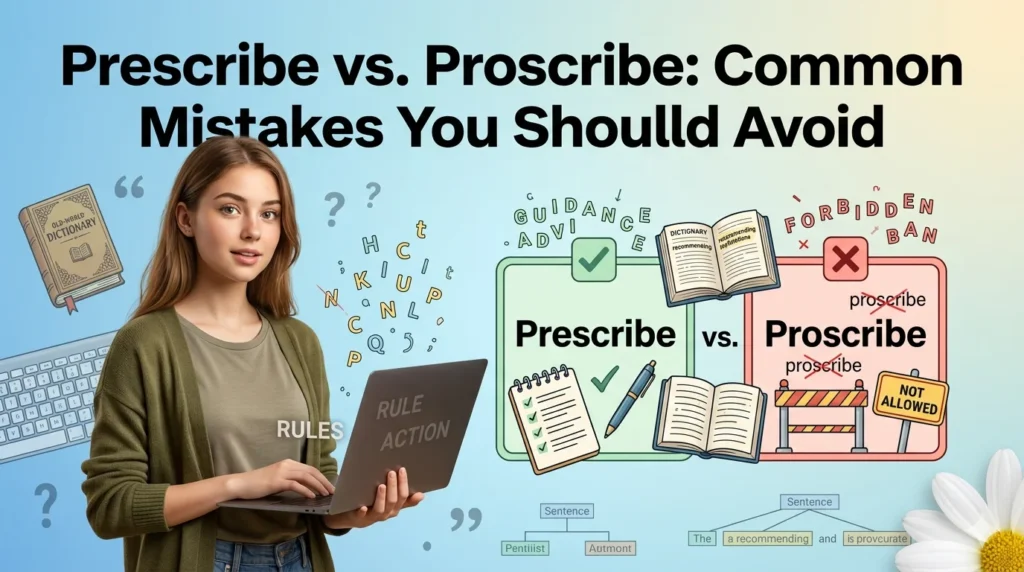

Language is full of words that look and sound alike but carry very different meanings. One commonly confused pair is “prescribe” and “proscribe.” Although they differ by only a few letters, their meanings stand on opposite sides. Understanding “Prescribe vs. Proscribe” is essential for clear and professional communication.
The word prescribe means to recommend, authorize, or advise a course of action. It is often used in medical settings when doctors prescribe medicine or treatment. In contrast, proscribe means to forbid, ban, or officially condemn something, especially in legal or formal contexts. While one word encourages action, the other strictly prohibits it.
Using the wrong term can completely change the meaning of a sentence. A doctor may prescribe medication, but a government may proscribe dangerous activities or substances. This distinction is important in healthcare, law, business, and everyday writing, where precision in language matters.
By learning the difference between prescribe and proscribe, writers and speakers can avoid confusion and communicate their ideas with greater accuracy and confidence.
What Do “Prescribe” and “Proscribe” Mean?
Let’s begin with their formal definitions. At a glance:
| Word | Meaning | Example |
| Prescribe | To officially recommend, instruct, or mandate | The doctor prescribed antibiotics. |
| Proscribe | To officially forbid or outlaw something | The policy proscribes child labor. |
Prescribe:
- Often used in medical, legal, and institutional contexts
- Suggests what should be done
- Implies authority and permission
Proscribe:
- Found in legal, political, and historical texts
- Indicates what must not be done
- Tied to prohibition or penalty
These aren’t just academic distinctions – misuse can entirely reverse the meaning of a sentence.
Origins of Confusion: How Close Roots Created Distant Meanings
The similarity between these words isn’t random – both come from Latin roots, specifically from the root verb scribere, which means “to write.” But their prefixes tell two very different stories:
| Word | Latin Origin | Literal Translation |
| Prescribe | prae + scribere | “To write before” |
| Proscribe | pro + scribere | “To write publicly against” |
Historically, prescribe meant to set something down ahead of time, such as a law, rule, or medical direction. Proscribe, however, meant to declare something forbidden, especially through official or legal channels.
“Scribere” is the common root, but the prefix flips the intent.
This small change has led to centuries of misuse, even among professionals.
Prescribe in Everyday English: More Than Just Medicine
Most people associate “prescribe” with doctors and pharmacies. But this word carries a broader legal and institutional function.
Uses of “Prescribe”:
- Medical: “The physician prescribed a new treatment.”
- Legal: “The law prescribes the steps for appeal.”
- Educational: “The curriculum prescribes five core texts.”
- Administrative: “The company prescribes uniform guidelines.”
When you see ‘prescribe’, think of:
- Rules
- Recommendations
- Procedures
Real-World Examples:
- The Food and Drug Administration (FDA) prescribes labeling regulations for all food packaging.
- A teacher may prescribe extra reading for advanced students.
Proscribe in Action: From Ancient Decrees to Modern Law
The word “proscribe” is less common in daily speech but remains powerful in legal and governmental contexts.
Uses of “Proscribe”:
- Legal bans: The law proscribes insider trading.
- Historical acts: Julius Caesar was proscribed by the Roman Senate.
- Censorship: The regime proscribed dissenting publications.
- Terror legislation: Certain organizations are proscribed under anti-terror laws.
Proscribe often implies:
- Severe penalty
- Moral or legal condemnation
- Suppression of actions or ideas
“To proscribe something is not simply to frown upon it – it is to outlaw it.”
Case Study:
In the UK, under the Terrorism Act 2000, several organizations are officially proscribed, making it a criminal offense to support or belong to them.
Side-by-Side Comparison: Usage Examples in Context
Let’s see how these two words behave in similar sentence structures:
| Context | Sentence with “Prescribe” | Sentence with “Proscribe” |
| Medical | The doctor prescribed physical therapy. | The policy proscribes self-medication. |
| Legal | The contract prescribes a 30-day notice period. | The law proscribes unlicensed firearm ownership. |
| Education | The syllabus prescribes five core readings. | The school proscribes plagiarism. |
This side-by-side comparison shows how easily misuse could change the meaning entirely.
Not Just Spelling – The Pronunciation Trap
Even though they differ by only a few letters, the pronunciation of prescribe and proscribe can lead to confusion.
| Word | Phonetic Spelling | IPA | Common Error |
| Prescribe | pri-skrahyb | /prɪˈskraɪb/ | Saying “pro” instead of “pre” |
| Proscribe | proh-skrahyb | /proʊˈskraɪb/ | Swapping with the prescription |
Tips to Differentiate:
- Prescribe starts with a soft “pri”, almost like “present”.
- Proscribe starts with “pro”, like “prohibit” – this can help link the meaning.
- Stress falls on the second syllable in both.
Phonetic Breakdown: How to Say It Right Every Time
Prescribe:
- Pre- = short, clipped /prɪ/
- -scribe = same as in “subscribe” or “describe”
Proscribe:
- Pro- = long /proʊ/ sound
- -scribe = identical ending
Mnemonic Tip:
“PREscribe = PREpare instructions. PROscribe = PROhibit actions.”
Contextual Deep Dive: Legal, Medical & Cultural Differences
Let’s break it down by domain:
Medical Field
- Prescribe: Treatment plans, drug regimens
- Proscribe: Prohibited substances (e.g., controlled drugs without a license)
Legal Field
- Prescribe: Statutory rules, procedural frameworks
- Proscribe: Criminal offenses, banned organizations
Cultural Use
- Prescribe: Ritual guidelines, traditions
- Proscribe: Taboos, banned literature
Quote from a Legal Scholar:
“A statute may prescribe a right but proscribe its misuse.” – Prof. L. Finch, Yale Law Review
Tricks to Remember the Difference
Mnemonics:
- Prescribe = Provide
- Proscribe = Prohibit
Visual Aids:
- Imagine a doctor with a clipboard (prescribing).
- Imagine a judge slamming a gavel (proscribe).
Memory Hook:
“Doctors prescribe drugs, but the law proscribes illegal ones.”
Grammar Focus: Verb Forms, Tenses, and Usage
| Verb | Present | Past | Participle | Gerund |
| Prescribe | prescribe | prescribed | prescribed | prescribing |
| Proscribe | proscribe | proscribed | proscribed | proscribing |
Grammar Tips:
- Both are transitive verbs (they need a direct object):
- ✅ The law prescribes penalties.
- ✅ The rule proscribes smoking.
Watch Out For:
- Mixing up forms: Prescript and proscript are adjectives, not verbs.
Common Mistakes and Confusions
- Autocorrect errors: Spelling is so close, many tools don’t catch the wrong usage.
- Soundalike slips: In fast speech, the difference disappears.
- ESL challenges: Limited exposure makes the distinction harder.
A simple spelling swap can change “allowed” into “forbidden.”
Related Terms and Other Lookalikes
| Word | Meaning | Confusion Risk |
| Describe | To explain or detail | Rhyming suffix |
| Subscribe | To agree or sign up | Same “-scribe” ending |
| Transcribe | To record in written form | Same Latin root |
| Ban | To prohibit | Synonym of proscribe |
| Mandate | To command or authorize | Synonym of prescribe |
In Real Life: How Writers, Journalists, and Lawyers Use Them
Journalistic Use:
- “The editorial prescribed steps to avoid further conflict.”
- “The journalist was detained for writing proscribed opinions.”
Legal Use:
- “The court prescribes specific filing procedures.”
- “The code proscribes acts of civil disobedience.”
Academic Use:
- “The professor prescribed a detailed reading list.”
- “Publishing the proscribed content led to the site’s shutdown.”
Test Your Understanding: Mini Quiz & Practice
Choose the Correct Word:
- The Constitution _____ certain civil rights.
- The new law _____ hate speech.
- My therapist _____ meditation daily.
- The regime _____ free expression.
Answers:
- prescribes
- proscribes
- prescribed
- proscribed
Final Thought
The words “prescribe” and “proscribe” may look and sound similar, but their meanings are completely different. Prescribe means to recommend, authorize, or officially advise something, often used in medical or professional contexts. In contrast, proscribe means to forbid, ban, or condemn something as unacceptable. Because these words are near opposites, confusing them can completely change the meaning of a sentence.
For example, a doctor may prescribe medicine, while a government may proscribe harmful activities. Understanding this distinction helps improve accuracy, professionalism, and clarity in both spoken and written English. These words often appear in academic writing, legal discussions, healthcare communication, and formal conversations.
Mastering commonly confused word pairs like “prescribe” and “proscribe” strengthens vocabulary and boosts writing confidence. The more attention you give to precise word choice, the more polished and effective your communication becomes in everyday English.
FAQs
What is the difference between prescribe and proscribe?
“Prescribe” means to recommend or authorize something, while “proscribe” means to forbid or ban something. Although the words sound similar, their meanings are very different and often opposite.
What does prescribe mean?
“Prescribe” means to officially recommend, order, or authorize something. Doctors commonly prescribe medicine, but the word can also apply to rules, treatments, or guidelines.
What does proscribe mean?
“Proscribe” means to prohibit, outlaw, or strongly condemn something. It is often used in legal, political, or formal contexts when discussing banned activities or actions.
Is prescribe commonly used in medicine?
Yes, “prescribe” is very common in healthcare. Doctors prescribe medicines, therapies, or treatments to help patients recover or manage health conditions.
Is proscribe a formal English word?
Yes, “proscribe” is considered a formal word and appears more often in legal, political, and academic writing than in casual conversation.
Can prescribe and proscribe be confused easily?
Yes, many people confuse them because they look and sound alike. However, remembering that “prescribe” involves recommending and “proscribe” involves banning can help avoid mistakes.
What are examples of prescribe in a sentence?
Examples include: “The doctor prescribed antibiotics” and “The policy prescribes strict safety procedures.” Both examples show recommendations or official directions.
What are examples of proscribe in a sentence?
Examples include: “The law proscribes illegal gambling” and “Certain organizations were proscribed by the government.” These sentences show prohibition or banning.
Are prescribe and proscribe opposites?
In many contexts, yes. “Prescribe” often means allowing or recommending something, while “proscribe” means forbidding or rejecting it.
Why is learning the difference important?
Understanding the difference prevents serious misunderstandings in writing and speech. Using the wrong word can completely reverse the meaning of a sentence and confuse readers.
