
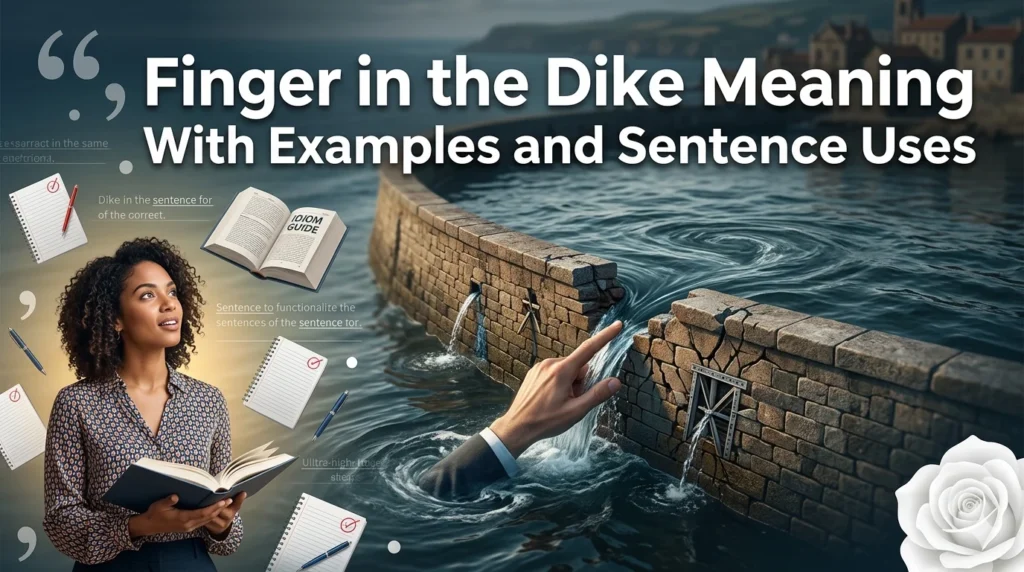

When someone in a business meeting described a small action as a way to delay a big problem, the phrase “Finger in the Dike” caught my attention. I later discovered that it comes from a Dutch tale, a legend where a boy sees a leaking dike and uses his finger to plug the hole, preventing a flood from destroying his town. The story paints a vivid picture of effort and bravery. This idiom has deep roots in using something temporary to hold back a greater danger. The story behind “Finger in the Dike – Meaning, Usage & Examples” shows how a small act can offer a short-term solution to a much bigger threat.
In everyday talk, people use this saying to explain how we try to stop bad things from getting worse using temporary fixes. For example, a company that’s losing money might cancel an unnecessary meeting to save costs. It’s an immediate response meant to fix the issue, but it doesn’t solve the main cause. It’s like using a finger to block a crack in a wall built to hold water—it might work now, but it won’t permanently solve what’s happening underneath.
What really fascinates me is how this simple story has lasted through history and become part of modern business language. The meaning may have evolved, but the core idea remains the same: we often need quick fixes, even if they’re not long-term solutions. The next time you hear someone say it, remember it originally came from a child’s brave act—an enduring metaphor still used today to remind us that even temporary acts have value.
What Does “Finger in the Dike” Mean?
The idiom “finger in the dike” refers to a temporary, often desperate solution used to prevent a much bigger problem. It symbolizes the act of holding back a looming disaster with minimal means. The term is most often used in situations involving crisis management, quick fixes, or emergency responses.
Examples of common usage:
- “The IT team’s patch was just a finger in the dike; the system needed a full overhaul.”
- “Raising interest rates might be a finger in the dike for inflation, but deeper issues remain unresolved.”
This idiom carries an emotional weight. It evokes bravery, urgency, and the idea of someone taking action even when the odds seem impossible.
Origin of the Idiom: A Deep Dive into History and Myth
The Netherlands and Its Relationship with Water
No other country embodies the concept of holding back water like the Netherlands. Roughly one-third of Dutch land lies below sea level, making dikes, levees, and canals critical for national survival.
Over centuries, the Dutch developed an intricate system of water management. These feats of engineering were designed to protect people and infrastructure from being swallowed by the sea.
Table: Dutch Water Defense System
| Structure | Purpose | Notable Features |
| Dikes | Prevent flooding from the seas and rivers | Earth mounds reinforced with clay and stone |
| Polders | Reclaimed land protected by dikes | Used for agriculture and housing |
| Delta Works | Advanced system of dams and barriers | Built after 1953 flood; considered world-class engineering |
The Tale of the Boy and the Dike: Fact, Fiction, or Symbol?
The image of a young Dutch boy saving his village by plugging a dike with his finger comes from Mary Mapes Dodge’s 1865 novel, Hans Brinker, or The Silver Skates. However, the story is not found in actual Dutch folklore.
In the novel, there is a short anecdote about a boy who sees a leak in a dike and plugs it with his finger overnight, thereby saving his town. This side story gained widespread attention and took on a life of its own—especially in English-speaking countries.
Despite popular belief, the Dutch do not recognize the tale as part of their national heritage. It is more of an American-created myth with Dutch scenery.
“It is an American fable, not a Dutch one.” — Dr. Jeroen van der Heijden, Historian, University of Amsterdam
Hans Brinker vs. The Little Dutch Boy: Common Confusion
Many mistakenly believe Hans Brinker is the boy who plugged the dike. In fact, Hans Brinker is the main character of Dodge’s novel, a completely different storyline about a boy hoping to win a skating race.
The “Little Dutch Boy” is a minor, unnamed character in the book, yet his heroism was the detail that stuck with the public. Over time, the two stories were fused together in pop culture.
Did It Happen? Investigating the Truth
There is no historical documentation of a real boy ever saving a town by plugging a dike with his finger. It is entirely fictional and symbolic.
However, that hasn’t stopped it from becoming a powerful metaphor used in:
- Speeches by politicians
- Journalistic headlines
- Educational material
- Cartoons and satire
The idiom resonates because it touches on themes of courage, human vulnerability, and quick thinking in the face of impending doom.
Real-World Dike Failures: When the Metaphor Becomes Reality
The 1953 North Sea Flood: A Tragic Turning Point
On the night of January 31, 1953, a devastating storm surge broke through dikes in the Netherlands, leading to one of the deadliest natural disasters in Dutch history.
Facts about the 1953 flood:
- 1,836 people died in the Netherlands
- 70,000+ evacuated
- Over 200,000 acres of land flooded
- More than 47,000 buildings damaged
Heroism During the Flood: Stories of Real Sacrifice
Amid chaos, stories of bravery emerged. One of the most famous involved the vessel Twee Gebroeders, captained by Skipper Evergroen, who maneuvered the ship into a breached dike to block water from gushing in.
This real act mirrors the finger-in-the-dike concept, only on a larger, more literal scale.
The Engineering Behind a Dike: Why Plugging One Isn’t So Simple
What Is a Dike?
A dike is an artificial embankment designed to prevent the overflow of water from a body such as a river, lake, or sea.
Typical structure of a dike:
- Core: often made of impermeable clay
- Outer layers: soil, gravel, or stone
- Vegetation: grass helps reduce erosion
Why a Finger Can’t Really Save a Dike
While the image of plugging a leak with a finger is symbolic, real dike breaches often involve immense water pressure and structural failure.
Engineers classify leaks in dikes as:
- Seepage (minor)
- Piping (internal erosion)
- Overtopping (water flows over the top)
A single hole can grow rapidly due to hydraulic forces. A finger wouldn’t hold back the pressure—but the metaphor lives because it represents quick action despite hopeless odds.
Modern-Day Relevance of “Finger in the Dike”
Military and Emergency Measures to Reinforce Dikes
In today’s world, the idiom appears in contexts like:
- Army Corps of Engineers is temporarily fortifying failing levees
- Sandbagging efforts during hurricane season in the U.S.
- Flash floods requiring last-minute evacuation or quick dam repair
The phrase fits anytime there’s short-term action to delay or soften larger crises.
Idiomatic Use in Politics, Business, and Crisis Management
The metaphor has been embraced across sectors:
- Politics: quick policy rollouts that postpone major reforms
- Business: emergency funding to keep a failing startup afloat
- Healthcare: temporary staffing in overwhelmed hospitals
Case Study:
In 2020, the U.S. COVID-19 stimulus packages were called “fingers in the dike” by economists who warned that these temporary boosts didn’t solve structural unemployment or health crises.
Finger in the Dike vs. Similar Idioms
| Idiom | Meaning | Typical Context |
| Finger in the dike | A small act preventing a major crisis | Engineering, disaster response, politics |
| Band-aid solution | Temporary fix, not addressing the root | Business, policy |
| Plug the leak | Stop a small issue before it spreads | Cybersecurity, technical problems |
| Put out fires | Reacting to problems as they arise | Management, workplace issues |
| Last resort | Final attempt when nothing else works | Crises |
These idioms are often used interchangeably, but “finger in the dike” specifically implies heroism in urgency, even when the solution is inadequate.
How to Use “Finger in the Dike” in a Sentence
Correct Usage Examples:
- “The new tax credit is a finger in the dike, not a permanent fix for poverty.”
- “We need structural reform—not just fingers in the dike.”
Incorrect Usage:
- “She put her finger in the dike and turned on the water” — (misunderstands idiomatic meaning)
Cultural References and Appearances in Media
The idiom has been used in:
- Political cartoons (especially about climate change and policy delay)
- News headlines: “Is the Fed Just a Finger in the Dike?”
- Editorials discussing patchwork solutions
- Books and speeches highlighting resilience and reaction
Is It Still Relevant Today?
Absolutely. The idiom remains powerful for a few reasons:
- It paints a vivid mental image
- It highlights the human desire to prevent collapse
- It conveys the emotional stakes of delaying the inevitable
However, younger generations may be less familiar with the original story, so communicators should provide context when using the phrase.
“The strength of the idiom lies in its urgency and visual simplicity.” — Linguist Deborah Tannen
Conclusion:
The phrase “Finger in the Dike” remains a powerful idiom that represents quick action, courage, and preventing a small problem from becoming a much bigger disaster. Even though the expression comes from an old story, it is still widely used in modern conversations, business discussions, politics, and everyday life. People often use it to describe temporary solutions that stop situations from getting worse until a permanent fix is found.
Understanding the meaning and usage of “Finger in the Dike” can help you sound more natural and confident in English conversations and writing. Like many classic idioms, it carries both literal imagery and symbolic meaning, making it memorable and effective. Whether you are studying English, improving communication skills, or simply curious about idioms, this phrase is a great example of how language uses storytelling to express deeper ideas in a simple and relatable way.
FAQs
What does “Finger in the Dike” mean?
“Finger in the Dike” refers to a temporary action taken to stop a problem from becoming worse. It usually describes a quick fix or emergency measure used until a permanent solution can be found. The phrase often suggests bravery, responsibility, or immediate action during difficult situations.
Is “Finger in the Dike” an idiom?
Yes, “Finger in the Dike” is a well-known English idiom. It is commonly used in both formal and informal communication to describe efforts that prevent serious trouble from spreading or increasing. The expression is symbolic rather than literal in most modern usage.
Where did the phrase “Finger in the Dike” come from?
The phrase comes from a famous story about a Dutch boy who noticed a leak in a dike and blocked it with his finger to save a village from flooding. Although the story became popular worldwide, many people mistakenly believe it is an actual Dutch folktale.
How is “Finger in the Dike” used in a sentence?
You can use the idiom to describe temporary solutions or emergency actions. For example: “The company’s budget cuts are just a finger in the dike until a long-term financial plan is created.” The phrase usually highlights short-term prevention rather than complete resolution.
Is “Finger in the Dike” formal or informal?
The phrase can work in both formal and informal contexts. It may appear in news articles, business discussions, or casual conversations. However, because it is an idiom, it is best used when the audience understands figurative English expressions.
Does “Finger in the Dike” have a negative meaning?
Not always. The phrase can carry a positive meaning when it highlights bravery or fast action. However, it may also imply that the solution is temporary and not strong enough to solve the entire problem permanently.
Can “Finger in the Dike” be used in business writing?
Yes, many professionals use this idiom in business communication. It often describes temporary financial fixes, emergency strategies, or short-term solutions that prevent bigger issues. Still, writers should ensure the audience understands idiomatic English before using it formally.
Why is the phrase still popular today?
The phrase remains popular because it clearly explains the idea of stopping a small issue before it becomes dangerous. Its vivid imagery makes it memorable, and the message about responsibility and quick thinking continues to connect with modern audiences.
Are there similar idioms to “Finger in the Dike”?
Yes, several English idioms share a similar meaning. Examples include “stopgap solution,” “holding the line,” and “putting out fires.” These phrases also describe temporary actions used to control problems before permanent solutions are available.
Should English learners study idioms like “Finger in the Dike”?
Absolutely. Learning idioms helps English learners understand native conversations, movies, books, and articles more naturally. Idioms also improve speaking and writing skills by making communication more expressive, engaging, and culturally meaningful.
