
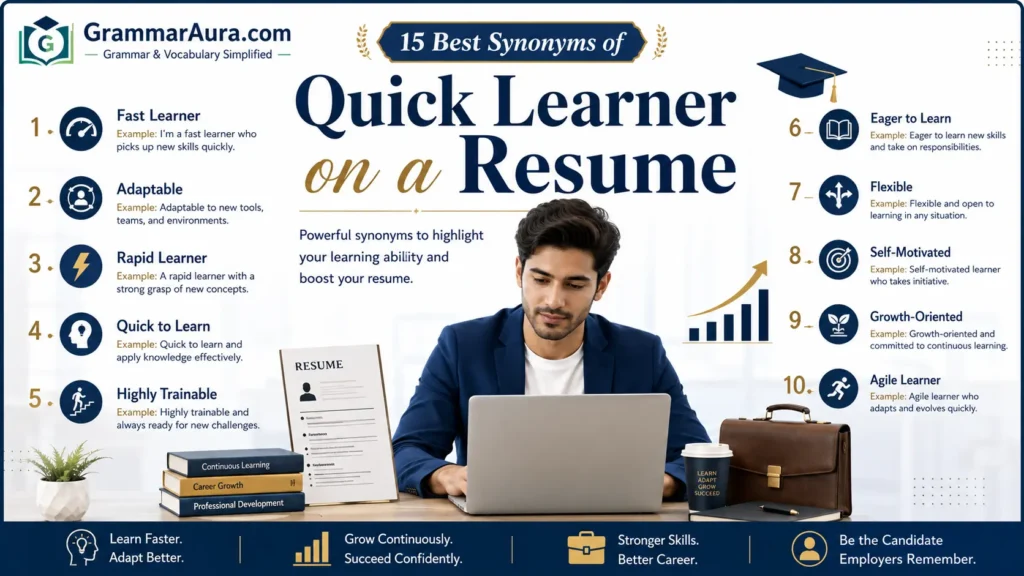

When applying for a job, many candidates rely on the phrase “quick learner” to describe their abilities. While it is a familiar expression, it can sound generic to employers and recruiters reviewing resumes, cover letters, or LinkedIn profiles. Choosing 15 Best Synonyms of “Quick Learner on a Resume” helps your application stand out by highlighting your adaptability, willingness to learn, and ability to succeed in new situations. Thoughtful wording also creates a more professional and memorable first impression.
Instead of repeating the same phrase, use alternatives that clearly demonstrate your ability to learn new skills, adapt quickly, and perform effectively in changing environments. These expressions communicate confidence, professionalism, and genuine capability while making your profile more engaging. Whether you are updating a resume, writing a cover letter, or enhancing your LinkedIn profile, the right language can better showcase your strengths.
From experience, word choice plays a significant role in how employers evaluate a candidate’s potential. Strong, specific phrasing helps demonstrate eagerness to learn, problem-solving ability, and readiness to grow. Candidates who present their skills with clarity and confidence are more likely to leave a lasting impression and position themselves as professionals who can adapt, contribute, and succeed in fast-paced workplaces.
What Does “Quick Learner on a Resume” Mean?
The phrase “Quick Learner” indicates that a candidate can grasp new skills, processes, or information rapidly and efficiently. It reflects adaptability, intelligence, and the ability to contribute to a team or project without prolonged training.
When to Use “Quick Learner on a Resume”?
- Highlighting your adaptability in professional experiences
- Demonstrating the capacity to pick up new tools, software, or workflows
- Strengthening your profile in industries that value rapid learning
Is It Professional/Polite to Say “Quick Learner on a Resume”?
Yes. It is a professional and widely recognized term on resumes. However, pairing it with examples or achievements increases credibility—for instance, showing how quickly you mastered a software or adapted to a new role.
Pros and Cons
Pros
- Clearly conveys adaptability and intelligence
- Easy for recruiters to understand
- Demonstrates enthusiasm and potential
Cons
- Overused and may seem generic if unsupported
- Can appear vague without concrete examples
- Needs context to truly impress hiring managers
Quick Learner on a Resume Synonyms:
- Fast Learner
- Adaptable
- Quick Study
- Fast Adapter
- Quick to Grasp Concepts
- Rapid Learner
- Highly Trainable
- Adapt Quickly
- Learns Quickly
- Fast Absorber of Knowledge
- Agile Learner
- Fast Grasper
- Learning-Oriented
- Proficient Quickly
- Efficient Learner
Fast Learner
Meaning:
Able to grasp new concepts, skills, or procedures quickly.
Explanation:
Direct synonym of “quick learner,” conveys speed and adaptability.
Example:
“Fast learner with the ability to master new software tools efficiently.”
Best Use:
Resume bullet points, LinkedIn summaries, professional profiles.
Worst Use:
Without context or supporting examples, it may seem generic.
Tone:
Professional, confident, positive
Adaptable
Meaning:
Capable of adjusting to new conditions, tasks, or environments quickly.
Explanation:
Highlights flexibility and capacity to thrive in changing work settings.
Example:
“Adaptable professional experienced in handling multiple projects and learning new technologies rapidly.”
Best Use:
When emphasizing flexibility and growth potential.
Worst Use:
If the role doesn’t require adaptability, it may feel misplaced.
Tone:
Professional, strategic, versatile
Quick Study
Meaning:
Someone who learns new skills or information swiftly.
Explanation:
Often used in both professional and casual contexts; adds personality to your resume or interview responses.
Example:
“Quick study, able to grasp complex processes with minimal supervision.”
Best Use:
Resume bullet points, informal interviews.
Worst Use:
Formal academic CVs may seem colloquial.
Tone:
Friendly, dynamic, approachable
Fast Adapter
Meaning:
Able to adjust quickly to new systems or processes.
Explanation:
Suggests both learning and flexibility, emphasizing practical workplace adjustment.
Example:
“Fast adapter, quickly integrating new software into daily workflows.”
Best Use:
Technology, startup, or dynamic industry resumes.
Worst Use:
Very formal or traditional sectors—it may sound informal.
Tone:
Professional, energetic, modern
Quick to Grasp Concepts
Meaning:
Learns and understands new ideas swiftly.
Explanation:
Focuses on intellectual absorption and analytical skills.
Example:
“Quick to grasp concepts, enabling smooth execution of new projects.”
Best Use:
Situations emphasizing technical, analytical, or strategic learning.
Worst Use:
Casual settings—it may read as overly wordy.
Tone:
Professional, intellectual, competent
Rapid Learner
Meaning:
Learns skills or information at an accelerated pace.
Explanation:
Slightly more formal than “fast learner,” it adds authority and credibility.
Example:
“Rapid learner with experience onboarding new tools within days.”
Best Use:
Formal resumes, cover letters, corporate profiles.
Worst Use:
Overuse without proof can seem like empty jargon.
Tone:
Professional, strong, credible
Highly Trainable
Meaning:
Open and capable of learning new skills efficiently.
Explanation:
Suggests potential and willingness to be guided or instructed.
Example:
“Highly trainable, quickly mastering new processes with minimal supervision.”
Best Use:
Entry-level resumes, industries emphasizing growth potential.
Worst Use:
Senior-level positions may imply a lack of experience.
Tone:
Positive, eager, approachable
Adapt Quickly
Meaning:
Adjusts to changes or new systems rapidly.
Explanation:
Emphasizes both learning speed and flexibility in dynamic situations.
Example:
“Adapt quickly to new software and team structures.”
Best Use:
Tech startups, consulting, and fast-paced industries.
Worst Use:
Roles that are routine are less relevant.
Tone:
Energetic, professional, versatile
Learns Quickly
Meaning:
Direct and simple expression of rapid learning ability.
Explanation:
Easily understood, straightforward; works in most professional settings.
Example:
“Learns quickly and applies knowledge effectively in real-world projects.”
Best Use:
All resumes, cover letters, and professional summaries.
Worst Use:
Overuse without examples—may sound generic.
Tone:
Neutral, polite, professional
Fast Absorber of Knowledge
Meaning:
Picks up new information efficiently.
Explanation:
Highlights both speed and comprehension, slightly more descriptive than “quick learner.”
Example:
“Fast absorber of knowledge, excelling in onboarding and training sessions.”
Best Use:
Technical or knowledge-heavy roles.
Worst Use:
Casual or short resumes may feel wordy.
Tone:
Professional, specific, competent
Agile Learner
Meaning: Learns and adapts with speed and flexibility.
Explanation: Suggests intellectual agility, often used in modern corporate or tech contexts.
Example:
“Agile learner, thriving in environments with evolving responsibilities.”
Best Use: Startups, IT, or innovative industries.
Worst Use: Conservative or traditional industries—it may sound trendy.
Tone: Modern, professional, dynamic
Fast Grasper
Meaning:
Quickly understands new ideas or processes.
Explanation:
Slightly informal, but conveys clear capability in comprehension.
Example:
“Fast grasper of new procedures and workflow improvements.”
Best Use:
Casual resumes or interview conversations.
Worst Use:
Very formal or traditional resumes.
Tone:
Friendly, direct, approachable
Learning-Oriented
Meaning:
Focused on acquiring new skills and knowledge.
Explanation:
Shows willingness and enthusiasm for ongoing learning, rather than speed alone.
Example:
“Learning-oriented professional with a track record of mastering new software efficiently.”
Best Use:
Growth-focused roles, entry-level positions, and corporate development.
Worst Use:
Senior expert roles where experience matters more than adaptability.
Tone:
Positive, eager, professional
Proficient Quickly
Meaning:
Gains competence in skills or knowledge rapidly.
Explanation:
Combines learning ability with practical application, highlighting results.
Example:
“Proficient quickly in new marketing tools and platforms.”
Best Use:
Technical, operational, or skill-driven roles.
Worst Use:
Abstract or non-technical positions may seem forced.
Tone:
Professional, capable, results-oriented
Efficient Learner
Meaning:
Learns quickly while applying knowledge effectively.
Explanation:
Emphasizes both speed and productivity in learning.
Example:
“Efficient learner, integrating new processes into daily tasks seamlessly.”
Best Use:
Roles requiring rapid adaptation and execution.
Worst Use:
Casual or generic resumes without supporting evidence.
Tone:
Professional, credible, positive
Comparison Table of Top Alternatives
| Phrase | Best For | Tone | Formality |
| Fast Learner | All resumes | Confident, professional | Medium |
| Adaptable | Flexible roles | Professional, versatile | Medium |
| Quick Study | Casual resumes, interviews | Friendly, approachable | Low |
| Fast Adapter | Startups, tech roles | Energetic, modern | Medium |
| Quick to Grasp Concepts | Analytical roles | Intellectual, competent | High |
| Rapid Learner | Corporate resumes | Professional, strong | High |
| Highly Trainable | Entry-level roles | Eager, approachable | Medium |
| Adapt Quickly | Dynamic environments | Energetic, versatile | Medium |
| Learns Quickly | General use | Neutral, professional | Medium |
| Fast Absorber of Knowledge | Technical roles | Professional, competent | High |
| Agile Learner | Modern/tech industries | Dynamic, professional | Medium |
| Fast Grasper | Informal resumes | Friendly, direct | Low |
| Learning-Oriented | Growth-focused roles | Positive, eager | Medium |
| Proficient Quickly | Skill-driven roles | Professional, results-oriented | Medium |
| Efficient Learner | Productivity-focused roles | Credible, professional | Medium |
Final Thoughts
Crafting a resume that effectively conveys your ability as a quick learner is more than just adding a generic phrase. By choosing from the 15 alternatives provided, you can tailor your language to highlight your adaptability, efficiency, and eagerness to grow. This not only makes your application stand out but also presents a more personalized, professional image to potential employers.
Remember, context matters. Pairing these phrases with specific achievements, examples, or metrics strengthens your credibility. Employers value candidates who demonstrate not just the ability to learn quickly but also the capacity to apply knowledge effectively in real-world scenarios. Using precise, varied language ensures your skills are communicated clearly and compellingly, giving you an edge in competitive hiring processes.
FAQs
What does “quick learner” really mean on a resume?
A “quick learner” indicates that a candidate can grasp new skills, processes, or information efficiently. It reflects adaptability, intelligence, and a capacity to contribute to projects without requiring extended training. Including examples of applied knowledge strengthens credibility and makes this skill tangible to employers.
Are “fast learner” and “quick learner” interchangeable?
Yes, they are largely interchangeable, but “fast learner” is slightly more casual, while “quick learner” is widely recognized in professional resumes. Using either phrase effectively requires supporting examples to demonstrate how you’ve mastered new tasks or tools.
Which synonym is best for entry-level resumes?
Phrases like “highly trainable,” “learning-oriented,” or “efficient learner” are ideal for entry-level candidates. They highlight potential, eagerness, and adaptability without implying prior extensive experience, making them suitable for early-career professionals.
Can using these synonyms make my resume stand out?
Absolutely. Using varied expressions like “agile learner” or “fast absorber of knowledge” shows creativity and attention to detail. Tailoring synonyms to match job descriptions ensures your resume is both relevant and engaging for recruiters.
How can I avoid making “quick learner” sound generic?
Avoid generic phrasing by pairing it with specific achievements, tools, or results. For example, “Rapid learner who mastered XYZ software in two weeks” demonstrates tangible skills and creates a stronger impression.
Are these synonyms suitable for senior-level resumes?
Some are, like “efficient learner,” “proficient quickly,” or “quick to grasp concepts.” Others, like “highly trainable,” may suggest a lack of experience, making them less appropriate for senior roles. Context and examples are key.
Should I include these phrases in cover letters, too?
Yes, incorporating synonyms in cover letters reinforces your adaptability and learning ability. Focus on showing how you’ve quickly applied new skills to solve problems or deliver results.
Do recruiters prefer examples over adjectives?
Absolutely. Adjectives like “quick learner” signal potential, but examples of applied skills, projects, or results make your ability concrete and credible, which recruiters value far more.
Can informal synonyms be used for LinkedIn profiles?
Yes, terms like “quick study” or “fast grasper” can work on LinkedIn or casual portfolios. For professional networking, pair them with clear achievements to maintain credibility.
How can I choose the right synonym for my industry?
Consider your industry’s tone and expectations. Use formal synonyms like “rapid learner” in corporate or technical fields, and modern or dynamic phrases like “agile learner” for startups or creative industries. Always tailor to context and audience.
