
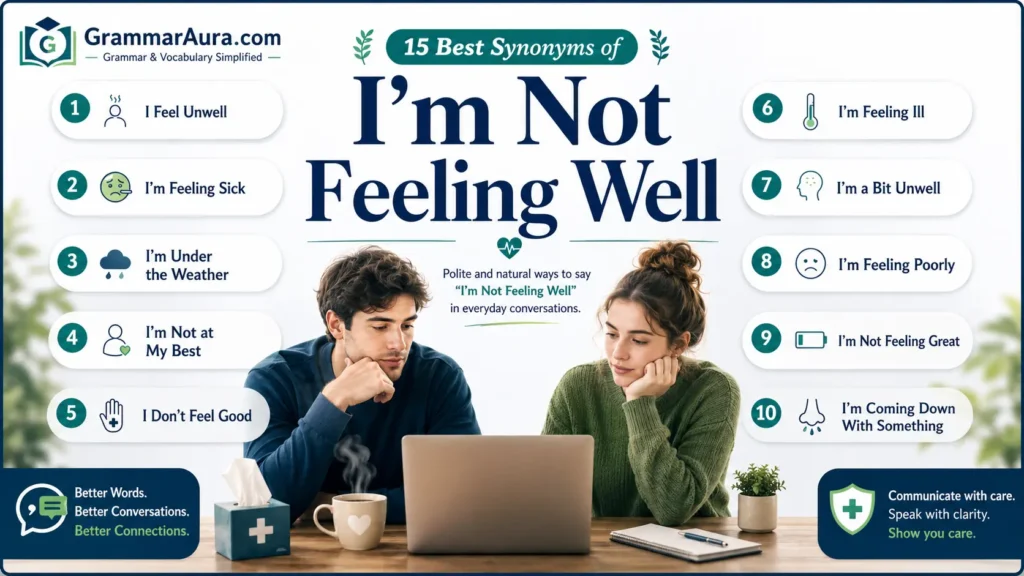

15 Best Synonyms of “I’m Not Feeling Well” helps you communicate illness or discomfort with greater clarity, empathy, and confidence. While “I’m not feeling well” is a simple and widely understood phrase, choosing thoughtful alternatives can make your message feel more personal, considerate, and appropriate for different situations. Whether you are informing a colleague, reaching out to a friend, or writing to a healthcare professional, the right wording helps your message sound respectful, sincere, and clear.
When talking about feeling unwell, word choice can greatly influence how your message is received. Thoughtful alternatives allow you to express your situation with warmth, empathy, and professionalism while matching the context and your relationship with the reader. Using clear and considerate language ensures your communication is easy to understand and reflects your personality and tone. The following alternatives will help you express how you feel naturally in both personal and professional conversations.
What Does “I’m Not Feeling Well” Mean?
The phrase “I’m Not Feeling Well” indicates that you are experiencing some level of physical or mental discomfort. It can encompass mild ailments like fatigue or headaches, as well as more serious conditions, without specifying the exact cause.
When to Use “I’m Not Feeling Well”
- Informing friends, family, or colleagues about illness
- Requesting rest or rescheduling commitments
- Expressing mild or general discomfort without oversharing
Is It Professional/Polite to Say “I’m Not Feeling Well”?
Yes. It is polite and appropriate in most casual and professional settings. For professional emails, you can combine it with a respectful request or explanation, such as “I’m not feeling well today, so I’ll need to rest and follow up tomorrow.”
Pros and Cons
Pros
- Clear and direct
- Polite and universally understood
- Suitable for casual and semi-professional use
Cons
- Vague about the exact issue
- Can sound repetitive in frequent use
- Lacks emotional nuance
I’m Not Feeling Well Synonyms:
- I’m Feeling Under the Weather
- I’m a Bit Off Today
- Not My Best Today
- I’m Feeling Unwell
- I’m Feeling Poorly
- I’m Not 100% Today
- Feeling a Bit Rough
- Not Feeling Myself
- Feeling Under-Par
- Feeling Off-Color
- Feeling Ill
- I’m a Bit Under the Weather
- Feeling Low
- Not Up to Par
- I’m Feeling Weak
I’m Feeling Under the Weather
Meaning:
Informal expression indicating mild illness or fatigue.
Explanation:
Commonly used in English to express that you’re not feeling your usual self, typically without specifying the problem.
Example:
“I’m feeling under the weather today, so I’ll work from home.”
Best Use:
Casual conversations, friendly emails, informal team updates.
Worst Use:
Highly formal communications or medical contexts.
Tone:
Informal, polite, friendly
I’m a Bit Off Today
Meaning:
Casual way to indicate you’re not feeling your best.
Explanation:
Suggests minor discomfort or low energy, often temporary and not serious.
Example:
“I’m a bit off today, so I might not be very responsive.”
Best Use:
Informal chats or messages with colleagues or friends.
Worst Use:
Formal emails or professional reporting.
Tone:
Casual, friendly, humble
Not My Best Today
Meaning:
Informal expression signaling low energy or mild illness.
Explanation:
Conveys personal discomfort or decreased performance without specifying illness.
Example:
“It’s not my best today, so I’ll need to take it slow.”
Best Use:
Casual conversations, team updates.
Worst Use:
Medical or official notifications.
Tone:
Informal, empathetic, humble
I’m Feeling Unwell
Meaning:
Slightly more formal way to say you’re sick or in discomfort.
Explanation:
Broad expression suitable for semi-formal contexts, covering physical or mental unease.
Example:
“I’m feeling unwell, so I won’t be attending the meeting today.”
Best Use:
Professional emails, polite notifications.
Worst Use:
Very casual or playful contexts.
Tone:
Neutral, polite, considerate
I’m Feeling Poorly
Meaning:
Polite, slightly formal way to indicate illness.
Explanation:
Traditional phrasing is often used in professional or polite personal settings.
Example:
“I’m feeling poorly, and I may need to reschedule our call.”
Best Use:
Professional, formal, or medical contexts.
Worst Use:
Casual texting—it may sound outdated.
Tone:
Formal, polite, neutral
I’m Not 100% Today
Meaning:
An informal way to communicate that you’re not feeling fully well.
Explanation:
Signals minor discomfort or low energy, without being too serious.
Example:
“I’m not 100% today, so I’ll take it easy.”
Best Use:
Informal work chats, text messages.
Worst Use:
Formal or medical communications.
Tone:
Casual, friendly, mild
Feeling a Bit Rough
Meaning:
An informal way to indicate minor sickness or fatigue.
Explanation:
Often used in British English; conveys temporary discomfort.
Example:
“Feeling a bit rough this morning, so I might skip the gym.”
Best Use:
Casual conversations with friends or colleagues.
Worst Use:
Formal emails or workplace reporting.
Tone:
Informal, casual, empathetic
Not Feeling Myself
Meaning:
Indicates physical or emotional discomfort.
Explanation:
Suggests a sense of imbalance or deviation from normal health.
Example:
“I’m not feeling myself today, so I’ll need a quiet day to rest.”
Best Use:
Personal communication, informal team updates.
Worst Use:
Very formal or medical documentation.
Tone:
Friendly, empathetic, honest
Feeling Under-Par
Meaning:
Slightly formal expression for being unwell or having low energy.
Explanation:
Common in workplace English, expressing temporary reduced capacity or mild illness.
Example:
“I’m feeling under-par, so I’ll postpone today’s tasks.”
Best Use:
Workplace conversations, semi-formal emails.
Worst Use:
Casual text messages may sound stiff.
Tone:
Neutral, polite, professional
Feeling Off-Color
Meaning:
British English idiom for minor illness.
Explanation:
Suggests slight discomfort, mild sickness, or fatigue.
Example:
“I’m feeling off-color, so I’ll rest at home today.”
Best Use:
Informal or semi-formal communications.
Worst Use:
Formal medical documentation.
Tone:
Casual, polite, empathetic
Feeling Ill
Meaning:
Direct expression of being sick.
Explanation:
Suitable for both casual and formal contexts; clearly conveys illness.
Example:
“I’m feeling ill, so I won’t be attending the meeting.”
Best Use:
Emails, professional notifications, mand edical contexts.
Worst Use:
Very casual messaging; may feel too blunt.
Tone:
Neutral, polite, direct
I’m a Bit Under the Weather
Meaning:
Alternative phrasing for mild sickness or fatigue.
Explanation:
Slightly longer version of “under the weather,” used casually.
Example:
“I’m a bit under the weather, so I’ll rest today.”
Best Use:
Friendly chats, casual workplace emails.
Worst Use:
Formal medical documentation.
Tone:
Casual, friendly, polite
Feeling Low
Meaning:
Can refer to physical or emotional malaise.
Explanation:
Broad phrase; may indicate tiredness, mild sickness, or low mood.
Example:
“Feeling low today, so I’ll take it slow.”
Best Use:
Informal conversations, emotional check-ins.
Worst Use:
Formal professional emails where specifics are required.
Tone:
Empathetic, honest, casual
Not Up to Par
Meaning:
Expresses that one’s health or energy is below normal.
Explanation:
Suggests mild illness or fatigue affecting performance.
Example:
“I’m not up to par, so I’ll miss today’s session.”
Best Use:
Workplace casual conversations or informal updates.
Worst Use:
Medical documentation or very formal reports.
Tone:
Casual, neutral, polite
I’m Feeling Weak
Meaning:
Direct expression of physical fatigue or illness.
Explanation:
Conveys physical discomfort or low energy clearly and respectfully.
Example:
“I’m feeling weak, so I’ll rest and return tomorrow.”
Best Use:
Professional or personal emails, notifications of illness.
Worst Use:
Overly casual or playful contexts—it may sound too serious.
Tone:
Polite, honest, neutral
Comparison Table of Top Alternatives
| Phrase | Best For | Tone | Formality |
| I’m Feeling Under the Weather | Casual conversations | Friendly, informal | Low |
| I’m a Bit Off Today | Informal messages | Casual, humble | Low |
| Not My Best Today | Casual updates | Informal, empathetic | Low |
| I’m Feeling Unwell | Professional emails | Neutral, polite | Medium |
| I’m Feeling Poorly | Formal notifications | Polite, formal | High |
| I’m Not 100% Today | Casual chats | Friendly, mild | Low |
| Feeling a Bit Rough | Informal conversations | Casual, empathetic | Low |
| Not Feeling Myself | Personal communication | Friendly, honest | Low |
| Feeling Under-Par | Workplace discussions | Neutral, polite | Medium |
| Feeling Off-Color | Casual or semi-formal | Polite, empathetic | Medium |
| Feeling Ill | Professional or medical | Neutral, direct | High |
| I’m a Bit Under the Weather | Casual workplace | Friendly, polite | Low |
| Feeling Low | Emotional check-ins | Empathetic, casual | Low |
| Not Up to Par | Casual workplace | Neutral, polite | Medium |
| I’m Feeling Weak | Personal/professional | Honest, polite | Medium |
Final Thoughts
Expressing that you are not feeling well can be more thoughtful and empathetic when you use varied phrasing. Choosing the right words helps convey your situation clearly while maintaining politeness and professionalism, whether in personal messages, emails, or workplace communication. Using alternatives allows your message to feel personal, caring, and considerate.
Remember to match your phrasing to the context and audience. Whether you’re speaking to a friend, family member, or colleague, supporting your message with clarity and warmth ensures it is received with understanding and compassion, helping maintain strong personal and professional relationships.
FAQs
What does “I’m not feeling well” mean?
It communicates that you are experiencing physical or mental discomfort. It’s a simple way to let others know you may need rest, support, or understanding. Using alternatives can express this message in a more empathetic or professional tone, depending on the context.
Can I use informal phrases instead?
Yes, phrases like “Feeling under the weather” or “Not at my best today” are casual alternatives suitable for friends, family, or informal colleagues. Context matters—avoid casual phrasing in formal professional communications.
What is a professional way to say it?
In workplace emails or messages, phrases like “I’m feeling unwell and will need to rest” or “I’m not feeling well and may be unavailable today” convey the situation politely and professionally.
How can I express it empathetically?
Adding context or gratitude can increase empathy, e.g., “I’m not feeling well, and I appreciate your understanding”. This shows self-awareness while respecting the recipient.
Is it okay to use humor when saying it?
Humor, like “Fighting off a bug today”, works with close friends or casual colleagues but may be inappropriate in formal or serious contexts. Always gauge the audience.
How do I politely inform my boss?
Keep it clear and concise: “I’m not feeling well and will be taking the day off”. This demonstrates professionalism and responsibility while communicating your situation effectively.
Can text abbreviations work?
For informal chats, abbreviations like “Not feeling well today :/” may be fine. Avoid them in professional emails or serious situations where clarity and tone are important.
What’s the difference between “I’m sick” and “I’m not feeling well”?
“I’m sick” implies a more serious condition, whereas “I’m not feeling well” is softer and can cover minor illness, fatigue, or general discomfort. The latter is more versatile and polite.
Are there cultural considerations?
Yes, in some cultures, being overly explicit about illness may be discouraged. Using polite or neutral alternatives like “under the weather” can help maintain professionalism and cultural sensitivity.
Can these alternatives be used in emails?
Absolutely. Phrases like “I’m not feeling well today and may be delayed in responding” or “Feeling unwell, kindly expect a later response” are professional, clear, and convey your situation respectfully.
