
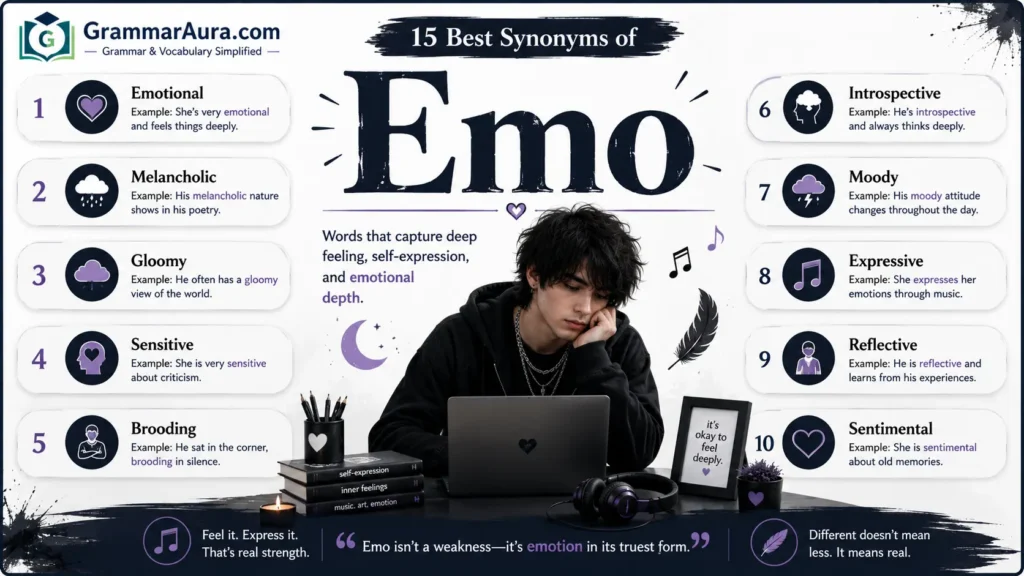

15 Best Synonyms of “Emo” helps you find more thoughtful and accurate ways to describe emotional expression in different contexts. While “emo” is often used casually, choosing the right alternative can make your writing feel more respectful, nuanced, and human-centered. Whether you are describing a person’s emotions, personality, or creative style, meaningful synonyms help communicate emotional depth with greater clarity and sensitivity.
From experience, carefully chosen words make emotional language more accurate and engaging. Thoughtful alternatives help express feelings, moods, and personality traits with warmth, empathy, and precision instead of relying on labels that may feel vague or oversimplified. By using expressive and respectful language, you can make your writing more meaningful, emotionally aware, and easier for readers to understand. These alternatives improve clarity while helping you communicate emotions in a natural, considerate, and authentic way.
What Does “Emo” Mean?
The word “emo” originally comes from “emotional,” and it is often used to describe someone who is deeply expressive, sensitive, or in touch with intense feelings. In modern use, it can also refer to a style or mood associated with introspection, sadness, or emotional intensity.
At its core, “emo” means emotionally expressive or emotionally intense, often in a way that reflects deep personal feelings, sometimes including sadness, nostalgia, or passion.
When to Use “Emo”
You can use “emo” when describing:
- Emotional expression in music, writing, or personality
- Intense or sensitive moods
- Moments of introspection or emotional reflection
- Artistic or expressive emotional states
However, it is often informal and can sound vague or slang-like depending on context.
Is It Professional or Polite to Say “Emo”?
In professional settings, “emo” is usually not recommended because it can sound casual or imprecise. Instead, words like “emotional,” “reflective,” or “introspective” are more appropriate.
In polite or emotional conversations, “emo” may feel too simplified or even dismissive if used to describe someone’s feelings.
Pros and Cons of Using “Emo”
Pros:
- Easy to understand in casual speech
- Commonly used in pop culture
- Conveys emotional intensity quickly
Cons:
- Too informal for professional writing
- Can sound vague or stereotypical
- May not fully express emotional depth
- Sometimes misunderstood
Emo Synonyms:
- Emotional
- Sensitive
- Expressive
- Introspective
- Moody
- Sentimental
- Heartfelt
- Passionate
- Brooding
- Melancholic
- Reflective
- Vulnerable
- Tender
- Intense
- Angsty
Emotional
Meaning:
Describes someone who feels or expresses strong emotions.
Explanation:
The most direct and neutral alternative to “emo.”
Example:
“She became very emotional while talking about her childhood.”
Best Use:
Everyday communication
Worst Use:
When nuance or depth is needed
Tone:
Neutral, expressive
Sensitive
Meaning:
Someone who easily feels emotions or reacts emotionally.
Explanation:
Focuses on emotional responsiveness.
Example:
“He is sensitive to criticism but deeply caring.”
Best Use:
Personal descriptions
Worst Use:
Formal analysis of mood
Tone:
Gentle, caring
Expressive
Meaning:
Showing feelings openly and clearly.
Explanation:
Highlights outward emotional communication.
Example:
“She is very expressive when she talks about art.”
Best Use:
Creative or artistic contexts
Worst Use:
Clinical descriptions
Tone:
Warm, open
Introspective
Meaning:
Deeply focused on inner thoughts and feelings.
Explanation:
Used for thoughtful self-reflection.
Example:
“He became introspective after the conversation.”
Best Use:
Writing, psychology, reflection
Worst Use:
Casual slang contexts
Tone:
Thoughtful, calm
Moody
Meaning:
Emotionally changeable or reflective in mood.
Explanation:
Often linked to shifting emotional states.
Example:
“She felt moody after the long day.”
Best Use:
Informal emotional description
Worst Use:
Professional tone
Tone:
Slightly negative, informal
Sentimental
Meaning:
Emotionally moved by memories or feelings.
Explanation:
Often tied to nostalgia and affection.
Example:
“He kept the letter for sentimental reasons.”
Best Use:
Memory-based emotions
Worst Use:
Logical or technical writing
Tone:
Warm, nostalgic
Heartfelt
Meaning:
Deeply sincere and emotionally genuine.
Explanation:
Focuses on the authenticity of emotion.
Example:
“She gave a heartfelt apology.”
Best Use:
Communication and writing
Worst Use:
Scientific or analytical tone
Tone:
Warm, sincere
Passionate
Meaning:
Intensely emotional or enthusiastic.
Explanation:
Strong emotional energy directed toward something.
Example:
“He is passionate about music.”
Best Use:
Motivation or interests
Worst Use:
Calm or neutral contexts
Tone:
Strong, energetic
Brooding
Meaning:
Deeply thoughtful, often in a dark or serious way.
Explanation:
Suggests emotional heaviness or reflection.
Example:
“She sat in a brooding silence.”
Best Use:
Literary or dramatic writing
Worst Use:
Positive emotional contexts
Tone:
Dark, intense
Melancholic
Meaning:
A gentle sadness or reflective sorrow.
Explanation:
A more poetic form of emotional sadness.
Example:
“The music had a melancholic tone.”
Best Use:
Literature, art, music
Worst Use:
Casual conversation
Tone:
Soft, sad
Reflective
Meaning:
Deeply thoughtful and self-examining.
Explanation:
Focuses on thinking about emotions and experiences.
Example:
“She became reflective after the meeting.”
Best Use:
Professional or academic tone
Worst Use:
Emotional storytelling slang
Tone:
Calm, thoughtful
Vulnerable
Meaning:
Emotionally open or exposed.
Explanation:
Shows emotional honesty and sensitivity.
Example:
“He felt vulnerable sharing his story.”
Best Use:
Emotional conversations
Worst Use:
Lighthearted contexts
Tone:
Deep, honest
Tender
Meaning:
Gentle and emotionally soft.
Explanation:
Expresses warmth and care.
Example:
“She spoke in a tender voice.”
Best Use:
Relationships and care
Worst Use:
Formal reports
Tone:
Warm, soft
Intense
Meaning:
Strong and powerful emotional experience.
Explanation:
Highlights emotional strength or depth.
Example:
“That was an intense conversation.”
Best Use:
Strong emotional situations
Worst Use:
Mild feelings description
Tone:
Strong, serious
Angsty
Meaning:
Emotionally frustrated or conflicted.
Explanation:
Often linked to teenage or creative emotional expression.
Example:
“He wrote an angsty poem about change.”
Best Use:
Creative or informal writing
Worst Use:
Professional communication
Tone:
Informal, emotional
Comparison Table of Top Alternatives
| Synonym | Meaning Focus | Tone | Best Use Case |
| Emotional | Strong feelings | Neutral | Everyday expression |
| Sensitive | Easily affected | Gentle | Personal descriptions |
| Expressive | Shows feelings openly | Warm | Creative contexts |
| Introspective | Inner reflection | Thoughtful | Writing, self-reflection |
| Moody | Changing emotions | Informal | Casual speech |
| Sentimental | Nostalgic feelings | Warm | Memories, keepsakes |
| Heartfelt | Genuine emotion | Sincere | Apologies, messages |
| Passionate | Strong enthusiasm | Energetic | Interests, goals |
| Brooding | Deep serious mood | Dark | Literature, drama |
| Melancholic | Soft sadness | Poetic | Art, music, writing |
| Reflective | Thoughtful review | Calm | Professional writing |
| Vulnerable | Emotionally open | Deep | Emotional sharing |
| Tender | Gentle affection | Soft | Relationships |
| Intense | Strong emotional power | Serious | Conflict, deep talks |
| Angsty | Emotional frustration | Informal | Creative expression |
Final Thoughts
The word “emo” may feel simple, but emotions are rarely simple in real life. That’s why choosing more precise alternatives like introspective, heartfelt, sensitive, or melancholic can help you express feelings in a way that feels more respectful and meaningful. The right synonym allows your message to carry emotional depth instead of staying on the surface.
Ultimately, language shapes how others understand your emotions and intentions. When you move beyond casual labels like “emo,” you gain the ability to communicate with more clarity, warmth, and emotional intelligence. Whether you’re writing, speaking, or reflecting, these alternatives help your words feel more human and thoughtful.
FAQs
What is the closest synonym of “emo” in formal writing?
The closest formal synonym is “emotional” or “introspective.” These words describe emotional depth without sounding slang-based. They are suitable for academic, professional, or reflective writing where clarity and neutrality are important while still capturing emotional expression.
Is “emo” a negative word?
Not always. “Emo” is neutral in meaning, but it can sometimes be used negatively depending on tone or context. It may imply someone is overly emotional. However, in music and culture, it simply refers to emotional expression and artistic sensitivity.
Can I use “emo” in professional communication?
It is generally not recommended in professional settings. The word is informal and vague. Instead, use alternatives like “emotional,” “reflective,” or “sensitive” to maintain professionalism and ensure your message is clear, respectful, and appropriately descriptive.
What is a more positive alternative to “emo”?
Positive alternatives include “heartfelt,” “expressive,” and “passionate.” These words highlight emotional depth in a constructive way. They emphasize sincerity and warmth rather than sadness or intensity, making them more suitable for uplifting or supportive communication.
Why do people use the word “emo”?
People use “emo” as a quick label for emotional expression or mood-driven personality traits. It comes from the “emotional hardcore” music culture. Over time, it became a casual way to describe people who are deeply expressive or sensitive.
What is the difference between “emo” and “melancholic”?
“Emo” is informal and broad, while “melancholic” is poetic and specific. Melancholic describes a gentle sadness or reflective mood. Emo can include fashion, attitude, or emotional intensity, while melancholic focuses mainly on emotional tone.
Is “sensitive” a good synonym for “emo”?
Yes, “sensitive” works well in many contexts, especially when referring to emotional awareness or responsiveness. However, it does not fully capture artistic or cultural aspects of “emo,” so it is best used when describing emotional reactions.
What word should I use instead of “emo in writing?
In writing, choose “introspective,” “reflective,” or “emotional.” These terms provide clarity and depth. They help describe inner feelings or mood without sounding slangy, making your writing more polished and suitable for readers or formal audiences.
Is “angsty” the same as “emo”?
They are related but not identical. “Angsty” refers to emotional frustration or inner conflict, often in younger expressions. “Emo” is broader and includes emotional style, music culture, and sensitivity. Angst is just one emotional aspect of emo expression.
How can I express emotions better than using “emo”?
To express emotions better, use specific words like “heartfelt,” “vulnerable,” “passionate,” or “reflective.” These terms give more detail and clarity. Instead of labeling someone as “emo,” describe what they are feeling or expressing in a more meaningful way.
