
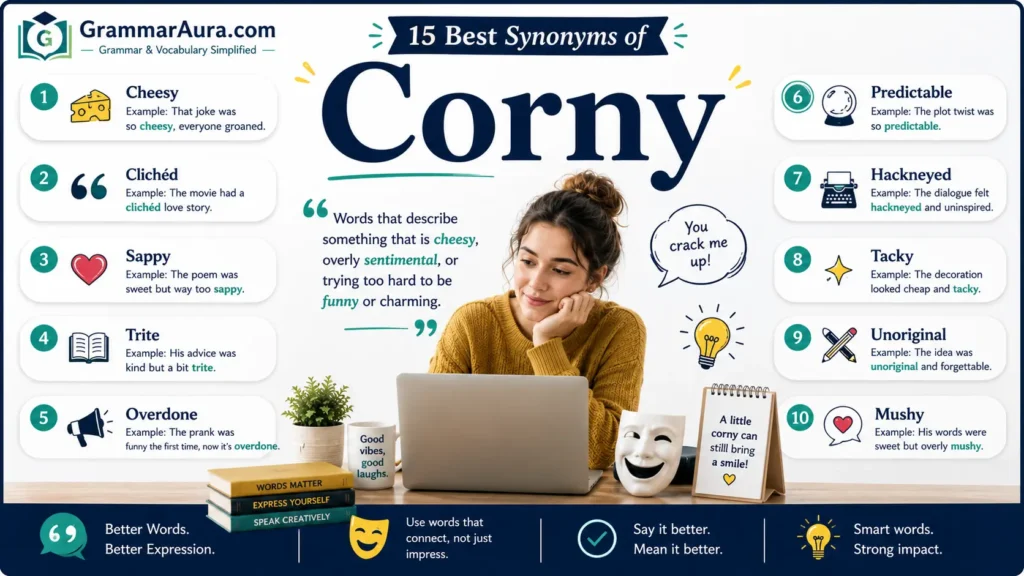

15 Best Synonyms of “Corny” helps you find more accurate and expressive ways to describe something that feels cheesy, overly sentimental, predictable, or clichéd. While “corny” is a common word in everyday conversation, it does not always capture the exact tone you want to convey. Choosing the right alternative helps your writing sound more thoughtful, balanced, and precise while improving clarity and emotional nuance.
From experience, even a simple word like “corny” can influence how a message is perceived. The right synonym allows you to describe overly sentimental or overused expressions with greater accuracy without sounding overly harsh or dismissive. Thoughtful word choices create clearer, more respectful communication and help readers better understand your intended meaning. The following alternatives will help you express different shades of meaning while making your writing more natural, engaging, and effective.
What Does “Corny” Mean?
The word “corny” describes something that feels overly sentimental, predictable, or lacking originality. It is often used when something seems exaggerated in emotion or too traditional in a way that feels slightly awkward or outdated.
At its core, “corny” means something overly sweet, cliché, or emotionally overdone, often in a way that feels unoriginal or forced.
When to Use “Corny”
You can use “corny” when describing:
- Overused jokes or phrases
- Too-sentimental messages or speeches
- Predictable romantic lines
- Emotional expressions that feel forced
It is commonly used in casual speech and informal writing.
Is It Professional or Polite to Say “Corny”?
In professional settings, “corny” is usually considered too informal. It may sound dismissive depending on context. Instead, words like “cliché,” “predictable,” or “overused” are more appropriate and neutral.
In polite conversations, it can be okay, but tone matters—otherwise it may sound judgmental.
Pros and Cons of Using “Corny”
Pros:
- Easy to understand
- Common in everyday speech
- Quickly expresses a lack of originality
Cons:
- Too informal for professional use
- Can sound rude or dismissive
- Lacks precision in emotional tone
- Overused in casual criticism
Corny Synonyms:
- Cheesy
- Cliché
- Saccharine
- Hokey
- Kitschy
- Mawkish
- Trite
- Hackneyed
- Overdone
- Predictable
- Sentimental
- Sappy
- Gimmicky
- Melodramatic
- Overly Sentimental
Cheesy
Meaning:
Something overly sentimental or awkwardly funny.
Explanation:
Used when humor or emotion feels forced or exaggerated.
Example:
“That joke was a bit cheesy, but it made people smile.”
Best Use:
Casual speech, humor
Worst Use:
Formal writing
Tone:
Light, informal
Cliché
Meaning:
An idea or expression that is overused.
Explanation:
Refers to something lacking originality due to repetition.
Example:
“That romantic line feels like a cliché.”
Best Use:
Writing, analysis
Worst Use:
Emotional conversations
Tone:
Neutral, critical
Saccharine
Meaning:
Excessively sweet or sentimental.
Explanation:
Describes emotions or expressions that feel artificially sweet.
Example:
“The movie had a saccharine ending.”
Best Use:
Reviews, criticism
Worst Use:
Casual talk
Tone:
Formal, slightly negative
Hokey
Meaning:
Awkwardly sentimental or obviously fake.
Explanation:
Used when something feels forced or unnatural.
Example:
“The advertisement felt hokey.”
Best Use:
Media critique
Worst Use:
Professional praise
Tone:
Casual, critical
Kitschy
Meaning:
Overly decorative or tacky in a nostalgic way.
Explanation:
Often used for style or design that feels outdated.
Example:
“The decor was fun but a little kitschy.”
Best Use:
Design, art
Worst Use:
Formal evaluation
Tone:
Neutral, stylish critique
Mawkish
Meaning:
Overly emotional in an exaggerated way.
Explanation:
Describes emotional expression that feels forced or excessive.
Example:
“The speech turned mawkish at the end.”
Best Use:
Literature, reviews
Worst Use:
Casual conversation
Tone:
Formal, critical
Trite
Meaning:
Lacking originality due to overuse.
Explanation:
Used when ideas feel dull and repetitive.
Example:
“That excuse sounds trite.”
Best Use:
Writing, critique
Worst Use:
Personal encouragement
Tone:
Neutral, sharp
Hackneyed
Meaning:
Overused to the point of losing meaning.
Explanation:
Strong version of cliché.
Example:
“That phrase is completely hackneyed.”
Best Use:
Academic or formal critique
Worst Use:
Friendly talk
Tone:
Formal, critical
Overdone
Meaning:
Exaggerated or too much in expression.
Explanation:
When something goes beyond natural limits.
Example:
“The drama felt overdone.”
Best Use:
Reviews
Worst Use:
Emotional support
Tone:
Neutral, direct
Predictable
Meaning:
Easy to guess or lacking surprise.
Explanation:
Used when outcomes or expressions are obvious.
Example:
“The ending was predictable.”
Best Use:
Story reviews
Worst Use:
Encouragement
Tone:
Neutral, simple
Sentimental
Meaning:
Emotionally nostalgic or tender.
Explanation:
Focuses on feelings tied to memories.
Example:
“He kept it for sentimental reasons.”
Best Use:
Emotional writing
Worst Use:
Critical reviews
Tone:
Warm, emotional
Sappy
Meaning:
Excessively emotional in a soft or silly way.
Explanation:
Often used when emotions feel exaggerated.
Example:
“That love letter was a bit sappy.”
Best Use:
Casual critique
Worst Use:
Formal writing
Tone:
Light, informal
Gimmicky
Meaning:
Designed to attract attention in a superficial way.
Explanation:
Focuses on tricks rather than substance.
Example:
“The ad felt gimmicky.”
Best Use:
Marketing critique
Worst Use:
Personal feedback
Tone:
Critical, analytical
Melodramatic
Meaning:
Overly emotional or exaggerated.
Explanation:
Used when reactions feel too intense.
Example:
“He was being melodramatic about the situation.”
Best Use:
Behavior description
Worst Use:
Sensitive discussions
Tone:
Strong, critical
Overly Sentimental
Meaning:
Too emotional in an exaggerated way.
Explanation:
Stronger version of sentimental with a critical tone.
Example:
“The film was overly sentimental.”
Best Use:
Reviews
Worst Use:
Personal support
Tone:
Formal, evaluative
Comparison Table of Top Alternatives
| Synonym | Meaning Focus | Tone | Best Use Case |
| Cheesy | Awkward humor/emotion | Light | Casual conversation |
| Cliché | Overused idea | Neutral | Writing critique |
| Saccharine | Overly sweet emotion | Formal | Reviews |
| Hokey | Fake sentiment | Casual | Media critique |
| Kitschy | Tacky style | Neutral | Art/design |
| Mawkish | Excessive emotion | Formal | Literature reviews |
| Trite | Overused expression | Sharp | Academic writing |
| Hackneyed | Very overused | Formal | Critical analysis |
| Sappy | Excess emotion | Informal | Casual feedback |
| Melodramatic | Exaggerated emotion | Strong | Behavior description |
Final Thoughts
Understanding the meaning behind words like “corny” and its many alternatives helps you communicate more thoughtfully in everyday conversations. Instead of relying on a single vague label, using terms like cliché, cheesy, or sentimental allows you to express exactly what feels overdone, emotional, or repetitive in a situation without sounding harsh or dismissive.
Language is powerful because it shapes tone and perception. When you choose more precise synonyms, your message becomes clearer and more respectful. Whether you’re giving feedback, describing a movie, or reacting to a message, these alternatives help you sound more intentional, balanced, and emotionally aware in how you express yourself.
FAQs
What is the simplest synonym of “corny”?
The simplest synonym of “corny” is “cheesy.” It is widely used in casual conversations to describe something overly sentimental or awkwardly funny. It works well when you want to express mild criticism without sounding too harsh or formal in everyday communication.
Is “corny” a negative word?
Yes, “corny” is generally slightly negative, but not strongly offensive. It usually describes something that feels overly sentimental, cliché, or outdated. However, the tone can be playful depending on how it is used in conversation or informal writing.
What is a formal word for “corny”?
A more formal alternative to “corny” is “cliché” or “hackneyed.” These words are commonly used in academic or professional writing to describe ideas or expressions that are overused and lack originality, making them more precise and neutral.
Can “corny” be used positively?
Sometimes yes. In casual speech, “corny” can be used affectionately to describe something sweet or charmingly old-fashioned. For example, a “corny joke” might still make people laugh, even if it is predictable or slightly cheesy.
What is the difference between “corny” and “cheesy”?
Both words are similar, but “cheesy” often refers to humor or emotional expression, while “corny” can describe broader situations like phrases, actions, or ideas. Cheesy feels slightly playful, while corny can feel more outdated or cliché.
Is “cliché” the same as “corny”?
Not exactly. A “cliché” refers to something overused, such as an idea or phrase, while “corny” adds emotional judgment, suggesting something is overly sentimental or awkward. Cliché is more neutral and formal compared to corny.
What does “sappy” mean compared to “corny”?
“Sappy” focuses more on excessive emotional sweetness, often romantically or sentimentally. “Corny” is broader and can include jokes, phrases, or actions that feel outdated or predictable. Sappy is more emotional, while corny is more general.
When should I avoid using “corny”?
You should avoid “corny” in professional or sensitive situations, as it can sound dismissive or judgmental. Instead, use neutral alternatives like “overused,” “cliché,” or “predictable” to maintain a respectful and clear tone in communication.
Is “hackneyed” stronger than “corny”?
Yes, “hackneyed” is much stronger and more formal than “corny.” It is often used in academic or literary critique to describe something that is extremely overused and has lost its original meaning or impact.
How can I replace “corny” in writing?
In writing, replace “corny” with words like “cliché,” “sentimental,” or “overdone.” These alternatives provide more clarity and precision, helping you express opinions without sounding too casual or emotionally vague
