
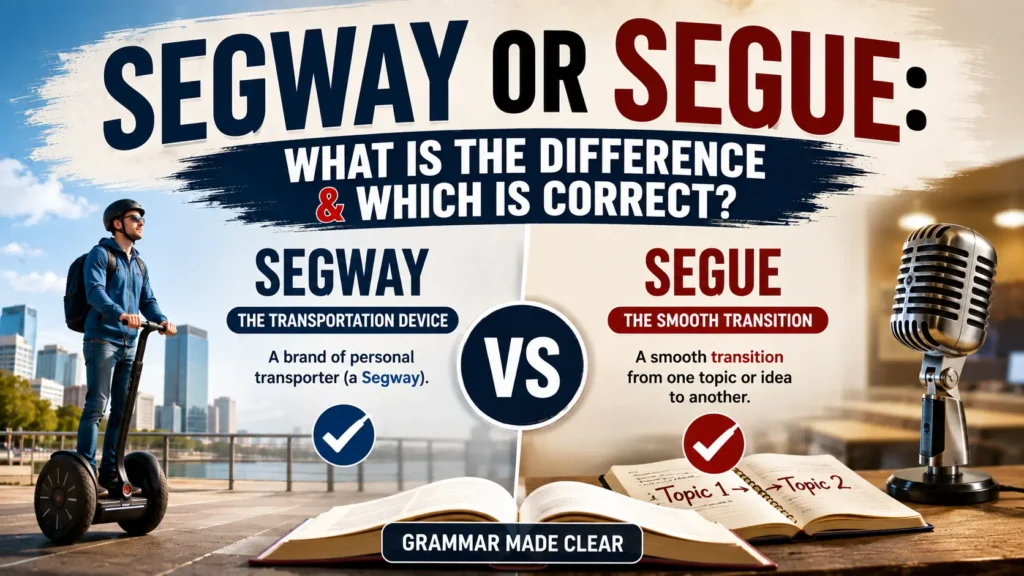

Segway or segue is a classic English mix-up because the two words sound very similar but have completely different meanings. Segway refers to a type of two-wheeled personal transporter, while segue means a smooth transition from one topic, idea, section, or activity to another. Knowing the difference helps you avoid an easy-to-make spelling and vocabulary mistake.
Comparison Overview
Segway and segue are pronounced similarly, which is why people often confuse them in writing. However, they belong to completely different semantic categories.
Segway is a proper noun and brand name commonly used for a self-balancing personal transporter. The word can also appear in lowercase as segway in informal usage when referring generally to such a device.
Segue, on the other hand, is a standard English word. It can function as both a verb and a noun. It describes a smooth transition between subjects, scenes, pieces of music, ideas, or activities.
| Feature | Segway | Segue |
| Basic meaning | A self-balancing personal transporter | A smooth transition |
| Part of speech | Proper noun; sometimes a common noun informally | Noun and verb |
| Pronunciation | Usually /ˈsɛɡweɪ/ | /ˈsɛɡweɪ/ |
| Main context | Transportation | Writing, speaking, music, film, conversation |
| Example | He rode a Segway through the park. | She used a segue to introduce the next topic. |
| Meaning related to transition? | No | Yes |
| Meaning related to transportation? | Yes | No |
The important lesson is simple:
Segway = transportation device.
Segue = smooth transition.
If you’re talking about moving from one idea to another, segue is the correct word.
Definition of Segway
Segway is the name of a brand associated with self-balancing personal transportation devices.
The classic Segway is a two-wheeled, electrically powered vehicle that allows a rider to stand upright while moving. It uses balancing technology and responds to the rider’s movements.
For example:
We took a Segway tour around the city.
The guide arrived on a Segway.
They rented Segways for the sightseeing trip.
Because Segway originated as a brand name, it is traditionally capitalized when referring specifically to the brand.
Segway as a Transportation Device
The word Segway is most commonly associated with personal mobility.
You might encounter it in contexts involving:
- City tours
- Tourism
- Security patrols
- Personal transportation
- Outdoor activities
- Guided sightseeing
- Mobility technology
For example:
The tourists traveled through the historic district on Segways.
Here, Segways refers to the vehicles.
Is Segway a Common Noun?
In everyday language, people sometimes use segway generically to refer to similar self-balancing devices.
However, when referring specifically to the brand, Segway is properly capitalized.
This distinction matters in formal writing:
The tour company provides Segway rentals.
In casual usage, you may encounter:
He bought a segway.
The second version treats the word as a generic noun, but the capitalization and trademark status can depend on the intended reference and style.
Definition of Segue
Segue means a smooth transition from one thing to another.
It can describe a transition between:
- Topics
- Ideas
- Conversations
- Musical sections
- Film scenes
- Television segments
- Speeches
- Written sections
- Activities
For example:
The speaker used a clever segue from education to technology.
As a verb:
The presenter segued from the introduction into the main discussion.
Unlike Segway, segue has nothing to do with transportation.
Segue as a Noun
As a noun, segue refers to the transition itself.
For example:
That was a smooth segue into the next topic.
The interviewer’s question provided a natural segue to the subject of education.
The music created a beautiful segue between the two songs.
Segue as a Verb
As a verb, segue means to move smoothly from one subject, activity, or section to another.
For example:
The presenter segued into the next section.
The conversation segued from travel to food.
The film segues from the present into a flashback.
The past tense is segued, not segwayed.
Main Differences Between Segway and Segue
The difference between Segway and segue is significant despite their similar pronunciation.
Meaning
Segway refers to a transportation device.
Segue refers to a smooth transition.
Compare:
We rented a Segway for the city tour.
versus:
The presenter made a smooth segue into the next topic.
The first sentence involves transportation. The second involves communication.
Part of Speech
Segway functions primarily as a proper noun and, in informal generic use, a noun.
Segue can function as both a noun and a verb.
Examples:
The Segway was easy to ride.
That was a smooth segue.
She segued into another subject.
Context
You normally encounter Segway in transportation or tourism contexts.
You encounter segue in:
- Public speaking
- Writing
- Journalism
- Podcasts
- Interviews
- Music
- Film
- Television
- Everyday conversation
Spelling
The spelling provides an important clue.
Segway contains -way, which can help you associate it with movement or transportation.
Segue contains -gue, a spelling that may look unusual but belongs to the transition-related word.
A useful memory trick is:
Segway = vehicle
Segue = transition
Why Do Segway and Segue Sound the Same?
The confusion becomes much easier to understand when you consider pronunciation.
Both words are generally pronounced approximately:
SEG-way
So when someone says the word aloud, you can’t always tell which spelling they mean.
This creates a common writing problem. Someone may hear:
“I need a smooth segway into the next topic.”
and write segway, even though the intended word is segue.
The pronunciation doesn’t tell you the spelling or meaning.
That’s why context is essential.
If someone is riding a device, think Segway.
If someone is changing subjects, think segue.
Grammar Guide
The two words have different grammatical roles, so their sentence patterns are also different.
How Each Term Is Used in Sentences
Segway is generally used as a noun:
She rode a Segway through the park.
Segue can be used as a noun:
He made a smooth segue into the next topic.
It can also be used as a verb:
He segued into the next topic.
The grammatical difference is important because you cannot simply replace one word with the other.
Segway Sentence Pattern
A common pattern is:
subject + ride/use + Segway
Examples:
We rode a Segway around downtown.
The security officer used a Segway to patrol the area.
They rented a Segway for the tour.
Segue Sentence Patterns
As a noun:
make/use/create + a segue + into/to + topic
She made a natural segue into the next subject.
As a verb:
subject + segue + into/to + topic
The presenter segued into the next section.
Both patterns are useful in professional writing and conversation.
Common Mistakes Learners Make
Mistake: Writing “Segway” for a Topic Transition
Incorrect:
The speaker made a smooth Segway into the next subject.
Correct:
The speaker made a smooth segue into the next subject.
The speaker isn’t riding a vehicle. The sentence describes a transition.
Mistake: Writing “Segue” for the Vehicle
Incorrect:
We rented a segue for the city tour.
Correct:
We rented a Segway for the city tour.
Here, you’re referring to the transportation device.
Mistake: Saying “Segwayed” for a Transition
Some people create segwayed because they associate the spelling with the sound.
For the transition-related verb, the standard past form is:
segued
Example:
The presenter segued into the next topic.
Not:
The presenter segwayed into the next topic.
Mistake: Assuming Similar Sound Means Similar Meaning
English contains many words that sound alike or nearly alike but have unrelated meanings.
Segway and segue are a good example.
Their pronunciation is similar, but their meanings couldn’t be more different.
Simple Rules to Remember
Use this rule:
Segway = something you can ride.
Segue = something you can make between ideas.
Another memory trick:
Segway → way → movement
Segue → transition → conversation
If you’re talking about a physical journey, think Segway.
If you’re talking about a mental, verbal, musical, or narrative journey, think segue.
Quick Tips for Writing and Speaking
Before writing the word, ask yourself:
Am I talking about transportation?
Use Segway.
Am I talking about changing from one idea to another?
Use segue.
Also remember that segue can be both a noun and a verb:
a segue
to segue
This makes it particularly useful in writing, presentations, interviews, and discussions.
Segue Pronunciation and Meaning
The word segue may look as though it should be pronounced differently from the way it is normally spoken.
It is generally pronounced:
SEG-way
This pronunciation is one reason writers confuse it with Segway.
The unusual spelling comes from the word’s history and its relationship to Italian. In English, however, it has developed into a familiar word meaning a smooth transition.
For example:
The host segued from sports into entertainment.
The pronunciation remains similar to “Segway,” but the spelling and meaning are completely different.
When to Use Each One
When to Use Segway
Use Segway when referring to the personal transportation device.
Examples include:
The tourists rode Segways through the old city.
The security guard traveled around the property on a Segway.
We booked a Segway sightseeing tour.
The surrounding words usually make the meaning obvious.
Words such as ride, rent, tour, vehicle, travel, helmet, wheels, and transportation strongly suggest Segway.
When to Use Segue
Use segue when referring to a smooth transition.
Examples:
Let’s segue into the next topic.
That question gives us a natural segue into the discussion.
The host made a smooth segue from politics to economics.
Words such as topic, idea, discussion, section, subject, conversation, speech, and presentation usually point toward segue.
When NOT to Use Each One
When Not to Use Segway
Don’t use Segway when you’re talking about changing subjects.
Incorrect:
The writer used a clever Segway between the two paragraphs.
Correct:
The writer used a clever segue between the two paragraphs.
The sentence is about a transition, not a vehicle.
When Not to Use Segue
Don’t use segue when referring to the transportation device.
Incorrect:
We rode a segue around the city.
Correct:
We rode a Segway around the city.
The word refers to a physical vehicle in this context.
Don’t Use “Segway” as the Verb for Transition
A common informal error is:
Let me Segway into the next point.
For standard English, use:
Let me segue into the next point.
The correct verb is segue.
Which One to Use: Decision Guide
Use this simple decision process.
Choose “Segway” If:
- You’re talking about a vehicle.
- Someone is riding or renting something.
- You’re discussing transportation.
- You’re describing a sightseeing tour.
- You’re talking about personal mobility equipment.
Example:
We rode a Segway through the park.
Choose “Segue” If:
- You’re changing topics.
- You’re moving between ideas.
- You’re connecting sections of a presentation.
- You’re transitioning between scenes.
- You’re describing a musical transition.
- You’re moving smoothly from one subject to another.
Example:
The presenter segued from marketing into sales.
Quick Decision Table
| If You Mean… | Use |
| A personal transportation device | Segway |
| A smooth transition | Segue |
| A vehicle you can ride | Segway |
| A transition between topics | Segue |
| A change in a presentation | Segue |
| A sightseeing vehicle | Segway |
| A transition in music | Segue |
| A transition in writing | Segue |
Real-World Practical Examples
Segway Examples
- Tourism: We rented a Segway to explore the historic district.
- Daily life: My brother learned how to ride a Segway during our vacation.
- Business: The tour company offers guided Segway trips around the city.
- Security: The officer used a Segway to move quickly around the large property.
- Technology: The Segway uses balancing technology to help the rider move.
- Conversation: “Have you ever ridden a Segway?”
- Travel: The visitors joined a Segway tour through the city center.
- Recreation: We spent the afternoon riding Segways along the designated path.
- Education: The instructor explained how to operate the Segway safely.
- Tourism business: The company added Segway tours to its list of visitor activities.
Segue Examples
- Education: The teacher used a smooth segue from grammar to writing.
- Business: The manager segued from the sales report into the marketing plan.
- Public speaking: The speaker created a natural segue into the final section.
- Writing: The author used a clever segue between the two topics.
- Conversation: “That gives us a good segue into our next question.”
- Podcasting: The host segued from the interview into a discussion of current events.
- Television: The program made a smooth segue from the news segment to sports.
- Music: The musician created a seamless segue between two pieces.
- Film: The director used the scene as a segue into the flashback.
- Technology presentation: The presenter segued from software features into security benefits.
Self-Assessment (Fill in the Blanks)
Complete each sentence with Segway, segue, or the appropriate form of segue.
- I will use ______ when referring to a self-balancing transportation device.
- The speaker made a smooth ______ into the next topic.
- We rented a ______ for the sightseeing tour.
- The presenter ______ from the introduction into the main discussion.
- I will use ______ when referring to a transition between ideas.
- The tourists were riding ______ around the historic district.
- The teacher created a natural ______ from grammar to writing.
- Let me ______ into our next point.
- The security officer traveled around the property on a ______.
- The host ______ from the interview into a discussion of technology.
- A musical ______ connected the two pieces.
- We booked a ______ tour during our vacation.
- The writer needed a smooth ______ between the two sections.
- The guide explained how to operate the ______ safely.
- The presenter used the question as a ______ into the next subject.
- The film ______ from the present-day scene into a flashback.
- If I’m talking about transportation, I will choose ______.
- If I’m talking about a smooth change in topic, I will choose ______.
- The tour company rents ______ to visitors.
- The manager ______ from the financial report into the marketing discussion.
Answers
- Segway — It refers to the self-balancing personal transportation device.
- segue — A segue is a smooth transition from one topic or idea to another.
- Segway — The sentence describes a vehicle used for sightseeing.
- segued — This is the past-tense form of the verb segue.
- segue — A transition between ideas is a segue.
- Segways — The sentence refers to multiple transportation devices.
- segue — The teacher is connecting two subjects smoothly.
- segue — Here, segue is being used as a verb meaning to transition.
- Segway — The security officer is using a transportation device.
- segued — The host moved smoothly from one subject to another.
- segue — In music, a segue connects one piece or section to another.
- Segway — A Segway can be used for guided sightseeing tours.
- segue — The writer needs a transition between sections.
- Segway — The sentence refers to operating a physical transportation device.
- segue — The question creates a transition to another subject.
- segued — The film transitions smoothly from one scene to another.
- Segway — Transportation is the key context.
- segue — A change in topic or idea is a segue.
- Segways — The sentence refers to multiple transportation devices.
- segued — The manager transitioned from one business topic to another.
Final Verdict
The difference between Segway or segue is easy to remember once you connect each word with its meaning.
Segway refers to a self-balancing personal transportation device, while segue means a smooth transition from one subject, idea, activity, scene, or section to another. The two words sound almost identical, which explains why they frequently get confused in writing.
Use:
Segway = vehicle
and:
Segue = transition
You can also remember that segue works as both a noun and a verb:
a smooth segue
to segue into another topic
If you’re writing a presentation, essay, article, speech, podcast script, or business document and want to describe a transition, segue is the word you need. If you’re describing a vehicle or sightseeing experience, choose Segway. Once you associate Segway with transportation and segue with transition, this commonly confused pair becomes much easier to use correctly.
Conclusion
Understanding Segway or Segue becomes much easier once you remember that these words have completely different meanings. Segway is a brand name commonly associated with a two-wheeled personal transporter, while segue is a word meaning a smooth transition from one topic, idea, scene, or activity to another. Although they sound similar, they aren’t interchangeable in standard English.
If you’re writing an article, email, essay, presentation, or social media post, choosing segue is usually correct when you’re talking about moving naturally from one idea to another. On the other hand, Segway should be used when referring to the transportation brand or its products. Keeping this simple distinction in mind can help you avoid a common spelling and usage mistake. Once you learn the difference, choosing between Segway and segue becomes quick, clear, and effortless.
FAQs
What is the difference between Segway and segue?
Segway and segue have different meanings despite their similar pronunciation. Segway is a brand associated with personal transportation devices, while segue is a verb or noun describing a smooth transition from one subject, idea, scene, or activity to another. In everyday writing about transitions, segue is almost always the word you need.
Is segue pronounced like Segway?
Yes, segue and Segway are generally pronounced the same way in English. Both sound like “SEG-way.” However, their meanings and spellings are different. This similar pronunciation is one reason people sometimes confuse them in writing. Remember that segue refers to a transition, while Segway refers to the transportation brand.
What does segue mean?
Segue means to move smoothly from one topic, subject, situation, or activity to another without a sudden break. For example, you might say, “The speaker segued from the company’s history to its future plans.” As a noun, a segue can also describe the smooth transition itself.
What does Segway mean?
Segway is a proper brand name associated with self-balancing personal transportation devices. The word is therefore different from segue, which is a regular English word meaning a smooth transition. Because the two terms sound alike, writers sometimes mistakenly use Segway when they actually mean segue.
Is “segue” a noun or a verb?
Segue can function as both a noun and a verb. As a verb, it means to transition smoothly from one thing to another. As a noun, it refers to that transition. For example, “She segued into another topic” uses it as a verb, while “That was a smooth segue” uses it as a noun.
Can I use Segway to mean a transition?
No. In standard English, Segway should not be used to mean a transition. The correct word is segue. Although autocorrect, speech recognition, or informal online writing may sometimes create confusion, using “Segway” for a change in topic is considered a spelling error.
How do you use segue in a sentence?
You can use segue when describing a smooth change from one subject to another. For example, “The teacher used a question about history to segue into a discussion of modern politics.” You can also say, “That was a natural segue into the next topic,” when using the word as a noun.
Why are Segway and segue commonly confused?
Segway and segue are commonly confused because they sound virtually identical when spoken aloud. Their spellings and meanings, however, are different. People who encounter the words mainly through conversation may not immediately know which spelling is correct. Remembering that segue means a transition is the easiest way to avoid the mistake.
Which spelling is correct for a change of topic: Segway or segue?
Segue is the correct spelling when you mean a change or transition between topics. For example, “Let’s segue into the next part of the presentation” is correct. Segway refers to the brand name and should not be used as a substitute for segue when describing a conversational or written transition.
Is segue formal English?
Yes, segue is a standard English word and is appropriate in professional, academic, creative, and everyday writing. It can be especially useful when describing smooth transitions between ideas, sections, or subjects. While it may sound slightly polished in some contexts, it isn’t incorrect or overly formal for normal English communication.
