
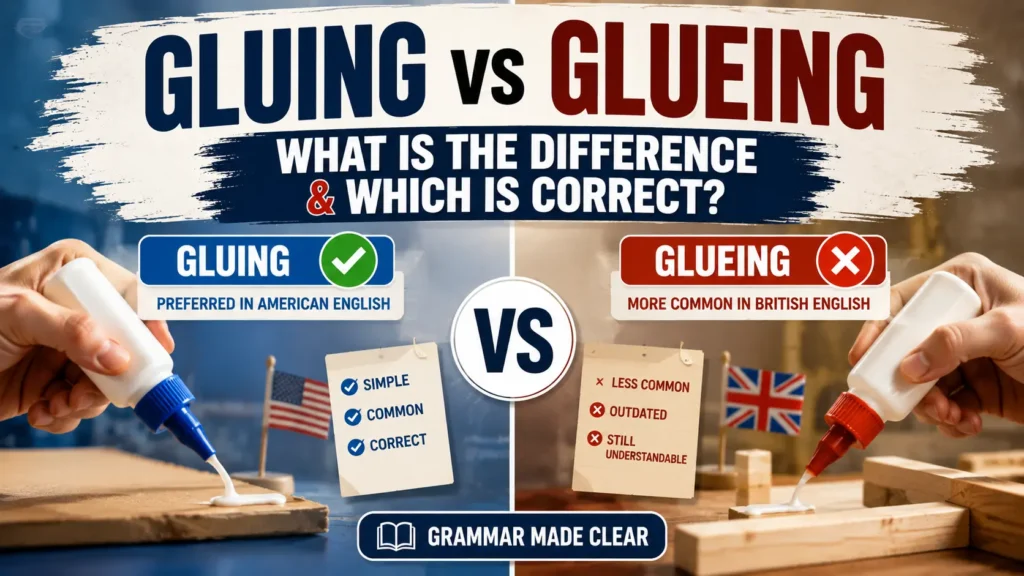

Gluing vs glueing is a spelling question that often confuses English learners because both forms appear in dictionaries and real-world writing. Both refer to the act of joining something with glue, but gluing is generally the preferred spelling in American English, while glueing is also recognized, particularly in British English. Understanding the difference helps you write naturally and consistently.
Comparison Overview
Gluing and glueing are both forms of the verb glue. They describe the action of applying glue to something or joining things together with glue.
The important point is that this is primarily a spelling variation, not a difference in meaning.
Cambridge Dictionary lists both glueing and gluing as present participles of glue.
| Word | Meaning | Grammatical Form | Common Usage |
| Gluing | Joining with glue | Present participle/gerund | Very common, especially in American English |
| Glueing | Joining with glue | Present participle/gerund | Used in British English and other varieties |
| Glue | To join with adhesive | Base verb | Standard everywhere |
For example:
I am gluing the pieces together.
You can also encounter:
I am glueing the pieces together.
The meaning remains the same.
However, if you’re choosing one spelling for general-purpose writing, gluing is usually the safest and most widely recognized choice.
Why Are There Two Spellings?
The variation comes from how English handles words ending in silent -e when adding -ing.
Normally, English drops a final silent e before -ing:
- make → making
- write → writing
- bake → baking
- use → using
Following that familiar pattern gives:
glue → gluing
But glue has a special spelling and pronunciation that has led to the alternative:
glue → glueing
Cambridge recognizes both forms.
Definition of Gluing
Gluing is the present participle and gerund form of glue.
It means joining, attaching, or securing something with glue.
Examples include:
She is gluing the paper together.
We spent the afternoon gluing the model pieces.
He is gluing the broken handle back onto the cup.
The word can function as part of a continuous verb phrase or as a gerund.
Gluing as a Present Participle
As a present participle, gluing appears in continuous verb constructions:
I am gluing the pieces together.
She was gluing photographs into her scrapbook.
They are gluing the cardboard panels.
Here, gluing helps describe an action that is happening at a particular time.
Gluing as a Gerund
A gerund is an -ing form that functions as a noun.
For example:
Gluing can be a useful craft technique.
Gluing small pieces requires patience.
I enjoy gluing paper models.
In these sentences, gluing names an activity rather than simply describing an ongoing action.
Definition of Glueing
Glueing is also a present participle or gerund form of glue.
It has the same basic meaning as gluing: using glue to join or attach things.
For example:
She is glueing the pieces together.
They spent the afternoon glueing decorations onto the poster.
Glueing the parts together requires careful alignment.
Cambridge Dictionary recognizes glueing as a present participle of glue.
Therefore, calling glueing an outright spelling error would be too strong. It is an established spelling variant.
However, gluing is also widely recognized and is often the preferred form, particularly in American English.
Main Differences Between Gluing and Glueing
The biggest difference between gluing and glueing is spelling preference, not meaning.
| Feature | Gluing | Glueing |
| Meaning | Applying glue or joining with glue | Applying glue or joining with glue |
| Base verb | Glue | Glue |
| Form | Present participle/gerund | Present participle/gerund |
| Meaning difference | None | None |
| American English | Common/preferred | Less common |
| British English | Common | Also recognized and used |
| Formal writing | Safe choice | Acceptable depending on style |
| Example | She is gluing the paper. | She is glueing the paper. |
Meaning
There is no meaningful difference in definition.
Both forms describe the same activity.
He is gluing the pieces together.
and:
He is glueing the pieces together.
Both mean that he is using glue to join the pieces.
Spelling
The only visible difference is the extra e in glueing.
Gluing:
g-l-u-i-n-g
Glueing:
g-l-u-e-i-n-g
That extra e is what causes the spelling debate.
Regional Preference
The distinction is often discussed in relation to American and British spelling preferences.
Gluing is especially common in American English.
Glueing is recognized in British English and appears in British dictionaries and writing.
Cambridge lists both forms for the verb glue, indicating that both are established present-participle spellings.
Style Consistency
If your audience is international, gluing is often the easiest choice because it is concise and widely familiar.
If you’re following a British publication’s house style and that style prefers glueing, you can use glueing consistently.
The important thing is to avoid switching between the two forms randomly within the same document.
Is Gluing or Glueing More Common?
Gluing is generally the more familiar spelling for many English speakers, particularly in American English.
The spelling follows the common pattern of dropping a final silent e before -ing.
However, glueing isn’t simply a random misspelling. Major dictionary sources recognize it as a legitimate form. Cambridge, for example, explicitly gives glueing or gluing as the present participle of glue.
Therefore, the best answer isn’t:
“One is always wrong.”
A more accurate answer is:
Both are recognized, but gluing is generally the more broadly preferred spelling.
Gluing vs Glueing in American English
In American English, gluing is usually the better choice.
For example:
The children are gluing paper onto the poster.
I am gluing the broken pieces together.
She enjoys gluing pictures into her scrapbook.
This spelling looks natural to most American readers.
If you’re writing:
- American school assignments
- Business documents
- Websites
- Product instructions
- General online content
- Technical documentation
gluing is usually the safest option.
Gluing vs Glueing in British English
British English can use glueing as well as gluing.
Cambridge’s British English dictionary gives both glueing and gluing as present participles.
For example:
She is glueing the pieces together.
is an accepted British spelling.
You may also see:
She is gluing the pieces together.
So British English doesn’t require writers to use glueing exclusively.
The key difference is that glueing has a stronger place in some British usage traditions, while gluing is highly familiar internationally.
Grammar Guide
Both gluing and glueing come from the verb glue and function grammatically in the same way.
The basic forms are:
| Form | Example |
| Base form | glue |
| Simple past | glued |
| Past participle | glued |
| Present participle | gluing / glueing |
| Gerund | gluing / glueing |
The spelling difference appears specifically in the -ing form.
How Each Term Is Used in Sentences
Both forms can be used after forms of be to create continuous tenses.
With gluing:
I am gluing the pieces together.
With glueing:
I am glueing the pieces together.
Both are grammatically equivalent.
They can also function as gerunds:
Gluing requires patience.
Glueing requires patience.
Again, the meaning remains the same.
Present Continuous
The present continuous uses:
am/is/are + gluing/glueing
Examples:
She is gluing the photographs.
They are gluing the cardboard.
I am glueing the decorations.
Past Continuous
The past continuous uses:
was/were + gluing/glueing
Examples:
She was gluing the pieces when I arrived.
They were glueing the labels onto the boxes.
Gerund Usage
Both spellings can act as nouns:
Gluing is part of the construction process.
Glueing is part of the construction process.
The spelling doesn’t change the grammatical role.
Common Mistakes Learners Make
Mistake: Assuming “Glueing” Is Always Wrong
This is one of the biggest misconceptions.
Because gluing is more familiar to many writers, they may assume glueing is simply misspelled.
That isn’t accurate.
Dictionary sources recognize glueing as a legitimate form.
Mistake: Assuming “Gluing” Is Incorrect Because “Glue” Ends in E
Some learners think the extra e must remain:
glue + ing = glueing
Others apply the usual silent-e rule:
glue + ing = gluing
Both forms are encountered in standard dictionary usage.
Mistake: Mixing Spellings in One Document
You might write:
The children are gluing the paper.
and later:
The students are glueing the cardboard.
This isn’t a serious grammar error, but inconsistent spelling can make your writing look less polished.
Pick one style and stick with it.
Mistake: Confusing “Gluing” With “Glued”
Remember that gluing describes an -ing activity, while glued is the past and past participle form.
Compare:
She is gluing the pieces.
She glued the pieces yesterday.
She has glued the pieces together.
These forms have different grammatical functions.
Simple Rules to Remember
Use this basic pattern:
Glue → glued → gluing/glueing
Remember:
- gluing = accepted spelling
- glueing = accepted spelling
- Both mean the same thing
- glued = simple past and past participle
For general writing, especially American English, gluing is usually the easiest choice.
Quick Tips for Writing and Speaking
When you’re writing for an international audience, gluing is a practical choice.
When following British English conventions, glueing may also be appropriate.
If your employer, school, publisher, or style guide specifies one spelling, follow that preference.
Most importantly, don’t treat the two forms as different actions. They describe the same activity.
Why Does Glue Become Gluing?
The spelling of gluing can look unusual because the base word glue ends with e.
Many English verbs drop a final silent e before -ing:
- write → writing
- bake → baking
- take → taking
- make → making
That pattern naturally gives:
glue → gluing
However, the word glue has a distinctive ending, and glueing has remained an established alternative spelling.
That’s why both forms can be found in dictionaries and real-world English.
Is Glueing a Misspelling?
No, not necessarily.
If you write glueing, you’re using a recognized variant of the present participle of glue.
Cambridge explicitly lists glueing and gluing as present-participle forms.
That said, gluing may be the better choice when you want the most widely familiar spelling, particularly for American or international audiences.
So:
Gluing = correct.
Glueing = also recognized.
The difference is mainly one of spelling preference and style.
When to Use Each One
When to Use “Gluing”
Use gluing when you want a concise, widely recognized spelling.
It’s especially useful in:
- American English
- International content
- School writing
- General websites
- Instructions
- Crafts and DIY articles
- Product descriptions
- Technical writing
Examples:
We are gluing the wooden pieces together.
She enjoys gluing paper crafts.
The machine is gluing the labels onto the containers.
When to Use “Glueing”
Use glueing when it matches the spelling conventions or house style of your audience.
It can be appropriate in:
- British English
- British-oriented publications
- Regional writing
- Publications that specifically prefer the form
- Contexts where consistency with existing text matters
Examples:
The children are glueing the pieces together.
He is glueing the edges of the model.
Glueing the components requires careful positioning.
Because dictionaries recognize this form, it isn’t automatically an error.
When NOT to Use Each One
When Not to Use “Gluing”
There is no general grammatical situation where gluing becomes incorrect simply because of the sentence context.
If you need the present participle or gerund, gluing can perform the job.
However, don’t use gluing when you actually need the simple past or past participle:
She glued the pieces yesterday.
Not:
She gluing the pieces yesterday.
When Not to Use “Glueing”
Likewise, glueing isn’t grammatically wrong simply because it contains the extra e.
However, if you’re following a style guide that requires gluing, use the preferred form.
For example, if your publication consistently uses American spelling, switching to glueing can create unnecessary inconsistency.
Don’t Use Either Form as a Noun for the Adhesive
This is another useful distinction.
Glue can be a noun:
I need some glue.
But gluing and glueing describe the activity:
Gluing the pieces took an hour.
You wouldn’t normally say:
I need some gluing.
The substance is glue; the activity is gluing/glueing.
Which One to Use: Decision Guide
If you’re unsure, use this quick guide.
Choose “Gluing” If:
- You’re writing American English.
- You’re writing for an international audience.
- You want the more concise spelling.
- Your style guide prefers it.
- You want to avoid distracting readers with an alternative spelling.
Example:
The technician is gluing the components together.
Choose “Glueing” If:
- You’re following a British spelling preference.
- Your publication uses glueing consistently.
- Your style guide specifically recommends it.
- You’re maintaining consistency with surrounding British English text.
Example:
The technician is glueing the components together.
Quick Decision Table
| Situation | Recommended Choice |
| American English | gluing |
| General international writing | gluing |
| British English | gluing or glueing |
| Style guide says “glueing” | glueing |
| Style guide says “gluing” | gluing |
| Casual writing | Either recognized form |
| Formal writing | Follow your chosen style consistently |
Real-World Practical Examples
Gluing Examples
- Education: The students are gluing colored paper onto their science posters.
- Daily life: I spent the afternoon gluing the broken picture frame.
- Crafts: She is gluing small decorations onto the card.
- Business: The factory is gluing labels onto product packages.
- Technology: The technician is gluing the protective strip to the device.
- Manufacturing: Workers are gluing the panels before assembly.
- Writing: The author describes gluing photographs into a scrapbook.
- Conversation: “I’m gluing the pieces together now.”
- Science: The researchers are gluing sample components together for testing.
- DIY: We are gluing the wooden joints before painting them.
Glueing Examples
- Education: The children are glueing pictures onto their classroom display.
- Daily life: She spent the morning glueing a torn craft project back together.
- Crafts: He enjoys glueing paper shapes onto handmade cards.
- Business: The workers are glueing labels onto the boxes.
- Technology: The technician is glueing a small component into place.
- Manufacturing: The team is glueing the panels before final assembly.
- Writing: The instructions explain how to prepare the surface before glueing.
- Conversation: “I’m glueing these pieces together.”
- Science: The team is glueing the test components into position.
- DIY: We spent the afternoon glueing the wooden pieces together.
Notice that the sentences don’t have different meanings. The spelling changes, but the underlying action remains the same.
Gluing vs Glueing in Education
Teachers and students may encounter both spellings in craft instructions, worksheets, textbooks, and online resources.
For example:
The students are gluing colored paper onto their posters.
or:
The students are glueing colored paper onto their posters.
Both communicate the same action.
If a school follows American English conventions, gluing will usually be the more natural choice.
If the school follows British English conventions, either form may be encountered, depending on the preferred style.
Gluing vs Glueing in Business
Business writing benefits from consistency.
Suppose a company is creating packaging instructions:
Begin gluing the side panel after applying the adhesive.
That is clear and natural.
A British-oriented company might use:
Begin glueing the side panel after applying the adhesive.
Neither sentence changes the actual process.
The important thing is to select one spelling and use it consistently throughout the document.
Gluing vs Glueing in Technical Writing
Technical writing often needs precise, consistent terminology.
For example:
The operator begins gluing the components after cleaning the surface.
The word gluing identifies the process.
You might also see:
The operator begins glueing the components after cleaning the surface.
Again, the meaning is unchanged.
If the technical manual follows a specific national or organizational style guide, follow that guide.
Gluing vs Glueing in Instructions
Instructions commonly use the -ing form to describe steps.
Examples:
Begin gluing the edges together.
Continue gluing until all sections are attached.
Avoid gluing the surface before cleaning it.
The same sentences can use glueing:
Begin glueing the edges together.
Continue glueing until all sections are attached.
The difference remains spelling preference rather than meaning.
Gluing vs Glueing in Search and Online Writing
If you’re writing online, gluing is generally the more practical spelling because it is familiar to a broad audience.
However, glueing may be important when addressing a search query that specifically uses that spelling.
A useful approach is to naturally acknowledge both forms:
Gluing and glueing are both recognized spellings of the present participle of “glue.” Gluing is often preferred for general usage, while glueing is also used, particularly in British English.
This allows readers to understand the relationship without incorrectly labeling one form as universally wrong.
Self-Assessment (Fill in the Blanks)
Complete each sentence with gluing, glueing, glue, or glued, according to the context.
- I will use ______ when referring to the activity of joining two pieces with adhesive.
- The children are ______ paper onto their classroom poster.
- Yesterday, Sarah ______ the broken handle back onto the cup.
- We need some ______ to repair the cardboard model.
- He is ______ the wooden pieces together right now.
- The British-style instructions use the spelling ______.
- The technician finished ______ the protective strip onto the device.
- She ______ the photographs into her scrapbook last night.
- I will use ______ when referring to the adhesive itself.
- The workers are ______ labels onto the boxes.
- ______ small pieces together requires patience.
- The craftsman ______ the broken parts yesterday.
- The students were ______ decorations onto their project.
- The instructions tell users to begin ______ after cleaning the surface.
- We bought strong ______ for the model-building project.
- The factory is ______ the panels before assembly.
- He has already ______ the pieces together.
- I enjoy ______ paper crafts with my children.
- She spent an hour ______ the torn pages together.
- I will use ______ rather than ______ when writing for a general international audience because it is a widely familiar spelling.
Answers
- gluing/glueing — Both are recognized forms for the activity of joining things with glue.
- gluing/glueing — The present continuous requires the -ing form.
- glued — Glued is the simple past form of glue.
- glue — Glue is the noun referring to the adhesive substance.
- gluing/glueing — The phrase “is” requires the present participle for the continuous construction.
- glueing — This is a recognized spelling variant that appears in British English usage.
- gluing/glueing — After “finished,” the activity can be expressed with the gerund form.
- glued — The phrase “last night” indicates a completed past action.
- glue — Here, the word refers to the sticky substance rather than the activity.
- gluing/glueing — “Are” plus the -ing form creates the present continuous.
- Gluing/Glueing — Both forms can function as gerunds, meaning the activity itself.
- glued — The word “yesterday” indicates the simple past.
- gluing/glueing — “Were” requires the present participle in the past continuous.
- gluing/glueing — “Begin” can be followed by a gerund describing the activity.
- glue — The sentence refers to the adhesive material.
- gluing/glueing — “Is” plus the -ing form describes an ongoing process.
- glued — The present perfect uses the past participle glued.
- gluing/glueing — “Enjoy” is followed by a gerund.
- gluing/glueing — “Spent an hour” can be followed by the -ing form describing the activity.
- gluing; glueing — Gluing is a widely familiar spelling, while glueing is also recognized.
Final Verdict
When comparing gluing vs glueing, the good news is that you don’t have to worry about a difference in meaning. Both spellings refer to the act of using glue to join or attach things. The main distinction is spelling preference.
Gluing is generally the safest and most widely familiar choice, especially in American English and international writing. Glueing is also a recognized spelling and is particularly encountered in British English. Cambridge Dictionary lists both forms as present participles of glue.
The basic forms are:
glue → glued → gluing/glueing
If you’re unsure which spelling to choose, gluing is an excellent default. However, if you’re following a British style guide or an established house style that uses glueing, there’s no need to change it.
The most important rule is simple: choose one spelling, understand your audience, and use it consistently.
Conclusion
Understanding gluing vs glueing is easier once you know that both words describe the same action: using glue to join, attach, or secure something. The main difference is spelling preference, not meaning or function. Gluing is the more widely familiar form and is often preferred in American English and general international writing. Glueing is also a recognized spelling and is commonly associated with British English usage. Neither form changes the basic meaning of the sentence. If you’re writing for a broad audience and aren’t following a specific style guide, gluing is a practical choice because most readers will recognize it immediately. However, if your publication or audience prefers glueing, you can confidently use that spelling. The most important thing is consistency. Remember the basic pattern: glue → glued → gluing/glueing. Once you understand this distinction, choosing between these two spellings becomes simple and stress-free.
FAQs
Is gluing or glueing correct?
Both gluing and glueing are recognized spellings of the present participle and gerund form of glue. They have the same meaning and grammatical function. Gluing is generally the more familiar spelling, particularly in American English and international writing, while glueing is also established and frequently encountered in British English. Your preferred style can determine the choice.
What is the difference between gluing and glueing?
There is no significant difference in meaning between gluing and glueing. Both describe the act of using glue to join or attach things. The difference is simply spelling. Gluing is often preferred for general and American English usage, while glueing remains a recognized variant, especially in British English. Both can function as a present participle or gerund.
Is glueing a misspelling?
No, glueing is not necessarily a misspelling. It is a recognized variant spelling of the present participle of glue. Although many readers are more familiar with gluing, dictionaries recognize glueing as well. Therefore, you shouldn’t automatically mark glueing as wrong. Instead, consider your audience, regional English, and the style guide you’re following.
Is gluing more correct than glueing?
Gluing isn’t inherently more correct than glueing. Both forms are recognized. However, gluing is often the safer choice when writing for an American or international audience because it is highly familiar. If you’re following British English conventions or a specific publication style that uses glueing, that spelling is also acceptable.
Which spelling is preferred in American English?
Gluing is generally the preferred and more familiar spelling in American English. For example, “The children are gluing paper onto the poster” sounds natural to American readers. While glueing can be understood and is recognized as a variant, gluing is usually the better choice for American schoolwork, websites, business writing, and general communication.
Which spelling is preferred in British English?
Both gluing and glueing can be found in British English. Glueing has a recognized place in British usage, while gluing is also widely understood and used. If you’re writing specifically for a British audience, either may work depending on the publication or house style. The best approach is to follow the spelling used consistently throughout your document.
Does gluing mean the same thing as glueing?
Yes. Gluing and glueing have the same basic meaning. Both describe the process of applying glue to join, attach, or secure materials. For example, “She is gluing the pieces together” and “She is glueing the pieces together” communicate the same idea. The difference is spelling preference rather than meaning, grammar, or the action being described.
What is the correct form of glue in the present participle?
The present participle of glue can be written as gluing or glueing. Both forms are recognized. The spelling gluing follows the common pattern of removing a final silent e before adding -ing, while glueing retains the e. In general writing, gluing is often the simpler and more familiar choice.
Should I use gluing or glueing in formal writing?
Both forms can be used in formal writing, but gluing is usually a practical default because it is widely familiar. If your organization, publisher, school, or style guide prefers glueing, use that form consistently. The key is not to switch randomly between spellings. A consistent spelling choice makes professional writing look cleaner and more carefully edited.
How can I remember gluing vs glueing?
A simple way to remember the difference is to focus on the spelling rather than the meaning. Gluing drops the final e, while glueing keeps it. Both refer to the same activity. If you’re unsure and don’t have a specific style requirement, choose gluing because it is concise, familiar, and widely used in modern English.
