
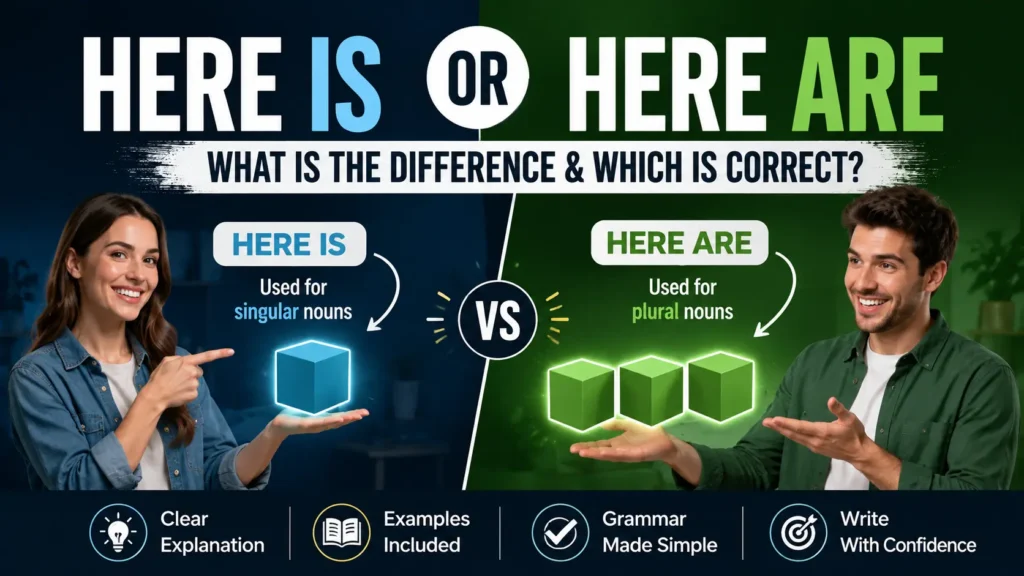

Here is and here are are both common English expressions used to introduce or point out something, but the choice depends on whether the noun that follows is singular or plural. Understanding this small grammar rule can make your writing sound clearer and more natural. Let’s explore when to use each expression with simple rules and practical examples.
Comparison Overview
Here is and here are have nearly the same basic purpose: they introduce, present, point out, or draw attention to something. The main difference is subject-verb agreement.
- Here is → generally used with a singular noun or an uncountable noun.
- Here are → generally used with a plural noun.
Compare these sentences:
Here is the document you requested.
Here are the documents you requested.
The expression here does not determine whether you use is or are. Instead, the verb agrees with the noun being introduced.
| Expression | Typical Use | Example |
| Here is | Singular noun | Here is the answer. |
| Here is | Uncountable noun | Here is some information. |
| Here are | Plural noun | Here are the answers. |
| Here are | Multiple people or things | Here are your friends. |
This distinction becomes especially important in formal writing, emails, instructions, presentations, and academic work.
Definition of Here Is
Here is is an introductory expression used when the thing being presented is singular or, in many contexts, uncountable.
For example:
Here is your book.
Here is the information you requested.
Here is an example.
In each sentence, the noun or noun phrase following the expression is treated as singular or uncountable.
What Does “Here Is” Mean?
Depending on context, here is can mean:
- This is here.
- This is what I am presenting.
- This is the thing you requested.
- I am showing or giving you this now.
- This is an example or explanation.
For example:
Here is the report you asked for.
This means the speaker is presenting or handing over the report.
Another example:
Here is why the plan failed.
Here, the expression introduces an explanation rather than a physical object.
Common Patterns With “Here Is”
A common structure is:
Here is + singular noun
Here is the key.
Another is:
Here is + uncountable noun
Here is some advice.
You can also use:
Here is + noun phrase
Here is the information about the project.
Here is + explanation
Here is what we need to do.
These patterns are extremely common in everyday English.
Definition of Here Are
Here are is used to introduce or present plural nouns.
For example:
Here are your keys.
Here are the documents.
Here are three reasons to reconsider the plan.
Because keys, documents, and reasons are plural, the verb are agrees with them.
What Does “Here Are” Mean?
Like here is, here are can introduce something being presented or pointed out.
For example:
Here are the books you ordered.
The speaker is presenting multiple books.
It can also introduce a list:
Here are three things you should remember.
The expression can therefore be useful when organizing information in both conversation and writing.
Common Patterns With “Here Are”
The basic structure is:
Here are + plural noun
Here are the results.
You can also use:
Here are + number + plural noun
Here are five useful examples.
Or:
Here are + plural noun phrase
Here are the main reasons for the change.
The key is that the noun being introduced is plural.
Main Differences Between Here Is and Here Are
The main difference between here is and here are is singular versus plural agreement.
| Feature | Here Is | Here Are |
| Main purpose | Introduces or presents something | Introduces or presents multiple things |
| Usually followed by | Singular or uncountable noun | Plural noun |
| Verb | is | are |
| Example | Here is the letter. | Here are the letters. |
| Example with list | Here is one reason. | Here are several reasons. |
Singular vs. Plural
The easiest rule is:
One thing → here is
More than one → here are
Examples:
Here is my phone.
Here are my phones.
Here is the answer.
Here are the answers.
Uncountable Nouns
Uncountable nouns generally take here is, not here are.
Correct:
Here is some information.
Correct:
Here is the advice you requested.
Correct:
Here is the equipment we need.
Incorrect in standard English:
Here are some information.
Here are the advice you requested.
Although the information or advice may contain multiple details, the nouns themselves are grammatically uncountable.
Why “Here” Does Not Control the Verb
A common misunderstanding is that here somehow determines whether the sentence needs is or are. It doesn’t.
The expression is an example of an existential or presentational construction, where here introduces or presents something.
Consider:
Here is the book.
Here are the books.
The word here stays exactly the same. The verb changes because book is singular and books is plural.
This is why you should look at the noun being presented rather than the word here.
Here Is or Here Are With Lists
Lists can create some confusion.
If you introduce a list of multiple items, here are is generally the natural choice:
Here are the supplies you need: paper, pens, folders, and notebooks.
However, if the grammatical subject is a singular noun that summarizes the list, here is can be appropriate:
Here is the list of supplies you need: paper, pens, folders, and notebooks.
The difference comes from the noun immediately being presented:
- the supplies → plural → here are
- the list → singular → here is
This distinction is very useful in professional and academic writing.
Here Is or Here Are With Multiple Items
When you’re directly introducing several separate things, use here are.
Here are your shoes.
Here are the files.
Here are the ingredients.
But if those things are treated as one unit or are introduced through a singular noun, use here is.
Here is your luggage.
Luggage is an uncountable noun, even though it may refer to several bags.
Here Is or Here Are With “What”
The word what can make the grammar slightly more interesting.
Consider:
Here is what I found.
This is correct because what I found functions as a singular noun phrase in this construction.
Similarly:
Here is what we need.
Here is what happened.
Here is what I suggest.
In these expressions, here is is normally the natural choice.
Here Is or Here Are With “The Reason” and “The Reasons”
The noun following the expression determines the verb.
Singular:
Here is the reason.
Plural:
Here are the reasons.
Compare:
Here is the main reason for the change.
Here are the main reasons for the change.
This is a useful example because writers sometimes focus on the words after the noun and accidentally choose the wrong verb.
Grammar Guide
Here is and here are are not nouns or main verbs by themselves. They are presentational expressions built around a form of the verb be.
The choice between is and are depends primarily on the number of the noun or noun phrase being introduced.
How Each Term Is Used in Sentences
Here Is
Use here is with a singular noun:
Here is the answer.
Here is your ticket.
Here is my brother.
Use it with an uncountable noun:
Here is some water.
Here is the information.
Use it to introduce a singular idea or clause:
Here is what I mean.
Here Are
Use here are with plural nouns:
Here are the answers.
Here are your tickets.
Here are my brothers.
Use it to introduce several items:
Here are three examples.
Here are the main points.
Common Mistakes Learners Make
Mistake: Using “Here Are” With a Singular Noun
Incorrect:
Here are the book.
Correct:
Here is the book.
The noun book is singular, so it needs is.
Mistake: Using “Here Is” With a Plural Noun
Incorrect:
Here is the books.
Correct:
Here are the books.
The noun books is plural, so are is required in standard English.
Mistake: Looking at the Nearest Noun Instead of the Main Subject
Consider:
Here is the list of important documents.
The noun documents is plural, but the main noun is list, which is singular.
Therefore:
Here is the list of important documents.
Not:
Here are the list of important documents.
Mistake: Treating Uncountable Nouns as Plural
Incorrect:
Here are some information.
Correct:
Here is some information.
Information is uncountable in standard English.
Simple Rules to Remember
Use these easy rules:
- One thing → here is
- More than one thing → here are
- Singular noun → is
- Plural noun → are
- Uncountable noun → usually is
Examples:
Here is the problem.
Here are the problems.
Here is some advice.
Here is what I mean.
A useful memory sentence is:
Here is one; here are many.
Quick Tips for Writing and Speaking
Before choosing is or are, identify the noun you’re introducing.
Ask:
What am I presenting?
If the answer is one thing:
Here is the answer.
If the answer is multiple things:
Here are the answers.
Don’t let nearby words distract you.
For example:
Here is the collection of books.
The word collection is singular, so is is correct.
In casual speech, some people use shortened forms such as here’s, but standard formal writing generally benefits from choosing the full expression when clarity matters.
When to Use Each One
When to Use “Here Is”
Use here is when introducing:
- One object
- One person
- One idea
- One document
- One answer
- An uncountable noun
- A singular noun phrase
- A singular clause or explanation
Examples:
Here is your coffee.
Here is the report.
Here is the answer.
Here is some useful information.
Here is what happened.
When to Use “Here Are”
Use here are when introducing:
- Two or more objects
- Multiple people
- Several documents
- Multiple ideas
- A group of examples
- A plural noun phrase
Examples:
Here are your shoes.
Here are the documents.
Here are several possible solutions.
Here are my friends.
Here are the results.
When NOT to Use Each One
When Not to Use “Here Is”
Don’t use here is with a straightforward plural noun.
Incorrect:
Here is the books.
Correct:
Here are the books.
Don’t use here is when the noun clearly requires a plural verb.
Incorrect:
Here is several reasons.
Correct:
Here are several reasons.
When Not to Use “Here Are”
Don’t use here are with a singular noun.
Incorrect:
Here are the answer.
Correct:
Here is the answer.
Also avoid using here are with ordinary uncountable nouns.
Incorrect:
Here are some advice.
Correct:
Here is some advice.
However, if you change the noun to a countable expression, are may become appropriate:
Here are some pieces of advice.
The grammatical subject is now pieces, which is plural.
Here Is vs Here Are in Formal Writing
Both forms are perfectly acceptable in formal writing when used correctly.
Here is works well for introducing:
Here is the conclusion of the report.
Here are works well for presenting multiple findings:
Here are the key findings of the report.
In business communication, these expressions can make writing direct and reader-friendly.
For example:
Here is the proposal for your review.
Or:
Here are the documents you requested.
They work especially well in emails, reports, presentations, instructions, and educational materials.
Here Is vs Here Are in Questions
You may also encounter questions using these expressions.
For example:
Here is the correct address?
This isn’t usually the most natural way to ask whether an address is correct. A better question would be:
Is this the correct address?
However, here is and here are can occur naturally in questions in particular conversational contexts, especially when the speaker is confirming or presenting something.
For learners, don’t confuse the presentational phrase here is/are with the standard question structure using is/are.
Here Is vs Here Are in Conversation
Both expressions are extremely common in everyday speech.
When handing someone one item:
Here is your coffee.
When handing someone several items:
Here are your keys.
When presenting information:
Here is what I think.
When presenting several suggestions:
Here are some ideas.
In casual speech, native speakers often shorten here is to here’s:
Here’s your book.
Here’s the answer.
However, here’s is not normally used as a replacement for here are in standard formal grammar.
Is “Here’s” Correct for Plural Nouns?
This is an important related issue.
In standard English:
Here’s the book.
is correct.
Here are the books.
is correct.
Using here’s directly before a plural noun is generally considered nonstandard in careful formal English:
Here’s the books.
For formal writing, use:
Here are the books.
In casual spoken English, you may hear variations, but learners should follow the standard agreement rule.
Which One to Use (Decision Guide)
Use this quick guide:
| If You Are Introducing… | Use |
| One book | Here is the book. |
| Several books | Here are the books. |
| One person | Here is Sarah. |
| Several people | Here are Sarah and John. |
| One answer | Here is the answer. |
| Several answers | Here are the answers. |
| Information | Here is the information. |
| Several pieces of information | Here are several pieces of information. |
| One list | Here is the list. |
| Several lists | Here are the lists. |
The Fastest Decision Rule
Look immediately after here is/here are and identify the main noun.
If it is singular:
Here is the report.
If it is plural:
Here are the reports.
If it is uncountable:
Here is some information.
This simple test handles most situations.
Real-World Practical Examples
Here Is Examples
Education
Here is the worksheet for today’s lesson.
The noun worksheet is singular.
Daily Life
Here is your phone.
The speaker is presenting one phone.
Business
Here is the contract for you to review.
The noun contract is singular.
Science
Here is the sample collected from the experiment.
The noun sample is singular.
Technology
Here is the link to the software update.
The noun link is singular.
Writing
Here is the main argument of the essay.
The noun argument is singular.
Conversation
Here is what I wanted to tell you.
The expression introduces one idea or explanation.
Customer Service
Here is your receipt.
The noun receipt is singular.
Here Are Examples
Education
Here are the answers to the exercise.
The noun answers is plural.
Daily Life
Here are your keys.
The speaker is presenting multiple keys.
Business
Here are the documents you requested.
The noun documents is plural.
Science
Here are the results of the experiment.
The noun results is plural.
Technology
Here are the files you need to upload.
The noun files is plural.
Writing
Here are three reasons to support the argument.
The noun reasons is plural.
Conversation
Here are my friends from college.
The noun friends is plural.
Customer Service
Here are your receipts.
The noun receipts is plural.
Self-Assessment (Fill in the Blanks)
Choose here is or here are for each sentence.
1. I will use ______ when referring to one document.
The correct phrase is ______ because the noun document is singular.
2. I will use ______ when referring to several documents.
The correct phrase is ______ because the noun documents is plural.
3. I will use ______ when presenting one answer.
The correct phrase is ______ because answer is singular.
4. I will use ______ when presenting multiple answers.
The correct phrase is ______ because answers is plural.
5. I will use ______ when introducing some information.
The correct phrase is ______ because information is uncountable.
6. I will use ______ when introducing three examples.
The correct phrase is ______ because examples is plural.
7. I will use ______ when handing someone one key.
The correct phrase is ______ because key is singular.
8. I will use ______ when handing someone several keys.
The correct phrase is ______ because keys is plural.
9. I will use ______ when presenting the main reason.
The correct phrase is ______ because reason is singular.
10. I will use ______ when presenting several reasons.
The correct phrase is ______ because reasons is plural.
11. I will use ______ when introducing one suggestion.
The correct phrase is ______ because suggestion is singular.
12. I will use ______ when introducing several suggestions.
The correct phrase is ______ because suggestions is plural.
13. I will use ______ when introducing the list of requirements.
The correct phrase is ______ because list is the singular main noun.
14. I will use ______ when introducing several lists.
The correct phrase is ______ because lists is plural.
15. I will use ______ when presenting some advice.
The correct phrase is ______ because advice is uncountable.
16. I will use ______ when presenting several pieces of advice.
The correct phrase is ______ because pieces is plural.
17. I will use ______ when showing one photograph.
The correct phrase is ______ because photograph is singular.
18. I will use ______ when showing multiple photographs.
The correct phrase is ______ because photographs is plural.
19. I will use ______ when introducing what I discovered.
The correct phrase is ______ because what I discovered functions as a singular noun phrase.
20. I will use ______ when introducing the main points.
The correct phrase is ______ because points is plural.
Answers
- Here is — Document is singular.
- Here are — Documents is plural.
- Here is — Answer refers to one thing.
- Here are — Answers refers to multiple things.
- Here is — Information is an uncountable noun.
- Here are — Examples is plural.
- Here is — Key is singular.
- Here are — Keys is plural.
- Here is — Reason is singular.
- Here are — Reasons is plural.
- Here is — Suggestion is singular.
- Here are — Suggestions is plural.
- Here is — The main noun is list, which is singular.
- Here are — Lists is plural.
- Here is — Advice is uncountable in standard English.
- Here are — Pieces is plural.
- Here is — Photograph is singular.
- Here are — Photographs is plural.
- Here is — What I discovered functions as a singular noun phrase in this construction.
- Here are — Points is plural.
Final Verdict
Here is and here are are both correct expressions, but you choose between them based on the noun or noun phrase being introduced. Use here is with a singular noun or an ordinary uncountable noun: “Here is the report,” or “Here is some information.” Use here are with a plural noun: “Here are the reports.”
The simplest rule is one thing = here is; more than one thing = here are. Pay attention to the main noun rather than nearby words. For example, “Here is the list of documents” is correct because list is singular, while “Here are the documents” is correct because documents is plural.
Once you understand subject-verb agreement, the choice becomes natural. Whether you’re writing an email, explaining a lesson, presenting results, or speaking in everyday conversation, this small distinction will help your English sound clearer, more polished, and grammatically accurate.
Conclusion
Understanding here is or here are is simple once you focus on the noun that follows the expression. Use here is when you introduce a singular noun or an uncountable noun, such as “Here is the answer” or “Here is some information.” Use here are when you introduce a plural noun, such as “Here are the answers” or “Here are the documents.” The most useful rule to remember is one thing = here is; more than one thing = here are. However, always look at the main noun rather than a nearby word. For example, “Here is the list of books” is correct because list is singular. Once you understand this subject-verb agreement rule, choosing between here is and here are becomes natural. Whether you’re writing emails, preparing reports, teaching English, or speaking casually, using the correct form will make your communication clearer, smoother, and more grammatically accurate.
FAQs
Is “Here is” grammatically correct?
Yes, here is is grammatically correct when you introduce a singular noun, an uncountable noun, or a singular idea. For example, “Here is the report” and “Here is some information” are correct. The verb is agrees with the singular or uncountable noun being presented. It is common in both everyday conversation and formal writing.
Is “Here are” grammatically correct?
Yes, here are is correct when you introduce a plural noun or multiple items. For example, “Here are the documents” and “Here are three examples” are grammatically correct. The verb are agrees with the plural noun. You can use this expression naturally in conversations, emails, presentations, instructions, academic writing, and professional communication.
Should I use “Here is” or “Here are”?
Choose here is for a singular or uncountable noun and here are for a plural noun. For example, say “Here is the book” but “Here are the books.” The easiest rule is one thing = here is; more than one thing = here are. Always identify the main noun before choosing the verb.
Is “Here is the books” correct?
No. In standard English, the correct sentence is “Here are the books.” The noun books is plural, so it requires the plural verb are. If you are introducing only one book, say “Here is the book.” The choice depends on whether the main noun being presented is singular or plural.
Is “Here are the book” correct?
No. The standard form is “Here is the book.” The noun book is singular, so it takes is, not are. You would use here are if the noun were plural: “Here are the books.” This simple singular-versus-plural distinction explains most differences between here is and here are.
Can I use “Here is” with uncountable nouns?
Yes. Here is commonly works with uncountable nouns such as information, advice, equipment, and water. For example, “Here is some advice” and “Here is the information you requested” are correct. Although these nouns can refer to many individual details or items, they are grammatically treated as uncountable and generally take the singular verb is.
Can I use “Here are” with several items?
Yes. Use here are when introducing multiple countable items. For example, “Here are your keys,” “Here are the files,” and “Here are several suggestions” are correct. The plural noun determines the verb. Even when the items are part of one presentation or explanation, here are is appropriate when the main noun being introduced is plural.
Why is “Here is the list of items” correct?
“Here is the list of items” is correct because the main noun is list, which is singular. The word items is plural, but it belongs to the phrase of items and does not control the verb. Therefore, use is with list. This is a useful example of why you should identify the main noun.
Is “Here’s” the same as “Here is”?
Yes. Here’s is the common contraction of here is. For example, “Here’s your book” means “Here is your book.” It is natural in conversation and informal writing. However, here’s should not normally replace here are before a plural noun in careful standard English. Use “Here are the books” for plural items.
What is the easiest way to remember “Here is” and “Here are”?
Remember the simple pattern: one = is, many = are. Say “Here is the answer” when presenting one answer, but “Here are the answers” when presenting several. For uncountable nouns, use here is, as in “Here is some advice.” Focusing on the main noun will help you choose the correct expression quickly.
