
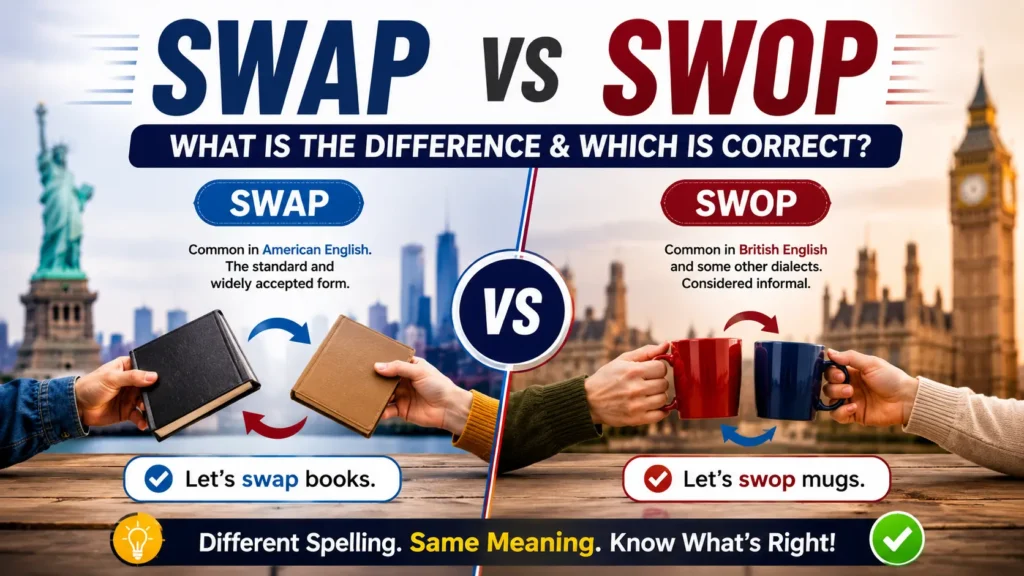

Swap and swop have the same basic meaning: to exchange one thing for another. The main difference is usage and regional preference. Swap is by far the more common spelling in modern English worldwide, while swop is a less common variant, especially associated with British English. Understanding the difference helps you choose the natural form for everyday writing and speech.
Comparison Overview
Swap and swop are two spellings of a word meaning to exchange or trade one thing for another.
In most modern English, swap is the standard and much more common form. You can use it as both a verb and a noun.
For example:
“Can we swap seats?”
“We made a swap.”
Swop has essentially the same meaning. It is a recognized variant spelling, particularly in British English, but it is much less common than swap.
For most readers and writers, swap is the safest choice because it is widely understood and commonly used in American English, British English, Canadian English, Australian English, and other varieties of English.
| Feature | Swap | Swop |
| Basic meaning | Exchange one thing for another | Exchange one thing for another |
| Part of speech | Verb and noun | Verb and noun |
| Standard modern usage | Very common | Less common |
| Meaning | Exchange, trade | Exchange, trade |
| American English | Common | Rare |
| British English | Very common | Recognized variant |
| Formal writing | Generally preferred | Less common |
| Everyday speech | Natural | Less common |
| Recommended default | Yes | Usually no |
So, if you’re wondering “Should I write swap or swop?”, the simple answer is: use swap unless you have a specific reason to use swop.
Definition of Swap
Swap means to exchange one thing, person, position, or responsibility for another.
It can describe a physical exchange:
“I swapped my old phone for a newer model.”
It can also describe exchanging responsibilities or arrangements:
“Can you swap shifts with me on Friday?”
As a noun, swap refers to the act or result of exchanging something:
“We made a quick swap.”
The word is flexible and appears in everyday conversation, business, technology, finance, sports, and informal writing.
Swap as a Verb
As a verb, swap means to exchange.
Common patterns include:
swap A for B
“She swapped tea for coffee.”
swap A with B
“I swapped seats with my friend.”
swap with someone
“Can we swap?”
Swap as a Noun
As a noun, swap means an exchange.
Examples:
“The two students made a book swap.”
“Let’s arrange a swap.”
“The swap was completed yesterday.”
The plural is swaps.
“The team made several swaps during the project.”
Definition of Swop
Swop is a variant spelling of swap. It means essentially the same thing: to exchange or trade something.
For example:
“They decided to swop houses for the weekend.”
This sentence means the same thing as:
“They decided to swap houses for the weekend.”
The important point is that swop isn’t a completely different word with a different meaning. It is mainly an alternative spelling.
However, swop is considerably less common than swap in contemporary English.
Swop as a Verb
As a verb, swop means to exchange.
“Would you like to swop seats?”
“They agreed to swop cars.”
“We can swop shifts tomorrow.”
Swop as a Noun
Swop can also function as a noun:
“The children arranged a swop of toys.”
However, this noun use is uncommon compared with swap.
For natural modern English, swap is usually the better choice.
Main Differences Between Swap and Swop
The biggest difference isn’t meaning. Both words mean essentially the same thing.
The main distinction is frequency, spelling preference, and regional usage.
Meaning
Both swap and swop mean:
to exchange one thing for another
For example:
“I swapped my blue shirt for a black one.”
and:
“I swopped my blue shirt for a black one.”
Both communicate the idea of exchanging the shirts.
Popularity
Swap is overwhelmingly more common.
You’ll see it frequently in:
- Everyday conversation
- Business
- Technology
- Sports
- Finance
- Education
- Online communication
- Newspapers
- Books
Swop is much less common.
Therefore, if you’re writing for a broad international audience, swap is generally the better choice.
Regional Usage
Swop is particularly associated with British English, although swap is also completely normal and widely preferred in British English.
This is an important point: British English does not require “swop.”
A British speaker can naturally say:
“Let’s swap seats.”
In fact, that version is much more common.
Spelling
The difference is simply the vowel:
- swap
- swop
The pronunciation may vary slightly depending on speaker and region, but the two words are generally understood as variants of the same term.
Swap vs Swop: Which Is More Common?
If your goal is natural, modern English, swap wins easily.
You are much more likely to encounter:
“Let’s swap numbers.”
than:
“Let’s swop numbers.”
Similarly:
“Can we swap seats?”
sounds more natural to most English speakers than:
“Can we swop seats?”
This doesn’t make swop meaningless or automatically incorrect. It simply means that swap is the established default spelling for most modern writing.
Is Swop Correct English?
Yes, swop is a recognized English word, but it is much less common than swap.
If you use swop, readers can generally understand what you mean. However, if you’re learning English or trying to write naturally for an international audience, swap is the better choice.
Think of it this way:
Swap = common and widely preferred
Swop = valid variant but uncommon
So, a teacher, editor, employer, or general reader will normally expect swap.
Grammar Guide
Both swap and swop can function as verbs and nouns.
How Each Term Is Used in Sentences
Swap as a Verb
The most common structure is:
swap + object
“We swapped seats.”
Another common structure is:
swap + A + for + B
“She swapped her old laptop for a new one.”
You can also use:
swap + A + with + person
“I swapped books with my classmate.”
Another useful construction is:
swap + with + person
“Can we swap with them?”
Swap as a Noun
As a noun, swap refers to an exchange:
“That was a fair swap.”
“We arranged a swap.”
“The swap happened yesterday.”
Swop as a Verb
The grammatical patterns are essentially the same:
“They swopped seats.”
“She swopped her old phone for a new one.”
“We swopped books.”
Swop as a Noun
The noun form is possible:
“The swop was completed quickly.”
However, this usage is much less common than swap.
Common Mistakes Learners Make
Mistake 1: Thinking Swap and Swop Have Different Meanings
They generally don’t.
Swap = exchange
Swop = exchange
The difference is mainly spelling and usage preference.
Mistake 2: Assuming Swop Is Always Wrong
Swop is a recognized variant. Calling it completely incorrect would be misleading.
However, it’s usually not the best default choice.
Mistake 3: Assuming British English Requires Swop
It doesn’t.
British speakers commonly use swap.
Mistake 4: Using Swop in Formal International Writing
Although it can be understood, swap is generally safer and more familiar to an international audience.
Mistake 5: Confusing Swap With Switch
Swap and switch can overlap, but they aren’t always identical.
“We swapped seats.”
means two people exchanged seats.
“We switched seats.”
can communicate the same idea in many contexts.
However, switch can also mean changing from one option to another without necessarily involving an exchange between two people.
Simple Rules to Remember
Remember these simple rules:
- Swap is the standard choice for most situations.
- Swop is a less common variant.
- Both mean exchange.
- Both can function as verbs and nouns.
- British English accepts swop, but commonly uses swap too.
- Use swap when writing for a broad audience.
- Don’t assume swop has a different meaning.
Quick Tips for Writing and Speaking
When you’re unsure, choose swap.
For example:
“Can we swap seats?”
“I want to swap my shift.”
“They swapped gifts.”
These sentences sound natural and widely understood.
Use swop only when you’re deliberately following a particular regional, stylistic, or editorial preference.
When to Use Each One
When to Use Swap
Use swap when you mean exchange.
It works well in everyday situations:
“Let’s swap seats.”
Use it in business:
“The companies agreed to swap services.”
Use it in education:
“Students can swap books.”
Use it in technology:
“You can swap the two components.”
Use it in writing:
“The author swapped the two paragraphs.”
Use it in sports:
“The coach decided to swap players.”
When to Use Swop
Use swop when you specifically want the alternative spelling.
It may appear in:
- British English contexts
- Older or regional writing
- Informal usage
- Personal stylistic choices
- Texts where the spelling has been intentionally retained
For example:
“The neighbors agreed to swop houses.”
The sentence is understandable and grammatically possible.
However, swap would normally be the more natural modern choice.
When NOT to Use Each One
When Not to Use Swap
There aren’t many situations where swap is grammatically wrong when you mean “exchange.”
However, don’t use it when you mean something unrelated to exchanging.
For example:
❌ “I swapped to another country.”
If you mean that you moved, say:
✅ “I moved to another country.”
Likewise, don’t use swap when you simply mean “turn something on or off.”
❌ “Swap the light on.”
Use:
✅ “Switch the light on.”
When Not to Use Swop
Avoid swop when your goal is the clearest and most widely recognized spelling for an international audience.
For example, in a formal report, this is generally preferable:
“The two departments agreed to swap resources.”
rather than:
“The two departments agreed to swop resources.”
The second isn’t necessarily incomprehensible or grammatically impossible. Swap is simply more familiar and conventional.
Swap vs Swop in Different Contexts
The best choice can become even clearer when you consider the context.
| Context | Recommended Form | Example |
| Everyday conversation | Swap | “Let’s swap seats.” |
| Academic writing | Swap | “Participants could swap responses.” |
| Business | Swap | “The companies agreed to swap services.” |
| Technology | Swap | “Swap the two components.” |
| Sports | Swap | “The teams swapped players.” |
| Social media | Swap | “Want to swap usernames?” |
| British informal writing | Swap | “Can we swap shifts?” |
| Regional or stylistic usage | Swop | “They decided to swop houses.” |
Which One to Use (Decision Guide)
Use this quick guide whenever you’re unsure.
Choose “Swap” If:
- You want the most common spelling.
- You’re writing for an international audience.
- You’re writing professionally.
- You’re learning standard modern English.
- You want your sentence to sound natural.
- You’re writing online.
- You’re using the word as either a verb or noun.
Choose “Swop” If:
- You’re intentionally using the alternative spelling.
- You’re following a particular regional or editorial style.
- The surrounding text already uses that spelling consistently.
- You’re discussing historical or regional language usage.
The Easiest Rule
If you have no special reason to choose swop, choose swap.
That one rule will solve the problem in almost every everyday writing situation.
Real-World Practical Examples
Swap Examples
Education
“The students decided to swap textbooks after finishing their assignments.”
Here, swap means exchange one textbook for another.
Daily Life
“Can we swap seats so I can sit near the window?”
The speakers are exchanging their positions.
Business
“The two companies agreed to swap services as part of the partnership.”
The companies are exchanging services.
Technology
“You can swap the old keyboard for a wireless model.”
The sentence describes exchanging one item for another.
Sports
“The coach decided to swap two players during the second half.”
The players’ positions or roles are being exchanged.
Writing
“The editor suggested that I swap the order of the final two paragraphs.”
Here, swap means exchange their positions.
Conversation
“Do you want to swap phone numbers?”
The speakers want to exchange contact information.
Shopping
“The store allowed me to swap the shirt for a different size.”
The customer exchanges one item for another.
Swop Examples
Daily Life
“The neighbors agreed to swop houses for the weekend.”
Here, swop means exchange.
Education
“The students decided to swop books after class.”
The students exchange books.
Conversation
“Would you like to swop seats?”
The speakers are considering an exchange.
Writing
“The editor suggested that the writer swop the two sections.”
The sections should change positions.
Business
“The partners agreed to swop services.”
The businesses exchange services.
Community
“The residents organized a swop of unwanted household items.”
The noun swop refers to an exchange.
Travel
“The two families agreed to swop homes during the holiday.”
The families exchange homes temporarily.
Self-Assessment (Fill in the Blanks)
Complete each sentence with swap or swop. In most cases, choose the form that is more common in modern standard English.
- I will use ______ when I want the most widely recognized spelling for “exchange.”
- I will use ______ when referring to exchanging seats with another person.
- I will use ______ when writing for an international audience.
- I will use ______ when saying, “Can we ______ shifts tomorrow?”
- I will use ______ when describing the common modern English spelling.
- I will use ______ when referring to an alternative spelling of “swap.”
- I will use ______ in a professional report about exchanging resources.
- I will use ______ when saying, “Let’s ______ phone numbers.”
- I will use ______ when deliberately following a regional or stylistic preference.
- I will use ______ when referring to the more common noun for an exchange.
- I will use ______ when writing, “The students decided to ______ books.”
- I will use ______ when discussing the less common variant spelling.
- I will use ______ in most everyday conversations.
- I will use ______ when writing, “The teams agreed to ______ players.”
- I will use ______ when I want readers to recognize the word immediately.
- I will use ______ when describing an exchange without any special regional preference.
- I will use ______ when saying, “She ______ her old laptop for a new one.”
- I will use ______ when discussing the alternative spelling rather than the standard common form.
- I will use ______ when writing a general English-learning article.
- I will use ______ because it is generally preferred over “swop” in modern English.
Answers
- Swap — it is the most widely recognized spelling.
- Swap — “swap seats” is the standard modern expression.
- Swap — it is more familiar to an international audience.
- Swap — “swap shifts” is a common expression.
- Swap — it is the dominant modern spelling.
- Swop — it is a recognized variant spelling of “swap.”
- Swap — it is the safer choice for professional writing.
- Swap — “swap phone numbers” is natural and common.
- Swop — it can be used intentionally as an alternative spelling.
- Swap — “swap” is the much more common noun.
- Swap — “swap books” is a standard expression.
- Swop — it is the less common variant.
- Swap — it is far more common in everyday English.
- Swap — “swap players” naturally describes an exchange.
- Swap — most readers recognize this spelling immediately.
- Swap — it is the normal default form.
- Swapped — the past tense of “swap” is “swapped.”
- Swop — the sentence specifically refers to the alternative spelling.
- Swap — it is the best general-purpose choice.
- Swap — it is generally preferred in modern English.
Final Verdict
Swap and swop essentially mean the same thing: to exchange one thing for another. The major difference is not meaning but frequency and usage.
Swap is the clear winner for modern everyday English. It is common in American and British English and is widely understood internationally. You can use it as both a verb and a noun: “Let’s swap seats” and “That was a fair swap.”
Swop is a legitimate alternative spelling, particularly associated with British English, but it is much less common. It isn’t automatically wrong, yet it may look unusual to many readers.
So, when you’re deciding between swap vs swop, remember the simplest rule: use “swap” as your default choice. Choose “swop” only when you have a specific regional, stylistic, or editorial reason to do so.
Conclusion
Understanding Swap Vs Swop is easier once you know that both words have essentially the same meaning: to exchange one thing for another. The main difference is how commonly each spelling is used. Swap is the standard and much more widely used form in modern English, making it the best choice for everyday conversations, professional writing, education, technology, and international communication. Swop is a recognized alternative spelling, particularly associated with British English, but it appears far less often. It isn’t necessarily incorrect, yet it may look unusual to many readers. If you’re unsure which word to choose, swap is the safest and most natural option. Whether you’re exchanging seats, books, shifts, information, or products, “swap” will almost always fit smoothly. Simply remember: swap is the common default, while swop is an uncommon variant.
FAQs
Is swap or swop correct?
Both swap and swop are recognized English words meaning to exchange something. However, swap is much more common and is generally the preferred spelling in modern English. Swop is a less common variant, particularly associated with British English. If you’re writing for a broad audience or simply want the safest choice, swap is usually the better option.
Is swop a real word?
Yes, swop is a real English word. It functions as a variant spelling of swap and carries essentially the same meaning: to exchange or trade something. Although it is recognized, it is much less common than swap. Modern writers generally choose swap, especially in professional, educational, and international contexts.
Is swap more common than swop?
Yes, swap is significantly more common than swop in contemporary English. It is widely used in American English, British English, and other varieties of English. Swop remains recognizable but is relatively uncommon. For general writing, online content, business communication, and everyday conversation, swap is normally the more natural choice.
Are swap and swop pronounced the same?
They can be pronounced differently depending on the speaker and regional variety, but their meanings are essentially the same. The spelling difference is more important than any consistent pronunciation distinction. In most situations, listeners will understand both words as referring to an exchange. The common form swap is generally the safest choice.
Is swop British English?
Swop is particularly associated with British English, but it isn’t the only British spelling. British speakers commonly use swap as well, and it is generally much more frequent. Therefore, it would be inaccurate to say that British English requires swop. It is better understood as a less common British-associated variant of the word swap.
Should I use swap or swop in formal writing?
In most formal writing, swap is the better choice because it is more widely recognized and commonly used. Although swop is a valid variant, it can appear unusual to some readers. Unless your organization, publication, or regional style specifically prefers swop, choosing swap will usually make your writing clearer and more conventional.
Can swap be used as both a noun and verb?
Yes. Swap can function as both a verb and a noun. As a verb, you can say, “Let’s swap seats.” As a noun, you might say, “That was a fair swap.” This flexibility makes swap particularly useful in everyday English, business communication, technology, education, and informal writing.
Does swap mean the same as exchange?
Yes, swap commonly means exchange, although the words can have slightly different uses depending on context. “Swap” often sounds more conversational and informal, while “exchange” can sound more neutral or formal. For example, “We swapped seats” and “We exchanged seats” communicate essentially the same basic idea.
Is swop wrong in American English?
Swop is not best described as completely wrong, but it is uncommon in American English. American readers are much more familiar with swap. If you’re writing for an American audience, using swap will sound more natural and avoid unnecessary confusion. For general international communication, swap is also the safer choice.
How do I remember whether to use swap or swop?
The easiest rule is to remember that swap is the standard, widely used spelling, while swop is an uncommon variant. When you mean “exchange” and have no special regional or stylistic reason to choose the alternative, use swap. For example: “swap seats,” “swap books,” “swap shifts,” and “swap information.”
