
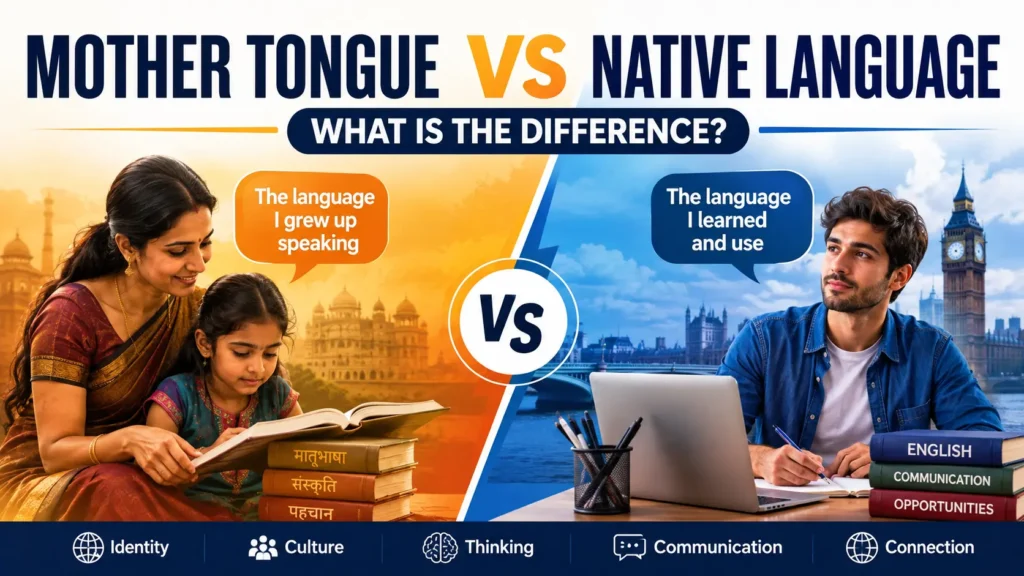

Mother tongue and native language are often used as if they mean exactly the same thing, but they can carry slightly different meanings depending on context. Both describe a language learned naturally early in life, yet native language often focuses on a person’s language ability or origin, while mother tongue can emphasize family, cultural, or childhood connection.
Comparison Overview
Mother tongue and native language are closely related terms. In everyday English, they are frequently interchangeable, especially when someone wants to identify the language they learned first during childhood.
However, there can be subtle differences.
Mother tongue traditionally refers to the language a person learns from family or caregivers during early childhood. The phrase can suggest a strong connection with home, family, culture, and identity.
Native language generally refers to a language acquired naturally from an early age rather than learned later through formal study. It often emphasizes natural fluency and early acquisition.
For example:
- “Urdu is my mother tongue.”
- “Urdu is my native language.”
Both sentences can be correct if Urdu was naturally acquired during the speaker’s childhood.
The distinction becomes more interesting when a person grows up in a multilingual household, moves to another country, or learns one language at home and another at school.
| Feature | Mother Tongue | Native Language |
| Basic meaning | Language learned naturally in childhood | Language acquired naturally from an early age |
| Main emphasis | Family, home, culture, identity | Natural acquisition and language ability |
| Common use | Personal and cultural contexts | Linguistic, educational, and professional contexts |
| Can someone have more than one? | Yes, depending on upbringing and definition | Yes |
| Usually learned early? | Yes | Yes |
| Can they refer to the same language? | Very often | Very often |
| Is one always more correct? | No | No |
The key point is that neither term is automatically more correct. The best choice depends on what you want to emphasize.
Definition of Mother Tongue
A mother tongue is a language that a person learns naturally during early childhood, usually through family members, caregivers, or the surrounding community.
The term traditionally connects language with the home and family environment. Despite the word “mother,” it doesn’t necessarily mean that the language must literally be taught by a person’s mother.
For example, imagine that a child grows up in a household where Punjabi is spoken every day. The child naturally learns Punjabi before receiving formal language instruction. Punjabi may be described as the child’s mother tongue.
The term can also carry a cultural meaning. Someone might say:
“Punjabi is my mother tongue, although I use English at work.”
Here, the speaker isn’t simply describing language ability. They’re also pointing toward their cultural and family background.
Important Characteristics of Mother Tongue
A mother tongue is commonly associated with:
- Early childhood acquisition
- Family communication
- Home environment
- Cultural identity
- Community connection
- Natural exposure
- First or one of the first languages learned
However, the definition isn’t universal. A person may grow up hearing several languages from birth. In that situation, identifying a single “mother tongue” can be difficult.
For this reason, mother tongue is sometimes more of a social or cultural term than a strictly technical linguistic category.
Definition of Native Language
A native language is a language that a person acquires naturally from early childhood and typically develops a high level of intuitive familiarity with.
The word native emphasizes that the language is acquired as part of a person’s early linguistic environment rather than primarily through later classroom study.
For example:
“English is her native language.”
This usually tells us that she acquired English naturally while growing up.
A native language doesn’t have to be the language a person currently speaks most often. Someone can acquire a language natively and later become more comfortable using another language.
Important Characteristics of Native Language
A native language is commonly associated with:
- Natural childhood acquisition
- Early exposure
- Intuitive grammatical knowledge
- Natural pronunciation
- Long-term familiarity
- Native-level linguistic development
The term is especially common in language education, linguistics, translation, and professional communication.
For example:
“The company needs a native English speaker to review the wording.”
In this context, native language or native speaker emphasizes natural language competence rather than cultural identity.
Main Differences Between Mother Tongue and Native Language
Although the two expressions overlap considerably, they aren’t always identical.
Difference in Emphasis
Mother tongue often emphasizes a person’s family, culture, and childhood environment.
Native language tends to emphasize natural acquisition and linguistic development.
Compare:
“Arabic is my mother tongue.”
This can sound personal and cultural.
“Arabic is my native language.”
This sounds more focused on language background and natural proficiency.
Difference in Everyday Usage
In casual conversation, people often use both terms interchangeably.
For example:
“What is your mother tongue?”
and
“What is your native language?”
can ask essentially the same question.
The answer might be:
“My mother tongue is Bengali.”
or:
“My native language is Bengali.”
Neither sentence is inherently wrong.
Difference in Cultural Meaning
Mother tongue can have a stronger emotional or cultural association.
Someone may describe a language as their mother tongue even when they rarely use it today because it remains connected to their family history.
Native language can sound more neutral and descriptive.
Difference in Multilingual Families
This is where the distinction can become complicated.
Suppose a child grows up with one parent speaking Spanish and another speaking English. The child may naturally acquire both languages.
In such a case, both Spanish and English could reasonably be described as native languages.
Calling one language the sole mother tongue may be less straightforward, depending on how the speaker defines the term.
Difference in Formal Contexts
Native language is often preferred when discussing language acquisition or proficiency.
For example:
“The study examined participants according to their native language.”
Mother tongue is common in discussions involving culture, education, demographics, and identity.
For example:
“Students were encouraged to maintain their mother tongue.”
Mother Tongue vs Native Language in Linguistics
The distinction becomes particularly important in linguistic discussions.
Linguists generally need to separate concepts such as:
- First language
- Native language
- Mother tongue
- Home language
- Heritage language
- Dominant language
- Second language
These terms can overlap, but they don’t always describe exactly the same thing.
First Language vs Native Language
A first language (L1) is generally a language acquired first.
A person can have more than one first language if multiple languages are acquired simultaneously during early childhood.
Native Language vs Dominant Language
Your native language isn’t necessarily your dominant language.
For example, someone might grow up speaking Polish at home but move to an English-speaking country at age six. After decades of living in an English-speaking environment, English might become their dominant language.
Polish could still be one of their native or first languages.
Mother Tongue vs Heritage Language
A heritage language is generally associated with a person’s family or cultural background but may not be the person’s strongest language.
For example, a child born in Canada to parents who speak Mandarin at home might understand Mandarin but use English more frequently.
Mandarin could be described as a heritage language, while English could become the person’s dominant language.
Grammar Guide
Both mother tongue and native language are noun phrases.
They function as nouns in sentences and can appear as subjects, objects, or complements.
How Each Term Is Used in Sentences
Mother Tongue
Common patterns include:
[Language] + is + my + mother tongue
“Urdu is my mother tongue.”
My + mother tongue + is + [language]
“My mother tongue is Urdu.”
[Person] + speaks + [language] + as their mother tongue
“She speaks Punjabi as her mother tongue.”
You can also use the plural form:
“The children grew up speaking different mother tongues.”
Native Language
Common patterns include:
[Language] + is + my + native language
“English is my native language.”
My + native language + is + [language]
“My native language is Spanish.”
[Person] + speaks + [language] + as their native language
“He speaks German as his native language.”
You can also use the plural form:
“Some children grow up with two native languages.”
Common Mistakes Learners Make
Mistake: Assuming “mother” must mean biological mother
The phrase mother tongue doesn’t require the language to have been taught by your biological mother.
❌ “It can’t be my mother tongue because my mother didn’t teach me.”
✅ “It can still be my mother tongue because I learned it naturally at home.”
Mistake: Treating the terms as completely different
In many everyday situations, the expressions overlap.
“French is my mother tongue.”
“French is my native language.”
Both can be correct.
Mistake: Assuming native means current strongest language
A native language is associated with natural early acquisition. It isn’t necessarily the language you currently use most.
Mistake: Assuming everyone has only one native language
Some multilingual people acquire two or more languages naturally from infancy.
Mistake: Using “mother tongue” only for women
Despite the word mother, the term applies to people of any gender.
Simple Rules to Remember
Use these simple guidelines:
- Mother tongue → think home, family, culture, and childhood.
- Native language → think natural acquisition and linguistic background.
- Both can describe the same language.
- A person can have more than one native language.
- Don’t assume native language means the language currently spoken most often.
- Don’t assume mother tongue must literally be taught by a mother.
- In casual English, the terms are often interchangeable.
Quick Tips for Writing and Speaking
If you’re talking about identity or culture, “mother tongue” can sound natural:
“My mother tongue connects me to my family’s culture.”
If you’re discussing language ability or acquisition, “native language” may sound more appropriate:
“English is her native language.”
If you’re unsure, consider the purpose of your sentence.
Are you discussing where the language comes from culturally? Choose mother tongue.
Are you discussing natural language acquisition? Choose native language.
If you’re simply asking which language someone learned naturally as a child, either may work.
When to Use Each One
Use “Mother Tongue” When Talking About Family and Culture
Choose mother tongue when the context involves:
- Family heritage
- Cultural identity
- Home language
- Community
- Traditional language
- Childhood communication
Example:
“My mother tongue is Punjabi, and I learned English at school.”
Use “Native Language” When Talking About Language Ability
Choose native language when the context involves:
- Linguistics
- Language acquisition
- Translation
- Education
- Speaking ability
- Native speakers
- Professional language assessment
Example:
“The software interface is available in several users’ native languages.”
Use Either in General Conversation
If someone asks:
“What’s your mother tongue?”
you can answer:
“My native language is Urdu.”
That isn’t necessarily a correction of the question. You’re simply using a closely related expression.
When NOT to Use Each One
Don’t Use “Mother Tongue” to Mean Any Language You Learned Later
If you started learning Japanese at age 25, Japanese generally wouldn’t be your mother tongue simply because you became fluent.
You could say:
“Japanese is a language I learned later in life.”
Don’t Use “Native Language” for Every Fluent Language
Being extremely fluent in a language doesn’t automatically make it your native language.
For example, someone might become highly proficient in English after studying it for many years without acquiring it natively.
Don’t Assume One Language Must Be the Answer
Multilingual people may legitimately have two or more languages acquired naturally during childhood.
Don’t Confuse Native Language With National Language
A country’s official or national language isn’t necessarily every citizen’s native language.
For example, a country can have multiple linguistic communities, with different languages spoken natively by different groups.
Which One to Use (Decision Guide)
Use this quick decision guide:
| If you mean… | Better choice |
| Language learned naturally at home | Mother tongue |
| Language connected to family culture | Mother tongue |
| Language naturally acquired during childhood | Native language |
| Language ability in a linguistic context | Native language |
| Cultural or personal identity | Mother tongue |
| Language background in a formal context | Native language |
| Casual question about someone’s first language | Either can work |
| Multiple languages acquired from birth | Native language(s) may be clearer |
A Simple Question to Ask Yourself
Before choosing, ask:
“Am I emphasizing culture or natural language acquisition?”
If the answer is culture, family, or identity, mother tongue is often a good choice.
If the answer is natural acquisition or linguistic ability, native language is often clearer.
If neither distinction matters, both may be acceptable.
Real-World Practical Examples
Mother Tongue Examples
Education
“The school allows students to submit some assignments in their mother tongue.”
Here, the phrase emphasizes students’ home or cultural languages.
Daily Life
“I speak English at work, but I use my mother tongue with my grandparents.”
The contrast highlights family communication.
Culture
“Learning traditional songs helped her reconnect with her mother tongue.”
Here, the phrase carries a strong cultural meaning.
Writing
“The author occasionally includes words from his mother tongue in his novels.”
The language contributes to the writer’s cultural identity.
Conversation
“What is your mother tongue?”
This is a natural way to ask someone which language they grew up speaking.
Business
“The company hired translators who understand the customers’ mother tongues.”
The phrase highlights the linguistic and cultural backgrounds of customers.
Native Language Examples
Education
“Students may receive additional support if their native language differs from the school’s teaching language.”
The focus is on language background.
Technology
“The application supports voice commands in several native languages.”
The emphasis is on natural language use by speakers.
Science
“Researchers compared language development among children with different native languages.”
The term fits a linguistic research context.
Business
“The company wants a native language editor to review the translated website.”
The emphasis is on natural linguistic competence.
Conversation
“Is English your native language?”
This is a common question about someone’s childhood language background.
Writing
“The translator carefully considered expressions that had no direct equivalent in her native language.”
The phrase focuses on linguistic understanding.
Self-Assessment (Fill in the Blanks)
Complete each sentence with mother tongue or native language. In some cases, both may be possible, but choose the option that best fits the context.
- I will use ______ when referring to a language strongly connected to my family and cultural identity.
- I will use ______ when discussing the language I acquired naturally during childhood.
- I will use ______ when describing the language I speak with my grandparents at home.
- I will use ______ when discussing language acquisition in a linguistic study.
- I will use ______ when talking about a language that forms an important part of my cultural heritage.
- I will use ______ when a company asks for an editor with natural command of English.
- I will use ______ when explaining that I learned a language naturally from childhood.
- I will use ______ when discussing the language spoken in my family for generations.
- I will use ______ when discussing a person’s natural linguistic background.
- I will use ______ when emphasizing a personal connection to a traditional language.
- I will use ______ when saying, “Spanish is the language I grew up speaking at home.”
- I will use ______ when describing natural language development among children.
- I will use ______ when discussing a language associated with family traditions.
- I will use ______ when a researcher categorizes participants according to their childhood language.
- I will use ______ when talking about the language that connects me with my grandparents’ culture.
- I will use ______ when emphasizing natural fluency rather than cultural identity.
- I will use ______ when writing about preserving a family’s traditional language.
- I will use ______ when describing the language a person acquired naturally rather than studied later.
- I will use ______ when discussing language and cultural identity together.
- I will use ______ when either term could naturally describe a language acquired during early childhood.
Answers
- Mother tongue — because the sentence emphasizes family and cultural identity.
- Native language — because the focus is on natural childhood acquisition.
- Mother tongue — because the context emphasizes home and family communication.
- Native language — because linguistic studies often focus on natural language acquisition.
- Mother tongue — because the focus is cultural heritage.
- Native language — because natural command and linguistic competence are emphasized.
- Native language — because the sentence focuses on natural acquisition.
- Mother tongue — because the language is connected to family and generations.
- Native language — because the focus is linguistic background.
- Mother tongue — because the sentence emphasizes traditional and personal identity.
- Mother tongue — because the home and family setting is central.
- Native language — because the context concerns natural language development.
- Mother tongue — because family traditions are emphasized.
- Native language — because the context is linguistic classification.
- Mother tongue — because cultural and family connections are central.
- Native language — because natural linguistic ability is emphasized.
- Mother tongue — because the context involves preserving family language.
- Native language — because the distinction is natural acquisition versus later study.
- Mother tongue — because both language and cultural identity are emphasized.
- Either — both terms can describe a language naturally acquired during early childhood.
Final Verdict
Mother tongue and native language are both correct expressions, and in many everyday situations, they mean essentially the same thing. The difference is mainly one of emphasis and context.
Choose mother tongue when you want to highlight family, culture, heritage, home life, or personal identity. Choose native language when you want to emphasize natural childhood acquisition, linguistic background, or language ability.
Neither term is automatically better. A multilingual person may also have more than one language acquired naturally during childhood, so the distinction isn’t always simple.
The easiest rule to remember is this: mother tongue connects language with home and identity, while native language focuses more on natural linguistic development. When the context is casual, either term may be perfectly natural.
Conclusion About Mother Tongue Vs Native Language
Understanding Mother Tongue Vs Native Language becomes much easier when you focus on the meaning behind each expression. Both terms can describe a language learned naturally during childhood, so they are often interchangeable in everyday English. However, mother tongue tends to highlight family, culture, heritage, and personal identity, while native language often emphasizes natural language acquisition and linguistic background. Neither expression is automatically more correct. Your choice should depend on what you want to communicate and the context in which you’re writing or speaking. If you’re discussing family traditions or cultural identity, mother tongue may feel more appropriate. If you’re talking about language development, proficiency, or linguistic background, native language may be clearer. Once you understand this small distinction, you can use both expressions confidently and naturally in conversations, academic writing, and professional communication.
FAQs
Is mother tongue the same as native language?
Mother tongue and native language often refer to the same language, especially when describing a language learned naturally during childhood. However, mother tongue can emphasize family, culture, and heritage, while native language may focus more on natural language acquisition and linguistic background. The exact meaning can depend on a person’s upbringing and the context in which the term is used.
Which is more correct, mother tongue or native language?
Neither is universally more correct. Mother tongue and native language are both standard expressions, and they frequently overlap in meaning. Use mother tongue when discussing family, culture, or heritage, and consider native language when discussing natural language acquisition or linguistic ability. In ordinary conversation, either expression can usually communicate the intended meaning clearly.
Can a person have two mother tongues?
Yes, a person can have two or more mother tongues, particularly when they grow up in a multilingual household. For example, a child may naturally learn Spanish from one parent and English from another from infancy. In such circumstances, both languages can be considered part of the child’s early linguistic and cultural background.
Can you have more than one native language?
Yes. A person can acquire multiple languages naturally from early childhood and therefore have more than one native language. This commonly happens when children grow up in multilingual families or communities. Native language doesn’t necessarily mean the first language learned in a strict chronological order; simultaneous early acquisition can result in multiple native languages.
Does mother tongue mean the language your mother speaks?
Not necessarily. Despite the word mother, mother tongue doesn’t have to mean the language spoken by your biological mother. Traditionally, it refers to a language learned naturally during childhood, often through family or the surrounding community. A person’s mother tongue may therefore come from a broader home or cultural environment rather than directly from their mother.
Is English my native language if I learned it as a child?
It can be, depending on how you acquired it. If you learned English naturally from early childhood through your home or surrounding environment, it may be considered a native language. However, simply starting English lessons at a young age doesn’t automatically make English your native language. Natural early exposure is an important part of the distinction.
Is mother tongue the same as first language?
They can mean the same thing, but they’re not always identical concepts. First language generally refers to a language acquired first, while mother tongue often carries additional associations with family, culture, and identity. Someone raised bilingually may acquire two languages from infancy, making the idea of a single first or mother tongue less straightforward.
Which term is better for academic writing?
Native language can be a useful choice in academic or linguistic contexts when discussing natural language acquisition, language development, or linguistic background. However, mother tongue is also widely used, particularly in research involving culture, education, identity, and multilingual communities. The best term depends on the specific definition being used and the focus of the research.
Can your native language change over time?
Your native language generally refers to a language acquired naturally during childhood, so the label itself doesn’t usually change simply because you later use another language more often. However, your dominant language can change. For example, someone may acquire one language at home but eventually become more fluent or comfortable in another language after years of living elsewhere.
How do I choose between mother tongue and native language?
Think about what you want to emphasize. Choose mother tongue when the context involves family, heritage, culture, or identity. Choose native language when the focus is natural childhood acquisition, linguistic background, or language ability. If you’re simply talking about the language you naturally learned as a child, both terms may be appropriate.
