
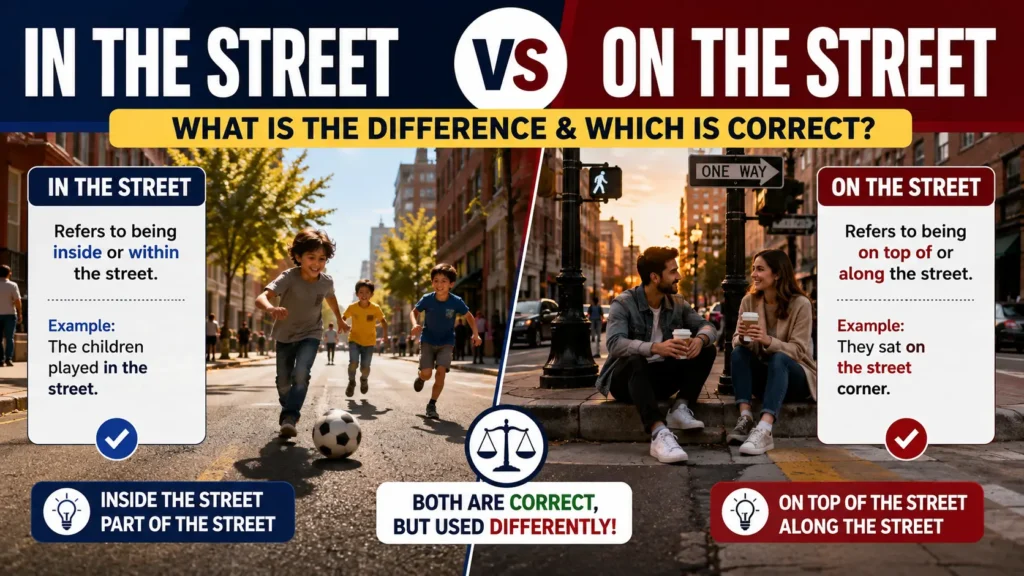

“In the street” and “on the street” are both grammatically correct, but they don’t always describe the same situation. The difference usually depends on whether you mean being within the street or roadway area or simply being located along a particular street. Understanding this small preposition difference can make your English sound more natural and precise.
Comparison Overview
In the street and on the street both describe a person’s or object’s relationship to a street, but English speakers generally use them in different situations.
The easiest distinction is:
- In the street usually means physically within the roadway or street area.
- On the street usually means located along a street, often referring to a position, address, business, building, or general location.
For example:
“The children are in the street.”
This suggests the children are physically in the roadway or street space.
Compare that with:
“The children are playing on the street.”
This can describe children playing along the street or in the street area, depending on context. In wide varieties of English, on the street is the more natural expression for general street activity.
Another important use is location:
“She lives on Green Street.”
Here, on is the normal preposition for an address or location along a named street.
| Expression | Main idea | Typical use |
| In the street | Within the street/roadway area | Physical position |
| On the street | Along or located by a street | Location, activity, addresses |
| In the street | Often emphasizes being in the roadway | Physical presence |
| On the street | Often emphasizes street-level location | Homes, businesses, people |
| On Green Street | Located along a named street | Addresses |
So, while both expressions can be correct, on the street is generally the more flexible choice for general location.
Definition of In the Street
In the street means being physically within the street area, especially the roadway where vehicles normally travel.
For example:
“There was a large box in the street.”
This suggests that the box was actually in the roadway or street area.
Another example:
“A dog was running in the street.”
The dog is physically occupying the street rather than simply being near it.
The expression often draws attention to physical position.
When “In the Street” Sounds Natural
You might use in the street when something is:
- In the roadway
- Blocking traffic
- Lying on the road
- Moving through the road
- Physically occupying the street
- Located in the central street area
For example:
“Someone left a bicycle in the street.”
The bicycle is physically in the roadway.
“In the Street” and British English
In British English, in the street can sometimes be used more broadly for activities that take place in the street environment.
For example:
“The children were playing in the street.”
This is a familiar expression in British English.
However, on the street is also widely used, especially when referring to general street activity or location.
Definition of On the Street
On the street generally means located along a street or at street level.
It can refer to people, buildings, businesses, objects, activities, and locations.
For example:
“There is a bakery on the street.”
This tells us the bakery is located along that street.
With a specific street name, on is especially common:
“She lives on Oak Street.”
“The office is on Main Street.”
“There’s a pharmacy on this street.”
When “On the Street” Sounds Natural
Use on the street when talking about:
- A street address
- A business location
- A building’s location
- Someone being outside
- Street activity
- Something located along a street
- A general street environment
For example:
“I met him on the street.”
This usually means you encountered him while you were out in a street environment.
“On the Street” Can Have Other Meanings
On the street can also be idiomatic.
For example:
“He has been living on the street.”
This can mean that someone is homeless or living outdoors rather than in a home.
Another example:
“The new product will be on the street next month.”
In informal language, this can mean the product will become available to the public.
Context is therefore important.
Main Differences Between In the Street and On the Street
The biggest difference is how the speaker conceptualizes the location.
Physical Position vs General Location
In the street often emphasizes physical presence within the roadway.
“The car is in the street.”
On the street often describes general location along a street.
“The restaurant is on the street.”
Roadway vs Address
Use in when you’re emphasizing that something is physically inside the street area.
“There is a pothole in the street.”
Use on when you’re identifying where a building or business is located.
“The restaurant is on the street.”
Named Streets Usually Take “On”
When giving an address or referring to a specific street by name, on is normally used.
“I live on King Street.”
“The hotel is on Baker Street.”
“Their office is on Market Street.”
This is one of the easiest rules to remember.
General Street Activity Can Take “On”
English commonly uses on the street for general street activity:
“I saw her on the street.”
“There were several musicians on the street.”
However, in the street can also be appropriate when you specifically mean the roadway.
“The musicians were in the street, blocking traffic.”
The context changes the meaning.
In the Street vs On the Street: A Simple Comparison Table
| Situation | Natural choice | Example |
| Something physically occupies the roadway | In the street | “The car is in the street.” |
| Something is located along a street | On the street | “The shop is on the street.” |
| Specific street name | On | “She lives on King Street.” |
| A person encountered outside | On the street | “I met him on the street.” |
| An object blocking traffic | In the street | “There is a tree in the street.” |
| A business location | On the street | “The café is on this street.” |
| A pothole or physical feature of the roadway | In the street | “There’s a hole in the street.” |
| Street performance | On the street | “They perform on the street.” |
| Someone physically standing in the roadway | In the street | “Don’t stand in the street.” |
Grammar Guide
In the street and on the street are prepositional phrases.
The prepositions in and on show the relationship between a person, object, or activity and the street.
How Each Term Is Used in Sentences
In the Street
Common pattern:
subject + verb + in the street
“The children are playing in the street.”
Another pattern:
There + be + noun + in the street
“There is a car in the street.”
You can also use it with movement:
“A cyclist was riding in the street.”
On the Street
Common pattern:
subject + verb + on the street
“I saw him on the street.”
For location:
subject + be + on + street name
“The store is on Main Street.”
For general location:
“There’s a café on this street.”
Common Mistakes Learners Make
Mistake 1: Using “In” With a Street Name
Learners sometimes say:
❌ “I live in Main Street.”
In standard English, the natural form is:
✅ “I live on Main Street.”
Mistake 2: Assuming “On the Street” Always Means Physically on the Road
It doesn’t.
“She lives on the street.”
This doesn’t mean she is physically standing on the road. It can mean her home is located along that street.
Mistake 3: Thinking “In the Street” Is Always Wrong
It isn’t.
“There is a fallen tree in the street.”
Here, in is exactly right because the tree is physically occupying the roadway.
Mistake 4: Treating “In” and “On” as Interchangeable
They sometimes overlap, but the mental picture can change.
“The children are in the street.”
emphasizes their physical position within the street.
“The children are on the street.”
can emphasize the general street environment.
Simple Rules to Remember
Remember these easy rules:
- On a street → usually a location or address.
- On Main Street → use on with named streets.
- In the street → often means physically within the roadway.
- On the street → often means along or around the street.
- In the street can emphasize danger or obstruction.
- On the street can describe general street activity.
- Context determines the best choice.
Quick Tips for Writing and Speaking
When talking about an address, choose on:
“I live on Park Avenue.”
When describing something physically occupying the roadway, choose in:
“There’s a bicycle in the street.”
When describing someone you encountered while outside, on the street is natural:
“I ran into my teacher on the street.”
When warning someone about traffic, in the street is often more precise:
“Don’t play in the street.”
When to Use Each One
Use “In the Street” When Something Is Physically Inside the Roadway
Examples include:
“A truck stopped in the street.”
“There’s broken glass in the street.”
“The children ran into the street.”
“A branch fell in the street.”
Here, the speaker focuses on the physical location within the road.
Use “On the Street” for Locations and Addresses
Examples:
“The bank is on this street.”
“She lives on Oxford Street.”
“There’s a restaurant on the street.”
“Our office is on King Street.”
The focus is on location along a street, rather than being physically inside the roadway.
Use “On the Street” for General Street Activity
“Street artists perform on the street.”
“I met an old friend on the street.”
“There were many people on the street.”
The phrase describes the broader street environment.
When NOT to Use Each One
When Not to Use “In the Street”
Don’t normally use in the street when giving the address of a building.
❌ “My office is in Main Street.”
✅ “My office is on Main Street.”
Don’t use in the street when you simply mean that a business is located along a street.
❌ “The café is in the street.”
✅ “The café is on the street.”
When Not to Use “On the Street”
Don’t use on the street when you need to emphasize that something is physically blocking or occupying the roadway.
For example:
“A fallen tree is in the street.”
is clearer than:
“A fallen tree is on the street.”
The second sentence isn’t necessarily impossible, but in the street more clearly communicates that the tree is occupying the roadway.
Don’t Confuse “On the Street” With “In the Street”
Compare:
“She lives on the street.”
This refers to location.
“She is standing in the street.”
This refers to physical position.
The difference becomes clear when you imagine the situation visually.
In the Street vs On the Street in American and British English
Both expressions occur in American and British English, although patterns can vary slightly depending on region and context.
One useful generalization is:
On the street is extremely common for general location and named streets.
In the street is often used when emphasizing the roadway or physical street area.
For example:
“The store is on the street.”
“The ball rolled into the street.”
British English may also use in the street naturally when discussing children playing or activities taking place in the street.
For example:
“The children were playing in the street.”
American English speakers can use the same expression, although on the street may also appear depending on the intended meaning.
In the Street vs On the Street With Addresses
This is one of the most useful rules for English learners.
When talking about a street name, use on:
“I live on Green Street.”
“The school is on Washington Avenue.”
“The hotel is on King Road.”
“Our office is on Main Street.”
However, when you’re talking about a street as a physical roadway, in can be appropriate:
“There’s a large pothole in Main Street.”
The second sentence focuses on something physically located within the roadway.
Which One to Use (Decision Guide)
Ask yourself what you mean.
Are You Giving an Address?
Use on.
“The office is on Main Street.”
Are You Describing a Business Location?
Use on.
“The café is on the street.”
Is Something Physically in the Roadway?
Use in.
“There’s a truck in the street.”
Are You Talking About Someone You Met Outside?
Use on.
“I met Sarah on the street.”
Are You Warning Someone About Traffic?
Use in.
“Don’t stand in the street.”
Are You Talking About General Street Activity?
Usually use on.
“There are performers on the street.”
Quick Decision Rule
Location along a street → ON
Physical position within the roadway → IN
That’s not an absolute rule for every sentence, but it’s an excellent starting point.
Real-World Practical Examples
In the Street Examples
Daily Life
“A child accidentally ran into the street while chasing a ball.”
The child moved into the roadway.
Traffic
“A broken-down car was sitting in the street.”
The car was physically occupying the roadway.
Safety
“Parents told the children not to play in the street.”
The phrase emphasizes the roadway and potential traffic danger.
Weather
“Heavy rain left large puddles in the street.”
The puddles are physically located on the roadway.
Science
“Researchers measured the temperature of the water collected in the street after the storm.”
The phrase identifies the physical location of the water.
Construction
“Workers discovered a damaged pipe beneath the street.”
Here, “beneath the street” is used because the location is below the roadway.
Writing
“The novel opens with a mysterious package lying in the street.”
The package is physically within the street area.
Conversation
“Why is that bicycle in the street?”
The speaker is asking why the bicycle is occupying the roadway.
On the Street Examples
Addresses
“My apartment is on Green Street.”
This identifies the location of the apartment.
Business
“There’s a new bakery on the street.”
The bakery is located along the street.
Conversation
“I met your brother on the street yesterday.”
The speaker encountered the brother while outside.
Education
“The students conducted interviews on the street for their community project.”
The interviews took place in a street environment.
Business
“The company opened a new office on Market Street.”
The street name identifies the office’s location.
Technology
“A technician was working on the street to repair the network connection.”
The technician was working outdoors along the street.
Writing
“The story follows a musician performing on the street.”
The musician is performing in a public street environment.
Daily Life
“There were several food vendors on the street.”
The phrase refers to the broader street setting.
Self-Assessment (Fill in the Blanks)
Choose in the street or on the street based on the context.
- I will use ______ when referring to a house located along a named street.
- I will use ______ when referring to a car physically blocking the roadway.
- I will use ______ when giving a business address such as Main Street.
- I will use ______ when describing someone I met while walking outside.
- I will use ______ when referring to a pothole located in the roadway.
- I will use ______ when saying that a restaurant is located along a particular street.
- I will use ______ when warning children not to play in the roadway.
- I will use ______ when describing musicians performing in a public street environment.
- I will use ______ when saying, “She lives ______ Oak Street.”
- I will use ______ when referring to broken glass physically lying in the roadway.
- I will use ______ when describing an office located along King Street.
- I will use ______ when saying that a dog is physically running through the roadway.
- I will use ______ when describing people walking around a street as a general environment.
- I will use ______ when referring to an object blocking traffic.
- I will use ______ when saying, “The hotel is ______ Park Avenue.”
- I will use ______ when describing someone standing in the roadway.
- I will use ______ when referring to a store’s location along a street.
- I will use ______ when saying that a fallen tree is physically occupying the road.
- I will use ______ when describing an encounter with a friend while outside.
- I will use ______ when emphasizing a physical object located within the roadway.
Answers
- On the street — addresses and locations along a named street normally use “on.”
- In the street — the car is physically occupying the roadway.
- On the street — “on Main Street” is the standard address pattern.
- On the street — this describes an encounter in a general street environment.
- In the street — the pothole is physically located in the roadway.
- On the street — the restaurant is located along the street.
- In the street — the warning concerns physical presence in the roadway.
- On the street — this describes a public street activity.
- On the street — use “on” with a named street address.
- In the street — the glass is physically lying within the roadway.
- On the street — the office is located along a named street.
- In the street — the dog is physically running through the roadway.
- On the street — the phrase describes the general street environment.
- In the street — the object is physically blocking the roadway.
- On the street — “on Park Avenue” is the natural address expression.
- In the street — the person is physically standing in the roadway.
- On the street — the phrase describes the store’s location.
- In the street — the tree is physically occupying the roadway.
- On the street — the encounter happened in a street environment.
- In the street — the focus is on the object’s physical position within the roadway.
Final Verdict
In the street and on the street are both correct, but they usually emphasize different ideas. On the street is the better choice when you’re talking about a location along a street, a business, a home, a named street, or general street activity. For example, “She lives on Main Street” and “I met him on the street” are natural expressions.
In the street is more specific when you mean something is physically within the roadway or street area. For example, “There’s a car in the street” suggests that the car is occupying the road.
The easiest rule is to remember: ON = location along a street; IN = physical position within the roadway. Context can sometimes allow both expressions, but this distinction will help you choose the most natural preposition in everyday English, professional writing, and conversation.
Conclusion
Understanding In The Street Vs On The Street becomes much easier when you focus on the type of location you want to describe. Both expressions are correct, but they often create a slightly different picture. On the street is commonly used for addresses, businesses, homes, and general activities taking place along a street. For example, you can say, “She lives on Main Street” or “I met him on the street.” In the street, however, usually emphasizes physical presence within the roadway or street area, as in “There is a car in the street” or “Don’t play in the street.” The simplest rule is on for a location along a street and in for physical position within the roadway. Once you understand this distinction, choosing the right preposition becomes much easier. Pay attention to context, picture the situation clearly, and your English will sound more natural and precise.
FAQs
Is “in the street” correct English?
Yes, “in the street” is completely correct English. It is commonly used when something or someone is physically within the street or roadway area. For example, “There is a bicycle in the street” means the bicycle is occupying the road. The expression can also describe activities occurring in the street, depending on the context and variety of English.
Is “on the street” correct English?
Yes, “on the street” is also correct and extremely common. It usually describes a location along a street, a person encountered outdoors, or an activity taking place in a street environment. For example, “The restaurant is on the street” and “I saw her on the street” are natural sentences. It is also used with named streets.
What is the main difference between “in the street” and “on the street”?
The main difference is the location being emphasized. In the street often means physically within the roadway, while on the street generally means along or around a street. For example, “A car is in the street” emphasizes its position in the road, while “A shop is on the street” describes the shop’s location.
Should I say “I live in Main Street” or “I live on Main Street”?
The natural expression is “I live on Main Street.” English normally uses on when referring to a home, business, or other location situated along a named street. For example, you can say, “The school is on Park Avenue” or “Their office is on King Street.” Using “in” with a named street is generally incorrect.
Should I say “there is a car in the street” or “on the street”?
Both can be possible, but “in the street” is usually clearer if you mean the car is physically occupying the roadway. “There is a car on the street” can simply describe a car located somewhere along the street. The choice depends on whether you want to emphasize the roadway itself or the broader street environment.
Is “on the street” used for addresses?
Yes. On is the standard preposition for many English street addresses. For example, you can say, “The library is on Green Street” or “She lives on Baker Street.” This pattern is especially important for English learners because using “in” with a named street can sound unnatural. Remember: on Main Street, on Oxford Road, and on Park Avenue.
When should I use “in the street”?
Use “in the street” when you want to emphasize that someone or something is physically inside the roadway or street area. Examples include “The children ran into the street,” “There is broken glass in the street,” and “A truck stopped in the street.” It is particularly useful when describing an obstruction, danger, or physical position.
When should I use “on the street”?
Use “on the street” for general street locations, addresses, outdoor encounters, and activities. You can say, “I met my friend on the street,” “The café is on this street,” or “The performers are on the street.” It often gives a broader sense of being located along or within the street environment rather than specifically inside the roadway.
Can “in the street” and “on the street” mean the same thing?
Sometimes their meanings can overlap, especially when describing people or activities. For example, “The children are playing in the street” and “The children are playing on the street” may describe a similar situation. However, in often emphasizes physical position within the roadway, while on tends to emphasize the general street environment or location.
Which is more common: “in the street” or “on the street”?
Neither is universally more correct because they serve different purposes. On the street is especially common for addresses, general locations, and street activities. In the street is common when describing something physically located within the roadway. Instead of choosing based only on frequency, consider whether you mean location along a street or physical position in the roadway.
