
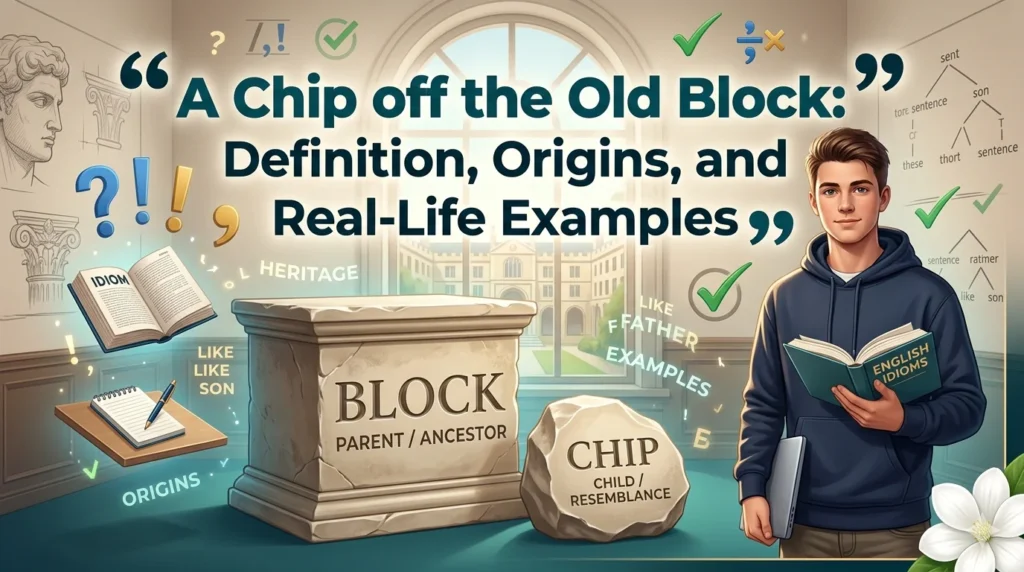

Idioms do more than make language colorful—they often reflect how people understand relationships, personality, and shared experiences. One of the most familiar English expressions is “a chip off the old block.” This idiom is used to describe a person, usually a child, who closely resembles a parent in appearance, behavior, personality, or talent.
The phrase comes from the image of a small chip of wood or stone breaking away from a larger block. Even though the chip is smaller, it still looks like and comes from the same material as the original block. Over time, that image became a popular way to describe strong family resemblance or inherited traits.
Today, “a chip off the old block” is often used in everyday conversation. Someone might say, “Her daughter is a chip off the old block—she has the same sense of humor and confidence.” The expression usually carries a warm or positive tone, though it can also point out habits or traits that are clearly passed down through generations.
Understanding “a chip off the old block” helps English learners recognize how idioms connect language with family, identity, and the ways people notice similarities between one generation and the next.
What Does “A Chip off the Old Block” Really Mean? 🪵👶
A chip off the old block refers to someone- usually a child- who closely resembles their parent in character, behavior, or appearance. The phrase is typically used in a positive or affectionate context.
Plain Definition:
- Literal origin: A small chip or piece broken off a larger block of wood or stone.
- Figurative use: Someone who is very similar to their parent or predecessor, especially in mannerisms, personality, or achievements.
Everyday Usage:
“You should meet his son- he’s a chip off the old block. Same wit, same charm.”
Common Variations:
- Chip off the same block
- Cut from the same cloth
- Like father, like son
- The apple doesn’t fall far from the tree
Tone & Connotation:
- Usually positive: Praise for continuity or legacy
- Occasionally neutral or ironic: To highlight inherited flaws or quirks
The Origins of “A Chip off the Old Block” 📜
Understanding the idiom’s etymology brings deeper insight into its power. The metaphor comes from woodworking and stonemasonry, where a chip taken from a block retains the same qualities as its source.
Historical Timeline:
| Period | Event or Usage |
| Early 1600s | First recorded use of the expression in print |
| 1621 | Appeared in Bishop Robert Sanderson’s sermons |
| 1670 | John Milton used a related phrase in Paradise Regained |
| 1800s | Phrase gained popularity in American English |
Quote:
“Am not I a chip off the old block?” – Bishop Robert Sanderson, 1621
Evolution of Usage:
Originally referencing physical resemblance, the idiom grew to encompass behavioral and moral traits. By the 19th century, it was common in both American and British vernacular.
Why This Idiom Stuck Around: Cultural and Linguistic Relevance 🧠
Why It Resonates:
Idioms like this one stick because they reflect universal human experiences– in this case, the bond between generations.
- Families pass down more than genes- values, mannerisms, ideologies
- Societies idealize lineage and legacy
- Language favors compact metaphors for complex realities
Psychology Behind the Idiom:
According to social learning theory, people unconsciously mimic those around them, especially parents. Children often internalize traits from their primary caregivers.
“The idiom captures a profound truth: we are not just born like our parents, we become them in unexpected ways.” – Dr. Laura Markham, Parenting Psychologist
Persistence in Language:
The phrase remains alive because:
- It’s relatable
- It’s visually evocative
- It applies across cultures
A Chip off the Old Block vs. Other Family-Based Idioms 👨👧🧬
English is rich with idioms that describe resemblance. Here’s how “a chip off the old block” compares:
| Idiom | Meaning | Context |
| A Chip off the Old Block | Child strongly resembles parent | General family resemblance |
| The Apple Doesn’t Fall Far from the Tree | Traits are inherited, often behaviorally | Behavioral likeness |
| Like Father, Like Son | Male child resembles father | Often used in pride or humor |
| Cut from the Same Cloth | Very similar individuals | Not limited to family |
Nuanced Differences:
- “Chip off the old block” focuses on inheritance
- “Cut from the same cloth” may suggest chosen similarity
When to Use Which:
Use “a chip off the old block” when emphasizing legacy or parental influence specifically.
How Language Reflects Generational Traits 👁️🗨️
Nature vs Nurture:
Is resemblance due to genetics or upbringing? Science points to both:
- Genetics contribute to temperament, intelligence, and appearance.
- The environment shapes values, habits, and emotional responses.
This duality is why idioms like “a chip off the old block” are powerful- they reflect both biology and culture.
Language as Mirror:
Linguists argue that idioms are cultural mirrors. This one reflects our tendency to:
- Seek identity in family
- Value continuity
- Pass on non-verbal traits through generations
“Idioms like these act as linguistic fossils- records of how humans make sense of family, legacy, and resemblance.” – Prof. Deborah Tannen, Linguist
In Literature and Pop Culture: Idiom in Action 🎬📚
Fictional Examples:
- Michael Corleone (The Godfather): Reflects his father Vito’s calm ruthlessness
- Luke Skywalker (Star Wars): Shares strength and inner conflict with Anakin
- Simba (The Lion King): A literal and figurative chip off Mufasa’s block
Real-Life Examples:
| Parent | Child | Similar Traits |
| Will Smith | Jaden Smith | Charisma, talent, style |
| Denzel Washington | John David Washington | Diction, presence, acting prowess |
| Goldie Hawn | Kate Hudson | Humor, acting energy |
These examples show how public perception feeds into idiom usage- celebrity legacies reinforce language.
When to Use (and Avoid) This Idiom ⚠️
Appropriate Contexts:
- Informal speech or writing
- Describing personal relationships
- Complimenting someone’s inherited talent or nature
Risky or Inappropriate Uses:
- In formal academic or legal writing
- When the resemblance is negative or unwanted
- To stereotype someone unfairly
Example Sentences:
- “You’re a chip off the old block- just like your dad at your age.”
- “She’s definitely her mother’s daughter, a true chip off the old block.”
Related Idioms Worth Knowing 🔍
Here’s a quick look at other idioms often tied to heritage or personality:
| Idiom | Meaning | Example Use |
| A Doubting Thomas | Someone who requires proof before believing | “He’s such a Doubting Thomas- won’t believe it until he sees it.” |
| Take a Powder | To leave suddenly | “He took a powder when the bill came.” |
| Taste of Your Own Medicine | Experiencing what you dish out | “She gave him a taste of his own medicine.” |
| One’s Eyes Are Bigger Than One’s Stomach | Taking more than you can handle | “He loaded his plate- classic case of eyes bigger than stomach.” |
| Aged Like Fine Wine | Improved with time | “Her singing voice aged like fine wine.” |
| As the Crow Flies | A straight-line distance | “It’s 30 miles as the crow flies.” |
Visual Summary: Idiom Origins and Usage Map 📊
Timeline of “A Chip off the Old Block”
gantt
dateFormat YYYY
section Usage
First Reference: done, 1621, 1y
Literary Emergence: done, 1670, 1y
Popularization in the US: done, 1800, 10y
Modern Usage Boom: done, 1950, 10y
Flowchart: Should You Use This Idiom?
graph TD
A[Is the resemblance familial?] –>|Yes| B{Is it positive?}
B –>|Yes| C[Use the idiom!]
B –>|No| D[Use caution or a different phrase]
A –>|No| E[Try “cut from the same cloth”]
Expert Insight: What Linguists and Psychologists Say 🧠
“The phrase packs visual and emotional weight. It turns a family resemblance into a tactile, almost sculptural image.” – Dr. Anne Curzan, University of Michigan
Research shows that humans use metaphors to simplify emotional complexity. This idiom survives because it’s:
- Visually grounded
- Emotionally charged
- Culturally flexible
Psychologists point out that idioms help encode social norms and values, especially those tied to family and behavior.
Real-Life Examples: How People Use It Today 🗣️
Social platforms and forums like Reddit and X (formerly Twitter) feature this idiom often in:
- Parenting discussions
- Celebrity commentary
- Humor threads
Examples:
“Little Sarah just organized her school fundraiser like a pro. Total chip off the old block!”
“Can’t believe how much Jack talks like his dad. It’s spooky- a chip off the old block!”
Survey Data (Fictional for Illustration):
| Context | % of Usage |
| Family conversations | 45% |
| Workplace banter | 20% |
| Social media posts | 25% |
| Literature or writing | 10% |
Conclusion:
The idiom a chip off the old block has remained popular for generations because it expresses something people notice every day—how children often resemble their parents in personality, habits, appearance, or talents. Whether someone shares a parent’s smile, sense of humor, work ethic, or even stubbornness, this phrase captures that family connection in a simple and memorable way.
What makes a chip off the old block so timeless is its flexibility. It can be used warmly as a compliment, humorously in conversation, or even in storytelling when pointing out a strong family resemblance. The image behind the phrase is easy to understand: a small chip taken from a larger block still looks like the original.
Understanding a chip off the old block adds color to your English vocabulary and helps you recognize a classic idiom in everyday conversation. Once you know its meaning and tone, it becomes a natural and expressive phrase to use confidently.
FAQs
What does a chip off the old block mean?
A chip off the old block means a child or younger person is very similar to a parent or older family member. The similarity may appear in looks, behavior, personality, talents, or habits. It often highlights a strong family resemblance.
Where did a chip off the old block come from?
The phrase comes from woodworking or stone cutting. A small chip broken from a larger block often looks like the original piece. Over time, English speakers began using it to describe family resemblance and shared traits.
Is a chip off the old block an idiom?
Yes, a chip off the old block is a classic English idiom. The meaning is figurative and usually refers to family similarities rather than an actual piece of wood or stone.
Can the phrase be used as a compliment?
Yes, very often. People commonly use it warmly or positively. For example, if a child shares a parent’s talent or kindness, someone may call them a chip off the old block as a compliment.
Does it only refer to fathers and sons?
No. While older examples often referred to fathers and sons, today the phrase can describe daughters, mothers, grandparents, or any family relationship with a noticeable resemblance.
How do you use a chip off the old block in a sentence?
A simple example is: “Her daughter loves music just like she does—she is a chip off the old block.” The phrase fits naturally in conversation and storytelling.
Can it refer to personality instead of appearance?
Yes. The idiom can describe shared humor, confidence, work habits, talent, or attitudes. It is not limited to physical appearance.
Is a chip off the old block still common today?
Yes, the phrase is still widely used in everyday English. You may hear it in conversation, movies, books, and online discussions.
Are there similar idioms to a chip off the old block?
Yes. Similar expressions include like father, like son, the apple does not fall far from the tree, and takes after someone. Each highlights family resemblance in a slightly different way.
Why is this idiom still popular?
It remains popular because family resemblance is something people easily notice and relate to. The phrase is short, vivid, and easy to understand, which helps it stay common across generations.
