
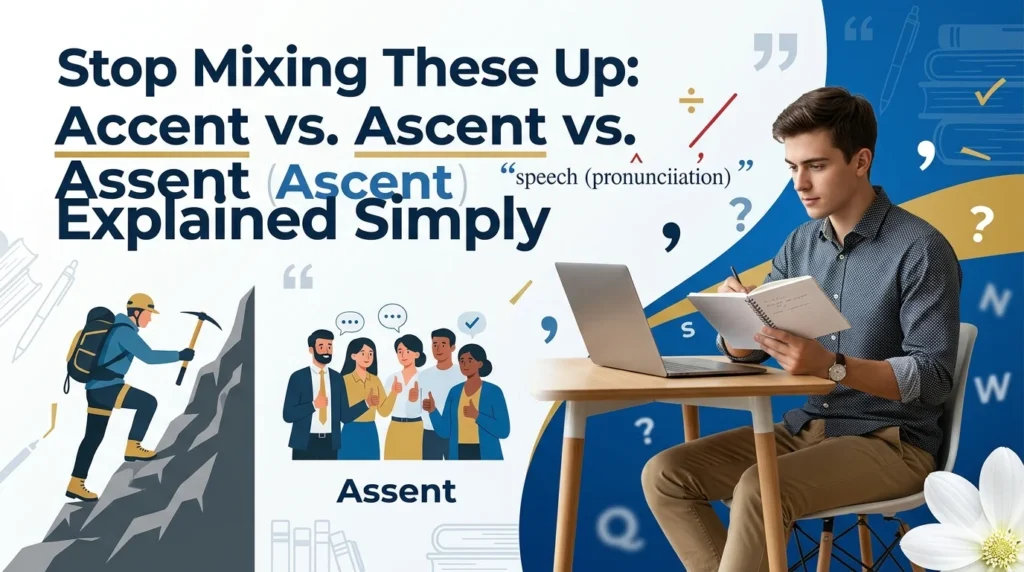

Accent vs. Ascent vs. Assent often confuses writers because these words may sound alike but carry completely different meanings in English usage and communication. The words accent, ascent, and assent often sound alike, but they mean wildly different things, and they can easily trip up even seasoned writers in English. These are common homophones with similar sounds, but their meanings, contexts, and grammatical roles vary significantly, which creates real confusion in both writing and speaking.
From a language learning point of view, the difference is based on clear linguistic and semantic differences. Accent refers to how someone speaks or pronounces speech, ascent means rising or going upward, and assent means agreement or approval. Even though they appear close in spelling, their sentence meaning changes completely depending on interpretation.
Good writing skills come from practicing correct word choice and understanding how meanings shift across different contexts. With steady practice, these errors become rare, and your writing becomes clearer and more precise.
Why “Accent,” “Ascent,” and “Assent” Confuse People
These three words are classic examples of homophones—they sound alike, especially “ascent” and “assent,” yet have very different meanings. The confusion intensifies because they often show up in similar contexts (e.g., speech, decisions, actions), but misusing them can completely change the meaning of a sentence.
Let’s break them down one by one, deeply, and with plenty of real-world usage to help you master them once and for all.
Accent: Pronunciation, Emphasis & Style
“Her accent told me she wasn’t from around here.”
Definition & Origins
- Accent (noun or verb)
- Pronunciation: /ˈæk.sənt/ or /ækˈsent/ (depending on context)
- Etymology: From Latin accentus, meaning “tone or signal”
Primary Meanings of “Accent”
| Usage Type | Meaning | Example |
| Linguistic | A distinct way of pronouncing a language | “She has a strong Italian accent.” |
| Emphasis | A stress on a syllable or word | “Put the accent on the first syllable.” |
| Style/Design | A distinctive feature that enhances | “The red pillow adds a nice accent.” |
“Accent” as a Verb
When used as a verb, accent means to highlight or emphasize something. For example:
- “The curtains accent the blue walls perfectly.”
- “He accented his argument with strong data points.”
Real-World Use Cases
- In design, Accent colors are used to make rooms pop.
- In linguistics, Regional accents shape identity and perception.
- In speechwriting, you might accent key points for emphasis.
Ascent: The Act of Climbing or Rising
“His ascent to the top of the mountain was inspiring.”
Definition & Origins
- Ascent (noun only)
- Pronunciation: /əˈsent/
- Etymology: From Latin ascendere, meaning “to climb up”
Core Meanings of “Ascent”
| Context | Meaning | Example |
| Physical | Climbing or moving upward | “The hiker’s ascent took 3 hours.” |
| Social/Professional | Advancing in status, rank, or power | “Her ascent to CEO surprised no one.” |
| Metaphorical | Spiritual or intellectual growth | “The story charts the ascent of the soul.” |
Common Collocations
- Rapid ascent
- Gradual ascent
- Ascent to power
- Ascent in altitude
In Popular Culture
- SpaceX’s Falcon 9 rocket launch refers to the initial phase as the ascent stage.
- In hiking communities, a difficult trail is often rated by its ascent difficulty, not just distance.
Assent: Agreement or Approval
“The board gave its assent to the new policy.”
Definition & Origins
- Assent (both noun and verb)
- Pronunciation: /əˈsent/
- Etymology: From Latin assentire, meaning “to agree to, approve”
Core Meanings of “Assent”
| Form | Meaning | Example |
| Noun | Expression of approval or agreement | “There was a murmur of assent.” |
| Verb | To express agreement formally or silently | “He assented to the proposal with a nod.” |
Usage Contexts
- Legal/Political: Royal assent is required in parliamentary systems to pass laws.
- Business: Executive boards give consent to approve policies.
- Daily life: Nodding in agreement is a form of assent.
Quotes & Cultural References
- “Silence means assent” — a proverb indicating that lack of opposition often equals agreement.
- In constitutional monarchies like the UK, royal assent is a critical legal step before a bill becomes law.
Accent vs. Ascent vs. Assent: A Clear Comparison
Here’s a straightforward table to help you remember the difference:
| Word | Part of Speech | Pronunciation | Meaning | Sample Sentence |
| Accent | Noun/Verb | /ˈæk.sənt/ | Pronunciation, emphasis, or design | “He has a Canadian accent.” |
| Ascent | Noun | /əˈsent/ | Climbing or rising upward | “Their ascent took 4 hours.” |
| Assent | Noun/Verb | /əˈsent/ | Agreement or formal approval | “She nodded in silent assent.” |
All Three in One Sentence
“During her ascent to the podium, her accent revealed her origin, and her smile conveyed her assent.”
How to Remember the Differences
💡 Memory aids that actually work.
- Accent: Think accentuate → to highlight.
- Ascent: Imagine a mountain climb.
- Assent: Rhymes with consent → to agree.
Mnemonic Device
Alligators Can’t Stand Elevators:
- Accent = C = Communication (speech)
- Ascent = S = Stepping up
- Assent = E = Endorsement/Agreement
Use visuals: Picture an arrow going up for “ascent,” a speech bubble for “accent,” and a checkmark for “assent.”
The Cost of Mixing Them Up
Using these words incorrectly isn’t just embarrassing—it can be damaging in professional and academic contexts.
Real Examples of Mistakes
| Incorrect Sentence | Intended Meaning | Corrected Version |
| “She gave her ascent to the proposal.” | Approval | “She gave her assent to the proposal.” |
| “His assent to the mountain was tough.” | Climb | “His ascent to the mountain was tough.” |
| “Her assent was very thick.” | Pronunciation/accent | “Her accent was very thick.” |
Consequences
- Business: Miscommunication in contracts or emails.
- Academia: Lower grades due to perceived carelessness.
- Legal: Incorrect interpretation of agreements or approvals.
Case Studies: Common Mix-ups in Real Life
🧑\u🏫 Academic Misuse
In a student thesis, the phrase “the monarch gave his ascent to the bill” appeared. The professor deducted marks, citing semantic inaccuracy.
🧑💼 Corporate Communication Error
In a corporate email to a client: “We await your ascent before proceeding.” The client responded with confusion, asking, “Do I need to climb something?”
🎭 Media Misstep
A voiceover script misused “assent” instead of “accent,” leading to a re-recording that cost thousands of dollars.
Test Your Knowledge: Quick Quiz
Fill in the blanks:
- She nodded in silent ___ to the plan.
- His French ___ was charming and distinct.
- The ___ to the summit was steep.
Answers:
- Assent
- Accent
- Ascent
Similar Sounding Words You Should Watch Out For
| Word Pair | Confusing Element | Quick Clarification |
| Principal vs. Principle | Same sound | Principal = person or main; Principle = rule |
| Complement vs. Compliment | Spelling | Complement = goes well with; Compliment = praise |
| Capital vs. Capitol | Usage in writing | Capital = city/money; Capitol = government building |
Final Thoughts
In English, words that sound similar often create confusion, and accent, ascent, and assent are perfect examples. While they may look or sound alike, their meanings are entirely different. Accent refers to pronunciation or emphasis, often linked to speech or stress in language. Ascent describes the act of rising or moving upward, whether physically climbing a mountain or metaphorically improving in life or career. Assent, on the other hand, is about agreement or approval, especially in formal or respectful contexts.
Understanding these differences helps you avoid common writing mistakes and improve clarity in communication. When you choose the right word, your message becomes more precise and professional. With a little practice, distinguishing Accent vs. Ascent vs. Assent becomes second nature, helping you write and speak with confidence in everyday and academic settings. Mastering these distinctions also strengthens your overall grammar accuracy and vocabulary skills.
FAQs
What is the difference between accent, ascent, and assent?
Accent refers to pronunciation or emphasis in speech. Ascent means rising or moving upward physically or metaphorically. Assent means agreement or approval, often in formal situations. Although they sound similar, their meanings are unrelated. Understanding the context of each word helps you choose correctly in writing and speech, improving clarity and reducing grammatical errors in communication.
How do I remember accent, ascent, assent?
A simple way to remember is: accent relates to sound and speech, ascent starts with “asc” like “climb,” and assent includes “sent” like sending approval. Associating each word with its meaning helps memory. Practice using them in sentences regularly, and over time, the differences become easy to recall in both writing and conversation. Visual associations and repetition make retention even stronger.
Is accent only about pronunciation?
No, accent is not only about pronunciation. It can also refer to emphasis placed on a syllable, word, or even a design feature in visual contexts. In language, however, it mainly describes how words are spoken in different regions or styles. This helps identify cultural or regional speech patterns in communication. It plays an important role in linguistics.
Can ascent be used metaphorically?
Yes, ascent can be used metaphorically to describe progress or improvement, such as career advancement, personal growth, or rising success. It is not limited to physical climbing. For example, someone’s ascent in their profession refers to their increasing achievements or status over time. This makes the word useful in both literal and figurative contexts.
What does assent mean in law or a formal context?
In legal or formal contexts, assent refers to giving approval, consent, or agreement to a proposal, contract, or decision. It is often used in official documents or governance settings. Assent shows acceptance without objection and is important in ensuring mutual understanding and agreement between parties involved in formal processes.
What are common mistakes with these words?
Common mistakes include confusing accent with ascent or assent due to similar pronunciation. Writers may also misuse ascent when meaning agreement, or assent when referring to speech. Another frequent error is spelling confusion in fast writing. Careful attention to context and meaning helps prevent these mistakes and improves overall writing accuracy.
Why are accent ascent and assent confusing?
These words are confusing because they sound nearly identical when spoken and differ by only a few letters in spelling. Their meanings also belong to completely different categories: speech, movement, and agreement. This overlap in sound but difference in meaning makes them easy to mix up for learners and even native speakers.
Can you give example sentences for accent ascent assent?
Accent: She has a strong British accent. Ascent: The mountain ascent took several hours. Assent: He gave his assent to the proposal. These examples show how each word functions in different contexts. Practicing such sentences helps reinforce understanding and ensures correct usage in both written and spoken English.
Are accent and accentuation the same?
No, accent and accentuation are not the same. Accent refers to pronunciation or emphasis in speech, while accentuation refers to the act of placing emphasis or stress on something. Accentuation is more technical and often used in linguistics or writing systems. Both are related but used in different grammatical contexts.
What are some tips to use these words correctly?
To use these words correctly, always check the context first. Think about whether you are referring to speech, movement upward, or agreement. Practice writing sentences regularly and review examples. Using memory tricks and understanding root meanings can also help. Over time, correct usage becomes natural and automatic in communication.
