
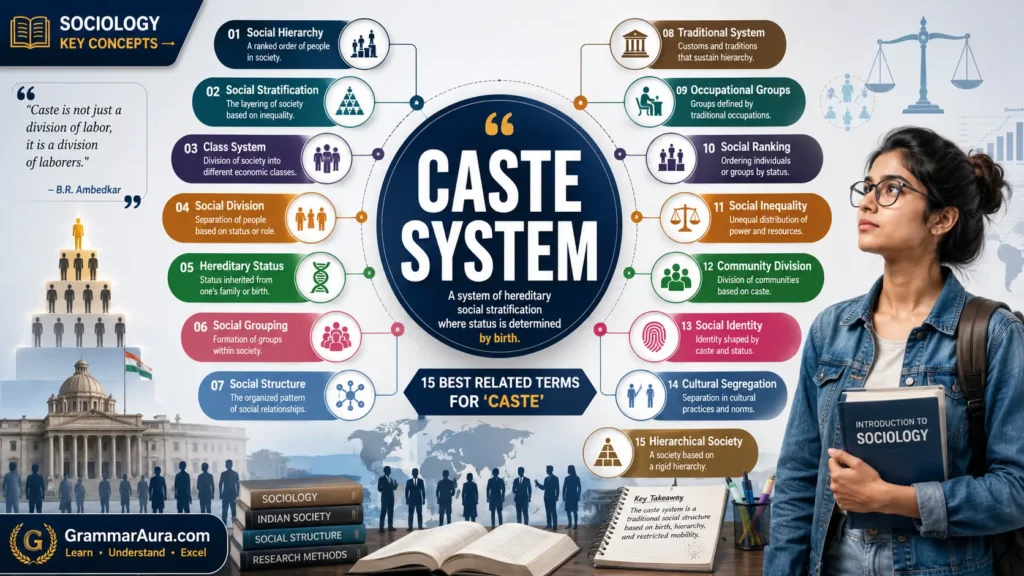

When choosing the right word in writing, I’ve found that accuracy matters, especially when discussing topics like Caste. Using accurate, respectful, and meaningful language helps readers better understand a social group or a hereditary class without confusion. From my experience, exploring alternatives is useful because different terms fit different contexts, allowing you to communicate ideas with greater clarity and sensitivity.
When discussing social structures, history, culture, or societal divisions, selecting the right synonyms can make your message more precise and balanced. I always try to choose wording that reflects the context accurately while remaining respectful and meaningful. This approach improves writing quality and helps readers understand complex topics related to Caste with more clarity and awareness.
What Does “Caste” Mean?
A caste is a social group that people are typically born into, and that may determine social status, occupation, or community membership. The term is most commonly associated with traditional social systems where movement between groups is limited. A hereditary social class or division within a society.A group of people sharing a particular social rank, status, or occupation.
When to Use “Caste”
You can use “caste” when discussing:
- Social hierarchies
- Historical social systems
- Cultural traditions
- Hereditary social groups
- Social status and divisions. The caste system influenced many aspects of daily life in the region.
Is It Professional or Polite to Say “Caste”?
Yes, “caste” is generally professional and appropriate when discussing sociology, history, anthropology, or cultural studies. However, because the term can relate to sensitive social issues, it is important to use it respectfully and accurately.
Pros and Cons of Using “Caste”
Pros
- Historically accurate
- Widely understood
- Useful in academic discussions
- Clearly describes social hierarchy
Cons
- May sound formal or technical
- Can carry sensitive cultural implications
- Not always suitable for modern social discussions
- May be misunderstood outside historical contexts
Caste Synonyms:
- Social Class
- Rank
- Stratum
- Social Group
- Community
- Order
- Estate
- Category
- Tier
- Division
- Hierarchy
- Clan
- Tribe
- Sect
- Status Group
Social Class
Meaning:
A group of people sharing similar economic or social status.
Definition:
A division of society based on wealth, education, or occupation.
Explanation:
Unlike caste, social class often allows movement between levels through education or economic success.
Example:
Many people move between social classes during their lifetime.
Best Use:
Modern sociology discussions.
Worst Use:
When referring specifically to hereditary caste systems.
Tone:
Professional, academic, neutral
Rank
Meaning:
A person’s position within a hierarchy.
Definition:
A level of status or authority.
Explanation:
Rank emphasizes standing within an organized structure.
Example:
His rank within society gave him certain privileges.
Best Use:
Hierarchy discussions.
Worst Use:
Cultural caste-specific contexts.
Tone:
Formal, professional
Stratum
Meaning:
A layer or level within society.
Definition:
One of several social layers.
Explanation:
Often used in sociology to describe divisions within populations.
Example:
The upper stratum enjoyed greater opportunities.
Best Use:
Academic writing.
Worst Use:
Casual conversation.
Tone:
Scholarly, formal
Social Group
Meaning:
A collection of people with shared characteristics.
Definition:
Individuals connected by common traits or interests.
Explanation:
A broad term that can sometimes replace caste.
Example:
The social group maintained its traditions.
Best Use:
General discussions.
Worst Use:
When hierarchy is central.
Tone:
Friendly, neutral
Community
Meaning:
A group of people sharing common interests or identity.
Definition:
A social unit with shared characteristics.
Explanation:
Less hierarchical than caste.
Example:
The community celebrated together.
Best Use:
Respectful modern communication.
Worst Use:
Strict social hierarchy descriptions.
Tone:
Warm, inclusive
Order
Meaning:
A social or organizational division.
Definition:
A class or category within a structure.
Explanation:
Historically used to describe societal divisions.
Example:
The order held specific responsibilities.
Best Use:
Historical writing.
Worst Use:
Every day casual speech.
Tone:
Formal, historical
Estate
Meaning:
A social class in traditional societies.
Definition:
One of the recognized divisions of society.
Explanation:
Frequently used in European historical contexts.
Example:
The third estate demanded reforms.
Best Use:
Historical discussions.
Worst Use:
Modern social analysis.
Tone:
Historical, academic
Category
Meaning:
A classification of people or things.
Definition:
A group sharing common characteristics.
Explanation:
A broad and flexible alternative.
Example:
People were placed into different categories.
Best Use:
General classification.
Worst Use:
Strict hierarchy discussions.
Tone:
Neutral
Tier
Meaning:
A level within a system.
Definition:
A ranked layer or stage.
Explanation:
Emphasizes levels rather than hereditary status.
Example:
They belonged to the highest tier.
Best Use:
Modern organizational structures.
Worst Use:
Traditional caste discussions.
Tone:
Professional
Division
Meaning:
A section or part of a larger group.
Definition:
A separation into categories.
Explanation:
Useful when describing social segmentation.
Example:
The division created social boundaries.
Best Use:
Analytical writing.
Worst Use:
Specific caste references.
Tone:
Objective
Hierarchy
Meaning:
A system of ranked levels.
Definition:
An arrangement according to status.
Explanation:
Focuses on ranking rather than group identity.
Example:
The hierarchy shaped opportunities.
Best Use:
Social structure discussions.
Worst Use:
Naming a specific social group.
Tone:
Formal
Clan
Meaning:
A group connected by family ties.
Definition:
A kinship-based community.
Explanation:
Emphasizes ancestry rather than social rank.
Example:
The clan preserved ancient customs.
Best Use:
Family or tribal contexts.
Worst Use:
Complex social hierarchy discussions.
Tone:
Traditional
Tribe
Meaning:
A social group united by culture or ancestry.
Definition:
A community sharing a common heritage.
Explanation:
Usually refers to ethnic or indigenous groups.
Example:
The tribe maintained its customs.
Best Use:
Anthropological discussions.
Worst Use:
General class systems.
Tone:
Cultural, respectful
Sect
Meaning:
A subgroup within a larger organization.
Definition:
A group with distinct beliefs.
Explanation:
Commonly used in religious contexts.
Example:
The sect followed unique traditions.
Best Use:
Religious discussions.
Worst Use:
Economic class descriptions.
Tone:
Formal
Status Group
Meaning:
A group sharing similar prestige or standing.
Definition:
Individuals connected by social status.
Explanation:
Focuses on social recognition and reputation.
Example:
The status group enjoyed special influence.
Best Use:
Sociological analysis.
Worst Use:
Casual conversation.
Tone:
Academic, professional
Comparison Table of Top Alternatives
| Alternative | Best For | Tone | Closest to Caste? |
| Social Class | Sociology | Professional | High |
| Rank | Hierarchy Discussions | Formal | High |
| Stratum | Academic Writing | Scholarly | High |
| Community | Inclusive Communication | Warm | Medium |
| Order | Historical Contexts | Formal | High |
| Estate | Historical Studies | Academic | High |
| Category | General Classification | Neutral | Medium |
| Tier | Organizational Levels | Professional | Medium |
| Division | Social Analysis | Objective | Medium |
| Hierarchy | Status Systems | Formal | High |
| Clan | Family Groups | Traditional | Low |
| Tribe | Cultural Contexts | Respectful | Low |
| Sect | Religious Groups | Formal | Low |
| Status Group | Sociology | Professional | High |
| Social Group | General Use | Neutral | Medium |
Final Thoughts
Choosing the right alternative to “caste” can significantly improve the clarity, sensitivity, and effectiveness of your communication. While the word itself remains useful in historical, cultural, and sociological discussions, there are many situations where terms like social class, community, social group, or social stratum may better match your intended meaning. Understanding the subtle differences between these alternatives helps you communicate with greater precision and respect for your audience.
Ultimately, the best synonym depends on the context. Academic writing may benefit from more formal options such as stratum or estate, while everyday conversations often sound more natural with words like group or community. By selecting the most appropriate term, you can discuss social structures thoughtfully, avoid misunderstandings, and create messages that feel both accurate and considerate.
FAQs
What is the closest synonym to “caste”?
The closest synonym to “caste” is often “social class.” Both terms describe groups within society that are distinguished by status, occupation, wealth, or social standing. However, caste typically implies a hereditary system, while social class may allow movement between levels. The best choice depends on whether you are discussing traditional or modern social structures.
Is “social class” the same as “caste”?
Not exactly. Social class generally refers to economic and social standing, while caste often refers to hereditary social groups with limited mobility between them. Although the two concepts can overlap, caste systems are usually more rigid. Understanding the distinction helps ensure accurate communication, especially in academic, historical, or sociological discussions involving social hierarchies.
Can I use “community” instead of “caste”?
Yes, in some contexts. Community emphasizes shared identity, culture, or interests rather than social hierarchy. If your focus is on belonging and collective experiences rather than rank or inherited status, community may be a more respectful and modern alternative. However, it may not accurately describe historical caste systems where social divisions and restrictions played a major role.
Which synonym sounds the most professional?
Social stratum, social class, and stratum are often considered the most professional alternatives. These terms frequently appear in sociology, anthropology, and academic research. They allow writers to discuss social divisions objectively while maintaining a formal tone. The most suitable choice depends on whether you’re writing for scholars, professionals, or a general audience.
Is it offensive to use the word “caste”?
The word caste is not inherently offensive, but it can be sensitive depending on the context. Because caste systems have historically been associated with inequality and discrimination, it is important to use the term accurately and respectfully. When discussing social issues, avoid stereotypes and ensure the word is used educationally or factually.
What is the difference between “rank” and “caste”?
Rank refers to a person’s position within a hierarchy, while caste refers to membership in a social group often determined by birth. Rank can change based on achievement or authority, whereas caste is traditionally hereditary. Because of this distinction, rank works better when discussing organizational structures rather than inherited social classifications.
Which synonym works best in academic writing?
For academic writing, social class, social stratum, and stratum are often the strongest choices. These terms are widely recognized in sociology and social science research. They provide precision and neutrality while allowing writers to analyze social structures, inequality, and mobility without relying exclusively on the more culturally specific concept of caste.
Can “group” replace “caste” in every situation?
No. While group is a broad and flexible word, it lacks the specific social and historical meaning associated with caste. A group can refer to any collection of people, whereas caste typically describes a structured social category. Group work works well in casual discussions but may be too general for academic or historical contexts.
What synonym is best for historical discussions?
For historical discussions, estate, order, and rank are often excellent alternatives. These words were commonly used to describe social divisions in various historical societies. They help convey the structure and hierarchy of past communities while preserving historical accuracy. Choosing the correct term depends on the specific period and culture being discussed.
Why should I use synonyms for “caste”?
Using synonyms helps make your writing more varied, precise, and audience-appropriate. Different alternatives highlight different aspects of social organization, such as hierarchy, community, status, or classification. Selecting the right word can improve readability, prevent repetition, and ensure your message accurately reflects the context you are describing while maintaining a thoughtful and respectful tone.
