
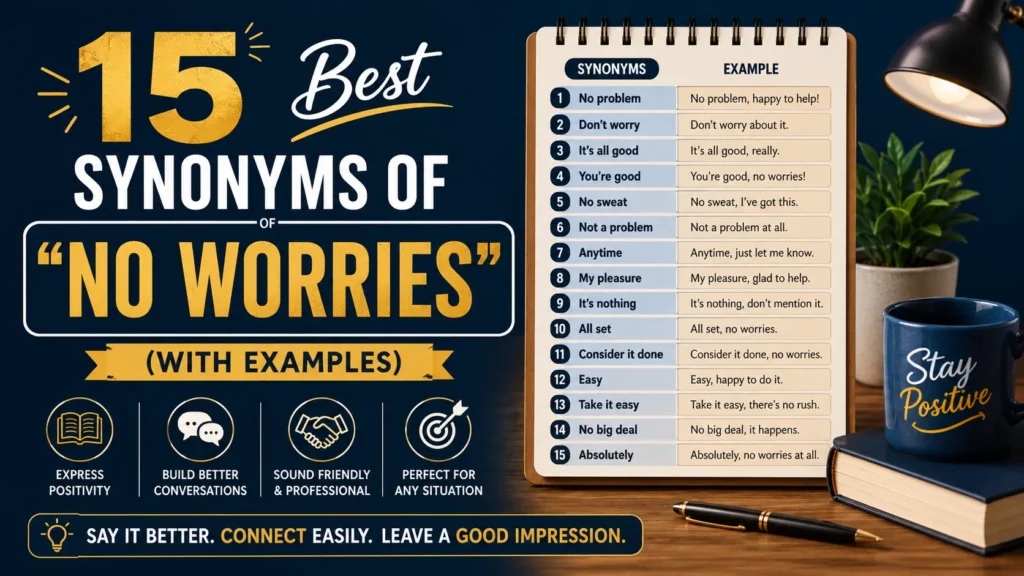

15 Best Synonyms of “No Worries” improve communication, chatting, friends, colleagues, message, writing, casual tone, reassurance, and friendliness effectively.
Sometimes, when you are chatting with friends or responding to colleagues, a simple no worries phrase can quickly put someone at ease in daily communication. But I’ve noticed that overusing or relying on it in every situation can feel too casual or impersonal in writing or email. That’s why choosing thoughtful alternatives is so important, because the right words can better convey care, reassurance, and friendliness in a warm, more genuine message.
From my experience, especially in professional and personal contexts, using more thoughtful language improves overall communication by keeping it considerate and meaningful. Instead of always saying no worries, I focus on words that feel warmer and more human, whether I’m writing or replying casually. This small shift in message style makes every interaction more respectful, calm, and supportive, improving how people feel in conversation.
What Does “No Worries” Mean?
“No Worries” is a casual expression used to reassure someone or indicate that something is not a problem. It communicates that you’re not upset, inconvenienced, or stressed about a situation. It’s widely used in everyday conversations, texts, and informal professional interactions.
When to Use “No Worries”
- Responding to thanks
- Dismissing small mistakes
- Reassuring someone
- Confirming that a task or favor is no trouble
Is It Professional or Polite to Say “No Worries”?
Yes, in informal professional contexts, especially with colleagues you know well. In formal emails or official communications, alternatives like “You’re welcome” or “It’s my pleasure” sound more polished.
Pros or Cons of Saying “No Worries”
Pros
- Casual, friendly, and approachable
- Quickly reassures someone
- Widely understood in English-speaking cultures
Cons
- Can sound too informal in professional contexts
- Overuse may seem dismissive
- Not ideal for serious or formal situations
No Worries Synonyms:
- No Problem
- Don’t Mention It
- It’s Fine
- You’re Welcome
- No Big Deal
- Not at All
- It Was My Pleasure
- Anytime
- Don’t Worry About It
- No Trouble
- All Good
- That’s Okay
- Happy to Help
- Don’t Give It a Second Thought
- It’s Nothing
No Problem
Meaning:
Indicates that the action or favor was not an inconvenience.
Explanation:
Simple, direct, and friendly. Often interchangeable with “No Worries.”
Example:
“Thanks for helping me move!” – “No problem!”
Best Use:
Casual conversations, texts, and informal professional settings.
Worst Use:
Formal emails or serious professional situations.
Tone:
Friendly, approachable.
Don’t Mention It
Meaning:
Suggests that there’s no need to feel grateful.
Explanation:
Polite and slightly formal, emphasizing humility and reassurance.
Example:
“Thanks for covering my shift.” – “Don’t mention it.”
Best Use:
Professional or personal settings where courtesy is appreciated.
Worst Use:
Very casual, playful interactions may make it sound stiff.
Tone:
Polite, considerate.
It’s Fine
Meaning:
Assures someone that everything is acceptable.
Explanation:
Neutral, calm, and reassuring.
Example:
“Sorry for being late!” – “It’s fine.”
Best Use:
Casual or semi-formal interactions.
Worst Use:
If emotional reassurance is needed, it may feel too brief.
Tone:
Neutral, calm.
You’re Welcome
Meaning:
Classic response to thanks, indicating it was no trouble.
Explanation:
Polite, universal, and professional.
Example:
“Thanks for your help!” – “You’re welcome.”
Best Use:
All settings, especially formal or professional.
Worst Use:
Informal texts may sound stiff if overused.
Tone:
Polite, professional.
No Big Deal
Meaning:
Minimizes the effort required, showing that the favor was easy.
Explanation:
Friendly and casual, it emphasizes that the action was not burdensome.
Example:
“Thanks for picking up the groceries!” – “No big deal.”
Best Use:
Casual conversations with friends or family.
Worst Use:
Professional or formal settings.
Tone:
Relaxed, casual.
Not at All
Meaning:
A formal way to say the action wasn’t inconvenient.
Explanation:
Polite and understated, often used in professional or refined contexts.
Example:
“Thank you for your assistance.” – “Not at all.”
Best Use:
Professional emails, formal conversations.
Worst Use:
Very casual chats may make it sound overly formal.
Tone:
Polite, understated.
It Was My Pleasure
Meaning:
Expresses gratitude in return, showing the favor was enjoyable.
Explanation:
More personal and warm than “No Worries.”
Example:
“Thanks for helping me prep the presentation.” – “It was my pleasure.”
Best Use:
Professional or personal settings where warmth is valued.
Worst Use:
Casual texting may feel slightly formal.
Tone:
Warm, sincere.
Anytime
Meaning:
Indicates willingness to help in the future.
Explanation:
Friendly, open, and encouraging.
Example:
“Thanks for your advice!” – “Anytime!”
Best Use:
Casual and friendly interactions.
Worst Use:
Formal professional communication.
Tone:
Friendly, approachable.
Don’t Worry About It
Meaning:
Reassures someone that there’s no need to feel guilty or concerned.
Explanation:
Softer and more conversational than “No Worries.”
Example:
“Sorry, I forgot to reply!” – “Don’t worry about it.”
Best Use:
Informal chats, emotional reassurance.
Worst Use:
Professional or formal writing.
Tone:
Gentle, supportive.
No Trouble
Meaning:
Indicates that helping was not inconvenient.
Explanation:
Polite and slightly formal alternative.
Example:
“Thanks for helping with the report.” – “No trouble.”
Best Use:
Professional or courteous situations.
Worst Use:
Very casual texting.
Tone:
Polite, neutral.
All Good
Meaning:
Casual reassurance that everything is fine.
Explanation:
Relaxed and friendly, often used in everyday conversations.
Example:
“Sorry for the delay.” – “All good.”
Best Use:
Informal chats, casual texting.
Worst Use:
Formal or professional settings.
Tone:
Casual, relaxed.
That’s Okay
Meaning:
Polite, short reassurance that everything is fine.
Explanation:
Simple and universally understood.
Example:
“Thanks for helping me move.” – “That’s okay.”
Best Use:
Casual or semi-formal settings.
Worst Use:
May feel too brief in professional emails.
Tone:
Neutral, polite.
Happy to Help
Meaning:
Shows willingness and positivity.
Explanation:
Friendly, warm, and encouraging.
Example:
“Thanks for covering my shift!” – “Happy to help.”
Best Use:
Friendly, professional, or casual situations.
Worst Use:
Overly formal contexts may prefer “It was my pleasure.”
Tone:
Warm, positive.
Don’t Give It a Second Thought
Meaning:
Reassures someone not to worry or feel bad.
Explanation:
Emphasizes that the action caused no inconvenience.
Example:
“Thanks for helping me clean up.” – “Don’t give it a second thought.”
Best Use:
Casual or informal reassurance.
Worst Use:
Formal emails may require a shorter alternative.
Tone:
Friendly, relaxed.
It’s Nothing
Meaning:
Minimizes the favor, showing it’s not a burden.
Explanation:
Short, casual, and humble.
Example:
“Thanks for lending me your notes.” – “It’s nothing.”
Best Use:
Friendly or casual settings.
Worst Use:
Formal professional communication.
Tone:
Casual, modest.
Comparison Table of Top Alternatives
| Expression | Best For | Formality | Tone |
| No Problem | Casual chats | Low | Friendly |
| It Was My Pleasure | Professional & personal | Medium | Warm |
| Don’t Mention It | Professional | High | Polite |
| Anytime | Casual/friendly | Low | Approachable |
| All Good | Texting/casual | Low | Relaxed |
| Happy to Help | Friendly & professional | Medium | Positive |
| Not at All | Formal/professional | High | Polite |
| No Big Deal | Informal | Low | Casual |
Final Thoughts
While “No Worries” is a friendly and widely recognized phrase, using thoughtful alternatives can make your communication feel more personal, warm, and considerate. Whether you’re speaking to friends, colleagues, or clients, choosing the right expression ensures your reassurance comes across clearly and sincerely. Small variations can strengthen your message and make interactions more meaningful.
The context and audience play a key role in selecting the best alternative. Casual chats call for relaxed phrases like “All Good” or “No Problem”, while professional or formal settings benefit from expressions like “It Was My Pleasure” or “Don’t Mention It”. Thoughtful word choice demonstrates attentiveness, respect, and emotional intelligence.
FAQs
Is “No Worries” too casual?
It can be, depending on context. While perfect for casual conversations and friendly texts, in formal emails or professional settings, alternatives like “It Was My Pleasure” or “Don’t Mention It” convey the same reassurance with a polished tone.
What is the best casual alternative?
Phrases like “No Problem”, “All Good”, and “It’s Nothing” work well in informal chats or texts. They sound friendly, approachable, and relaxed, making them ideal for everyday interactions with friends or colleagues.
Which alternative is best for professional settings?
“It Was My Pleasure”, “Don’t Mention It”, and “Not at All” are suitable for formal communication. They maintain politeness and professionalism while reassuring the other person that their request was not inconvenient.
Can I use these alternatives in text messages?
Yes. Casual phrases like “No Problem”, “Anytime”, and “All Good” are perfect for texting. They convey warmth and friendliness in a concise, natural way that fits digital communication.
Which alternative sounds the warmest?
“It Was My Pleasure” and “Happy to Help” are warm and sincere. They go beyond simple reassurance to show genuine willingness and care, making them ideal for personal or semi-professional contexts.
Are these phrases universally understood?
Most are widely recognized in English-speaking cultures, but casual phrases like “All Good” or “No Big Deal” may not be familiar in highly formal or cross-cultural professional contexts. Choosing alternatives depends on audience awareness.
Can these alternatives work in emails?
Yes. For professional emails, “It Was My Pleasure”, “Don’t Mention It”, or “Not at All” are appropriate. For informal emails, casual alternatives like “No Problem” or “Anytime” feel friendly and natural.
Which alternative is the most polite?
“Don’t Mention It” and “Not at All” are the most polite options. They are slightly formal, show humility, and are suitable for professional or courteous exchanges where respect is key.
Can “No Worries” be used in serious situations?
It depends. In informal contexts, it works for minor mistakes or delays. In serious situations, alternatives like “It’s Fine” or “Don’t Worry About It” sound more empathetic and reassuring.
How do I choose the right alternative?
Consider audience, context, and tone. Casual interactions benefit from relaxed expressions like “No Problem”, while professional or formal contexts require more polished phrases like “It Was My Pleasure”. Matching your choice to the situation ensures your message feels genuine, warm, and appropriate.
