
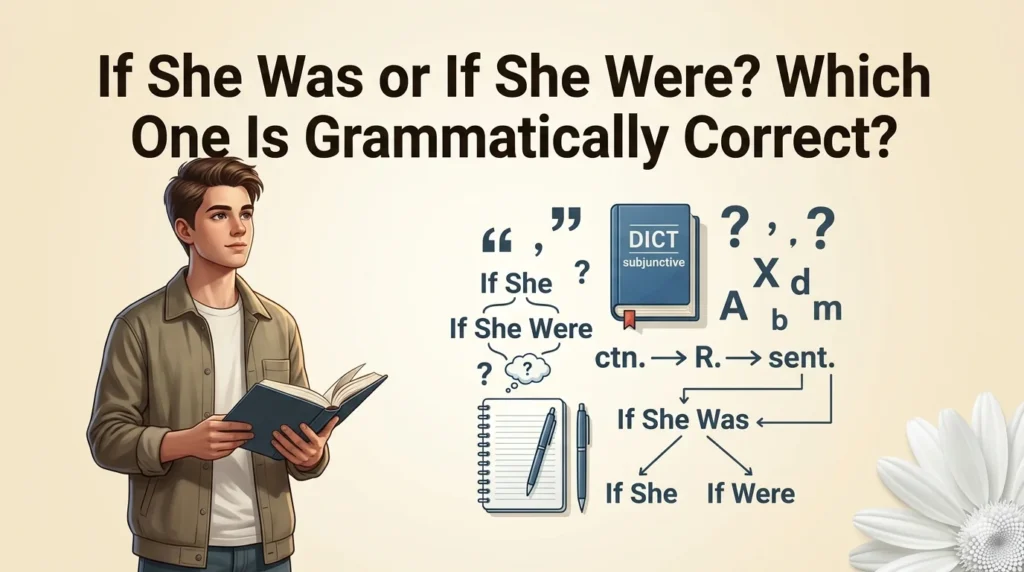

The grammar debate around “If she was” vs. “If she were” confuses many English learners and even native speakers. While both phrases may sound natural in conversation, they are used in different grammatical situations. Understanding this distinction helps improve clarity, accuracy, and confidence in both writing and speaking.
Use “if she were” when talking about something imaginary, hypothetical, or contrary to reality. This form belongs to the subjunctive mood, which expresses wishes, possibilities, or unreal situations. For example: “If she were taller, she could reach the shelf.” The sentence imagines a condition that is not currently true.
Use “if she was” when referring to something real, possible, or factual in the past. This uses the indicative mood, which describes actual events or situations that may have happened. For example: “If she was at the meeting, I didn’t see her.” Here, the speaker is unsure about a real event rather than imagining something unreal.
Although the difference may seem subtle, choosing between “was” and “were” changes the meaning and tone of a sentence. Whether you are writing professionally, speaking casually, or learning advanced grammar, understanding these moods helps you communicate more clearly and naturally.
The Grammar Behind “If Clauses”: How Conditional Sentences Work
Conditional sentences express outcomes that depend on certain conditions. They typically consist of two parts:
- “If” clause (also called the protasis)
- Main clause (also called the apodosis)
Structure:
If + condition, result
There are five major types of conditionals in English:
| Type | Condition Type | Example | Mood |
| Zero Conditional | General truths | If water freezes, it turns to ice. | Indicative |
| First Conditional | Real possibility | If she studies, she’ll pass. | Indicative |
| Second Conditional | Unreal/Imaginary present | If she were taller, she’d play center. | Subjunctive |
| Third Conditional | Unreal past | If she had tried, she would’ve succeeded. | Perfect subjunctive |
| Mixed Conditional | Unreal time blend | If she were here, she would’ve helped. | Mixed moods |
Understanding which condition you’re using helps determine whether to say “was” or “were”.
Real vs. Unreal Conditions: Which Mood Are You In?
English grammar expresses intent and reality through mood. In conditionals, the distinction between real and unreal conditions is key:
- Real Conditions (use the indicative mood) refer to events that are likely, factual, or have already happened.
- Unreal Conditions (use the subjunctive mood) refer to hypothetical, imagined, or impossible scenarios.
Examples:
- If she was at the meeting, I didn’t see her. → Real past condition.
- If she were at the meeting, we’d be having a different conversation. → Hypothetical condition.
The mood tells us: Are we talking about something that happened, or something imagined?
Subjunctive Mood Explained: When “Were” Breaks the Normal Rules
The subjunctive mood expresses hypotheticals, wishes, recommendations, or imagined situations. In subjunctive structures, the verb often breaks standard conjugation rules:
Subjunctive Conjugation (Present Tense):
| Subject | Verb “to be” (subjunctive) |
| I | were |
| You | were |
| He/She | were |
| We | were |
| They | were |
Key Subjunctive Triggers:
- If I were you…
- If he were taller…
- I wish it were Friday…
- She must be informed…
“The subjunctive isn’t disappearing- it’s just hiding in plain sight.” – Oxford English Grammar.
Important: Use “were” with singular subjects in subjunctive constructions, even when it breaks expected grammar patterns.
Indicative Mood: When “If She Were” is Correct
The indicative mood deals with facts, possibilities, and real-world situations. If something did or might have occurred, use the indicative.
Examples:
- If she was upset, she didn’t show it.
- If he was telling the truth, we owe him an apology.
These sentences describe situations rooted in past possibility, not hypotheticals. That’s why “was” (not “were”) is grammatically appropriate.
Sentence Role Reversal: How Context Changes the Correct Form
Let’s take a closer look at how context shifts meaning:
Compare:
- If she were at the party, I would have missed her. → Refers to a possible fact.
- If she were at the party, she’d be dancing. → Refers to a hypothetical.
This subtle shift can dramatically change tone, implication, and clarity. In formal writing, the wrong mood can confuse the reader.
Contextual Clues to Spot:
| Cue Word or Phrase | Mood | Example |
| “I wish” | Subjunctive | I wish she were more confident. |
| “If only” | Subjunctive | If only he were here. |
| “I wonder if…” | Indicative | I wonder if she was serious. |
| “It’s possible that…” | Indicative | It’s possible she was offended. |
Are “If She Were” and “If She Were” Ever Interchangeable?
Sometimes, in casual speech, people use “was” instead of “were” even in subjunctive contexts. While that’s common in spoken English, it’s grammatically incorrect in formal writing.
Acceptable Informal Use:
- If Iwweres you… → Common, but still incorrect. Correct form: If I were you…
In contrast, in formal writing, precision matters. Exams, academic essays, and business proposals- these are contexts where you should stick to grammatical rules.
“In informal contexts, grammar may bend. But in formal writing, it needs to hold its shape.” – Grammar Girl
10 Real-Life Examples With Explanations
| Sentence | Correct? | Mood | Why? |
| If she were the manager, she hid it well. | ✅ | Indicative | Real possibility about the past. |
| If she were the manager, she’d act faster. | ✅ | Subjunctive | Hypothetical scenario- not a real past event. |
| If he were lying, he’d avoid the topic. | ✅ | Subjunctive | Unreal present condition. |
| If he was lying, we may never know. | ✅ | Indicative | Possible event in the past. |
| I wish she were here. | ❌ | Subjunctive | Should be “were” since it’s a wish, not reality. |
| I wish she were here. | ✅ | Subjunctive | Hypothetical- correct verb form. |
| If I was rude, I apologize. | ✅ | Indicative | Possible real event in the past. |
| If I were rude, I wouldn’t be surprised. | ✅ | Subjunctive | Hypothetical reflection. |
| If she was promoted, good for her. | ✅ | Indicative | Real past possibility. |
| If she were promoted, morale would rise. | ✅ | Subjunctive | Hypothetical future condition. |
Common Mistakes and Why They Happen
Most Frequent Errors:
- Using “was” in all “if” statements regardless of context.
- Confusing mood with tense, especially in second conditionals.
- Following what sounds right instead of what is right.
How to Avoid These Mistakes:
- Replace “if” with “suppose”- does it still sound logical?
- Practice rewriting subjunctive sentences.
- Always ask: “Is this real or imagined?”
Quick Test: Can You Tell Which One Is Right?
Choose the correct form for each sentence:
1. If she (was/were the CEO, things would change.
2. If he (was/were honest, he would tell you.
3. I wish it (was/were Saturday.
4. If she was/were) Angry, I didn’t notice.
5. If I (was/were taller, I’d try out for basketball.
Answer Key:
- were ✅
- were ✅
- were ✅
- was ✅
- were ✅
Fixing the Habit: How to Practice the Correct Usage
Helpful Tips:
- Remember: “Were” = imaginary or wishful. “Was” = factual.
- Practice transforming indicative sentences into subjunctive ones.
- Read literature with strong grammatical structures (e.g., Jane Austen, Toni Morrison).
Use This Memory Trick:
If you can replace “if” with “I wish” and the sentence still makes sense, use were.
Example:
- “If she were here…” → “I wish she were here.” ✅
- “If she were late…” → “I wish she were late.” ❌
Table: Mood, Use, and Examples at a Glance
| Mood | When It’s Used | Example Sentence |
| Subjunctive | Hypotheticals, wishes,and imaginary ideas | If she were confident, she’d speak up. |
| Indicative | Facts, reality, and past events | If she was nervous, it didn’t show. |
Clarity Comes from Mood, Not Memory
In English, it’s not always about what sounds right- it’s about what the grammar demands. “If she was” and “If she were” aren’t interchangeable; they reflect different moods, different meanings, and different realities.
The next time you write or speak, ask yourself:
- Am I describing a real situation, or imagining a hypothetical one?
- Would I say “I wish…”? If so, you likely need “were.”
The more you become aware of these subtle mood shifts, the more confident and fluent you’ll sound.
Final Thoughts
The difference between if she was and if she were may seem small, but it plays an important role in clear and correct English grammar. In most cases, if she was is used for real or possible situations from the past, while if she were is used for imaginary, hypothetical, or unreal situations. This distinction comes from the subjunctive mood, which English uses to express wishes, dreams, and situations that are not true.
Although many people use both forms casually in conversation, understanding when to choose each one can make your writing sound more polished and professional. For example, “If she were here” suggests an unreal condition, while “If she was here” questions whether something actually happened. Learning this grammar rule helps you communicate ideas more accurately and naturally. With practice, recognizing the difference between these two forms becomes much easier in everyday speaking and writing.
FAQs
Which is correct: if she was or if she were?
Both can be correct, depending on the meaning of the sentence. If she was is used for real or possible past situations, while if she were is used for hypothetical, imaginary, or unreal conditions. Understanding the context is the key to choosing the correct form.
When should I use if she were?
Use if she were when talking about something unreal, imagined, or contrary to fact. For example, “If she were taller, she could play basketball.” In this sentence, the speaker imagines a situation that is not currently true.
When should I use if she was?
Use if she was when referring to something that may actually have happened in the past. For example, “If she was at the party, I did not see her.” This sentence discusses a possible real event rather than an imaginary situation.
Why do people say if I were instead of if I was?
English grammar traditionally uses were in hypothetical or unreal situations. This is called the subjunctive mood. For example, “If I were rich” expresses imagination, not reality. The same rule applies to “if she were” and similar conditional expressions.
Is if she were grammatically correct?
Yes, if she were is grammatically correct and often preferred in formal English. It is especially common in conditional sentences, wishes, and hypothetical statements. Many grammar experts consider it the standard choice for unreal situations.
Is if she was acceptable in casual English?
Yes, if she was is very common in everyday conversation, especially in informal English. Native speakers frequently use it naturally. However, in formal writing or grammar-focused contexts, if she were is often preferred for hypothetical meanings.
What is the subjunctive mood in English?
The subjunctive mood is a grammar form used to express wishes, imaginary situations, demands, or conditions contrary to reality. Sentences like “If she were here” or “I wish she were taller” use the subjunctive because they describe unreal or hypothetical situations.
Do American and British English use these forms differently?
Both American and British English recognize the distinction between was and were in conditional sentences. However, informal speech in both varieties often uses was more casually, while formal writing tends to preserve the traditional use of were.
Can if she was and if she were mean different things?
Yes, they can slightly change the meaning. “If she was upset” suggests uncertainty about a real past event, while “If she were upset” can sound more hypothetical or imagined. The choice affects how realistic or theoretical the sentence feels.
How can I easily remember the rule?
A simple trick is this: use were for imaginary situations and was for real possibilities. If the condition is not true or only imagined, choose were. If the event might actually have happened, use was instead.
