
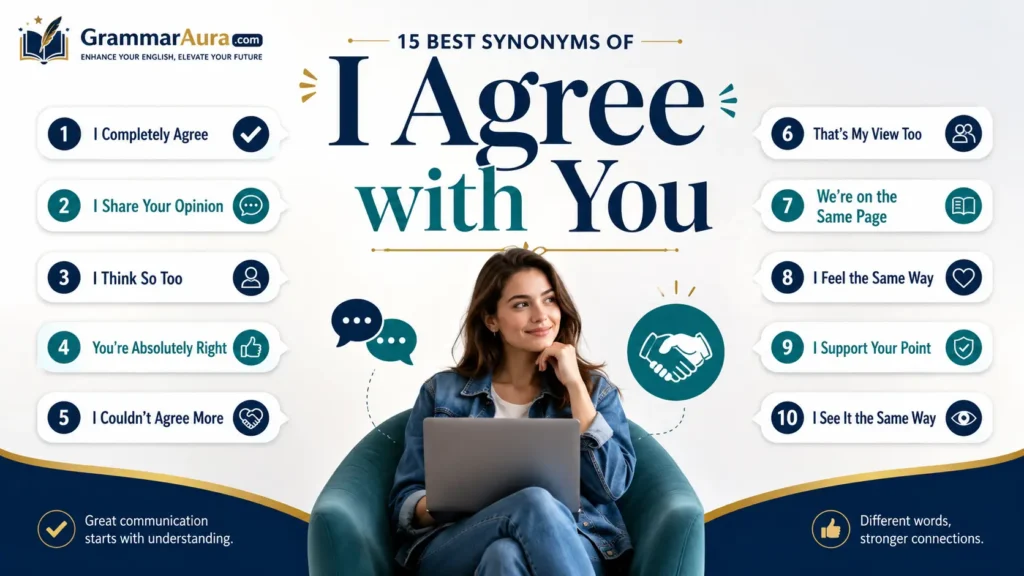

15 Best Synonyms of “I Agree with You” helps improve everyday communication by offering more natural, thoughtful, and professional ways to agree. Using alternative phrases makes your responses feel more genuine, engaging, and meaningful in both personal and professional conversations.
Agreement is about more than simply saying “I agree with you.” The words you choose can convey understanding, empathy, and genuine engagement. Thoughtful alternatives help you express support, shared understanding, and respect while making your conversations feel warmer and more memorable.
Whether you are participating in professional meetings, casual conversations, or online discussions, choosing the right phrase helps your communication sound authentic and considerate. Alternatives to “I Agree with You” express alignment and support without sounding repetitive, keeping your message clear, natural, and impactful.
What Does “I Agree with You” Mean?
The phrase “I agree with you” expresses that you share the same opinion or viewpoint as someone else. It conveys understanding, alignment, or validation of what the other person said, creating a sense of connection in communication.
When to Use “I Agree with You”
- In discussions where you want to validate someone’s point
- During meetings, debates, or brainstorming sessions
- In casual conversations, to show understanding
- When writing emails, messages, or online comments
Is It Professional/Polite to Say “I Agree with You”?
Yes. It is both professional and polite. However, using alternative phrases can make your agreement sound more thoughtful, engaging, and nuanced, especially in professional or sensitive discussions.
Pros and Cons
Pros
- Simple and clear
- Universally understood
- Polite and professional
Cons
- Can sound repetitive or plain
- Lacks emotional nuance or warmth
- Doesn’t convey enthusiasm or emphasis
I Agree with You Synonyms:
- I Totally Agree
- Absolutely
- You’re Right
- That Makes Sense
- I Couldn’t Agree More
- Exactly
- I See Your Point
- That’s True
- I Feel the Same Way
- I’m with you.
- That’s Exactly How I See It
- I Share Your View
- That’s a Good Point
- Couldn’t Have Said It Better Myself
- I’m in Complete Agreement
I Totally Agree
Meaning:
Strong agreement expressing enthusiasm.
Explanation:
Adds emphasis to your agreement, showing full alignment with the speaker.
Example:
“I totally agree! Your approach makes perfect sense.”
Best Use:
Casual conversations, team discussions, friendly debates.
Worst Use:
Formal written communication or very professional emails.
Tone:
Enthusiastic, friendly, supportive
Absolutely
Meaning:
Strong affirmation of agreement.
Explanation:
Short and impactful, conveys firm support or certainty.
Example:
“Absolutely. I think your point is spot-on.”
Best Use:
Both casual and professional conversations for emphasis.
Worst Use:
Overuse may feel abrupt or blunt.
Tone:
Confident, assertive, supportive
You’re Right
Meaning:
Confirms the correctness of someone’s statement.
Explanation:
Validates the speaker directly, showing understanding and alignment.
Example:
“You’re right. That strategy could really work.”
Best Use:
Meetings, debates, collaborative work, or advice situations.
Worst Use:
Overly casual use in very formal written reports.
Tone:
Affirmative, respectful, clear
That Makes Sense
Meaning:
Expresses logical agreement and comprehension.
Explanation:
Indicates you understand and align with the reasoning presented.
Example:
“That makes sense. I see why this approach works better.”
Best Use:
Professional discussions, emails, and problem-solving conversations.
Worst Use:
When emotional support is needed rather than logical acknowledgment.
Tone:
Thoughtful, reasonable, professional
I Couldn’t Agree More
Meaning:
Strongest way to express full agreement.
Explanation:
Emphasizes complete alignment, showing strong support or shared belief.
Example:
“I couldn’t agree more. Your suggestion is exactly what we need.”
Best Use:
Meetings, presentations, or strong consensus statements.
Worst Use:
Informal texting might feel overly dramatic.
Tone:
Emphatic, supportive, enthusiastic
Exactly
Meaning:
Concise, strong confirmation of agreement.
Explanation:
Indicates precise alignment with what was said.
Example:
“Exactly! That’s the approach I had in mind, too.”
Best Use:
Meetings, chats, or discussions that require clarity.
Worst Use:
Overuse can seem curt or repetitive.
Tone:
Direct, concise, affirmative
I See Your Point
Meaning:
Shows understanding and partial or full agreement.
Explanation:
Acknowledges the speaker’s reasoning while signaling agreement or empathy.
Example:
“I see your point. Incorporating this idea could improve the project.”
Best Use:
Collaborative discussions, debates, and negotiations.
Worst Use:
Situations requiring strong or full affirmation.
Tone:
Empathetic, thoughtful, considerate
That’s True
Meaning:
Confirms factual or logical correctness.
Explanation:
Highlights agreement on factual or objective points.
Example:
“That’s true. I hadn’t considered that perspective before.”
Best Use:
Informal and professional conversations with factual discussion.
Worst Use:
Emotional or subjective debates require empathy.
Tone:
Affirmative, neutral, supportive
I Feel the Same Way
Meaning:
Agrees with emotional alignment.
Explanation:
Shows empathy and shared perspective beyond just logical agreement.
Example:
“I feel the same way. This approach really resonates with me.”
Best Use:
Team bonding, emotional discussions, collaborative projects.
Worst Use:
Highly formal or corporate reports.
Tone:
Empathetic, friendly, supportive
I’m with you.
Meaning:
Informal expression of solidarity and agreement.
Explanation:
Conveys support and alignment, often in a friendly or motivational context.
Example:
“I’m with you. Let’s implement this plan together.”
Best Use:
Informal teamwork, brainstorming, and supportive discussions.
Worst Use:
Formal written communication or official reports.
Tone:
Supportive, friendly, motivational
That’s Exactly How I See It
Meaning:
Highlights alignment in perception and understanding.
Explanation:
Strong, thoughtful agreement expressing shared perspective.
Example:
“That’s exactly how I see it. Implementing this change makes perfect sense.”
Best Use:
Professional or formal discussions, emails, and presentations.
Worst Use:
Casual chats may find it too wordy.
Tone:
Professional, affirmative, thoughtful
I Share Your View
Meaning:
Formal expression of agreement.
Explanation:
Shows alignment while maintaining politeness and professionalism.
Example:
“I share your view. This approach aligns with our objectives.”
Best Use:
Professional meetings, reports, and academic discussions.
Worst Use:
Casual social conversations-it can sound stiff.
Tone:
Formal, polite, professional
That’s a Good Point
Meaning:
Agreement combined with acknowledgment of insight.
Explanation:
Shows appreciation for the speaker’s idea while agreeing.
Example:
“That’s a good point. We should consider this in our next plan.”
Best Use: T
team meetings, discussions, and collaborative settings.
Worst Use:
Overused in casual chat, it may feel generic.
Tone:
Supportive, friendly, considerate
Couldn’t Have Said It Better Myself
Meaning:
Expresses strong agreement and admiration for the phrasing.
Explanation:
Highlights alignment while complementing the speaker’s articulation.
Example:
“Couldn’t have said it better myself. This captures the idea perfectly.”
Best Use:
Informal and professional discussions when praising insight.
Worst Use:
Overly formal writing-it may feel colloquial.
Tone:
Supportive, friendly, enthusiastic
I’m in Complete Agreement
Meaning:
Strong, formal expression of full agreement.
Explanation:
Conveys professionalism and complete alignment, ideal for formal contexts.
Example:
“I’m in complete agreement. Let’s move forward with this plan.”
Best Use:
Formal meetings, presentations, emails, or reports.
Worst Use:
Informal conversations-it may sound too stiff.
Tone:
Formal, professional, affirmative
Comparison Table of Top Alternatives
| Phrase | Best For | Tone | Formality |
| I Totally Agree | Casual chats, team discussions | Enthusiastic, supportive | Low |
| Absolutely | Casual & professional | Confident, assertive | Medium |
| You’re Right | Meetings, advice | Affirmative, respectful | Medium |
| That Makes Sense | Problem-solving, professional | Thoughtful, professional | Medium |
| I Couldn’t Agree More | Meetings, consensus | Emphatic, enthusiastic | Medium |
| Exactly | Direct discussions | Direct, concise | Medium |
| I See Your Point | Collaborative discussions | Empathetic, considerate | Medium |
| That’s True | Factual discussions | Neutral, supportive | Medium |
| I Feel the Same Way | Emotional discussions | Empathetic, friendly | Low-Medium |
| I’m with you | Informal teamwork | Supportive, motivational | Low |
| That’s Exactly How I See It | Formal/professional | Thoughtful, affirmative | High |
| I Share Your View | Formal meetings/reports | Polite, professional | High |
| That’s a Good Point | Team discussions | Supportive, friendly | Medium |
| Couldn’t Have Said It Better Myself | Praise/discussions | Friendly, enthusiastic | Low-Medium |
| I’m in Complete Agreement | Formal meetings/reports | Formal, professional | High |
Final Thoughts
Agreeing is a subtle but powerful way to strengthen communication. By using alternatives to “I Agree with You”, you can convey alignment, empathy, and understanding in a manner that feels thoughtful, genuine, and engaging. The right phrase can make your interactions more meaningful, showing that you not only hear but also value the other person’s perspective.
Choosing the best alternative depends on context, audience, and tone. Casual phrases like “I’m with you” or “I feel the same way” foster warmth and friendliness, while formal expressions like “I’m in complete agreement” or “I share your view” maintain professionalism and respect. Tailoring your agreement ensures clarity, connection, and a positive impression in any conversation.
FAQs
When should I use alternatives to “I Agree with You”?
Use alternatives when you want to express alignment with warmth, enthusiasm, or nuance. Different phrases can suit casual chats, professional meetings, or emotional conversations, making your agreement feel more authentic and thoughtful.
Which alternative is best for professional emails?
Phrases like “I’m in complete agreement”, “I share your view”, or “That makes sense” convey agreement respectfully and professionally, making them ideal for corporate communications or formal correspondence.
Can I use casual alternatives in formal settings?
Casual phrases like “I totally agree” or “I’m with you” are best for informal interactions. In formal settings, stick to more professional and polished expressions to maintain credibility and respect.
Are some alternatives better for showing empathy?
Yes. Phrases like “I feel the same way” or “I see your point” express emotional understanding, showing that you connect not just intellectually but also emotionally with the speaker.
Which phrases are best for team meetings?
Use phrases like “That’s a good point”, “I couldn’t agree more”, or “Exactly” to highlight agreement while promoting collaboration and discussion in team-based environments.
Can I combine alternatives for emphasis?
Absolutely. Combining phrases, like “I totally agree, that’s exactly how I see it”, can add emphasis, enthusiasm, and clarity, making your agreement more engaging and persuasive.
Is it okay to use these phrases in instant messaging?
Yes. Casual expressions such as “Absolutely”, “I’m with you”, or “You’re right” are perfect for messaging apps, making your responses friendly and relatable without losing clarity.
How do I avoid sounding repetitive?
Rotate between alternatives based on tone and context. Use stronger phrases for emphasis, lighter phrases for casual agreement, and empathetic ones for emotional connection to keep your communication fresh and engaging.
Can these phrases strengthen professional relationships?
Yes. Thoughtful agreement conveys active listening, respect, and understanding, which foster trust and collaboration, enhancing your credibility and strengthening professional bonds.
Are some alternatives better for debates or discussions?
Yes. Phrases like “I see your point”, “That makes sense”, or “Exactly” allow you to agree while remaining analytical and respectful, promoting constructive debate without dismissing others’ opinions.
