
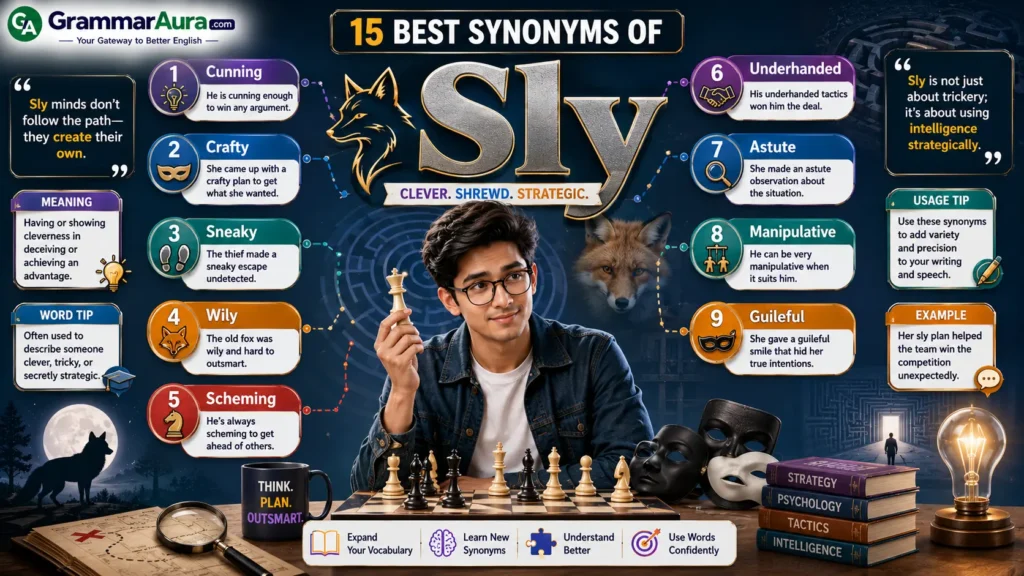

15 Best Synonyms of “Sly” (With Examples) help you understand sly behavior, meaning, and tone while improving clarity and expression in everyday writing.
When we talk about sly, choosing the right word can completely change the message and how it is understood, especially when aiming for clearer communication in any situation. From my experience, using the correct synonym improves the meaning with better precision, emotional balance, and care, especially when describing subtle behavior. A single word can shift how someone’s personality or behavior is seen, whether it feels clever, sneaky, or quietly intelligent, depending on the context, so the thoughtful way of choosing the right word helps express intelligent behavior more accurately.
From my perspective, using sly in the right context helps the reader better understand the message behind a person’s actions. A good synonym supports a clearer description of behavior while keeping emotional balance and proper care in tone. When we pick the right word, it improves how we present subtle behavior and gives deeper meaning to personality traits with more clarity. This approach ensures higher precision in communication and allows us to express ideas in a more thoughtful way, especially when explaining intelligent behavior that may appear both clever and sneaky depending on the situation.
What Does “Sly” Mean?
Sly describes someone or something as clever in a sneaky, secretive, or cunning way. It can be positive (smart and clever) or negative (deceptive or tricky), depending on context. Acting in a way that is clever but slightly secretive or deceitful.
- “He gave a sly smile after the joke.”
- “That was a sly trick to win the game.”
When to Use “Sly”
You use sly when:
- Describing subtle cleverness or trickery
- Talking about hidden intentions
- Writing stories or character descriptions
- Highlighting playful or sneaky behavior
Examples:
- “She gave a sly look.”
- “It was a sly move in the negotiation.”
Is It Professional/Polite to Say “Sly”?
Sly is acceptable in casual and creative writing, but it can sometimes sound negative or suspicious. In professional settings, softer alternatives like clever, strategic, or astute are often preferred depending on tone.
Pros and Cons of Using “Sly”
Pros:
- Strong descriptive word
- Works well in storytelling
- Can describe both cleverness and mischief
Cons:
- May sound negative or untrustworthy
- Not ideal for formal writing
- Can be misunderstood without context
Sly Synonyms:
- Cunning
- Crafty
- Sneaky
- Shrewd
- Devious
- Wily
- Slyly Smart
- Astute
- Foxy
- Calculating
- Canny
- Tricky
- Sly Fox
- Manipulative
- Clever
Cunning
Meaning:
Skillful in achieving goals, often in a sneaky way.
Definition:
Clever but sometimes deceptive behavior.
Explanation:
Often used for strategic thinking or trickery.
Example:
“He used a cunning plan to win.”
Best Use:
Storytelling and strategy discussions.
Worst Use:
Formal praise contexts.
Tone:
Clever but slightly negative
Crafty
Meaning:
Skilled at getting what one wants through clever tricks.
Definition:
Smart and resourceful, sometimes sneaky.
Explanation:
Can be playful or suspicious depending on the tone.
Example:
“The crafty fox escaped the trap.”
Best Use:
Animal descriptions or stories.
Worst Use:
Professional evaluation.
Tone:
Playful and clever
Sneaky
Meaning:
Acting in a secretive or hidden way.
Definition:
Doing something quietly or without being noticed.
Explanation:
Often informal and slightly negative.
Example:
“He made a sneaky move in the game.”
Best Use:
Casual conversation.
Worst Use:
Formal writing.
Tone:
Informal and secretive
Shrewd
Meaning:
Very smart and good at making decisions.
Definition:
Practical intelligence with sharp judgment.
Explanation:
Usually positive and professional.
Example:
“She made a shrewd investment.”
Best Use:
Business and leadership contexts.
Worst Use:
Childlike behavior descriptions.
Tone:
Smart and professional
Devious
Meaning:
Deliberately misleading or tricky.
Definition:
Using indirect or dishonest methods.
Explanation:
Often negative and serious.
Example:
“He took a devious path to success.”
Best Use:
Conflict or character analysis.
Worst Use:
Compliments.
Tone:
Negative and serious
Wily
Meaning:
Clever in a tricky or cunning way.
Definition:
Skilled at using intelligence to deceive.
Explanation:
Often used in storytelling.
Example:
“The wily cat caught the mouse.”
Best Use:
Creative writing.
Worst Use:
Formal praise.
Tone:
Clever and slightly mischievous
Slyly Smart
Meaning:
Clever in a subtle, hidden way.
Definition:
Intelligent with a hint of secrecy.
Explanation:
Modern phrase combining intelligence and subtlety.
Example:
“He slyly solved the problem.”
Best Use:
Informal storytelling.
Worst Use:
Academic writing.
Tone:
Modern and playful
Astute
Meaning:
Very sharp and perceptive.
Definition:
Quick to understand situations accurately.
Explanation:
Highly positive synonym.
Example:
“She is an astute observer.”
Best Use:
Professional and academic contexts.
Worst Use:
Trickery contexts.
Tone:
Positive and intelligent
Foxy
Meaning:
Clever or attractive in a sneaky way.
Definition:
Slang term for smart and charming behavior.
Explanation:
Can be playful or flirtatious.
Example:
“He used a foxy trick to win.”
Best Use:
Casual speech.
Worst Use:
Formal writing.
Tone:
Playful and informal
Calculating
Meaning:
Carefully planning for personal gain.
Definition:
Strategic and sometimes manipulative thinking.
Explanation:
Often negative or neutral, depending on tone.
Example:
“She made a calculating decision.”
Best Use:
Character analysis.
Worst Use:
Compliments.
Tone:
Neutral to negative
Canny
Meaning:
Smart and careful in dealing with people.
Definition:
Practical intelligence and awareness.
Explanation:
Often used in British English.
Example:
“He made a canny move in business.”
Best Use:
Professional discussions.
Worst Use:
Fantasy writing.
Tone:
Smart and practical
Tricky
Meaning:
Difficult or deceptive.
Definition:
Something that requires careful handling.
Explanation:
Used for both situations and people.
Example:
“That was a tricky question.”
Best Use:
Casual and descriptive writing.
Worst Use:
Formal praise.
Tone:
Neutral and slightly negative
Sly Fox
Meaning:
A clever and sneaky person.
Definition:
Metaphor for intelligent trickery.
Explanation:
Often used playfully.
Example:
“He’s a sly fox in negotiations.”
Best Use:
Storytelling and idioms.
Worst Use:
Professional writing.
Tone:
Playful and expressive
Manipulative
Meaning:
Influencing others in a controlling way.
Definition:
Using clever but unethical tactics.
Explanation:
Strong negative connotation.
Example:
“That was a manipulative tactic.”
Best Use:
Psychological or character analysis.
Worst Use:
Positive descriptions.
Tone:
Negative and critical
Clever
Meaning:
Quick to understand or solve problems.
Definition:
General intelligence and smart thinking.
Explanation:
Neutral and widely positive synonym.
Example:
“That was a clever solution.”
Best Use:
Every day and for professional use.
Worst Use:
Deceptive behavior descriptions.
Tone:
Positive and neutral
Comparison Table of Top Alternatives
| Alternative | Meaning | Best Use | Tone |
| Cunning | Clever but tricky | Storytelling | Slightly negative |
| Crafty | Skillfully sneaky | Casual stories | Playful |
| Sneaky | Secretive behavior | Informal talk | Informal |
| Shrewd | Smart judgment | Business | Positive |
| Devious | Dishonest cleverness | Character analysis | Negative |
| Wily | Clever trickery | Fiction | Mischievous |
| Astute | Highly perceptive | Professional use | Positive |
| Calculating | Strategically self-serving | Analysis | Neutral/negative |
| Canny | Practical intelligence | Business | Smart |
| Clever | General intelligence | Everyday use | Positive |
Final Thoughts
Understanding the different meanings behind “sly” and its synonyms helps you express personality traits with much greater accuracy and emotional balance. Whether you choose astute, clever, crafty, or cunning, each word carries its own shade of meaning that can shift how your message is received. This makes your communication more thoughtful, expressive, and context-aware.
In everyday writing and conversation, selecting the right synonym allows you to describe behavior without misunderstanding or exaggeration. Some words highlight intelligence, while others lean toward mischief or manipulation. By choosing carefully, you can ensure your tone stays aligned with your intent, making your communication clearer, more human, and more meaningful.
FAQs
What is the simplest synonym of “sly”?
The simplest synonym of sly is clever or crafty, depending on context. These words are easy to understand and commonly used in everyday speech. They help describe someone smart or sneaky without sounding too harsh or overly negative in most casual conversations.
Is “sly” a positive or negative word?
The word sly can be both positive and negative. It is positive when it suggests cleverness or wit, but negative when it implies deception or dishonesty. The meaning depends heavily on context, tone, and how the behavior is being described in a sentence or situation.
What is a positive synonym of “sly”?
Positive synonyms of sly include astute, clever, and shrewd. These words highlight intelligence, quick thinking, and good judgment rather than trickery. They are often used in professional, academic, or respectful contexts where admiration is intended rather than criticism.
Is “crafty” the same as “sly”?
Crafty is very similar to sly, but it often feels slightly more playful or creative. While both can suggest cleverness and trickery, crafty is more commonly used in storytelling or casual speech, whereas sly may carry a slightly more secretive tone depending on context.
What is the most formal synonym of “sly”?
Some of the most formal synonyms of sly include astute, calculating, and shrewd. These words are used in professional, academic, or analytical writing. They describe intelligence and strategic thinking in a more structured and less emotional way than sly.
Can “sly” describe a person positively?
Yes, sly can describe a person positively when it refers to cleverness, humor, or wit. For example, a “sly smile” can suggest playful intelligence. However, it may still carry a slightly secretive tone, so context is important when using it in a positive way.
What is the difference between “sly” and “devious”?
Sly can be playful or clever, while devious is more strongly negative. Devious clearly suggests dishonest or manipulative behavior, whereas sly can sometimes be lighthearted or harmless depending on the situation. Devious almost always has a critical or disapproving tone.
Is “astute” better than “sly”?
Astute is generally considered more positive than sly. It highlights intelligence, sharp thinking, and good judgment without suggesting secrecy or trickery. It is often preferred in professional or academic settings where clarity and respect are important.
When should I avoid using “sly”?
You should avoid using sly in formal, professional, or sensitive situations where tone matters. Because it can imply secrecy or dishonesty, it may be misunderstood. In such cases, safer alternatives like clever, shrewd, or astute are better choices.
Why should I use synonyms for “sly”?
Using synonyms for sly helps you control tone and avoid misunderstandings. Different words highlight different shades of meaning, such as intelligence, trickery, or strategy. Choosing carefully ensures your message is clearer, more precise, and better suited to your audience and intent.
