
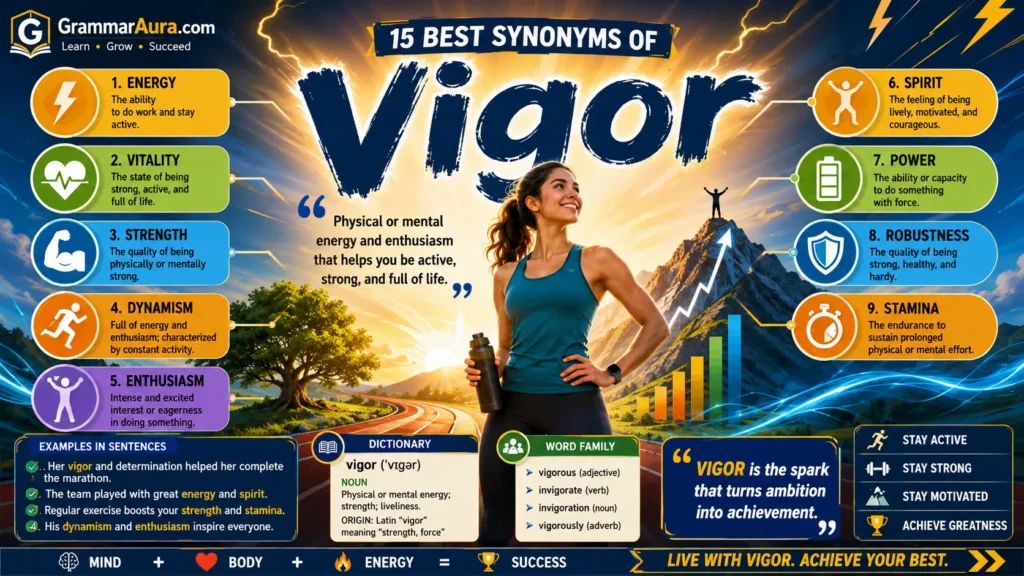

15 Best Synonyms of “Vigor” (With Examples) explores how choosing the right word for vigor improves clarity, tone, and expressive writing.
Choosing the Choosing of the right word for vigor in writing is not only about clarity, but also about how it can communicate emotionally with warmth in a natural tone and strong expression. It should feel powerful and full of enthusiasm, bringing energy and strength into the sentence. From experience, this kind of word choice helps the reader connect better, especially when the idea describes motivation, health, or personality in a way that feels engaging and alive. A good synonym or alternative must match the idea precisely, so the meaning stays clear and easy to understand.
When I work on writing, I often think about how one word changes expression and creates a powerful feeling of energy and action. The word vigor should feel natural, smooth, and fit the tone in a way that keeps the sentence engaging and alive. This is why choosing the right synonym is important, because it can help the message stay clear while sounding emotionally strong. A good match between alternatives and ideas describes stronger strength, motivation, and enthusiasm in content.
What Does “Vigor” Mean?
Vigor means physical strength, mental energy, or enthusiastic activity. It describes a strong and lively state of being—the state of being strong, active, and full of energy or enthusiasm.
- “She worked with great vigor.”
- “The plant grew with renewed vigor.”
When to Use “Vigor”
You use vigor when:
- Describing physical energy or strength
- Talking about enthusiasm or motivation
- Writing about health, activity, or performance
- Expressing intensity or liveliness
Examples:
- “He attacked the task with vigor.”
- “The team played with vigor.”
Is It Professional/Polite to Say “Vigor”?
Yes, vigor is professional, neutral, and widely accepted in both formal and informal contexts. However, depending on the tone, you might choose alternatives such as energy, vitality, or enthusiasm for simpler or more emotional expression.
Pros and Cons of Using “Vigor”
Pros:
- Strong and expressive word
- Works in formal and informal writing
- Clearly conveys energy and strength
Cons:
- Slightly formal for casual speech
- Can feel abstract in emotional contexts
- Limited variety in everyday conversation
Vigor Synonyms:
- Energy
- Vitality
- Strength
- Power
- Stamina
- Liveliness
- Spirit
- Zest
- Pep
- Dynamism
- Force
- Verve
- Drive
- Exuberance
- Animation
Energy
Meaning:
The ability to be active and strong.
Definition:
A general term for physical or mental power.
Explanation:
The most common synonym for vigor is used daily.
Example:
“She has a lot of energy today.”
Best Use:
Everyday conversation and writing.
Worst Use:
Highly poetic contexts.
Tone:
Simple and universal
Vitality
Meaning:
Strong and active life force.
Definition:
The state of being lively and healthy.
Explanation:
Often used in health and wellness contexts.
Example:
“He is full of vitality.”
Best Use:
Health, lifestyle, and motivation writing.
Worst Use:
Casual slang.
Tone:
Positive and uplifting
Strength
Meaning:
Physical or mental power.
Definition:
Ability to endure or exert force.
Explanation:
Used in both emotional and physical contexts.
Example:
“She showed great strength.”
Best Use:
Fitness, resilience, motivation.
Worst Use:
Light emotional tone.
Tone:
Strong and stable
Power
Meaning:
Ability to influence or act strongly.
Definition:
Force or energy to perform actions.
Explanation:
A more intense synonym of vigor.
Example:
“The engine runs with power.”
Best Use:
Technology and leadership.
Worst Use:
Soft emotional writing.
Tone:
Intense and strong
Stamina
Meaning:
Ability to sustain effort over time.
Definition:
Endurance and long-lasting energy.
Explanation:
Common in sports and fitness.
Example:
“He has great stamina.”
Best Use:
Athletics and physical performance.
Worst Use:
Emotional expression.
Tone:
Enduring and athletic
Liveliness
Meaning:
Full of life and spirit.
Definition:
Energetic and animated behavior.
Explanation:
Used for personality and mood.
Example:
“The room was full of liveliness.”
Best Use:
Social and descriptive writing.
Worst Use:
Technical contexts.
Tone:
Cheerful and bright
Spirit
Meaning:
Inner energy or enthusiasm.
Definition:
Emotional and motivational force.
Explanation:
Often used in inspirational contexts.
Example:
“She showed great spirit.”
Best Use:
Motivational writing.
Worst Use:
Scientific description.
Tone:
Emotional and uplifting
Zest
Meaning:
Great enthusiasm or excitement.
Definition:
Energetic enjoyment of something.
Explanation:
Often used for personality traits.
Example:
“He approached life with zest.”
Best Use:
Positive lifestyle writing.
Worst Use:
Formal reports.
Tone:
Fun and energetic
Pep
Meaning:
Lively energy and enthusiasm.
Definition:
Quick, cheerful energy.
Explanation:
Casual and informal term.
Example:
“She had a lot of pep today.”
Best Use:
Casual conversation.
Worst Use:
Academic writing.
Tone:
Light and playful
Dynamism
Meaning:
Active and forceful energy.
Definition:
Constant movement and change.
Explanation:
Used in business and leadership.
Example:
“The team showed dynamism.”
Best Use:
Professional environments.
Worst Use:
Casual speech.
Tone:
Modern and professional
Force
Meaning:
Strong physical or mental energy.
Definition:
Power that causes action.
Explanation:
More intense synonym of vigor.
Example:
“The wind hit with force.”
Best Use:
Scientific or physical descriptions.
Worst Use:
Emotional tone.
Tone:
Strong and direct
Verve
Meaning:
Great enthusiasm and energy.
Definition:
Exciting liveliness in action.
Explanation:
Often used in creative performance.
Example:
“She performed with verve.”
Best Use:
Arts and performance.
Worst Use:
Technical writing.
Tone:
Creative and expressive
Drive
Meaning:
Inner motivation and determination.
Definition:
Force that pushes action forward.
Explanation:
Used in career and personal growth.
Example:
“He has a strong drive.”
Best Use:
Career and success topics.
Worst Use:
Physical energy description.
Tone:
Motivational and strong
Exuberance
Meaning:
Overflowing energy and excitement.
Definition:
High emotional and physical energy.
Explanation:
Very expressive and emotional term.
Example:
“She showed youthful exuberance.”
Best Use:
Creative and emotional writing.
Worst Use:
Formal reports.
Tone:
Joyful and expressive
Animation
Meaning:
Lively and energetic movement.
Definition:
State of being full of life.
Explanation:
Used for both people and expressions.
Example:
“He spoke with animation.”
Best Use:
Descriptive storytelling.
Worst Use:
Technical contexts.
Tone:
Lively and expressive
Comparison Table of Top Alternatives
| Alternative | Meaning | Best Use | Tone |
| Energy | General activity power | Everyday use | Simple |
| Vitality | Life energy | Health/wellness | Positive |
| Strength | Physical/mental power | Motivation | Strong |
| Power | Strong force | Leadership | Intense |
| Stamina | Endurance | Sports | Athletic |
| Liveliness | Active spirit | Social tone | Cheerful |
| Spirit | Inner enthusiasm | Motivation | Emotional |
| Zest | Excitement | Lifestyle | Fun |
| Pep | Light energy | Casual talk | Playful |
| Dynamism | Active force | Business | Professional |
Final Thoughts
Understanding the word vigor and its many synonyms gives you more control over how you express energy, emotion, and strength in communication. Whether you choose energy, stamina, or exuberance, each word carries a slightly different shade of meaning. These subtle differences help you describe people, actions, and moods in a way that feels more accurate and naturally expressive.
In everyday writing and speech, the right synonym can completely change how your message feels to others. Some words highlight physical strength, while others emphasize emotional enthusiasm or inner motivation. By choosing carefully, you can make your communication clearer, more engaging, and more connected to the tone you truly want to convey.
FAQs
What is the simplest synonym of “vigor”?
The simplest synonym of vigor is energy. It is widely used in everyday conversation and clearly describes physical or mental activity. Unlike more formal terms, energy is easy to understand and fits naturally in casual speech, making it the most accessible alternative for most situations.
Is “vigor” a positive word?
Yes, vigor is generally a positive word. It describes strength, enthusiasm, and active energy. It is often used to highlight someone’s healthy or powerful state, whether physically or mentally. In most contexts, it carries an encouraging and uplifting meaning.
What is the difference between vigor and stamina?
Vigor refers to overall energy and liveliness, while stamina specifically refers to endurance over time. Vigor is about intensity and enthusiasm, whereas stamina focuses on how long someone can maintain effort or performance, especially in physical activities.
What is the most formal synonym of vigor?
The most formal synonyms of vigor include dynamism, vitality, and strength. These words are commonly used in academic, medical, or professional writing to describe energy, life force, or active performance in a structured and precise way.
Can vigor describe personality?
Yes, vigor can describe personality when referring to someone energetic, lively, or enthusiastic. In this case, synonyms like zest, spirit, or liveliness are often used to express a more emotional or character-based form of energy.
Is “vitality” the same as vigor?
Vitality and vigor are very similar, but not identical. Vitality often emphasizes life force and health, while vigor focuses more on strength and energetic activity. Both describe positive energy, but vitality is slightly more connected to wellness and long-term health.
What synonym of vigor is best for sports?
For sports contexts, stamina, strength, and energy are the best synonyms. These words describe physical performance, endurance, and active movement, making them ideal for athletic descriptions, training discussions, and competitive environments.
Is “zest” a good synonym for vigor?
Yes, zest is a good synonym for vigor, especially when describing enthusiasm and excitement. However, it is more emotional and playful than physical. It is best used when describing personality, attitude, or enjoyment rather than physical strength.
Can vigor be used in formal writing?
Yes, vigor is suitable for formal writing, especially in academic, scientific, or descriptive contexts. It is a neutral and widely accepted term that clearly conveys energy or strength without sounding too casual or overly emotional.
Why should I use synonyms for vigor?
Using synonyms for vigor helps you avoid repetition and improve clarity in communication. Different words highlight different aspects of energy—such as emotion, strength, or endurance—allowing you to express ideas more precisely and make your writing more engaging and natural.
