
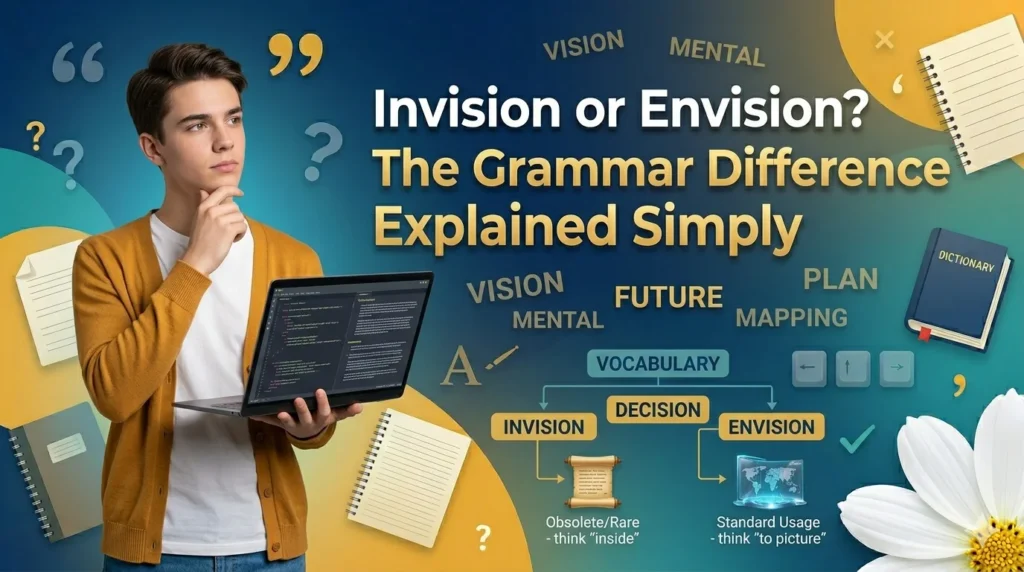

Many speakers and writers face a common mix-up between Invision and Envision because they sound almost the same, but their meanings differ. Invision or Envision – Which Is Correct? is a question often asked by those wanting to express their ideas clearly without confusion or error.
When it comes to spelling, even small differences can trip us up. One common puzzle many face is whether to write “invision” or “envision.” You might have seen both forms floating around, but only one holds the crown as correct English. This article will clear up the confusion once and for all, showing you exactly why “envision” is the right choice, how to use it effectively, and how to avoid the trap of misspelling it as “invision.”
To be careful, the better choice is envisioning, which means to think about or imagine something clearly before it happens. On the other hand, Invision is not a proper English word; it is mostly a brand name, not a verb. Knowing this helps you avoid confusion and ensures your message is clear and smooth.
Understanding the Meaning of Envision
To start, what does envision mean? The word is a verb that means to picture something in your mind before it happens. When you envision something, you imagine a future event, goal, or outcome clearly and in detail.
- Example: She envisions a future where technology makes education accessible to everyone.
- Example: I can envision the celebration after we win the championship.
This word is powerful because it helps express creativity, planning, and foresight. Whether you’re a leader, writer, or dreamer, envision is a go-to verb for talking about ideas and possibilities.
The Origins and History of Envision
Words have stories, and envision has an interesting one. It stems from the Latin roots:
- “en” meaning “in” or “within.”
- “vision” meaning “sight” or “seeing.”
Together, it means “to see within.” This word entered English in the 17th century and has since evolved into the common verb we use today.
Unlike some words that have undergone drastic spelling changes over time, envision has remained relatively stable. The clarity of its components (en + vision) helps reinforce its correct spelling and meaning.
Language naturally shifts, but envision‘s roots keep it firmly spelled the way it is. This history explains why “invision” is not a valid variant: it simply breaks the word into parts that don’t match the original meaning or standard English formation.
Why “Invision” Is Incorrect and a Common Misspelling
You might ask, ” Why do so many people type “invision” if it’s wrong? The answer lies partly in phonetics and partly in assumptions.
Phonetically, “envision” and “invision” sound very similar, especially in casual speech. The soft “en” at the start can easily be misheard as “in.” Plus, since “in” is a common prefix in English (think “inside,” “input,” “inbox”), some might assume “invision” is a correct variant.
But here’s the catch:
| Reason | Explanation |
| Phonetic similarity | Sounds like “vision,” leading to confusion. |
| Familiar prefix “in.” | People assume it fits common patterns. |
| Lack of recognition | Spellcheck or writing tools may not catch it. |
| Brand Influence | Some companies use “Invision” as a brand name. |
Indeed, a popular software company uses “Invision” as its brand name, which adds to the confusion online. However, as a word in English, “invision” has no place in standard dictionaries.
Correct Usage of Envision in Modern English
Now that you know envision is correct, let’s look at how to use it confidently.
Envision in Sentences
- Use it when talking about imagining something future-oriented.
- Usually followed by a noun or clause describing what’s being imagined.
Examples:
- We envision a greener planet.
- Can you envision how this project will impact the community?
- They envisioned success despite the challenges.
American vs. British English Usage
There is no difference in spelling or meaning of envision between American and British English. Both varieties use the same form, making it easier to remember.
However, British English may prefer synonyms like “envisage” for some contexts, which is a subtle nuance but not a replacement for envision.
Synonyms and Related Words for Envision
If you want to diversify your writing, here are some powerful alternatives to envision, along with their slight shades of meaning:
| Word | Meaning/Usage |
| Imagine | To form a mental image, often more casually. |
| Visualize | To form a vivid mental picture, often detailed. |
| Picture | To imagine vividly or in detail. |
| Envisage | To contemplate or conceive is more common in British English. |
| Foresee | To predict or expect based on insight. |
| Anticipate | To expect or look forward to something. |
Choosing the right synonym depends on the tone and precision you want. For example, visualize often implies a detailed mental image, while envision tends to be broader and more conceptual.
Practical Tips to Avoid Spelling Mistakes
Here are some simple, memorable ways to nail the spelling of envision every time:
- Think of the root “vision” first. The word ends with “vision,” just like “television” or “revision.”
- Remember the prefix “en-” means “in.” So, envision means “see within.”
- Avoid confusing “in” with “en-.” “En” often means “to cause” or “put into” in English verbs (like “encourage” or “enable”).
- Use mnemonics: “Envision starts with ‘en’ like entering your mind’s eye.”
- Spellcheck helps, but don’t rely fully on it. Some autocorrects might miss this error due to brand names or slang.
Real-World Examples: Envision in Action
Using envision correctly can improve your writing in business, education, and creative fields. Here are examples from different areas:
| Context | Example Sentence |
| Business | The CEO envisioned a global expansion within five years. |
| Education | Teachers encourage students to envision their career goals early. |
| Literature | The author envisioned a dystopian future filled with challenges. |
| Technology | Innovators envision new gadgets that transform everyday life. |
The correct use of envision helps you sound confident, clear, and professional.
Summary Table: Envision vs Invision
| Aspect | Envision | Invision |
| Meaning | To imagine or picture in the mind | Not a valid English word |
| Spelling | Starts with “en” + “vision” | Incorrect prefix “in” + “vision” |
| Usage | Standard verb in English | Brand name or misspelling only |
| American/British Use | Same spelling, widely accepted | Not accepted in any dialect |
| Common Confusion | Similar-sounding, often mixed up | Caused by phonetics and brand influence |
Conclusion
Understanding the difference between Invision or Envision can make your writing clearer, more professional, and more natural. While envision is a widely accepted English verb that means to imagine or picture something in the future, InVision is mainly recognized as a brand name connected to digital design and collaboration tools. That is why confusing the two can easily change the meaning of a sentence.
In everyday grammar and communication, envision is usually the correct choice when discussing goals, ideas, plans, or imagination. Whether you are writing business emails, academic papers, blog posts, or casual messages, using the right term improves both readability and credibility.
Language often contains words that sound similar but serve very different purposes. By learning the distinction between Invision or Envision, you can avoid common writing mistakes and communicate your ideas with greater confidence. Small grammar choices like this often create a big impact on how polished your writing feels.
FAQs
What is the difference between Invision and Envision?
Envision is a dictionary word that means to imagine or picture something clearly in your mind. InVision is commonly known as a company or brand name in the design industry. In normal writing, envision is usually the correct grammatical choice when talking about ideas, goals, or plans.
Is Invision a real English word?
The spelling Invision is not commonly recognized as a standard English verb in modern dictionaries. Most people actually mean envision when they write it. However, InVision may appear as a proper noun referring to a software or technology brand.
When should I use Envision?
You should use envision when describing imagination, future thinking, planning, or visualizing possibilities. For example, you can say, “I envision a successful future,” or “The company envisions global growth.” It is commonly used in professional, academic, and creative writing.
Why do people confuse Invision and Envision?
People often confuse these words because they sound very similar when spoken aloud. In addition, the popularity of the InVision brand has made the spelling more familiar online. As a result, writers sometimes accidentally replace the correct word envision with Invision.
Is it envisioned as formal or informal?
Envision works well in both formal and informal writing. It is commonly used in business communication, essays, presentations, and everyday conversation. Because it sounds thoughtful and professional, many writers prefer it when discussing goals, innovation, or future ideas.
Can envision be used in business writing?
Yes, envision is frequently used in business writing. Companies often use it when discussing strategy, leadership, innovation, or future objectives. Phrases like “We envision growth” or “The team envisions success” are common in professional communication and corporate presentations.
Is envision grammatically correct?
Yes, envision is completely grammatically correct and widely accepted in English. It appears in dictionaries, style guides, and professional writing. It is the preferred spelling when referring to imagining or mentally picturing something.
What are some synonyms for envision?
Common synonyms for envision include imagine, foresee, picture, visualize, anticipate, and conceptualize. These words share similar meanings but may fit different contexts depending on the tone and style of the sentence.
Can you envision describing future goals?
Absolutely. Envision is often used to describe plans, ambitions, or long-term goals. For example, a teacher may envision student success, or an entrepreneur may envision expanding a business internationally. It helps express hopeful or strategic thinking.
How can I remember the correct spelling of envision?
A simple trick is to connect envision with the word vision. Since both words relate to seeing or imagining, the spelling becomes easier to remember. If you are talking about ideas or future possibilities, envision is almost always the correct choice.
