
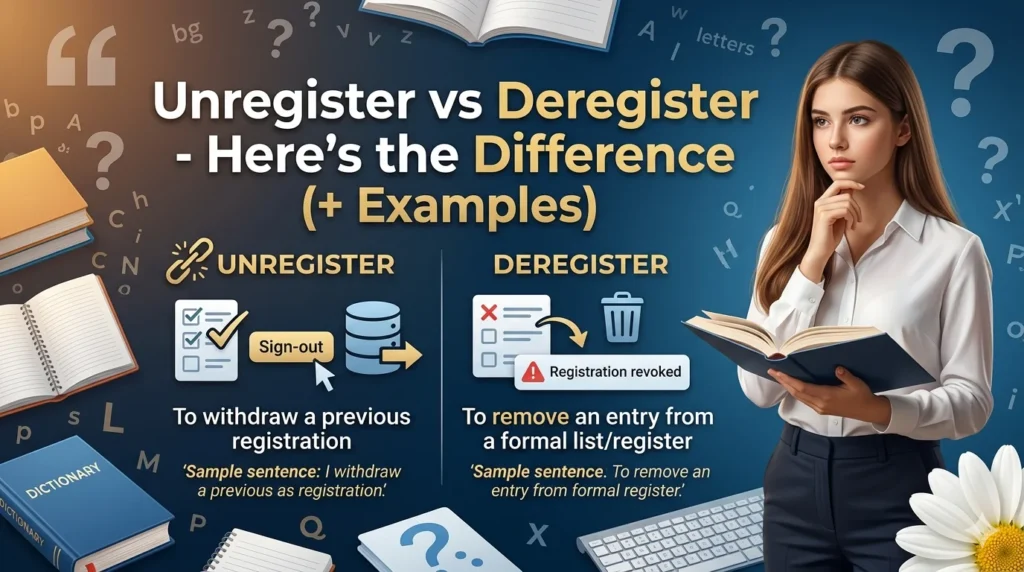

Many people think unregister vs deregister mean the same thing, but that’s not quite right. These words are like twins with their own identities and purposes- more like apples and oranges. While both involve removal from a list or system, their uses differ in everyday conversations and writing. Choosing the right word can make a world of difference, helping you communicate clearly and precisely without confusion.
In practice, unregister usually means you stop using or remove your name from a list or system you signed up for by choice. Meanwhile, deregister often refers to an official or formal removal carried out by an authority or institution. If you’re ever unsure which word to use, remember they are related but separate actions- both important but not interchangeable.
When it comes to using precise language in legal, technological, and business settings, confusing terms like “unregister” and “deregister” can lead to misunderstandings, errors, or even legal complications. These words might appear interchangeable, but each serves a unique role depending on the context. In this detailed guide, we’ll unpack the differences between unregister and deregister with real-world examples, step-by-step use cases, and clear explanations that hold up under scrutiny.
Understanding the Difference Between Unregister and Deregister
Both unregister and deregister involve the act of reversing or undoing a prior registration, but they aren’t twins. They differ in tone, formality, usage, and domain-specific meaning.
Definition of Unregister
- Meaning:
To remove an object, person, or entity from a registry, list, or system. - Tone:
Informal to semi-formal. - Common Uses:
Tech applications, user accounts, plugins, APIs.
Definition of Deregister
- Meaning:
To officially or formally remove from an authoritative or governmental register. - Tone:
Formal and often legal. - Common Uses:
Business licenses, vehicles, educational institutions, and legal systems.
Key Difference
| Term | Formality | Typical Domain | Example Usage |
| Unregister | Medium | Tech, apps, events | “I unregistered from the beta program.” |
| Deregister | High | Legal, governmental | “They deregistered the company in 2022.” |
Etymology and Historical Context
Unregister
- Prefix:
Un- (meaning: not or reverse action) - Root:
Register (from Latin registrare, meaning “to record”) - First appeared in technical and informal contexts around the mid-20th century, especially in computing.
Deregister
- Prefix:
De- (meaning: down, off, reversal) - Root:
Register - Common in official/legal contexts since the 19th century, with stronger roots in British English.
Regional Preference
| Region | Preferred Term | Notes |
| United States | Unregister | Common in tech, less in law/business |
| United Kingdom | Deregister | Preferred in official/legal documentation |
| Australia | Deregister | Standard in government forms |
Where Each Term is Commonly Used
Understanding the right term to use depends largely on the context and the field you’re operating in.
Unregister in Technology and Software
- Removing a plugin or software component
- Detaching an API key
- Opting out of an online beta testing program
- Deactivating a user profile from an application
Example: “To fix the error, you may need to unregister the DLL file.”
Deregister in Legal and Government Sectors
- Shutting down a business
- Removing a vehicle from the national database
- Exiting a professional licensing body
- Voluntary cancellation of a company from Companies House
Example: “The company was officially deregistered in December 2023.”
Industry-Specific Use Cases
Technology and Software
| Use Case | Appropriate Term | Explanation |
| Removing a browser extension | Unregister | Informal, user-initiated |
| Deactivating a user session | Unregister | Found in software logs or admin panels |
| Canceling a domain registry | Deregister | Often involves legal/formal paperwork |
| Deregistering a device from iCloud | Deregister | Formal removal from a tracking system |
Business and Legal Settings
| Scenario | Term to Use | Example |
| Closing down an LLC | Deregister | Legal paperwork required |
| Canceling a tax registration | Deregister | Seen in IRS forms or VAT deregistration |
| Removing a software license | Unregister | Not legally binding |
| Employee removal from a company app | Unregister | User-account-based process |
Transportation
- Deregistering a vehicle after selling
- Required to avoid tax or toll penalties
- Needed for the export or scrapping of cars
Education and Events
| Context | Preferred Term | Description |
| Dropping a university course | Deregister | Formal process with institutional records |
| Removing your name from a webinar list | Unregister | Usually informal; self-service |
| Opting out of a certification program | Deregister | Recognized by accreditation authorities |
Step-by-Step Examples
How to Unregister a Device from a Google Account
- Go to your Google Account dashboard.
- Click on Security.
- Scroll down to Your Devices.
- Select the device you want to unregister.
- Click Sign out and confirm.
How to Deregister a Business with the UK Companies House
- File a DS01 form (Striking off application by a company).
- Pay the deregistration fee.
- Ensure all debts and taxes are settled.
- Wait for confirmation of dissolution in the Gazette.
How to Deregister a Vehicle in Australia
- Visit your state’s transport authority website.
- Submit a deregistration form.
- Surrender the number plates.
- Provide proof of sale or disposal.
- Get confirmation and cancel insurance.
Common Mistakes to Avoid
- Using “unregister” in legal filings: Courts or agencies may not accept informal terms.
- Deregistering instead of deactivating: These actions are not the same. Deactivation might be temporary, while deregistration is permanent.
- Assuming they’re synonyms: These are context-sensitive verbs and not universally interchangeable.
Comparison Table for Quick Reference
| Feature | Unregister | Deregister |
| Formality | Informal to semi-formal | Formal/official |
| Common Use | Apps, accounts, and plugins | Vehicles, businesses, and legal registries |
| Typical Action | Voluntary, user-initiated | Regulated, document-heavy process |
| Can it be reversed easily? | Often yes | Rarely reversible |
| Domain Examples | Tech, events | Government, finance, education |
| Example Sentence | “I unregistered from the app.” | “He deregistered the company.” |
Related Terms Often Confused
Deactivate vs Deregister
- Deactivate implies a temporary stop
- Deregister is a permanent removal
Cancel vs Deregister
- Cancel focuses on stopping a service
- Deregister removes a presence from a registry
Unenroll vs Deregister
- Unenroll is used in casual academic contexts
- Deregister is official and documented
Final Thoughts
Precision in language builds credibility. Whether you’re writing documentation, filling out legal forms, managing an online platform, or attending a virtual event, knowing when to use unregister vs deregister can save you from errors, delays, or rejections.
Think of it this way:
- Unregistering is like deleting your account from Spotify.
- Deregistering is like dissolving a company from the government database.
They might seem similar, but their implications are vastly different. Always match the term to the formality, context, and intent of your action.
FAQs
Can I use “unregister” in legal documents?
No. Legal bodies expect formal, universally recognised terminology. “Deregister” is the correct choice in contracts and filings.
Is “deregister” only British English?
No. It’s more common in the UK and Commonwealth countries, but it’s used in formal US contexts too, especially government-related.
Is there a software-specific difference?
Yes. Developers use “unregister” when detaching event handlers or modules, while “deregister” may be used in SDKs with formal service bindings.
Can a user deregister themselves from a website?
Most systems use the term “unregister” for user self-removal. “Deregister” typically requires administrative approval.
Which is stronger legally: unregister or deregister?
Deregister carries more legal weight. It often involves records, compliance, and proof.
