
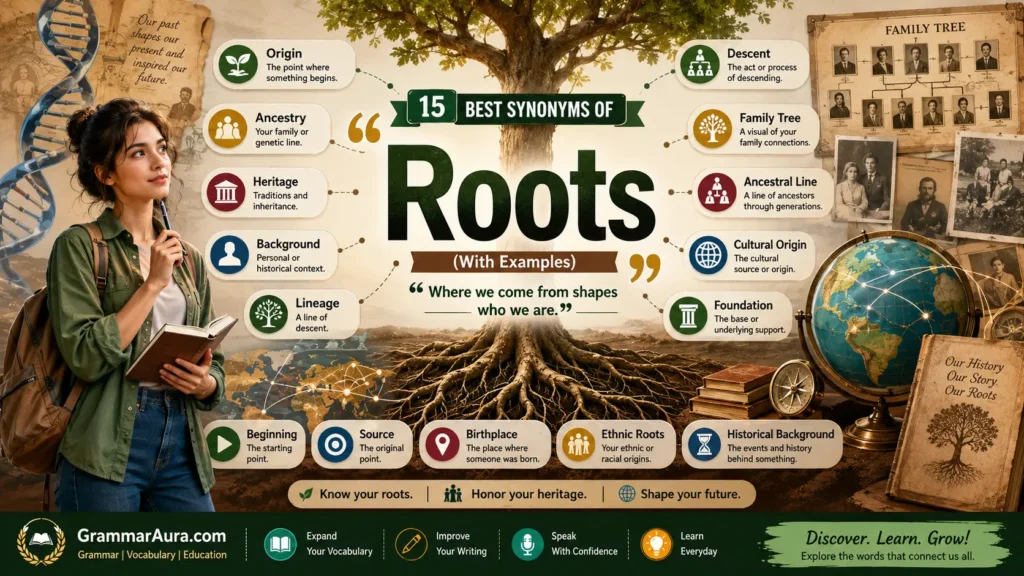

The right words can turn a message into something more personal, thoughtful, and meaningful. The word roots are often connected to origins, heritage, family, family background, and foundational beginnings. From my experience, choosing suitable synonyms and alternatives for a specific situation can help you express yourself with greater warmth and precision, especially when sharing a personal story or explaining an important idea.
When discussing culture, ancestry, traditions, and history, it is important to match the language to the context for a better connection with readers. The concept of roots can describe a starting point, early influences, or the foundation of a belief, making it a powerful part of human communication. Understanding related expressions and synonyms allows you to present ideas with clarity while keeping the focus on identity, belonging, and deeper personal meaning.
What Does “Roots” Mean?
The word “roots” generally refers to the origin, source, foundation, or heritage of a person, culture, idea, or thing. It can be used literally to describe the underground part of a plant or figuratively to discuss someone’s background, ancestry, traditions, or the beginning of something.“She never forgot her roots, even after moving abroad.”In this sentence, roots refer to a person’s heritage and upbringing.
When to Use “Roots”
You can use roots when discussing:
- Family history
- Cultural heritage
- Origins of traditions
- Foundations of beliefs
- Beginning of ideas or movements
- Personal background
Is It Professional or Polite to Say “Roots”?
Yes, roots are both professional and polite. It is commonly used in academic, business, cultural, and personal discussions.“Understanding the roots of the issue helps us develop effective solutions.”He enjoys learning about his family roots.”
Pros and Cons of Using “Roots”
Pros
- Easy to understand
- Emotionally meaningful
- Works in personal and professional settings
- Can describe heritage, beginnings, and foundations
Cons
- Can be vague in some contexts
- May need clarification when discussing complex topics
- Some alternatives may be more precise
Roots Synonyms:
- Origin
- Heritage
- Ancestry
- Foundation
- Source
- Lineage
- Background
- Beginnings
- Genesis
- Tradition
- Heritage Line
- Provenance
- Base
- Birthplace
- Cornerstone
Origin
Meaning:
The point where something begins or comes into existence.
Definition:
The source or starting point of a person, idea, tradition, or object.
Explanation:
Origin emphasizes where something first started. It is often used when discussing historical beginnings, inventions, cultures, and personal backgrounds.
Example:
“Researchers studied the origin of the tradition.”
Best Use:
Historical, academic, and professional discussions.
Worst Use:
When discussing emotional family connections.
Tone:
Formal, informative, professional
Heritage
Meaning:
Something inherited from previous generations.
Definition:
A person’s cultural traditions, values, and history.
Explanation:
Heritage focuses on cultural identity and inherited customs.
Example:
“She is proud of her cultural heritage.”
Best Use:
Cultural and family discussions.
Worst Use:
Technical or scientific contexts.
Tone:
Respectful, warm, meaningful
Ancestry
Meaning:
Family lineage or descent.
Definition:
The people from whom someone is descended.
Explanation:
Ancestry specifically highlights family history and genealogy.
Example:
“He researched his ancestry through historical records.”
Best Use:
Genealogy and family history.
Worst Use:
Business discussions.
Tone:
Personal, historical, reflective
Foundation
Meaning:
The base upon which something is built.
Definition:
The underlying support or starting structure.
Explanation:
Foundation is ideal when discussing principles, organizations, or beliefs.
Example:
“Trust is the foundation of a strong relationship.”
Best Use:
Professional and educational settings.
Worst Use:
Family lineage discussions.
Tone:
Strong, professional, dependable
Source
Meaning:
Where something originates.
Definition:
The place, person, or thing from which something comes.
Explanation:
Source focuses on the immediate point of origin.
Example:
They traced the source of the information.”
Best Use:
Research and investigations.
Worst Use:
Emotional family discussions.
Tone:
Neutral, factual
Lineage
Meaning:
Direct descent from ancestors.
Definition:
A line of hereditary descent.
Explanation:
Lineage emphasizes family succession through generations.
Example:
“The family has a long lineage of artisans.”
Best Use:
Historical and family contexts.
Worst Use:
General business discussions.
Tone:
Formal, historical
Background
Meaning:
A person’s history and experiences.
Definition:
The circumstances that shape a person’s identity.
Explanation:
Background includes education, culture, and upbringing.
Example:
“Her multicultural background enriches her perspective.”
Best Use:
Professional and personal introductions.
Worst Use:
When discussing specific genealogy.
Tone:
Neutral, conversational
Beginnings
Meaning:
The early stage of something.
Definition:
The point at which something starts.
Explanation:
Beginnings often carry a positive and inspiring tone.
Example:
“The company had humble beginnings.”
Best Use:
Stories and motivational writing.
Worst Use:
Scientific analysis.
Tone:
Optimistic, reflective
Genesis
Meaning:
The creation or origin of something.
Definition:
The starting point of an idea, event, or process.
Explanation:
Genesis is often used in formal writing.
Example:
“The project’s genesis dates back to 2010.”
Best Use:
Academic and professional contexts.
Worst Use:
Casual conversation.
Tone:
Formal, sophisticated
Tradition
Meaning:
Customs passed through generations.
Definition:
Long-established beliefs or practices.
Explanation:
Tradition highlights cultural continuity.
Example:
“The recipe is a cherished family tradition.”
Best Use:
Cultural and family discussions.
Worst Use:
Technical subjects.
Tone:
Warm, nostalgic
Heritage Line
Meaning:
A family or cultural line of inheritance.
Definition:
The continuing legacy passed through generations.
Explanation:
This phrase emphasizes both ancestry and cultural identity.
Example:
Their heritage line spans several centuries.”
Best Use:
Historical and cultural writing.
Worst Use:
Everyday casual speech.
Tone:
Elegant, respectful
Provenance
Meaning:
The origin or history of something.
Definition:
A record of ownership or origin.
Explanation:
Often used for art, artifacts, and historical objects.
Example:
“The painting’s provenance was carefully documented.”
Best Use:
Academic and museum contexts.
Worst Use:
Personal heritage discussions.
Tone:
Formal, scholarly
Base
Meaning:
The fundamental support.
Definition:
The lowest supporting part of something.
Explanation:
Base can refer to principles, operations, or structures.
Example:
“The company built its success on a strong customer base.”
Best Use:
Business and organizational contexts.
Worst Use:
Family history discussions.
Tone:
Direct, practical
Birthplace
Meaning:
The place where something begins.
Definition:
The location where a person, idea, or movement originated.
Explanation:
Birthplace often connects a subject to a geographical origin.
Example:
“The city is considered the birthplace of jazz.”
Best Use:
Historical and geographical discussions.
Worst Use:
Abstract concepts without a location.
Tone:
Descriptive, informative
Cornerstone
Meaning:
An essential foundation.
Definition:
A key principle or basis upon which something is built.
Explanation:
Cornerstone suggests strength and importance.
Example:
Integrity is the cornerstone of leadership.”
Best Use:
Professional and motivational writing.
Worst Use:
Genealogy discussions.
Tone:
Strong, inspiring
Comparison Table of Top Alternatives
| Synonym | Best For | Tone | Formality |
| Origin | Beginnings and sources | Informative | High |
| Heritage | Culture and traditions | Warm | Medium |
| Ancestry | Family history | Reflective | Medium |
| Foundation | Principles and structures | Professional | High |
| Source | Causes and origins | Neutral | High |
| Lineage | Generational descent | Historical | High |
| Background | Personal history | Conversational | Medium |
| Beginnings | Early stages | Optimistic | Low |
| Genesis | Creation and origin | Sophisticated | High |
| Tradition | Customs and heritage | Nostalgic | Medium |
| Heritage Line | Family legacy | Respectful | High |
| Provenance | Historical ownership | Scholarly | Very High |
| Base | Support and structure | Practical | Medium |
| Birthplace | Geographic origins | Informative | Medium |
| Cornerstone | Essential principles | Inspiring | High |
Final Thoughts
Choosing the right synonym for “roots” can make your writing more precise, engaging, and meaningful. While roots is a versatile word that often refers to origins, heritage, or foundations, alternatives such as heritage, ancestry, origin, and foundation can add greater clarity depending on the context. Whether you’re discussing family history, cultural traditions, personal identity, or the beginning of an idea, selecting the most suitable word helps your message connect more effectively with readers.
Language is powerful because small word choices can shape how people understand and feel about a message. By exploring these alternatives, you can communicate with greater confidence and accuracy. The next time you want to talk about someone’s background, the start of a movement, or the source of a tradition, consider which synonym best captures your intended meaning. A thoughtful choice can transform a simple sentence into one that feels richer, warmer, and more memorable.
FAQs
What is the most common synonym for “roots”?
The most common synonym for “roots” is origin. It refers to the place, event, or circumstance where something begins. While roots often carry emotional or cultural meaning, origin is more general and works well in academic, professional, and everyday contexts. It is especially useful when discussing the beginning of ideas, traditions, organizations, or historical developments.
Is “heritage” the same as “roots”?
Heritage and roots are closely related, but they are not the same. Heritage focuses on the customs, traditions, values, and culture passed down through generations. Roots can include heritage but also refer to a person’s origins, upbringing, or foundational experiences. Heritage is often more specific when discussing cultural identity and family traditions.
When should I use “ancestry” instead of “roots”?
Use ancestry when discussing family lineage, genealogy, or biological descent. Ancestry specifically refers to the people from whom someone is descended. Roots are broader and may include cultural, social, or personal influences. If you’re researching family history or discussing generations of relatives, ancestry is usually the more accurate choice.
Is “foundation” a good replacement for “roots”?
Yes, foundation is an excellent replacement when discussing principles, systems, organizations, or beliefs. It emphasizes the supporting structure upon which something is built. However, the foundation is less suitable when talking about family history or cultural identity. In those situations, words like heritage, ancestry, or origin may be more appropriate.
What synonym works best in professional writing?
For professional writing, origin, source, foundation, and genesis are often the best choices. These words sound clear and formal while maintaining accuracy. The ideal option depends on context. Foundation works well for principles, source for causes, and genesis for the beginning of projects, ideas, or organizational developments.
Can “roots” refer to culture and traditions?
Yes, roots frequently refer to culture, traditions, and identity. People often use the word to describe the customs, beliefs, and values inherited from their families or communities. In this context, roots symbolize a connection to the past and a sense of belonging. Heritage and tradition are common alternatives in cultural discussions.
What is the difference between “origin” and “source”?
Although they are similar, the origin and source have different nuances. Origin refers to the beginning or creation of something, while source often refers to the immediate cause or provider. For example, a culture’s origin may be historical, while the source of information might be a document or person. Context determines which fits better.
Is “lineage” a formal word for “roots”?
Yes, lineage is a more formal and specific term than roots. It refers to a line of descent through generations and is commonly used in historical, genealogical, and academic contexts. While roots can include culture, upbringing, and heritage, lineage focuses specifically on family succession and ancestral connections over time.
Which synonym is best for discussing traditions?
Tradition and heritage are usually the best synonyms when discussing customs and practices passed down through generations. Tradition focuses on the actual practices, while heritage includes the broader cultural identity behind them. Depending on the context, either term can effectively replace roots when highlighting long-standing family or cultural values.
Why is it important to choose the right synonym for “roots”?
Choosing the right synonym improves clarity, tone, and reader understanding. Different alternatives highlight different aspects of meaning. For example, ancestry emphasizes family history, foundation stresses support and structure, and heritage focuses on cultural identity. Using the most accurate word ensures your message feels intentional, meaningful, and appropriate for the audience and context.
