
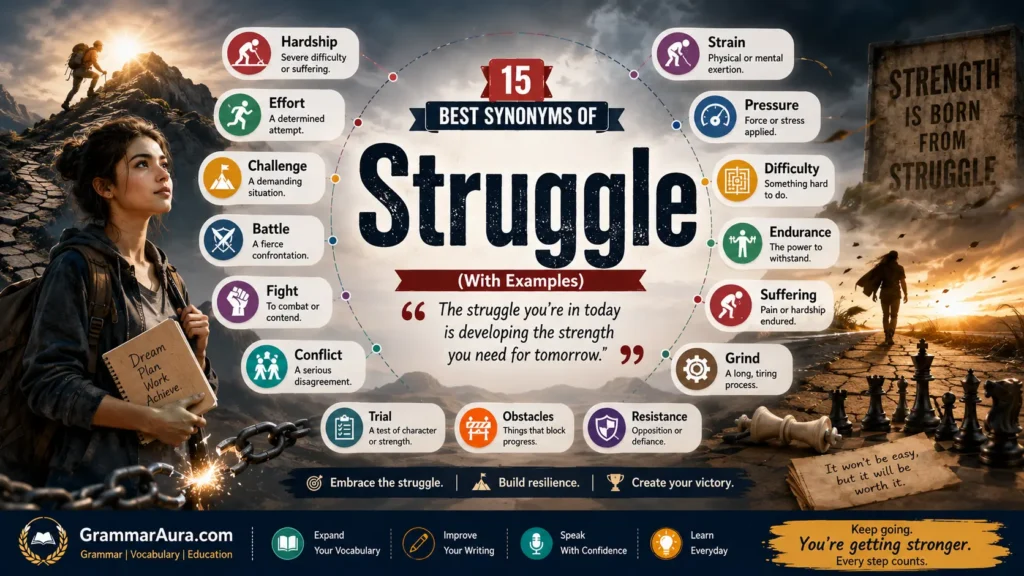

The right words can make a message feel more human, gentle, and full of understanding. The word struggle often describes difficulty, effort, or a challenging situation. From my experience, choosing suitable synonyms and alternatives can communicate the same idea with greater emotional depth, clarity, and professionalism, allowing writers to express thoughts, feelings, and experiences in a more meaningful way.
When discussing personal challenges or professional challenges, the right language can show empathy, resilience, and support while helping a message connect with readers. Selected words create a stronger sense of communication and help people understand difficult experiences without sounding harsh. Using thoughtful and supportive alternatives can reflect the reality of a challenge while maintaining respect and compassion.
What Does “Struggle” Mean?
Struggle means experiencing difficulty, effort, or resistance while trying to achieve something or cope with a situation. It can refer to emotional, physical, financial, or mental challenges. “She is struggling to balance work and studies.”
When to Use “Struggle”
You can use struggle when talking about:
- Emotional difficulties
- Personal challenges
- Financial problems
- Academic pressure
- Physical or mental effort
- Overcoming obstacles
Example:
“He struggled to recover after the setback.”
Is It Professional or Polite to Say “Struggle”?
Yes, struggle is both professional and polite, especially when used carefully. It is commonly used in workplaces, education, healthcare, and personal communication.
However, in formal writing, softer alternatives like challenge, difficulty, or effort may sound more polished depending on context.
Pros and Cons of Using “Struggle”
Pros
- Emotionally expressive
- Easy to understand
- Widely used in everyday communication
- Conveys empathy and realism
Cons
- Can sound too negative in formal settings
- May feel emotionally heavy
- Sometimes too broad or vague
Struggle Synonyms:
- Challenge
- Hardship
- Effort
- Battle
- Fight
- Ordeal
- Adversity
- Strain
- Striving
- Endeavor
- Conflict
- Tension
- Difficulty
- Setback
- Labor
Challenge
Meaning:
A difficult task requiring effort and skill.
Definition:
Something that tests ability or patience.
Explanation:
Challenge focuses more on growth and opportunity rather than hardship alone.
Example:
“Learning a new language is a big challenge.”
Best Use:
Work, education, motivation.
Worst Use:
Deep emotional suffering.
Tone:
Positive, motivational
Hardship
Meaning:
Severe difficulty or suffering.
Definition:
A condition of ongoing struggle or distress.
Explanation:
Hardship emphasizes long-term or serious difficulties.
Example:
“They faced financial hardship after the crisis.”
Best Use:
Economic or life difficulties.
Worst Use:
Light or temporary issues.
Tone:
Serious, emotional
Effort
Meaning:
Physical or mental energy used to do something.
Definition:
The act of trying hard.
Explanation:
Effort focuses on action rather than difficulty.
Example:
“She put in great effort to succeed.”
Best Use:
Productivity and motivation.
Worst Use:
Emotional distress.
Tone:
Neutral, positive
Battle
Meaning:
A strong fight against something difficult.
Definition:
A forceful attempt to overcome a problem.
Explanation:
Battle adds emotional intensity and determination.
Example:
“He is battling illness bravely.”
Best Use:
Health and personal fights.
Worst Use:
Formal reports.
Tone:
Intense, emotional
Fight
Meaning:
Active resistance against difficulty.
Definition:
A determined effort to overcome obstacles.
Explanation:
Fight suggests energy and persistence.
Example:
She is fighting for her dreams.”
Best Use:
Inspirational writing.
Worst Use:
Formal academic writing.
Tone:
Strong, passionate
Ordeal
Meaning:
A painful or difficult experience.
Definition:
A severe test of endurance.
Explanation:
Ordeal highlights emotional or physical stress.
Example:
“The recovery process was an ordeal.”
Best Use:
Trauma or hardship stories.
Worst Use:
Light challenges.
Tone:
Serious, heavy
Adversity
Meaning:
Difficult or unfavorable conditions.
Definition:
A state of hardship or misfortune.
Explanation:
Adversity is often used in inspirational or formal contexts.
Example:
“He grew stronger through adversity.”
Best Use:
Motivation and leadership writing.
Worst Use:
Casual conversation.
Tone:
Formal, inspirational
Strain
Meaning:
Pressure or tension from effort.
Definition:
Mental or physical stress caused by difficulty.
Explanation:
Strain emphasizes stress on the mind or body.
Example:
“The workload caused emotional strain.”
Best Use:
Health or workplace stress.
Worst Use:
General life challenges.
Tone:
Neutral, serious
Striving
Meaning:
Actively working toward a goal.
Definition:
Continuous effort to achieve something.
Explanation:
Striving is more hopeful than struggling.
Example:
“She is striving for success.”
Best Use:
Goals and ambition.
Worst Use:
Deep suffering.
Tone:
Hopeful, uplifting
Endeavor
Meaning:
A serious attempt to achieve something.
Definition:
A purposeful effort toward a goal.
Explanation:
Endeavor sounds formal and professional.
Example:
“The project was a team endeavor.”
Best Use:
Business and academic writing.
Worst Use:
Emotional contexts.
Tone:
Formal, structured
Conflict
Meaning:
A disagreement or struggle between forces.
Definition:
Opposition or clash of ideas or interests.
Explanation:
Conflict is often external rather than internal.
Example:
“There was conflict between teams.”
Best Use:
Workplace or social issues.
Worst Use:
Personal emotional struggles.
Tone:
Neutral, analytical
Tension
Meaning:
Mental or emotional strain.
Definition:
A state of stress or unease.
Explanation:
Tension suggests underlying pressure or discomfort.
Example:
“There was tension in the meeting.”
Best Use:
Emotional or social situations.
Worst Use:
Achievement contexts.
Tone:
Serious, subtle
Difficulty
Meaning:
Something hard to do or understand.
Definition:
A problem or obstacle.
Explanation:
Difficulty is a simple, neutral alternative.
Example:
“She had difficulty completing the task.”
Best Use:
General communication.
Worst Use:
Inspirational writing.
Tone:
Neutral, clear
Setback
Meaning:
A delay or reversal of progress.
Definition:
An unexpected obstacle or failure.
Explanation:
Setback focuses on interruptions in progress.
Example:
“The project faced a setback.”
Best Use:
Business and planning.
Worst Use:
Emotional suffering descriptions.
Tone:
Practical, factual
Labor
Meaning:
Hard physical or mental work.
Definition:
Sustained effort requiring endurance.
Explanation:
Labor emphasizes continuous hard work.
Example:
“It took years of labor to complete the book.”
Best Use:
Work and creation contexts.
Worst Use:
Emotional struggles.
Tone:
Formal, industrious
Comparison Table of Top Alternatives
| Synonym | Best Use Case | Tone | Intensity |
| Challenge | Growth & learning | Positive | Medium |
| Hardship | Life difficulties | Serious | High |
| Effort | Motivation & work | Neutral | Low |
| Battle | Health/personal fight | Emotional | High |
| Fight | Inspiration | Strong | High |
| Ordeal | Severe suffering | Heavy | Very High |
| Adversity | Inspirational writing | Formal | High |
| Strain | Stress situations | Serious | Medium |
| Striving | Goals & ambition | Hopeful | Medium |
| Endeavor | Professional goals | Formal | Medium |
| Conflict | Disagreements | Analytical | Medium |
| Tension | Emotional stress | Subtle | Medium |
| Difficulty | General problems | Neutral | Low |
| Setback | Progress interruption | Practical | Medium |
| Labor | Hard work | Formal | Medium |
Final Thoughts
The word “struggle” carries a deep emotional weight, often reflecting moments of effort, pressure, and resilience. While it is a powerful and widely understood term, exploring its synonyms allows you to express experiences with greater precision and empathy. Words like challenge, adversity, and striving can soften or strengthen your message depending on the emotional tone you want to convey.
Choosing the right alternative helps you connect more meaningfully with readers or listeners. Whether you want to highlight perseverance, describe hardship, or simply clearly explain difficulty, these synonyms give you flexibility. Thoughtful word choice not only improves communication but also ensures your message feels respectful, human, and relatable in any context.
FAQs
What is the simplest synonym of “struggle”?
The simplest synonym of “struggle” is difficulty. It clearly describes something hard to do or manage without adding emotional weight. It works well in everyday communication, education, and professional writing when you want a neutral, easy-to-understand word that still conveys the idea of facing an obstacle or challenge.
Is “challenge” a positive word for struggle?
Yes, “challenge” is often seen as a positive alternative to “struggle.” It emphasizes growth, learning, and opportunity rather than hardship alone. People use it in motivational, educational, and professional contexts to describe situations that require effort but also offer potential for improvement and success over time.
When should I use “hardship” instead of struggle?
Use “hardship” when describing serious or long-term difficulties, especially financial, emotional, or life-related problems. Unlike struggle, which can be temporary or broad, hardship emphasizes deeper suffering or ongoing challenges. It is commonly used in formal writing, reports, and discussions about social or economic conditions affecting individuals or communities.
Is “battle” too strong for everyday use?
“Battle” is a strong and emotional synonym for “struggle.” It is best used when describing serious personal challenges like illness or major life difficulties. In everyday casual situations, it may feel too intense. However, it works well in inspirational or storytelling contexts where emotional strength and determination are emphasized.
What is the difference between struggle and effort?
“Struggle” focuses on difficulty and resistance, while “effort” focuses on the action of trying. Struggle highlights the problem, whereas effort highlights the attempt to overcome it. For example, struggle feels negative or challenging, while effort sounds more positive and proactive, especially in academic or professional environments.
Can I use “adversity” in professional writing?
Yes, “adversity” is highly suitable for professional writing. It refers to difficult or unfavorable conditions and is often used in leadership, business, and motivational contexts. It sounds formal and respectful, making it a strong choice when describing challenges in a way that emphasizes resilience, growth, and overcoming obstacles.
Is “setback” a synonym of struggle?
“Setback” is a related term but not an exact synonym of “struggle.” It refers to a temporary delay or obstacle that interrupts progress. While struggle describes ongoing difficulty, setback focuses on a specific event or failure. It is commonly used in business, planning, and project-related communication.
What synonym is best for emotional struggles?
For emotional situations, “tension,” “ordeal,” or “hardship” are often the best choices. These words reflect internal stress, emotional pressure, or difficult experiences. The right choice depends on intensity—tension for mild stress, hardship for serious conditions, and ordeal for extremely painful or overwhelming experiences.
Is “striving” the same as struggling?
No, “striving” is more positive than “struggling.” Striving means actively working toward a goal with hope and determination, while struggling emphasizes difficulty and resistance. Striving is often used in motivational or inspirational contexts to highlight persistence and ambition rather than hardship or failure.
Why should I use synonyms for “struggle”?
Using synonyms for “struggle” helps you communicate more clearly and emotionally. Different words highlight different shades of meaning—some focus on difficulty, others on effort or growth. This improves writing quality, avoids repetition, and helps your message feel more natural, empathetic, and engaging for readers in various contexts.
