
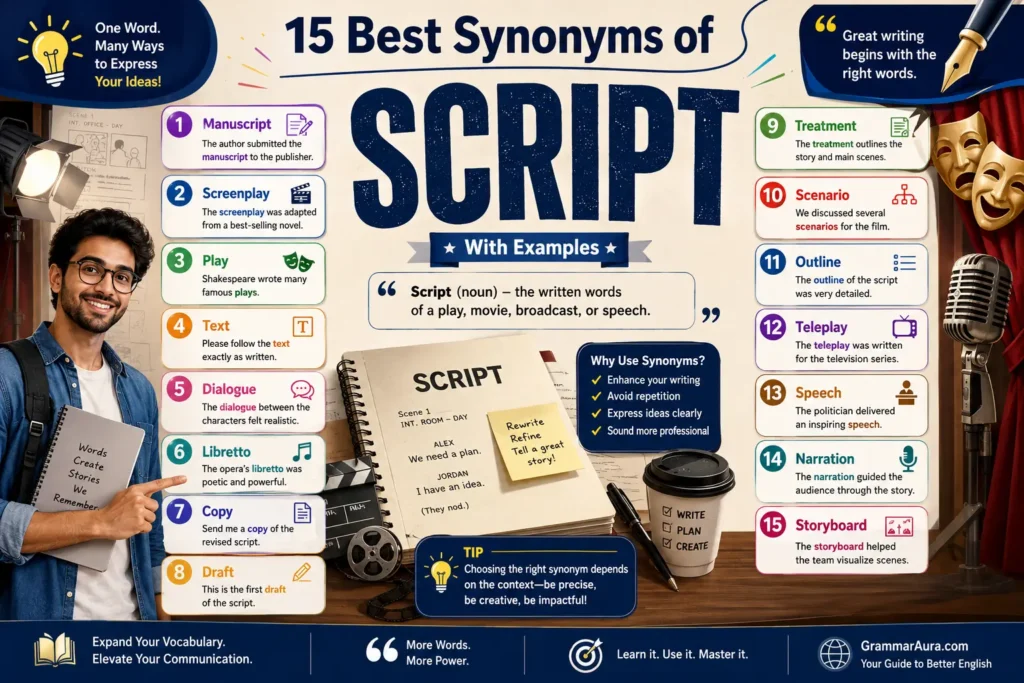

15 Best Synonyms of “Script” (With Examples) helps writers find the right word that can transform how they communicate with greater clarity and purpose. A script is a common term often used for written dialogue, plans, instructions, or any form of text, but choosing a precise alternative can improve your writing and make it sound more natural, thoughtful, and meaningful. Whether you are discussing a movie, preparing a speech, working with code, or creating a communication guide, the best synonyms help you express your ideas more clearly.
From my experience creating different types of content, selecting a specific term often adds warmth and improves understanding. Instead of relying on a familiar word, using a suitable alternative allows your message to better match the situation. This approach helps readers connect with your meaning, strengthens communication, and makes your writing feel clearer and more effective.
What Does “Script” Mean?
A script is a written text that serves as a guide for speaking, performing, programming, or following instructions. A document containing dialogue, directions, commands, or prepared content intended for use in a specific situation. The word script can refer to many things, including movie screenplays, theater dialogue, speeches, customer service responses, computer code, or written instructions. Because it has multiple meanings, selecting the right synonym often depends on the context.
- The actor memorized the script before filming.
- The customer support team followed a script during calls.
- The developer wrote a script to automate the process.
When to Use “Script”
Use “script” when referring to:
- Written dialogue for actors.
- Prepared speeches.
- Customer service talking points.
- Computer automation code.
- instructions or procedures.
Examples:
- The presenter reviewed her script before the conference.
- The programmer updated the automation script.
- The actor received the final script two weeks before production.
Is It Professional/Polite to Say “Script”?
Yes, “script” is generally professional and widely accepted.
It works well in business, entertainment, education, customer service, and technology settings. However, in some conversations, alternatives like outline, guide, or screenplay may sound more specific and natural.
Professional Example:
- The training department created a customer service script.
- Please review the meeting script before the presentation.
Pros and Cons of Using “Script”
Pros
- Widely understood
- Works in multiple industries
- Professional and clear
- Suitable for formal communication
- Easy to use in writing and speech
Cons
- Can sound rigid or rehearsed
- May feel impersonal in some contexts
- Doesn’t always specify the type of document
Script Synonyms:
- Screenplay
- Manuscript
- Dialogue
- Outline
- Draft
- Text
- Transcript
- Scenario
- Guide
- Program
- Copy
- Blueprint
- Framework
- Narrative
- Playbook
Screenplay
Meaning:
A written story created for film production.
Definition:
A script containing dialogue, scenes, and directions for a movie.
Explanation:
Screenplay is the preferred term in the film industry and specifically refers to scripts written for movies.
Example:
She spent two years writing her first screenplay.
Best Use:
Film and movie production.
Worst Use:
Business presentations.
Tone:
Creative, professional
Manuscript
Meaning:
A written document intended for publication.
Definition:
An author’s original written work.
Explanation:
This term is commonly used for books, articles, and literary works before publication.
Example:
The publisher reviewed the author’s manuscript.
Best Use:
Publishing and literature.
Worst Use:
Programming discussions.
Tone:
Formal, literary
Dialogue
Meaning:
A conversation between characters or individuals.
Definition:
Written or spoken exchanges in a text or performance.
Explanation:
Unlike a complete script, dialogue focuses specifically on conversations.
Example:
The playwright revised the dialogue to sound more natural.
Best Use:
Theater, movies, and storytelling.
Worst Use:
Technical instructions.
Tone:
Conversational, expressive
Outline
Meaning:
A structured summary of key points.
Definition:
A framework used to organize content before full development.
Explanation:
An outline provides direction without including every detail.
Example:
The speaker prepared an outline for the presentation.
Best Use:
Planning speeches and projects.
Worst Use:
Final movie productions.
Tone:
Organized, professional
Draft
Meaning:
An early version of written work.
Definition:
A preliminary document that may later be revised.
Explanation:
A draft is often the first step before a final version is completed.
Example:
She submitted the first draft for feedback.
Best Use:
Writing and editing.
Worst Use:
Completed documents.
Tone:
Flexible, developmental
Text
Meaning:
Written words forming a document.
Definition:
The actual content of written material.
Explanation:
Text is a broad term that can apply to nearly any written communication.
Example:
Please review the text before publishing.
Best Use:
General writing references.
Worst Use:
Specific entertainment industry contexts.
Tone:
Neutral, straightforward
Transcript
Meaning:
A written record of spoken words.
Definition:
An exact written version of speech or conversation.
Explanation:
Unlike a script, a transcript records what was actually said.
Example:
The journalist reviewed the interview transcript.
Best Use:
Interviews and recordings.
Worst Use:
Future performance planning.
Tone:
Accurate, factual
Scenario
Meaning:
A planned sequence of events.
Definition:
A description of how a situation might unfold.
Explanation:
This term often appears in training, planning, and storytelling.
Example:
The team practiced an emergency scenario.
Best Use:
Training and simulations.
Worst Use:
Published novels.
Tone:
Practical, strategic
Guide
Meaning:
A document that provides direction.
Definition:
Instructions designed to help someone complete a task.
Explanation:
A guide focuses on assistance rather than dialogue.
Example:
The employee followed the onboarding guide.
Best Use:
Training and education.
Worst Use:
Film dialogue.
Tone:
Helpful, informative
Program
Meaning:
A planned sequence of content or instructions.
Definition:
A structured arrangement of activities or material.
Explanation:
Depending on context, it may refer to events or computer instructions.
Example:
The event program was distributed to attendees.
Best Use:
Events and schedules.
Worst Use:
Character dialogue.
Tone:
Professional, organized
Copy
Meaning:
Written content prepared for publication or advertising.
Definition:
Text designed for communication or marketing.
Explanation:
Copy is widely used in journalism, advertising, and marketing.
Example:
The editor revised the advertising copy.
Best Use:
Marketing and media.
Worst Use:
Movie production.
Tone:
Professional, persuasive
Blueprint
Meaning:
A plan.
Definition:
A framework for creating or building something.
Explanation:
Blueprint emphasizes planning and structure.
Example:
The proposal served as a blueprint for the project.
Best Use:
Strategy and planning.
Worst Use:
Character conversations.
Tone:
Strategic, visionary
Framework
Meaning:
An organized structure.
Definition:
A system that supports development or execution.
Explanation:
Frameworks provide organization without specifying every detail.
Example:
The company developed a communication framework.
Best Use:
Business and planning.
Worst Use:
Movie dialogue.
Tone:
Professional, structured
Narrative
Meaning:
A story or account of events.
Definition:
A structured description that communicates a sequence of events.
Explanation:
Narrative focuses on storytelling rather than instructions.
Example:
The documentary followed a compelling narrative.
Best Use:
Storytelling and content creation.
Worst Use:
Technical documentation.
Tone:
Creative, engaging
Playbook
Meaning:
A collection of strategies or instructions.
Definition:
A practical guide for handling specific situations.
Explanation:
A playbook is commonly used in business, sports, and leadership.
Example:
The sales team followed the company’s playbook.
Best Use:
Business operations and strategy.
Worst Use:
Literary publishing.
Tone:
Practical, professional
Comparison Table of Top Alternatives
| Synonym | Meaning | Best Use | Tone |
| Screenplay | Film script | Movies | Creative |
| Manuscript | Written work | Publishing | Literary |
| Dialogue | Conversation text | Theater | Conversational |
| Outline | Content framework | Planning | Organized |
| Draft | Early version | Writing | Flexible |
| Text | Written content | General use | Neutral |
| Transcript | Recorded speech | Interviews | Factual |
| Scenario | Planned situation | Training | Strategic |
| Guide | Instruction document | Education | Helpful |
| Program | Planned content | Events | Professional |
| Copy | Marketing text | Advertising | Persuasive |
| Blueprint | plan | Strategy | Visionary |
| Framework | Organized structure | Business | Structured |
| Narrative | Story account | Storytelling | Engaging |
| Playbook | Strategy guide | Business | Practical |
Final Thoughts
Choosing the right synonym for “script” can make your communication more precise, engaging, and effective. While script is a versatile word that works across many industries, it doesn’t always capture the specific purpose of a document. Alternatives like screenplay, manuscript, outline, and guide offer greater clarity and help readers immediately understand the type of content being discussed. Selecting the most appropriate term can improve both professional and personal communication.
The best synonym depends on your audience, context, and goals. A filmmaker may prefer a screenplay, a marketer might use copy, and a business leader may rely on a playbook or framework. Understanding these distinctions allows you to communicate with confidence and accuracy. By expanding your vocabulary beyond script, you can create messages that feel more natural, meaningful, and tailored to the situation at hand.
FAQs
What is the closest synonym for “script”?
The closest synonym for “script” is often “text” or “manuscript,” depending on the context. A manuscript refers to a written work intended for publication, while text is a broader term covering any written content. In entertainment settings, a screenplay is usually the closest equivalent to a script for film productions.
Is “script” a professional word?
Yes, “script” is widely considered a professional term. It is commonly used in business, entertainment, customer service, education, and technology. Whether referring to a presentation guide, call center responses, or programming instructions, the word is clear, accepted, and appropriate for formal and professional communication.
When should I use “screenplay” instead of “script”?
You should use “screenplay” when referring specifically to a script written for a film. While all screenplays are scripts, not all scripts are screenplays. The term screenplay provides greater precision and is the standard word used within the movie and film production industry.
What’s the difference between a script and a manuscript?
A script is usually written for performance, speaking, or execution, while a manuscript is generally a written work intended for reading or publication. Scripts often include dialogue and instructions, whereas manuscripts focus primarily on narrative content, research, or literary writing.
Can “outline” replace “script”?
Sometimes. An outline can replace a script when discussing a plan or structure rather than a complete written document. An outline contains key points and organization, while a script provides wording, dialogue, or instructions. The choice depends on how much detail the document contains.
Is “guide” a good alternative to “script”?
Yes, ga uide is an excellent alternative when the document’s purpose is to provide instructions or direction. Unlike a script, which may contain exact wording, a guide focuses on helping people understand a process, task, or procedure without necessarily prescribing every word or action.
What synonym works best for customer service scripts?
For customer service settings, guides, playbooks, and frameworks often work well. These terms sound less rigid than script and can encourage more natural communication. However, if employees must follow specific wording, script remains the most accurate and commonly used term.
Is “playbook” more modern than “script”?
In many business environments, a playbook is considered more modern and strategic. It suggests a collection of best practices, processes, and recommended actions rather than fixed wording. Companies often use playbooks to provide flexibility while maintaining consistency across teams and departments.
Which synonym is best for creative writing?
For creative writing, manuscripts, narratives, and dialogue are among the best alternatives. Each highlights a different aspect of the writing process. Manuscript refers to the complete work, narrative focuses on storytelling, and dialogue emphasizes conversations between characters.
Why should I use synonyms for “script”?
Using synonyms for “script” improves clarity, avoids repetition, and helps readers better understand your meaning. Different alternatives carry different shades of meaning, making your writing more accurate and engaging. Choosing the right word allows you to communicate more effectively and connect with your audience in a more meaningful way.
