
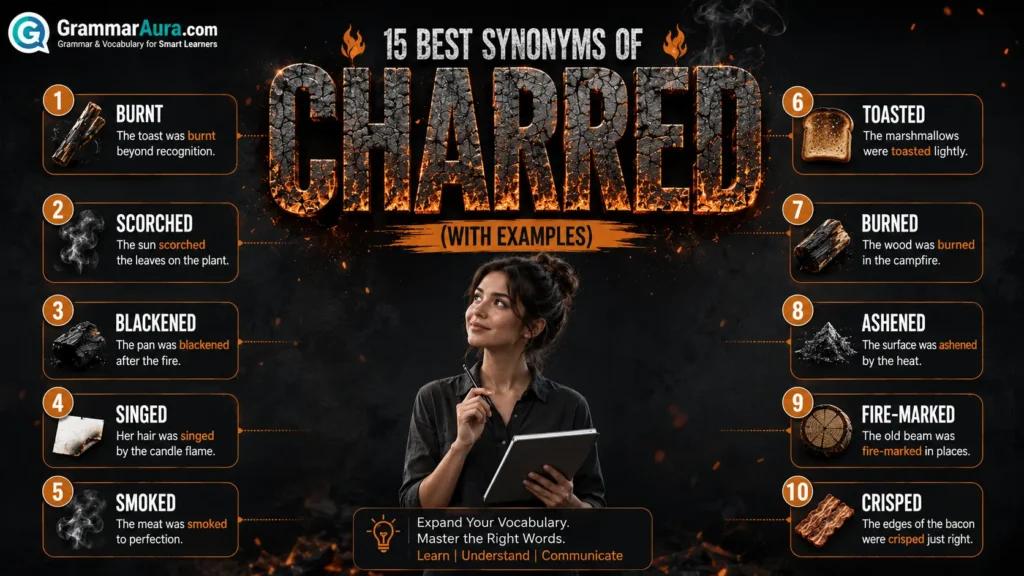

The guide, 15 Best Synonyms of “Charred” (With Examples), helps you find the right word with useful examples for every situation.
In my personal editing experience, choosing a synonym from several synonyms improves writing by making every description more precise, vivid, and clear. Selecting or exploring the best term to describe food, fire, damage, or natural effects requires readers to think, because, depending on the context, the intended tone should express ideas accurately, gently, and descriptively rather than repeating “charred”.
A surface may be partially burned, blackened by heat, or carry an emotionally powerful visual impact, so different wording can make a decision much easier. Reviewing examples and making a careful choice often creates stronger sentences, helping readers understand what happened without confusion, especially when subtle differences in meaning matter.
What Does “Charred” Mean?
Charred means partially burned, so that the surface becomes blackened or carbonized by fire or intense heat.
Something that has been burned on the surface until it turns black or dark brown.
- “The wood was charred after the fire.”
- “The steak had a charred crust.”
When to Use “Charred”
You use charred when:
- Describing food cooked over a flame or grill
- Talking about fire damage or burn marks
- Writing about survival, disasters, or nature scenes
- Adding dramatic or sensory detail in storytelling
Examples:
- “The building was charred after the wildfire.”
- “She enjoyed charred vegetables from the grill.”
Is It Professional/Polite to Say “Charred”?
Yes, charred is professional and widely acceptable, especially in cooking, environmental studies, and descriptive writing. However, in sensitive contexts like disasters, softer alternatives such as burned, scorched, or damaged by fire may feel more considerate.
Pros and Cons of Using “Charred”
Pros:
- Strong visual and sensory description
- Common in culinary and environmental writing
- Conveys clear fire-related imagery
Cons:
- Can sound harsh in sensitive contexts
- Not always suitable for formal reporting
- Limited emotional softness
Charred Synonyms:
- Burned
- Scorched
- Blackened
- Seared
- Singed
- Smoldered
- Crisped
- Carbonized
- Overcooked
- Toasted
- Fire-damaged
- Ashen
- Burnt-edged
- Fire-kissed
- Burnt-out
Burned
Meaning:
Damaged by fire or heat.
Definition:
General term for fire damage.
Explanation:
The most basic synonym of charred.
Example:
“The toast was burned.”
Best Use:
Everyday speech.
Worst Use:
Precise culinary descriptions.
Tone:
Neutral and simple
Scorched
Meaning:
Slightly burned or dried by heat.
Definition:
Surface damage caused by intense heat.
Explanation:
Often used for plants or surfaces.
Example:
“The grass was scorched by the sun.”
Best Use:
Nature and environment writing.
Worst Use:
Cooking precision.
Tone:
Descriptive and natural
Blackened
Meaning:
Turned black due to burning.
Definition:
Darkened by fire or smoke.
Explanation:
Common in cooking descriptions.
Example:
“The fish was blackened on the grill.”
Best Use:
Culinary writing.
Worst Use:
Scientific detail.
Tone:
Strong and visual
Seared
Meaning:
Quickly cooked with high heat.
Definition:
Surface browned by intense heat.
Explanation:
Often positive in cooking.
Example:
“The steak was perfectly seared.”
Best Use:
Food and culinary arts.
Worst Use:
Fire damage description.
Tone:
Professional and culinary
Singed
Meaning:
Lightly burned at the edges.
Definition:
Slight burning without full damage.
Explanation:
Often accidental burning.
Example:
“The paper was singed by fire.”
Best Use:
Accidental fire descriptions.
Worst Use:
Large-scale damage.
Tone:
Mild and precise
Smoldered
Meaning:
Burned slowly without flame.
Definition:
Low, smoky burning.
Explanation:
Used for ongoing fire effects.
Example:
“The wood smoldered overnight.”
Best Use:
Storytelling.
Worst Use:
Cooking context.
Tone:
Atmospheric and dramatic
Crisped
Meaning:
Made dry and slightly burned.
Definition:
Food cooked until firm or slightly burnt.
Explanation:
Often used in cooking.
Example:
“The edges were crisped.”
Best Use:
Food descriptions.
Worst Use:
Disaster reporting.
Tone:
Light and culinary
Carbonized
Meaning:
Reduced to carbon by burning.
Definition:
Fully burned organic material.
Explanation:
Scientific and technical term.
Example:
“The remains were carbonized.”
Best Use:
Scientific contexts.
Worst Use:
Casual speech.
Tone:
Technical and formal
Overcooked
Meaning:
Cooked too long or too much heat.
Definition:
Food beyond the ideal cooking point.
Explanation:
Common kitchen term.
Example:
“The vegetables were overcooked.”
Best Use:
Cooking feedback.
Worst Use:
Fire damage.
Tone:
Casual and practical
Toasted
Meaning:
Lightly browned by heat.
Definition:
Food is lightly exposed to heat.
Explanation:
Often a positive food term.
Example:
“Bread was toasted perfectly.”
Best Use:
Food preparation.
Worst Use:
Fire damage.
Tone:
Warm and friendly
Fire-damaged
Meaning:
Harmed by fire.
Definition:
Structures or items affected by fire.
Explanation:
Used in reports and emergencies.
Example:
“The house was fire-damaged.”
Best Use:
Insurance and reporting.
Worst Use:
Casual writing.
Tone:
Formal and serious
Ashen
Meaning:
Covered in ash or pale gray.
Definition:
Fire residue or emotional tone.
Explanation:
Can be literal or metaphorical.
Example:
“The remains were ashen.”
Best Use:
Literary writing.
Worst Use:
Cooking.
Tone:
Poetic and soft
Burnt-edged
Meaning:
Edges slightly burned.
Definition:
Partial burning on borders.
Explanation:
Used in food or paper.
Example:
“The cake had burnt edges.”
Best Use:
Descriptive cooking.
Worst Use:
Formal reports.
Tone:
Descriptive and simple
Fire-kissed
Meaning:
Lightly touched by flame.
Definition:
Mild poetic way of saying slightly charred.
Explanation:
Often used in food marketing.
Example:
“Fire-kissed vegetables tasted amazing.”
Best Use:
Creative writing.
Worst Use:
Scientific writing.
Tone:
Poetic and appealing
Burnt-out
Meaning:
Completely burned or exhausted by fire.
Definition:
Fully consumed by burning.
Explanation:
Used for structures or emotional fatigue metaphorically.
Example:
“The remains were burnt out.”
Best Use:
Disaster descriptions.
Worst Use:
Food context.
Tone:
Strong and emotional
Comparison Table of Top Alternatives
| Alternative | Meaning | Best Use | Tone |
| Burned | Fire-damaged | General use | Simple |
| Scorched | Heat-damaged surface | Nature writing | Descriptive |
| Blackened | Turned dark by fire | Cooking | Visual |
| Seared | Quickly heated | Culinary | Professional |
| Singed | Light burn | Small accidents | Mild |
| Smoldered | Slow burning | Storytelling | Dramatic |
| Carbonized | Fully burned matter | Science | Technical |
| Toasted | Light heat browning | Food | Friendly |
| Fire-damaged | Harmed by fire | Reports | Formal |
| Fire-kissed | Lightly charred | Creative writing | Poetic |
Final Thoughts
The word charred carries strong visual and sensory weight, often evoking fire, heat, and transformation. However, its synonyms like scorched, seared, blackened, and singed allow you to fine-tune that imagery depending on context. Whether you’re describing food, nature, or fire damage, each alternative helps you express the situation with greater clarity and emotional balance.
Choosing the right word is not just about accuracy; it’s about tone and sensitivity. Some terms feel technical, others poetic, and some are more suitable for everyday speech. By using these synonyms thoughtfully, you can make your writing more expressive, reader-friendly, and better aligned with the feeling you want to convey.
FAQs
What is the simplest synonym of “charred”?
The simplest synonym of charred is burned. It is widely used in everyday language and clearly describes something damaged by fire or heat. Unlike more specific terms like scorched or carbonized, burned is general and easy for anyone to understand in any context.
Is “charred” a positive or negative word?
Charred is usually neutral to negative, depending on context. In cooking, it can be positive when referring to flavor or texture, such as grilled food. However, in disaster or damage contexts, it has a negative tone because it implies destruction caused by fire or heat.
What is the difference between “charred” and “burned”?
Burned is a general term, while charred refers to a more specific condition where the surface is blackened or partially carbonized. Charred often describes food or surfaces exposed to high heat, whereas burned can refer to anything damaged by fire at any level.
Is “scorched” the same as “charred”?
They are similar but not identical. Scorched means lightly burned or dried by heat, while charred usually indicates a darker, more intense level of burning. Scorched is often used for plants or surfaces exposed to sun or heat rather than full fire damage.
What is a culinary synonym of “charred”?
In cooking, common synonyms of charred include seared, blackened, and toasted. These terms describe food that has been cooked with high heat, often enhancing flavor. Seared and blackened are especially popular in restaurant and gourmet food descriptions.
Can “charred” be used in cooking descriptions?
Yes, charred is widely used in cooking to describe food cooked over flame or grill. It often refers to a smoky, slightly crispy outer layer. Many chefs use it to enhance flavor descriptions, especially for vegetables, meats, and grilled dishes.
What does “blackened” mean compared to “charred”?
Blackened is more visually intense than charred, often meaning the surface is fully turned black from burning or seasoning techniques. It is commonly used in cooking styles, especially Cajun cuisine, while charred can mean partial burning or browning.
Is “carbonized” the same as “charred”?
Not exactly. Carbonized is a scientific term meaning something has been completely reduced to carbon through intense burning. Charred usually refers to partial burning, while carbonized implies a more complete and advanced stage of combustion.
What is a softer synonym for “charred”?
A softer synonym for charred is scorched or lightly burned. These terms reduce the intensity of fire-related imagery and are often used when you want a more gentle or less dramatic description, especially in sensitive contexts.
Why should I use synonyms for “charred”?
Using synonyms for charred helps you control tone, clarity, and emotional impact. Different words like scorched, seared, or fire-damaged allow you to describe situations more precisely, whether you’re writing about food, nature, or disasters, making your communication more effective and expressive.
