
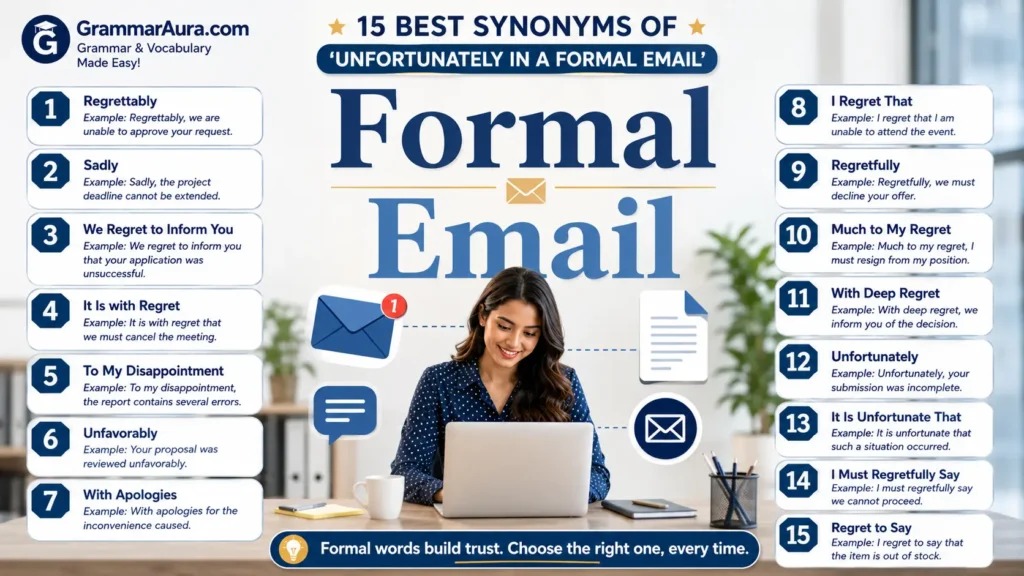

15 Best Synonyms of “Unfortunately” in a Formal Email can help improve how you communicate disappointing, sensitive, or negative information in professional settings. Choosing the right words in formal emails is essential, especially in business communication and workplace interactions where tone, clarity, and professionalism matter. The right phrasing can make difficult messages feel more respectful, empathetic, and easier for the recipient to understand.
From professional writing experience, careful word choice, strong alternatives, and effective communication skills play a major role in maintaining professionalism, empathy, and clear messaging. Selecting the right expression helps you deliver sensitive updates while preserving a strong formal tone and respectful communication style. This is where tone management, diplomatic language, and softening techniques become valuable, as they improve email etiquette and strengthen overall written communication.
In formal writing, maintaining a polite and considerate tone is especially important when delivering negative news or difficult updates. A clear communication strategy and thoughtful message framing improve readability and reduce the risk of misunderstanding. Using suitable synonyms, refining your formal writing, and applying professional writing techniques can significantly improve how your message is received. The right linguistic choice, combined with respectful and empathetic communication, ensures that even challenging messages remain balanced, clear, and professional while building trust in every business interaction.
What Does “Unfortunately in a Formal Email” Mean?
Using “Unfortunately” signals that the content of the message is negative, disappointing, or unfavorable. It communicates regret about a situation while maintaining a professional tone. In formal emails, “Unfortunately” introduces unwelcome news politely, showing that you recognize the impact on the recipient without sounding harsh or insensitive. Polite, professional, and empathetic.
When to Use “Unfortunately in a Formal Email”
- Declining requests politely
- Communicating delays or cancellations
- Providing negative feedback in professional contexts
Avoid using when:
- Delivering critical feedback in informal messages
- Writing casual emails where a softer tone may be preferred
Is It Professional/Polite to Say “Unfortunately in a Formal Email”?
Yes. It is widely accepted in business and professional correspondence. Using “Unfortunately” maintains politeness, clarity, and professionalism while signaling that the news may not be what the recipient hoped for.
Pros or Cons
Pros:
- Clear and widely understood
- Polite and professional
- Suitable for most formal situations
Cons:
- Overused in business communication
- Can feel impersonal if not paired with empathetic language
Unfortunately, in a Formal Email, Synonyms:
- Regrettably
- I’m Sorry to Say
- Sadly
- I Regret to Inform You
- It Is With Regret That
- I’m Afraid
- Unfortunately, I Must Inform You
- I Hate to Say
- I Wish I Could Say Otherwise
- It Is Disappointing to Note
- I Regret That
- We Apologize That
- It Is Unfortunate That
- We Regret That
- I Must Apologize That
Regrettably
Definition:
Expresses polite regret.
Meaning:
Conveys professional disappointment without sounding harsh.
Explanation:
A formal alternative to “Unfortunately,” suitable for email communication where maintaining diplomacy is key.
Example:
“Regrettably, we are unable to approve your request at this time.”
Best Use:
Professional emails, formal letters.
Worst Use:
Informal texting.
Tone:
Polite, professional, empathetic.
I’m Sorry to Say
Definition:
Soft introduction to negative news.
Meaning:
Personalizes the message by showing concern.
Explanation:
Adds a human touch while remaining professional.
Example:
“I’m sorry to say that the meeting has been postponed.”
Best Use:
Semi-formal or formal emails with a personal tone.
Worst Use:
Very stiff corporate communication.
Tone:
Empathetic, sincere.
Sadly
Definition:
Indicates disappointment.
Meaning:
Straightforwardly conveys regret.
Explanation:
Suitable for formal but slightly softer communication, acknowledging negative circumstances.
Example:
“Sadly, the event cannot take place as scheduled.”
Best Use:
Emails to colleagues or clients.
Worst Use:
Casual messages with light topics.
Tone:
Polite and considerate.
I Regret to Inform You
Definition:
Classic formal phrase for delivering bad news.
Meaning:
Politely informs the recipient of disappointing circumstances.
Explanation:
Highly formal, often used in HR, legal, or corporate correspondence.
Example:
“I regret to inform you that your application was not successful.”
Best Use:
Formal emails, official correspondence.
Worst Use:
Friendly or casual contexts.
Tone:
Very professional, polite.
It Is With Regret That
Definition:
Formal expression of dismay or disappointment.
Meaning:
Signals serious or sensitive news with tact.
Explanation:
Common in professional announcements, letters, or official notices.
Example:
“It is with regret that we must cancel the scheduled meeting.”
Best Use:
Corporate announcements or formal notifications.
Worst Use:
Informal messages.
Tone:
Formal, considerate.
I’m Afraid
Definition:
Gentle way to introduce negative information.
Meaning:
Softens the impact of bad news politely.
Explanation:
Less rigid than “I regret to inform you,” good for semi-formal emails.
Example:
“I’m afraid we cannot provide additional funding at this time.”
Best Use:
Emails where a courteous tone is important.
Worst Use:
Casual or very formal letters.
Tone:
Polite and approachable.
Unfortunately, I Must Inform You
Definition:
Direct and formal announcement of negative news.
Meaning:
Maintains clarity while being courteous.
Explanation:
Keeps communication precise and professional, suitable for official emails.
Example:
“Unfortunately, I must inform you that the contract has been delayed.”
Best Use:
Corporate or legal correspondence.
Worst Use:
Casual messages.
Tone:
Formal and professional.
I Hate to Say
Definition:
Slightly informal, empathetic alternative.
Meaning:
SHow’s regret with a conversational touch.
Explanation:
Good for emails where friendliness and empathy are balanced with professionalism.
Example:
“I hate to say that we cannot accommodate your request.”
Best Use:
Semi-formal emails to colleagues or clients.
Worst Use:
Very formal corporate letters.
Tone:
Empathetic, approachable.
I Wish I Could Say Otherwise
Definition:
Expresses regret creatively.
Meaning:
Softens the impact of negative news politely.
Explanation:
Implies that the outcome is disappointing but unavoidable.
Example:
“I wish I could say otherwise, but the event has been postponed.”
Best Use:
Professional emails with a slightly personal tone.
Worst Use:
Formal legal correspondence.
Tone:
Warm, empathetic.
It Is Disappointing to Note
Definition:
Polite acknowledgment of unfavorable news.
Meaning:
Signals recognition of impact while remaining professional.
Explanation:
A formal phrase that emphasizes consideration and sensitivity.
Example:
“It is disappointing to note that the shipment has been delayed.”
Best Use:
Professional notifications and updates.
Worst Use:
Casual email or informal chat.
Tone:
Formal, respectful.
I Regret That
Definition:
Simple expression of formal regret.
Meaning:
Communicates negative news politely and concisely.
Explanation:
Classic and professional, ideal for emails that need brevity.
Example:
“I regret that we cannot approve your proposal at this stage.”
Best Use:
Formal emails, concise communication.
Worst Use:
Informal messaging.
Tone:
Polite and professional.
We Apologize That
Definition:
Corporate or organizational alternative.
Meaning:
Expresses collective regret professionally.
Explanation:
Used in company correspondence, especially client-facing communications.
Example:
“We apologize that the shipment did not arrive on time.”
Best Use:
Professional emails or client communication.
Worst Use:
Personal or individual emails.
Tone:
Polite, corporate.
It Is Unfortunate That
Definition:
Direct formal alternative.
Meaning:
A professional way to acknowledge negative circumstances.
Explanation:
Neutral and objective, without adding personal emotion.
Example:
“It is unfortunate that the meeting cannot proceed as planned.”
Best Use:
Official notifications, neutral professional tone.
Worst Use:
Casual emails or friendly notes.
Tone:
Formal, neutral.
We Regret That
Definition:
A corporate version of expressing regret.
Meaning:
Polite, formal acknowledgment of unfavorable events.
Explanation:
Often used in HR, finance, or client service emails.
Example:
“We regret that the account approval has been delayed.”
Best Use:
Professional and client-focused communication.
Worst Use:
Personal emails.
Tone:
Formal, courteous.
I Must Apologize That
Definition:
Polite acknowledgment of responsibility for bad news.
Meaning:
Expresses accountability and regret.
Explanation:
Shows personal responsibility in professional communication while delivering negative information.
Example:
“I must apologize that the report was not completed on time.”
Best Use:
Emails where accountability is key.
Worst Use:
Casual contexts.
Tone:
Formal, sincere, respectful.
Comparison Table of Top Alternatives
| Alternative Phrase | Best For | Tone | Formality |
| Regrettably | Formal emails | Polite | High |
| I’m Sorry to Say | Semi-formal, personal | Empathetic | Medium |
| Sadly | Friendly professional | Considerate | Medium |
| I Regret to Inform You | Official letters | Very formal | High |
| It Is With Regret That | Corporate or legal | Formal | High |
| I’m Afraid | Semi-formal emails | Gentle | Medium |
| Unfortunately, I Must Inform You | Corporate/professional | Professional | High |
| I Hate to Say | Semi-formal | Approachable | Medium |
| I Wish I Could Say Otherwise | Semi-formal | Warm | Medium |
| We Apologize That | Client communication | Polite | High |
Final Thoughts
Delivering negative news in a formal email requires tact, professionalism, and empathy. While “Unfortunately” is widely used, these 15 alternatives give you flexibility to match your tone to the situation. Using the right phrasing ensures your message is clear, polite, and respectful, maintaining trust and professionalism with colleagues, clients, and stakeholders.
Choosing the appropriate alternative depends on the relationship, context, and level of formality. Corporate emails may benefit from phrases like “I regret to inform you” or “It is with regret that”, while semi-formal emails can feel warmer with “I’m sorry to say” or “I’m afraid”. Thoughtful phrasing shows that you care about the recipient’s experience even when delivering disappointing news.
FAQs
Is “Unfortunately” always appropriate in formal emails?
Yes, it is widely accepted for professional correspondence. However, overuse can feel impersonal. Consider alternatives like “Regrettably” or “I regret to inform you” for a more polished and empathetic tone, particularly when communicating sensitive or disappointing news.
What is the most formal alternative to “Unfortunately”?
“I regret to inform you” is the most formal and commonly used phrase in official letters, corporate emails, or legal correspondence. It conveys professionalism, clarity, and empathy without appearing casual.
Can “I’m sorry to say” be used in professional emails?
Yes. It adds a personal and empathetic tone, suitable for semi-formal or internal emails, particularly when addressing colleagues or clients with whom you have a cordial relationship.
When should I use “I’m afraid” instead of “Unfortunately”?
Use “I’m afraid” in semi-formal or polite professional emails where you want a softer, approachable tone. It’s less rigid than “I regret to inform you” and works well in customer communication or internal updates.
Are corporate alternatives like “We apologize that” acceptable?
Absolutely. Phrases like “We apologize that” or “We regret that” are ideal for client-facing emails, corporate notices, and situations requiring formal accountability or collective responsibility.
Is “Sadly” too informal for professional emails?
“Sadly” is slightly less formal than “Regrettably” but still acceptable in professional emails, especially when you want to express gentle empathy while remaining polite and considerate.
Can I use “I wish I could say otherwise” in emails?
Yes. This phrase softens negative news with a thoughtful, human touch, suitable for professional emails that also aim to convey empathy and warmth.
How do I choose the right tone for negative news?
Consider formality, recipient relationship, and message impact. Corporate or legal emails require formal phrases like “It is with regret that”, while semi-formal emails may benefit from softer, empathetic alternatives like “I’m sorry to say”.
Can these alternatives be used in international professional emails?
Yes. Most alternatives, including “Regrettably”, “I regret to inform you”, and “I’m afraid”, are widely understood and polite in professional English, making them suitable for global communication.
Are there risks of sounding insincere with these phrases?
Yes, overusing formal phrases like “Unfortunately” without context or empathetic language can feel formulaic. Pairing the phrase with a polite explanation, acknowledgment of impact, and helpful next steps ensures your message is perceived as sincere and professional.
