
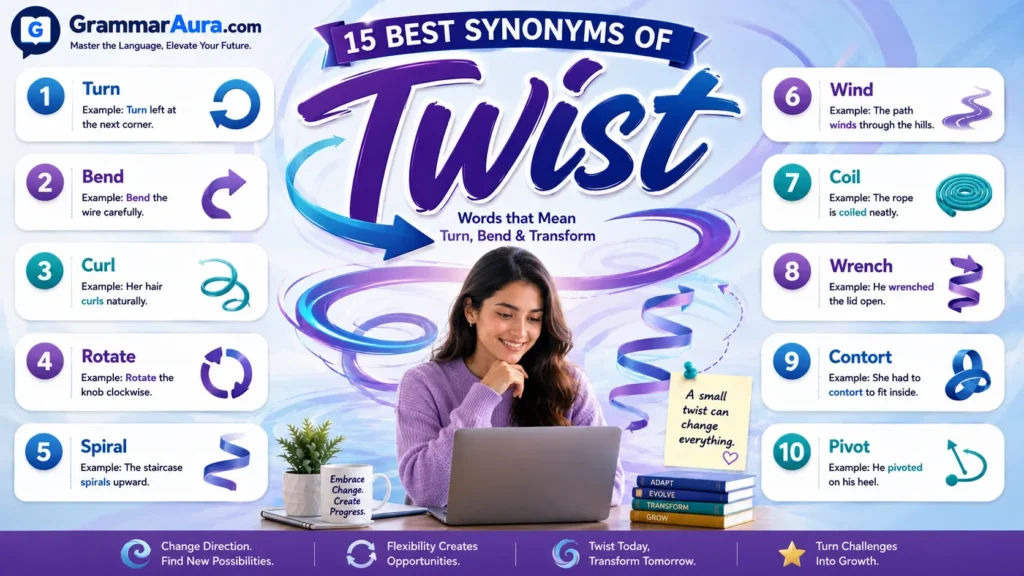

15 Best Synonyms of “Twist” helps explain how different word choices can describe movement, change, and transformation more effectively in writing. The word twist is highly versatile because it can express physical motion, emotional shifts, and changing ideas naturally and engagingly. Using the right synonym makes your message more precise, expressive, and easier for readers to understand.
From a writing perspective, sentence clarity depends heavily on natural phrasing and strong word selection. Even a small word change can significantly alter meaning and emotional impact. Thoughtful synonym choices help writing feel more vivid, precise, and engaging while making complex ideas—such as transformation or movement—easier to follow.
What Does “Twist” Mean?
The word “twist” means to turn, rotate, or bend something out of its original shape or direction, or to describe an unexpected change in situation or meaning. In simple terms, twist = turning or changing direction physically or figuratively. She twisted the cap open.
When to Use “Twist”
You use “twist” when:
- Describing physical rotation or bending
- Explaining movement or manipulation
- Talking about unexpected story changes
- Showing a change in direction or shape
- The story had a surprising twist at the end.
Is It Professional/Polite to Say “Twist”?
Yes, “twist” is neutral and widely acceptable in both formal and informal contexts. It is used in:
- Everyday communication
- Storytelling and literature
- Basic science descriptions
However, in technical writing, more precise terms like “rotation” or “torsion” may be preferred.
Pros and Cons of Using “Twist”
Pros:
- Very versatile
- Easy to understand
- Works in literal and figurative contexts
- Common in storytelling
Cons:
- Can be vague
- Not always precise
- Multiple meanings may confuse readers
- Less formal in technical writing
Twist synonyms:
- Turn
- Rotate
- Bend
- Curl
- Spiral
- Contort
- Wrench
- Distort
- Tangle
- Coil
- Swirl
- Twist Around
- Screw
- Warp
- Deviate
Turn
Meaning:
To move something into a different position.
Explanation:
The most basic and common replacement for twist is used for simple movement.
Example:
She turned the key.
Best Use:
Everyday actions
Worst Use:
Complex motion
Tone:
Simple, neutral
Rotate
Meaning:
To move in a circular direction.
Explanation:
A more technical and precise form of turning.
Example:
The wheel rotates smoothly.
Best Use:
Science, mechanics
Worst Use:
Emotional writing
Tone:
Technical, precise
Bend
Meaning:
To curve or change shape.
Explanation:
Used when twisting involves flexibility.
Example:
The wire bends easily.
Best Use:
Physical descriptions
Worst Use:
Storytelling twists
Tone:
Natural, visual
Curl
Meaning:
To form a curved shape.
Explanation:
A soft, gentle form of twisting motion.
Example:
Smoke curls upward.
Best Use:
Descriptive writing
Worst Use:
Mechanical contexts
Tone:
Gentle, visual
Spiral
Meaning:
To move in a circular upward or downward path.
Explanation:
Shows continuous curved motion.
Example:
The stairs spiral upward.
Best Use:
Nature, architecture
Worst Use:
Simple actions
Tone:
Dynamic, vivid
Contort
Meaning:
To twist into an unnatural shape.
Explanation:
Suggests extreme or uncomfortable twisting.
Example:
His face contorted in pain.
Best Use:
Dramatic writing
Worst Use:
Casual tone
Tone:
Intense, expressive
Wrench
Meaning:
To twist forcefully.
Explanation:
Implies sudden, strong rotational force.
Example:
He wrenched the door open.
Best Use:
Action scenes
Worst Use:
Gentle descriptions
Tone:
Forceful, strong
Distort
Meaning:
To change or twist out of shape or meaning.
Explanation:
Used physically or figuratively.
Example:
The mirror distorts images.
Best Use:
Analysis, media
Worst Use:
Simple motion
Tone:
Formal, analytical
Tangle
Meaning:
To twist into a messy form.
Explanation:
Often used for hair, wires, or confusion.
Example:
The cables tangled together.
Best Use:
Everyday objects
Worst Use:
Technical precision
Tone:
Casual, messy
Coil
Meaning:
To form into loops.
Explanation:
A neat and structured twisting motion.
Example:
The snake coils tightly.
Best Use:
Nature, objects
Worst Use:
Emotional tone
Tone:
Controlled, visual
Swirl
Meaning:
To move in smooth circular motion.
Explanation:
Soft and flowing form of twisting.
Example:
Cream swirls in coffee.
Best Use:
Food, nature
Worst Use:
Mechanical use
Tone:
Smooth, gentle
Twist Around
Meaning:
To rotate around something.
Explanation:
Shows wrapping or circular motion.
Example:
The vine twists around the pole.
Best Use:
Nature descriptions
Worst Use:
Formal writing
Tone:
Natural, descriptive
Screw
Meaning:
To turn tightly in a spiral motion.
Explanation:
Mechanical twisting action.
Example:
Screw the lid on.
Best Use:
Tools, mechanics
Worst Use:
Emotional writing
Tone:
Functional, technical
Warp
Meaning:
To bend or twist out of shape.
Explanation:
Often used for materials or abstract change.
Example:
Heat warped the wood.
Best Use:
Science, metaphor
Worst Use:
Simple motion
Tone:
Abstract, flexible
Deviate
Meaning:
To change direction from a path.
Explanation:
Figurative form of twisting away from direction.
Example:
The car deviated from the route.
Best Use:
Formal writing
Worst Use:
Physical twisting
Tone:
Analytical, formal
Comparison Table of Top Alternatives
| Synonym | Type | Tone | Best Use |
| Turn | Basic motion | Simple | Everyday use |
| Rotate | Mechanical | Technical | Science |
| Bend | Physical | Natural | Shape change |
| Curl | Visual | Gentle | Description |
| Spiral | Motion | Vivid | Nature/structure |
| Contort | Extreme | Intense | Drama |
| Wrench | Forceful | Strong | Action scenes |
| Distort | Figurative | Formal | Analysis |
| Tangle | Messy | Casual | Objects |
| Swirl | Fluid | Soft | Nature/food |
Final Thoughts
The word “twist” is one of those versatile terms that quietly carries a lot of expressive power. Whether you’re describing physical movement, emotional shifts, or unexpected story changes, it helps bring motion and meaning into your writing. However, using alternatives like “spiral,” “rotate,” or “distort” allows you to refine that expression and choose a tone that better fits your context.
Ultimately, learning synonyms of “twist” is about more than expanding vocabulary—it’s about improving how clearly and vividly you communicate ideas. Each synonym adds its own shade of meaning, helping you create writing that feels more precise, engaging, and naturally expressive for your readers.
FAQs
What is the simplest synonym of “twist”?
The simplest synonym of “twist” is “turn.” It describes basic rotational movement in a clear and direct way. It is commonly used in everyday language and is the easiest alternative when you want to keep your writing simple and understandable without losing meaning or clarity.
Is “twist” used in both literal and figurative ways?
Yes, “twist” is used both literally and figuratively. Literally, it refers to physical movement like turning or bending something. Figuratively, it describes unexpected changes in stories, events, or emotions, such as a “plot twist” in a movie or novel.
What is the most technical synonym of “twist”?
The most technical synonym of “twist” is “rotate.” It is widely used in science, engineering, and mathematics to describe circular motion. It is precise, formal, and ideal for contexts where accuracy and clarity are more important than expressive language.
What synonym of “twist” is best for storytelling?
For storytelling, the best synonyms include “distort,” “contort,” and “spiral.” These words create strong visual and emotional impact, helping readers feel tension, surprise, or transformation in a narrative scene or character development.
What is the difference between “twist” and “bend”?
“Twist” involves rotational movement, while “bend” refers to a curved shape without rotation. For example, a stick bends when it curves, but a rope twists when it is turned around its axis.
Can “twist” describe emotions or situations?
Yes, “twist” is often used metaphorically to describe unexpected changes in emotions or situations. For example, a “twist of fate” refers to a surprising turn of events that changes the expected outcome.
What is the most visual synonym of “twist”?
The most visual synonyms of “twist” are “swirl,” “curl,” and “spiral.” These words help readers imagine smooth, flowing movement, making them ideal for descriptive or creative writing.
What synonym of “twist” is used in science?
In science, commonly used synonyms include “rotate,” “warp,” and sometimes “deviate.” These terms describe precise physical or directional changes and are often used in physics, engineering, and material studies.
Is “contort” a negative word?
Yes, “contort” usually has a negative tone. It suggests unnatural or painful twisting, often used to describe strong emotional or physical reactions, such as discomfort, stress, or strain.
Why should I learn synonyms of “twist”?
Learning synonyms of “twist” helps improve clarity, creativity, and expression in writing. It allows you to choose words that better match tone and context, making your communication more vivid, precise, and engaging for readers.
