
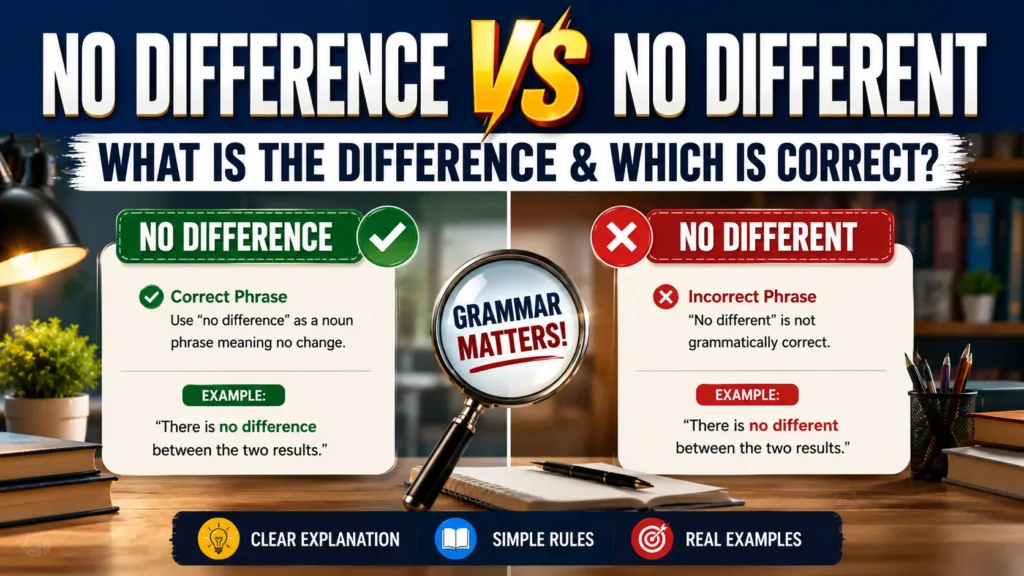

“No difference” and “no different” may look similar, but they serve different grammatical purposes. The key is understanding the difference between the noun difference and the adjective different. While no difference is a standard and common expression, no different usually needs additional words to form a complete and natural comparison. Let’s explore when and how to use each correctly.
Comparison Overview
No difference and no different are not interchangeable because difference and different belong to different parts of speech.
- No difference uses difference, a noun.
- No different uses different, an adjective.
The expression no difference is grammatically complete when you want to say that two or more things are the same or that there is no distinction between them.
For example:
There is no difference between the two products.
By contrast, no different is generally incomplete or unnatural when used by itself. The adjective different normally needs a linking verb, such as is, are, was, or were, or it may appear in a larger structure such as no different from.
For example:
The new version is no different from the old one.
| Expression | Part of Speech | Common Structure | Example |
| No difference | Noun phrase | no difference between/from | There is no difference between them. |
| No different | Adjective phrase | no different from | The result is no different from before. |
The most important point is that no difference is usually the natural choice when you mean “there is no distinction.”
Definition of No Difference
No difference is a noun phrase meaning that two or more things are the same in a particular respect or that there is no meaningful distinction between them.
The word difference is a noun. It refers to a way in which people or things are not the same.
When preceded by no, the phrase no difference indicates the absence of such a distinction.
Examples:
- There is no difference between the two answers.
- I can see no difference in the results.
- It makes no difference to me.
- There was no difference in their performance.
- The two methods produced no difference in the final outcome.
A very common structure is:
There is/was + no difference + between + A and B
Example:
There is no difference between these two designs.
Another common expression is:
It makes no difference + to + someone
Example:
It makes no difference to me which option you choose.
Definition of No Different
No different is not normally used as a complete expression by itself. This is because different is an adjective, and adjectives generally need to describe a noun or occur after a linking verb.
For example:
The new design is different.
Here, different describes the design.
When you want to express that something is not different from another thing, the natural structure is:
The new design is no different from the old design.
The phrase no different from means not different from or essentially the same as.
Examples:
- This process is no different from the previous one.
- Her experience was no different from mine.
- The new policy is no different from the old policy.
- This situation is no different from what we expected.
- His approach is no different from that of his competitors.
Therefore, if you simply write “no different”, the phrase may sound incomplete. In most contexts, you need something after it, especially from and the thing being compared.
Main Differences Between No Difference and No Different
The biggest difference is grammatical.
No Difference Is a Noun Phrase
In no difference, the word difference is a noun.
There is no difference between the two machines.
The phrase refers to the absence of a distinction.
No Different Uses an Adjective
In no different, the word different is an adjective.
The second machine is no different from the first.
Here, different describes the second machine and is connected to the subject by is.
They Use Different Sentence Structures
Compare:
There is no difference between the two plans.
and:
The two plans are no different from each other.
Both sentences communicate a similar idea, but their grammatical structures are different.
Comparison Table
| Feature | No Difference | No Different |
| Key word | Difference | Different |
| Part of speech | Noun | Adjective |
| Usually complete alone? | Yes | Usually no |
| Common structure | There is no difference between A and B | A is no different from B |
| Meaning | No distinction exists | A is not different from B |
| Example | There is no difference between them. | They are no different from each other. |
“No Difference” vs “No Different From”
A particularly useful distinction is between no difference and no different from.
These expressions can communicate almost the same idea but use different grammar.
No Difference
There is no difference between the two products.
This construction uses the noun difference.
No Different From
The two products are no different from each other.
This construction uses the adjective different.
The word from is important in the second construction because different from is the standard comparison pattern.
For example:
This version is no different from the original.
The two structures can often be rewritten:
There is no difference between A and B.
and:
A is no different from B.
Both express the idea that A and B do not differ in the relevant respect.
Grammar Guide
How Each Term Is Used in Sentences
Using No Difference
The most common pattern is:
There is/are + no difference + between A and B.
Example:
There is no difference between the two options.
Another useful pattern is:
It makes no difference + to + person.
Example:
It makes no difference to me.
You can also use:
no difference + in + noun
Example:
Researchers found no difference in the results.
And:
no difference + between + noun phrases
Example:
We noticed no difference between the two versions.
Using No Different
The usual pattern is:
Subject + be + no different from + comparison.
Examples:
This model is no different from the previous model.
Her response was no different from mine.
Their approach is no different from ours.
You may also see:
A and B are no different from each other.
Example:
The two devices are no different from each other in terms of performance.
Common Mistakes Learners Make
Mistake 1: Using “No Different” as a Noun Phrase
Incorrect:
There is no different between these options.
Correct:
There is no difference between these options.
Because difference is the noun required after “no” in this structure.
Mistake 2: Omitting “From”
Unnatural:
The new system is no different the old system.
Correct:
The new system is no different from the old system.
The adjective different commonly takes from when identifying what something is being compared with.
Mistake 3: Confusing “Different” and “Difference”
Incorrect:
I can see no different between them.
Correct:
I can see no difference between them.
Use difference when you need a noun.
Mistake 4: Assuming “No Different” Is Always Wrong
“No different” is not inherently wrong. It can be grammatically correct when used in an appropriate structure.
For example:
This situation is no different from the previous one.
The problem occurs when learners use no different where the noun difference is required.
Simple Rules to Remember
Use these simple rules:
- Difference = noun.
- Different = adjective.
- Use no difference to say that no distinction exists.
- Use no different from to describe something as not different from another thing.
- After there is/are, use no difference, not no different.
- After a linking verb such as is/are, you can use no different from.
A helpful memory trick is:
No difference = no distinction.
No different from = not different from something else.
Quick Tips for Writing and Speaking
When you want to say two things are essentially the same, ask yourself what grammatical structure you need.
If your sentence begins with:
There is…
Use:
There is no difference…
If your sentence describes a subject using is, are, was, or were, you may use:
is no different from…
For example:
There is no difference between the two answers.
or:
The two answers are no different from each other.
For formal writing, no difference between is often the clearest option because its meaning is immediately obvious.
When to Use Each One
When to Use No Difference
Use no difference when you are talking about the absence of a distinction.
Comparing two things
There is no difference between the two samples.
Discussing results
The study found no difference in the results.
Discussing preferences
It makes no difference to me.
Discussing quality
There is no difference in quality between the products.
Discussing methods
We found no difference between the two approaches.
When to Use No Different
Use no different from when an adjective is needed to describe a subject.
Comparing situations
Today’s situation is no different from yesterday’s.
Comparing experiences
Her experience was no different from mine.
Comparing products
This model is no different from the older version.
Comparing behavior
His response was no different from what we expected.
Comparing methods
Their method is no different from the standard approach.
When NOT to Use Each One
When Not to Use No Difference
Do not use no difference when you need an adjective to directly describe a subject.
For example:
Incorrect: The new product is no difference from the old one.
Correct:
The new product is no different from the old one.
Here, different is needed because it describes the product.
When Not to Use No Different
Do not use no different when a noun is required after no.
Incorrect:
There is no different between the two products.
Correct:
There is no difference between the two products.
Also avoid leaving no different incomplete when a comparison is needed:
Unclear: The new product is no different.
Better:
The new product is no different from the old one.
The shorter version can occasionally be understood from context, but no different from is usually clearer when making a direct comparison.
Which One to Use: Decision Guide
Choosing between no difference and no different becomes easy when you examine the sentence structure.
Step 1: Do You Need a Noun?
If you need a noun meaning “distinction,” choose difference.
There is no difference between the answers.
Step 2: Are You Describing Something?
If you need an adjective meaning “not different,” use different.
The answers are no different from each other.
Step 3: Does the Sentence Begin With “There Is”?
Use no difference.
There is no difference between the two options.
Not:
There is no different between the two options.
Step 4: Are You Using “Is,” “Are,” “Was,” or “Were” to Link a Subject to a Comparison?
Consider no different from.
The new version is no different from the old version.
Quick Decision Chart
Need a noun?
→ No difference
Need an adjective?
→ No different from
Meaning “there is no distinction”?
→ No difference
Meaning “A is not different from B”?
→ No different from
Real-World Practical Examples
No Difference Examples
Education
There is no difference between the two answers because both produce the same result.
Here, difference is a noun referring to the absence of distinction.
Daily Life
It makes no difference to me whether we eat at home or go out.
The phrase means that either choice is equally acceptable.
Science
The researchers found no difference in the measurements taken from the two samples.
The study found no meaningful distinction between the measurements.
Business
There was no difference in customer satisfaction between the two services.
The noun difference identifies the absence of variation.
Technology
There is no difference in performance between the two software versions.
The phrase describes equal performance.
Writing
The editor found no difference between the two revised paragraphs.
The two paragraphs were considered equivalent in the relevant respect.
Conversation
It makes no difference to me which movie we watch.
The speaker has no preference.
No Different Examples
Education
The second solution is no different from the first.
The adjective different describes the second solution.
Daily Life
Today’s routine is no different from yesterday’s.
The phrase compares today’s routine with yesterday’s.
Science
The new sample was no different from the control sample.
The adjective describes the relationship between the samples.
Business
The new pricing strategy is no different from the previous strategy.
The new strategy does not differ from the previous one.
Technology
This phone is no different from the older model in terms of battery life.
The adjective describes the phone’s similarity to the older model.
Writing
Her writing style is no different from what we saw in her earlier work.
The current style is being compared with an earlier style.
Conversation
Your opinion is no different from mine.
The phrase means that the two opinions are essentially the same.
Self-Assessment: Fill in the Blanks
Complete each sentence with no difference or no different from.
- There is ______ between the two answers.
- The new model is ______ the previous model.
- It makes ______ to me which restaurant we choose.
- Researchers found ______ in the test results.
- This situation is ______ what we experienced last year.
- There was ______ between the two methods.
- Her opinion is ______ mine.
- I can see ______ between these two pictures.
- The updated software is ______ the previous version.
- It makes ______ whether you arrive today or tomorrow.
- The results showed ______ in performance.
- This process is ______ the one we used before.
- There is ______ between the two products in quality.
- His explanation was ______ the one he gave earlier.
- The teacher noticed ______ in the students’ scores.
- The new policy is ______ the old policy.
- There is ______ between the two designs.
- Their experience was ______ ours.
- It makes ______ which option you select.
- The second experiment produced ______ in the final measurements.
Answers
- no difference — “Difference” is the noun required after “there is.”
- no different from — “Different” is an adjective describing the new model.
- no difference — “It makes no difference” is the standard expression.
- no difference — The sentence needs the noun describing the absence of variation.
- no different from — “Is no different from” compares the current situation with a previous one.
- no difference — “There was no difference” is the correct noun structure.
- no different from — “Different” describes her opinion in relation to another opinion.
- no difference — “See no difference” requires the noun “difference.”
- no different from — The software is being described as not different from the previous version.
- no difference — “It makes no difference” is a standard phrase.
- no difference — “Difference” is the noun referring to variation in performance.
- no different from — “Is no different from” is the correct adjective structure.
- no difference — The sentence uses “there is,” so the noun “difference” is needed.
- no different from — “Was no different from” correctly compares two explanations.
- no difference — “Notice no difference” requires a noun.
- no different from — The adjective describes the policy’s similarity to the old one.
- no difference — “There is no difference” is the correct construction.
- no different from — “Was no different from” compares two experiences.
- no difference — “It makes no difference” expresses that the choice does not matter.
- no difference — The experiment showed an absence of variation in the measurements.
Final Verdict
The choice between no difference and no different depends on grammar and sentence structure. No difference is the standard noun phrase used when you mean that there is no distinction or variation between two or more things. For example, “There is no difference between the two products.”
No different, meanwhile, is normally used as part of the structure no different from, where different functions as an adjective. For example, “The new product is no different from the old one.”
The easiest rule is to remember the parts of speech: difference is a noun, while different is an adjective. If you need to say that no distinction exists, choose no difference. If you are describing something as not different from another thing, choose no different from. Once you recognize this grammatical distinction, you can use both expressions naturally and confidently.
Conclusion
Understanding No Difference Vs No Different becomes much easier once you recognize that difference and different have different grammatical roles. No difference is a noun phrase used to say that there is no distinction or variation between people, things, ideas, or results. For example, “There is no difference between the two options.” No different, on the other hand, is normally used as part of the phrase no different from, where different functions as an adjective. For example, “The new version is no different from the old one.” The simplest rule is to remember that difference is a noun, while different is an adjective. When you mean “no distinction,” choose no difference. When you mean that one thing is “not different from” another, use no different from. With this simple distinction in mind, you can use both expressions naturally and confidently in everyday and professional English.
FAQs
Is “no difference” grammatically correct?
Yes, no difference is grammatically correct and commonly used in English. It is a noun phrase that means there is no distinction, variation, or meaningful change between two or more things. For example, “There is no difference between the two answers.” It can also appear in expressions such as “It makes no difference to me.”
Is “no different” grammatically correct?
Yes, no different can be grammatically correct, but it is usually used within a larger structure, especially no different from. For example, “This method is no different from the previous one.” Because different is an adjective, it normally needs a subject and linking verb or another appropriate grammatical structure to complete the meaning.
What is the difference between “no difference” and “no different”?
No difference contains the noun difference and refers to the absence of a distinction. No different contains the adjective different and is commonly used in the phrase no different from to describe something as not different from another thing. For example, “There is no difference” and “It is no different from the original” use different grammatical structures.
Should I say “there is no difference” or “there is no different”?
The correct expression is “there is no difference.” The word difference is a noun and fits naturally after “there is no.” Different is an adjective, so “there is no different” is incorrect in standard English. For example, say, “There is no difference between the two products,” rather than “There is no different between them.”
Can I say “no different from”?
Yes, no different from is a correct and useful expression. It means that something is essentially the same as another thing or does not differ from it. For example, “The new policy is no different from the old policy.” Here, different functions as an adjective, while from introduces the thing being compared.
Is “no different than” correct?
No different than is used in some varieties of English, particularly American English, but no different from is widely accepted and often preferred in careful or formal writing. For maximum clarity, especially in academic or professional contexts, use no different from. For example, “The new system is no different from the previous system.”
What part of speech is “difference”?
Difference is a noun. It refers to a way in which two or more things are not the same. For example, in “There is a difference between the two plans,” the word difference names the distinction. This is why no difference works as a noun phrase: “There is no difference between the plans.”
What part of speech is “different”?
Different is an adjective. It describes something that is not the same as another thing. For example, in “The new design is different from the old design,” different describes the new design. This is why expressions such as different from and no different from can be used to make comparisons.
How can I remember when to use “no difference”?
Remember that difference is a noun meaning a distinction or variation. If your sentence could use the phrase “no distinction,” no difference is probably the right choice. For example, “There is no difference between the two answers” means “There is no distinction between the two answers.” This simple substitution can help you remember the grammar.
How can I remember the difference between “no difference” and “no different”?
Use this simple rule: difference is a noun, while different is an adjective. Choose no difference when you are talking about the absence of a distinction. Choose no different from when describing one thing as not different from another. For example, “There is no difference” versus “The result is no different from before.”
