

Being fully present and enjoying life as it unfolds is a powerful way to connect with yourself and others. The phrase living in the moment captures the idea of embracing each experience, but using it repeatedly can feel predictable.
Exploring alternatives allows you to express mindfulness, awareness, and presence in ways that feel fresh, empathetic, and meaningful. From my personal experience, choosing the right synonym can make your message resonate more deeply, giving your communication an authentic tone.
Whether in conversation, social media, or personal reflection, these 15 alternatives provide meanings, examples, best and worst uses, and guidance to help communicate with warmth, clarity, and authenticity. By being intentional, you make your words meaningful, connect with others on a deeper level, and turn living in the moment into a practice that feels personal, genuine, and truly engaging.
Quick Answer: What Is Another Way to Say “Living in the Moment”?
The most versatile alternative to “living in the moment” is “being present.” It clearly communicates the idea of paying attention to what is happening right now.
Other useful alternatives include:
- Being present — best general alternative
- Mindful awareness — best for mindfulness and wellness
- Savoring the moment — best for enjoyment and appreciation
- Fully engaged — best for professional or active contexts
- Immersed in the now — best for reflective or creative writing
- Experiencing the present — best for personal growth
- Appreciating the moment — best for gratitude
- Here and now — best for concise, motivational language
- Living fully — best for inspirational writing
- Mindfully present — best for meditation and wellness
The best choice depends on what you want to emphasize: attention, enjoyment, gratitude, mindfulness, participation, or appreciation of life.
What Does “Living in the Moment” Mean?
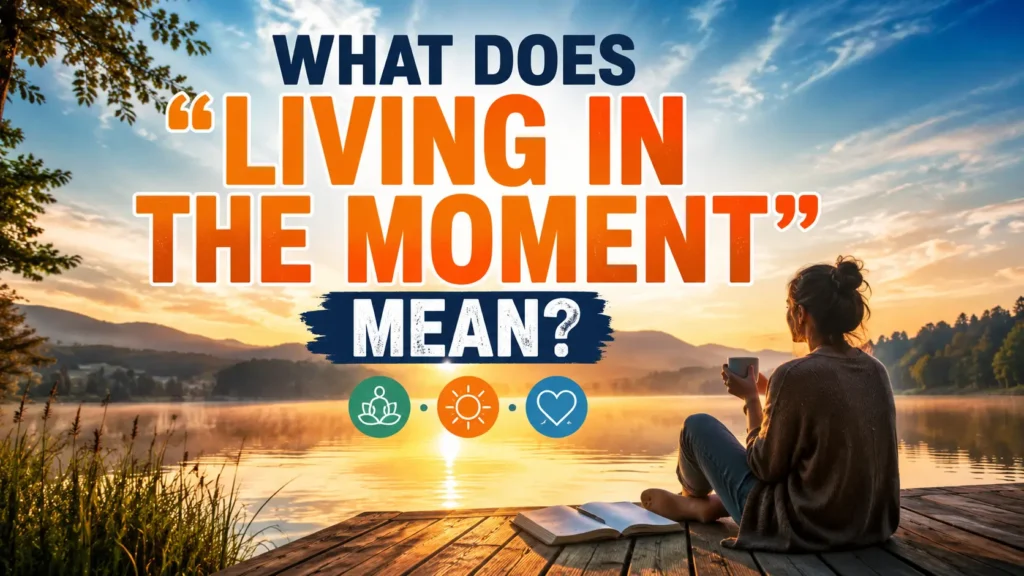
“Living in the moment” means fully experiencing the present without undue concern for the past or future. It’s about mindfulness, savoring life as it happens, and appreciating what is happening right now.
Example:
“By taking a deep breath and enjoying the sunset, I felt I was truly living in the moment.”
When to Use “Living in the Moment”
- During conversations about mindfulness, stress relief, or personal growth
- In social media posts or journals emphasizing gratitude and presence
- In coaching, therapy, or motivational contexts, to encourage awareness
Is It Professional/Polite to Say “Living in the Moment”?
Yes, it is generally professional, especially in well-being, coaching, or creative contexts. However, in highly formal or corporate writing, consider alternatives like “being fully present” or “mindful awareness” for a polished tone.
Pros and Cons
Pros:
- Clear and widely understood
- Conveys mindfulness, positivity, and presence
- Can be used in personal, professional, and casual settings
Cons:
- Overused in social media or wellness circles
- Can feel informal or vague in corporate communication
- Lacks specificity in professional writing
Living in the Moment Synonyms:
- Being Present
- Mindful Awareness
- Savoring the Moment
- Fully Engaged
- Immersed in the Now
- Experiencing the Present
- Appreciating the Moment
- Here and Now
- Living Fully
- Immersed in the Present
- Engaged in the Moment
- Mindfully Present
- Here in the Moment
- Enjoying the Moment
- Fully Experiencing Life
Being Present
Meaning:
Focusing completely on the current moment without distraction.
Explanation:
Highlights mindfulness and attention to what’s happening right now.
Example:
“During the meeting, I focused on being present rather than worrying about tomorrow’s tasks.”
Best Use:
Workshops, coaching, and mindful exercises.
Worst Use:
Casual texts might sound overly formal if overused.
Tone:
Neutral, thoughtful
Mindful Awareness
Meaning:
Conscious attention to the present moment, embracing awareness and observation.
Explanation:
Emphasizes mental clarity and reflection; popular in meditation and wellness practices.
Example:
“Mindful awareness of each breath helped reduce my stress.”
Best Use:
Meditation guides, wellness blogs.
Worst Use:
Overly casual settings may feel jargon-y.
Tone:
Calm, reflective
Savoring the Moment
Meaning:
Enjoying and appreciating every detail of the present experience.
Explanation:
Focuses on gratitude and enjoyment, often in sensory or emotional experiences.
Example:
“I sat on the beach, savoring the moment as waves lapped the shore.”
Best Use:
Personal stories, reflective writing.
Worst Use:
Corporate reports may sound too poetic.
Tone:
Warm, experiential
Fully Engaged
Meaning:
Being deeply involved and attentive in the current activity or interaction.
Explanation:
Highlights active participation, not just passive presence.
Example:
“He was fully engaged during the team discussion, contributing valuable ideas.”
Best Use:
Workshops, team meetings, and coaching.
Worst Use:
Casual social media posts may feel stiff.
Tone:
Professional, active
Immersed in the Now
Meaning:
Completely absorbed in the present moment.
Explanation:
Focuses on deep engagement and mindfulness.
Example:
“She was immersed in the now, enjoying the painting session without distraction.”
Best Use:
Art, meditation, reflective writing.
Worst Use:
Overly formal business communication.
Tone:
Calm, reflective
Experiencing the Present
Meaning:
Actively noticing and feeling what is happening now.
Explanation:
Encourages conscious observation and emotional awareness.
Example:
“Experiencing the present helped me forget my worries for a while.”
Best Use:
Personal development blogs, therapy.
Worst Use:
Corporate board meetings.
Tone:
Empathetic, thoughtful
Appreciating the Moment
Meaning:
Acknowledging and valuing the present moment.
Explanation:
Focuses on gratitude, recognition, and positivity.
Example:
“I appreciated the moment as laughter filled the room.”
Best Use:
Journals, mindfulness exercises.
Worst Use:
Highly technical or formal writing.
Tone:
Warm, heartfelt
Here and Now
Meaning:
Emphasizing attention to the current time and place.
Explanation:
Simple, concise way to highlight presence and mindfulness.
Example:
“Focusing on the here and now helped me stop overthinking.”
Best Use:
Motivational speeches, coaching.
Worst Use:
Overly formal contexts.
Tone:
Direct, mindful
Living Fully
Meaning:
Engaging in life with energy and presence.
Explanation:
Conveys enthusiasm, awareness, and vitality in daily living.
Example:
“She believed in living fully, savoring every laugh and challenge.”
Best Use:
Inspirational content, wellness blogs.
Worst Use:
Formal business documentation.
Tone:
Positive, inspiring
Immersed in the Present
Meaning:
Deeply engaged in what is happening right now.
Explanation:
Focuses on attention and mindfulness rather than distraction.
Example:
“He was immersed in the present while hiking through the forest.”
Best Use:
Meditation guides, personal storytelling.
Worst Use:
Overly casual or repetitive communication.
Tone:
Reflective, calm
Engaged in the Moment
Meaning:
Actively participating and aware of the current experience.
Explanation:
Highlights mindfulness and conscious interaction.
Example:
“During the concert, I was engaged in the moment and felt pure joy.”
Best Use:
Workshops, coaching sessions, and personal reflection.
Worst Use:
Highly formal contexts.
Tone:
Friendly, thoughtful
Mindfully Present
Meaning:
Consciously aware and attentive to the present.
Explanation:
Popular in meditation and wellness; emphasizes intentional awareness.
Example:
“By being mindfully present, I noticed the subtle beauty in everyday life.”
Best Use:
Meditation, wellness programs, coaching.
Worst Use:
Casual texting may feel jargon-y.
Tone:
Calm, reflective
Here in the Moment
Meaning:
Acknowledging the current time and experience fully.
Explanation:
Casual, friendly alternative emphasizing presence and awareness.
Example:
“I focused on being here in the moment and stopped worrying.”
Best Use:
Casual conversations, social media posts.
Worst Use:
Formal reports or academic writing.
Tone:
Friendly, approachable
Enjoying the Moment
Meaning:
Actively finding pleasure or gratitude in the present.
Explanation:
Focuses on positivity, appreciation, and mindfulness.
Example:
“We sat by the lake, enjoying the moment together.”
Best Use:
Personal storytelling, journals, social media.
Worst Use:
Formal or technical writing.
Tone:
Warm, joyful
Fully Experiencing Life
Meaning:
Engaging with life completely and with awareness.
Explanation:
Broader than mindfulness; conveys vitality, awareness, and gratitude.
Example:
“By fully experiencing life, she felt more connected to her friends and surroundings.”
Best Use:
Motivational writing, personal development content.
Worst Use:
Technical or corporate communication.
Tone:
Inspiring, heartfelt
Which Synonym Is Best for “Living in the Moment”?
The best alternative depends on the context and the specific meaning you want to communicate.
| Context | Best Alternative | Why It Works |
| General conversation | Being Present | Clear and versatile |
| Mindfulness | Mindful Awareness | Emphasizes conscious attention |
| Enjoyment | Savoring the Moment | Highlights pleasure and appreciation |
| Professional setting | Fully Engaged | Emphasizes active participation |
| Creative writing | Immersed in the Now | Has a reflective quality |
| Personal growth | Experiencing the Present | Emphasizes awareness |
| Gratitude | Appreciating the Moment | Highlights appreciation |
| Motivation | Here and Now | Short and memorable |
| Inspirational writing | Living Fully | Suggests embracing life |
| Meditation | Mindfully Present | Directly emphasizes mindfulness |
| Casual conversation | Enjoying the Moment | Natural and friendly |
Formal vs. Casual Alternatives for “Living in the Moment”
Not every alternative has the same level of formality.
Formal or Professional Alternatives
For professional, educational, or wellness-related writing, consider:
- Being fully present
- Mindful awareness
- Experiencing the present
- Fully engaged
- Maintaining present-moment awareness
Example:
“Being fully present during client discussions can improve communication and understanding.”
Casual Alternatives
For everyday conversation, texts, captions, and social media, consider:
- Enjoying the moment
- Here and now
- Savoring the moment
- Living fully
- Being present
Example:
“No plans, no worries—just enjoying the moment.”
“Living in the Moment” vs. “Being Present”
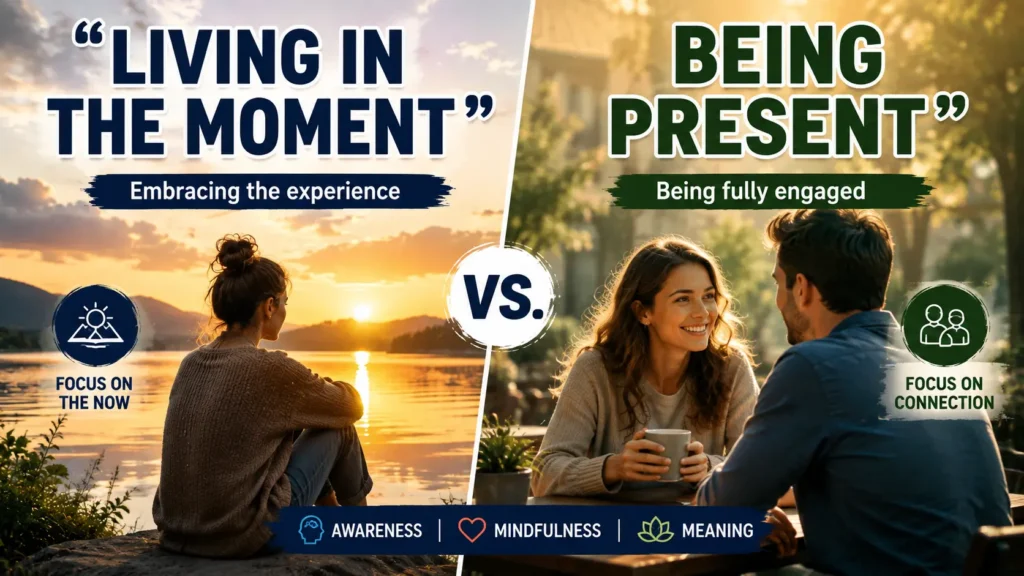
These expressions are closely related, but they are not always identical.
Living in the moment generally suggests embracing and experiencing life as it happens.
Being present focuses more specifically on directing your attention toward what is happening right now.
For example:
“I’m living in the moment and enjoying my vacation.”
This suggests enjoyment and appreciation.
“I’m being present during this conversation.”
This emphasizes attention and active listening.
Therefore, “being present” is often the closest and most versatile alternative, while “living in the moment” can carry a stronger sense of embracing life.
“Living in the Moment” vs. “Mindfulness”
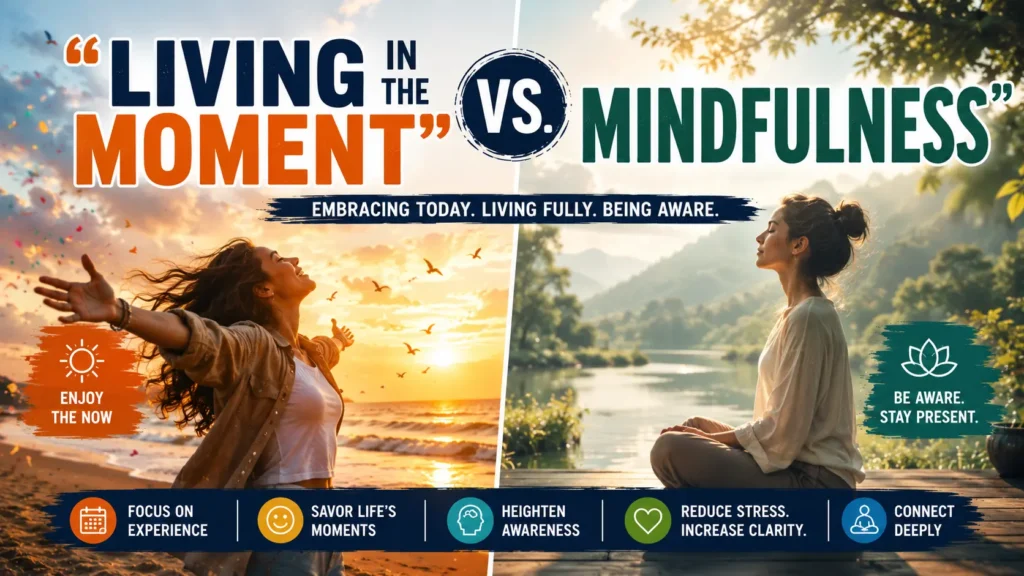
Mindfulness and living in the moment are closely connected, but they should not automatically be treated as exact synonyms.
Living in the moment generally means focusing on and appreciating the present rather than becoming overly concerned with the past or future.
Mindfulness involves consciously paying attention to the present, often with an attitude of awareness and acceptance.
For example:
“She is living in the moment and enjoying her time with her family.”
This emphasizes the experience.
“She practices mindfulness by paying attention to her breathing.”
This emphasizes a conscious awareness practice.
In short, mindfulness can support living in the moment, but the two expressions do not necessarily mean the same thing.
Examples of “Living in the Moment” in Different Contexts
In Everyday Conversation
“I’m trying to live in the moment instead of worrying about everything that could happen tomorrow.”
In Professional Communication
“Being fully present during meetings helps us listen carefully and respond thoughtfully.”
In Personal Writing
“I stopped thinking about what came next and simply savored the moment.”
In a Romantic Context
“Let’s forget about tomorrow for a while and enjoy the moment together.”
In Inspirational Writing
“Learning to live fully can help us appreciate the small joys that often go unnoticed.”
In a Social Media Caption
“Just enjoying the moment and making memories.”
In a Mindfulness Context
“Mindful awareness allows us to notice our thoughts, feelings, and surroundings without becoming completely absorbed by them.”
Common Mistakes When Using Alternatives for “Living in the Moment”
Choosing an alternative is not simply about replacing one phrase with another. The meaning and tone should remain appropriate.
Mistake 1: Treating Every Alternative as an Exact Synonym
Phrases such as “fully engaged,” “living fully,” and “savoring the moment” overlap with “living in the moment,” but each emphasizes something slightly different.
Choose the phrase that matches your intended meaning.
Mistake 2: Using Formal Language in Casual Situations
Expressions such as “mindful awareness” can sound unnatural in a casual text.
Instead, something like “enjoying the moment” may feel more natural.
Mistake 3: Using Casual Expressions in Formal Writing
Phrases such as “here and now” can work in motivational writing but may sound less precise in an academic or corporate document.
In those settings, “being fully present” or “present-moment awareness” may be more appropriate.
Mistake 4: Repeating the Same Alternative
Replacing “living in the moment” with “being present” every time does not necessarily improve your writing.
Vary your language according to the context and intended meaning.
Mistake 5: Assuming “Living in the Moment” Means Ignoring the Future
Living in the moment does not necessarily mean refusing to plan. The expression usually emphasizes not allowing excessive concern about the past or future to prevent you from appreciating the present.
Comparison Table of Top Alternatives
| Alternative | Best For | Tone |
| Being Present | Mindfulness, workshops | Thoughtful, neutral |
| Mindful Awareness | Meditation, wellness | Calm, reflective |
| Savoring the Moment | Personal stories, reflection | Warm, experiential |
| Fully Engaged | Workshops, team meetings | Professional, active |
| Immersed in the Now | Art, meditation | Calm, reflective |
| Experiencing the Present | Therapy, personal growth | Empathetic, thoughtful |
| Appreciating the Moment | Journals, mindfulness | Warm, heartfelt |
| Here and Now | Coaching, motivation | Direct, mindful |
| Living Fully | Inspirational content | Positive, inspiring |
| Immersed in the Present | Meditation, storytelling | Reflective, calm |
| Engaged in the Moment | Workshops, coaching | Friendly, thoughtful |
| Mindfully Present | Wellness, meditation | Calm, reflective |
| Here in the Moment | Casual conversation | Friendly, approachable |
| Enjoying the Moment | Personal stories, journals | Warm, joyful |
| Fully Experiencing Life | Motivational writing | Inspiring, heartfelt |
How to Choose the Right Alternative
Before replacing “living in the moment,” ask yourself what you are trying to emphasize.
If you want to emphasize attention, choose “being present.”
If you want to emphasize mindfulness, choose “mindful awareness” or “mindfully present.”
If you want to emphasize enjoyment, choose “savoring the moment” or “enjoying the moment.”
If you want to emphasize professional involvement, choose “fully engaged.”
If you want to emphasize gratitude, choose “appreciating the moment.”
If you want to emphasize a broader appreciation of life, choose “living fully” or “fully experiencing life.”
The right phrase is therefore determined not only by grammar but also by tone, audience, and intended meaning.
Living in the Moment Synonyms for Different Situations

The best alternative to “living in the moment” depends on the situation, audience, and tone you want to create. A phrase that sounds natural in a personal conversation may not be the best choice for professional writing. Likewise, an inspirational message may benefit from a warmer or more expressive alternative.
For Everyday Conversation
In casual conversations, choose simple and natural expressions such as:
- Being present
- Enjoying the moment
- Living in the present
- Appreciating the moment
- Enjoying the here and now
Example:
“I’m trying to stop worrying so much and just enjoy the moment.”
These expressions sound natural because they communicate the idea without sounding overly formal or technical.
For Professional Writing
When writing professionally, choose alternatives that emphasize attention, participation, or awareness.
Good options include:
- Being fully present
- Fully engaged
- Maintaining present-moment awareness
- Experiencing the present
- Remaining focused on the current situation
Example:
“Being fully present during client meetings allows us to listen more carefully and respond more effectively.”
These alternatives are particularly useful in workplace communication, coaching, education, leadership, and professional development.
For Mindfulness and Wellness
If you are writing about mindfulness, meditation, or emotional well-being, consider:
- Mindful awareness
- Being present
- Mindfully present
- Present-moment awareness
- Experiencing the present
Example:
“Practicing mindful awareness can help you notice your thoughts and surroundings without becoming overwhelmed by them.”
These expressions focus more on conscious awareness than simple enjoyment.
For Romantic Writing
Romantic writing often benefits from warmer and more emotional alternatives.
You could use:
- Savoring the moment
- Cherishing the moment
- Enjoying the moment together
- Being fully present with you
- Appreciating this moment
Example:
“I don’t want to think about tomorrow right now. I just want to savor this moment with you.”
These expressions make the idea feel more personal and emotionally meaningful.
For Inspirational Writing
Inspirational content often uses expressions that encourage readers to appreciate life and make the most of their experiences.
Good alternatives include:
- Living fully
- Embracing the present
- Making the most of today
- Enjoying the here and now
- Fully experiencing life
Example:
“You cannot change yesterday, and tomorrow is not guaranteed, so learning to embrace the present can help you appreciate today.”
For Social Media Captions
Short, memorable phrases usually work best for captions.
Consider:
- Enjoying the moment
- Living fully
- Here and now
- Embracing the now
- Making memories
- Present and grateful
- Making the most of today
Example:
“No overthinking. Just enjoying the moment. ✨”
Short Alternatives to “Living in the Moment”
Sometimes you do not need a complete synonym. A short phrase can communicate the same general idea more naturally.
Here are some concise alternatives:
- Be present
- Stay present
- Enjoy today
- Embrace the now
- Focus on now
- Enjoy the present
- Appreciate today
- Embrace the present
- Enjoy the here and now
- Make the most of today
- Be here now
- Stay in the present
These shorter expressions are especially useful for captions, motivational messages, personal notes, headlines, and informal conversations.
For example:
“Forget tomorrow for a moment. Be here now.”
This is shorter and more direct than:
“Forget tomorrow for a moment and focus on living in the moment.”
One-Word Alternatives to “Living in the Moment”
There is no single word that perfectly replaces the entire meaning of “living in the moment.” However, several words can express parts of the concept depending on the context.
Present
“Present” can describe someone who is mentally attentive to what is happening now.
“She remained present throughout the conversation.”
Mindful
“Mindful” suggests conscious awareness and careful attention.
“He became more mindful of his surroundings.”
Attentive
“Attentive” emphasizes paying close attention.
“She was attentive to every detail of the experience.”
Engaged
“Engaged” suggests active involvement in an activity or interaction.
“Everyone was engaged in the discussion.”
Conscious
“Conscious” can describe deliberate awareness of thoughts, feelings, or surroundings.
“He became more conscious of how often he worried about the future.”
These words can be useful substitutes in specific sentences, but they should not automatically be treated as exact synonyms for “living in the moment.”
Positive Ways to Say “Live in the Moment”
If you want to communicate the idea in a positive, encouraging, or motivational way, consider these expressions:
- Embrace the present.
- Enjoy the moment.
- Be fully present.
- Make the most of today.
- Appreciate where you are.
- Enjoy the here and now.
- Focus on what matters today.
- Cherish the present.
- Take in the moment.
- Make today count.
- Embrace the now.
- Appreciate the little things.
Each expression has a slightly different emphasis.
For example, “embrace the present” sounds motivational, while “cherish the present” sounds more emotional. “Make today count” focuses on purposeful action rather than simply being aware of the present.
Common Phrases Related to “Living in the Moment”
Some expressions are not exact synonyms but communicate a similar idea.
Be Here Now
This expression encourages someone to focus their attention on the current experience.
“Put your worries aside and be here now.”
Enjoy the Here and Now
This phrase emphasizes appreciating the present instead of constantly thinking about what comes next.
“We decided to stop planning and enjoy the here and now.”
Make the Most of Today
This expression encourages someone to use the present opportunity positively.
“You may not know what tomorrow will bring, so make the most of today.”
Stop and Smell the Roses
This idiomatic expression encourages people to slow down and appreciate life instead of rushing through it.
“You work hard every day, but remember to stop and smell the roses.”
Take Things One Day at a Time
This phrase means dealing with life gradually instead of becoming overwhelmed by the future.
“I’m not going to worry about next month. I’m taking things one day at a time.”
Appreciate the Little Things
This expression emphasizes noticing and valuing ordinary positive experiences.
“Learning to appreciate the little things can make everyday life feel more meaningful.”
These expressions can enrich your writing because they convey the broader idea of present-moment appreciation without repeating “living in the moment.”
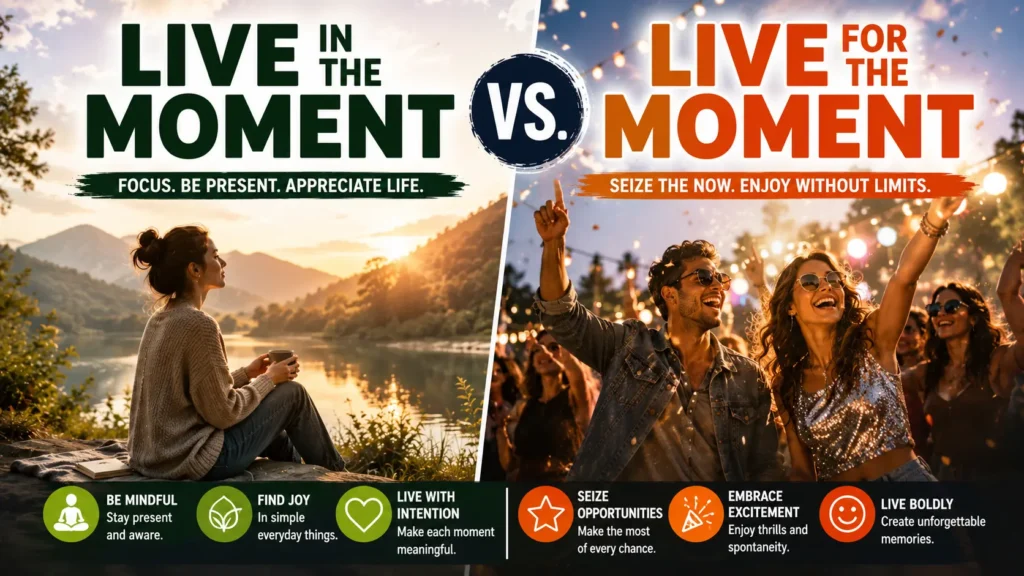
“Live in the Moment” vs. “Live for the Moment”
Although these phrases look similar, they can have different meanings.
“Live in the moment” means focusing on and appreciating the present experience.
“I’m learning to live in the moment instead of worrying about the future.”
“Live for the moment” can mean prioritizing immediate enjoyment or excitement over long-term concerns.
“He tends to live for the moment and rarely thinks about what might happen later.”
The difference is important. Living in the moment generally has a positive association with awareness and appreciation, while living for the moment can sometimes suggest impulsiveness or placing immediate pleasure above future planning.
Therefore, do not automatically use these expressions interchangeably.
“Living in the Moment” vs. “Living in the Present”
“Living in the present” is one of the closest alternatives to “living in the moment.” Both expressions describe focusing attention on the current experience instead of becoming overly focused on the past or future.
For example:
“She is learning to live in the moment and appreciate what she has.”
and:
“She is learning to live in the present and appreciate what she has.”
Both sentences communicate a very similar idea.
The main difference is stylistic. “Living in the moment” is highly natural and conversational, while “living in the present” can sound slightly more reflective or philosophical.
“Living in the Moment” vs. “Enjoying Life”
These expressions overlap, but they are not identical.
Living in the moment specifically focuses on the present experience.
“I’m trying to live in the moment and stop worrying about tomorrow.”
Enjoying life has a broader meaning. It can refer to appreciating life generally, including memories, current experiences, relationships, accomplishments, and plans.
“She enjoys life by spending time with her family and pursuing her favorite hobbies.”
Therefore, use “living in the moment” when present-moment awareness is important and “enjoying life” when you mean overall happiness and appreciation.
“Living in the Moment” vs. “Being Present”
These phrases are closely connected, but “being present” is usually more focused on attention.
When someone is being present, they are mentally attentive to what is happening now.
“Try to be present during the conversation instead of checking your phone.”
When someone is living in the moment, the idea can extend beyond attention to include enjoyment, appreciation, and an embrace of the current experience.
“She decided to live in the moment and enjoy every part of her vacation.”
This makes “being present” one of the closest and most versatile alternatives, while “living in the moment” can carry a slightly broader emotional meaning.
“Living in the Moment” vs. “Mindfulness”
Mindfulness is closely related to living in the moment, but the concepts are not completely interchangeable.
Living in the moment generally means focusing on and appreciating the present rather than becoming overly concerned with the past or future.
Mindfulness involves consciously paying attention to the present, often with awareness and acceptance of thoughts, feelings, sensations, and surroundings.
For example:
“I am living in the moment by enjoying my time with my family.”
Compared with:
“I practice mindfulness by paying attention to my breathing.”
The first emphasizes experiencing the present, while the second emphasizes conscious awareness.
In simple terms, mindfulness can help someone live more fully in the present, but the two expressions do not always mean the same thing.
How to Use “Living in the Moment” in a Sentence
Here are several natural examples showing how the phrase can work in different contexts:
- Everyday conversation:
“I’m trying to live in the moment instead of worrying about things I cannot control.” - Personal reflection:
“Living in the moment has helped me appreciate the small experiences I once overlooked.” - Relationships:
“When we spend time together, I try to live in the moment and enjoy our conversations.” - Travel:
“I put my camera away for a while so I could live in the moment and enjoy the scenery.” - Work:
“Living in the moment at work can mean giving your full attention to the task in front of you.” - Mindfulness:
“Meditation can encourage you to live in the moment and notice your thoughts more carefully.” - Social media:
“Less scrolling, more living in the moment.” - Motivational writing:
“You cannot change the past, so learning to live in the moment can help you appreciate today.” - Romantic writing:
“I just want to live in the moment and enjoy this beautiful evening with you.” - Personal development:
“Learning to live in the moment helped her become less consumed by future worries.”
Is “Living in the Moment” Always a Good Thing?
Generally, “living in the moment” has a positive meaning. It can encourage people to appreciate their experiences, focus their attention, and avoid becoming unnecessarily consumed by past regrets or future worries.
However, the expression should not be interpreted as meaning that people should completely ignore future responsibilities.
For example, planning for an important deadline, saving money, preparing for an event, or considering long-term consequences can all be responsible behaviors.
A balanced approach is to appreciate the present while still making sensible plans for the future.
This distinction is especially useful when comparing “living in the moment” with “living for the moment.” The first can suggest healthy present-moment awareness, while the second may sometimes imply prioritizing immediate pleasure over future consequences.
When Should You Avoid “Living in the Moment”?
Although the phrase is natural and widely understood, there are situations where another expression may be more precise.
Avoid relying on it when you need to communicate a very specific idea.
For example:
- If you mean paying attention, use “being present.”
- If you mean active participation, use “fully engaged.”
- If you mean conscious awareness, use “mindful awareness.”
- If you mean gratitude, use “appreciating the moment.”
- If you mean enjoyment, use “savoring the moment.”
- If you mean overall enjoyment of life, use “living fully” or “enjoying life.”
Choosing a more precise expression can make your writing clearer and prevent vague or repetitive language.
Final Tip for Choosing the Right Alternative
The best synonym for “living in the moment” is not necessarily the phrase that looks most similar. Instead, choose the expression that communicates your intended meaning most accurately.
Ask yourself:
Am I emphasizing attention?
Choose “being present.”
Am I emphasizing enjoyment?
Choose “savoring the moment” or “enjoying the moment.”
Am I emphasizing mindfulness?
Choose “mindful awareness.”
Am I emphasizing active participation?
Choose “fully engaged.”
Am I emphasizing gratitude?
Choose “appreciating the moment.”
Am I emphasizing a broader appreciation of life?
Choose “living fully.”
This small distinction can make your writing sound more natural, purposeful, and expressive.
Final Thoughts
Choosing the right words to convey “living in the moment” can transform your communication, making it feel genuine, empathetic, and engaging. While the original phrase is widely understood, using alternatives such as “being present,” “savoring the moment,” or “mindful awareness” adds variety, nuance, and warmth, helping your audience connect more deeply with the sentiment you’re expressing.
These alternatives also allow for contextual flexibility, whether you’re writing a reflective journal, delivering a motivational talk, or coaching someone on mindfulness. By selecting phrasing that matches your tone and setting, you can communicate clarity, positivity, and authenticity, showing that you are present and attentive, both in language and in action.
FAQs
What does “living in the moment” mean?
“Living in the moment” means being fully aware and engaged in the present without worrying excessively about the past or future. It encourages mindfulness, presence, and appreciation for what is happening right now. This practice is often used for stress relief, personal growth, and enhancing overall well-being.
Why should I use synonyms for “living in the moment”?
Using synonyms prevents repetition and monotony in writing or speech. Alternatives like “being present” or “savoring the moment” provide subtle nuance, convey warmth, and make your communication more engaging, thoughtful, and polished.
Is “living in the moment” professional?
Yes, it is generally professional in contexts like coaching, mindfulness, or motivational writing. However, for formal corporate communication, consider alternatives like “mindful awareness” or “being fully present” for a polished tone.
When should I use “living in the moment”?
Use it when encouraging mindfulness, reflection, or personal growth, during workshops, coaching sessions, journaling, or casual conversations where presence and awareness are the focus.
What are casual alternatives to “living in the moment”?
Casual alternatives include “here in the moment,” “enjoying the moment,” or “savoring the moment.” These work well in informal conversations, personal journals, or social media posts.
What are formal alternatives to “living in the moment”?
Formal options include “mindful awareness,” “being fully present,” and “experiencing the present.” These phrases are ideal for wellness programs, professional workshops, or academic discussions on mindfulness.
Can “living in the moment” be overused?
Yes. Overuse may make communication sound clichéd or vague. Alternating with other synonyms ensures your message remains fresh, meaningful, and attentive to the audience.
Which synonym is the most versatile?
“Being present” is versatile across casual, formal, professional, and reflective contexts. It communicates mindfulness clearly while maintaining neutrality and warmth.
How can I use these phrases in writing?
In writing, choose synonyms based on tone: use “savoring the moment” for reflection, “fully engaged” for professional contexts, and “mindfully present” for wellness-related content to ensure clarity and empathy.
Why is it important to vary these phrases?
Varying phrasing prevents monotony, repetition, and overused clichés. It enhances readability, makes content more engaging, and conveys mindfulness, authenticity, and thoughtfulness, allowing your audience to truly connect with the message.
