
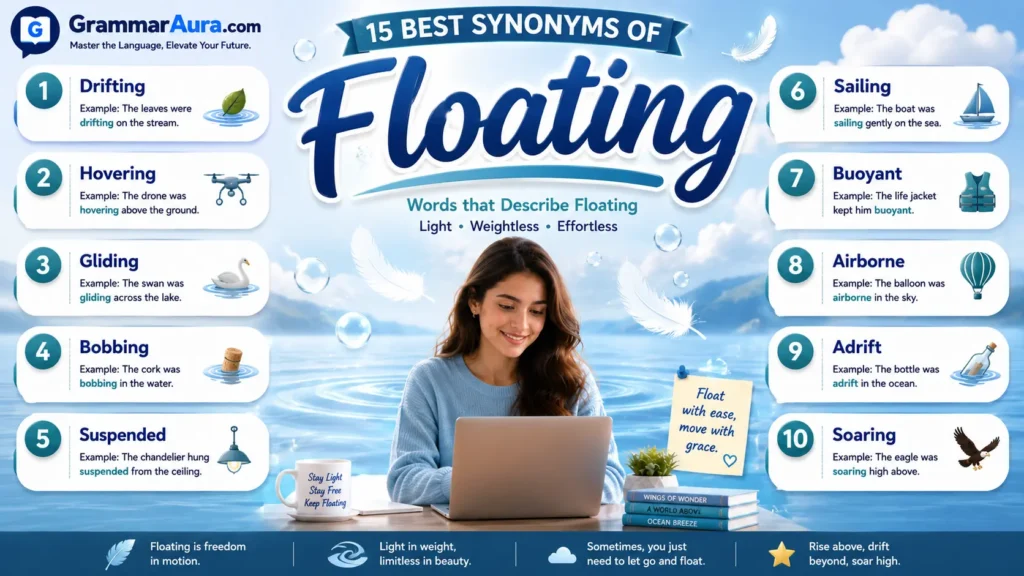

15 Best Synonyms of ‘Floating’ helps readers describe floating ideas with a light, gentle style and clear meaning. In everyday writing, the word often suggests being suspended in air or water, with effortless, smooth motion, weightlessness, and softness. Depending on the context, it may also reflect a calm, warm, and emotional mood. From my own experience with editing, selecting the right term can change the mental picture a reader forms and better express a meaningful idea.
When exploring synonyms and alternatives, it is useful to start with the basic definition and focus on the sense you want to create. A poetic choice may paint a vivid image, while a scientific option may fit technical explanations more naturally. Paying attention to descriptive language keeps your wording natural, clear, and matches the exact style and feeling you hope to convey.
What Does “Floating” Mean?
The word “floating” means resting or moving on the surface of a liquid or in the air without sinking or falling. It can also describe a feeling of lightness or drifting motion.
In simple terms, floating = moving lightly without touching the ground or sinking. The leaves were floating on the water.
When to Use “Floating”
You use “floating” when:
- Describing movement on water or air
- Talking about light or airy motion
- Expressing dreamy or relaxed feelings
- Writing poetic or descriptive scenes
- Clouds were floating across the sky.
Is It Professional/Polite to Say “Floating”?
Yes, “floating” is completely polite and neutral, but its professionalism depends on context.
- Fine in creative writing
- Acceptable in general communication
- Common in science and physics
- Less formal in technical reporting (unless specified physically)
Pros and Cons of Using “Floating”
Pros:
- Easy to understand
- Visually expressive
- Works in poetry and storytelling
- Flexible meaning
Cons:
- Too vague in technical writing
- Can sound informal
- Multiple meanings can cause confusion
- Not precise for scientific measurement
Floating synonyms:
- Drifting
- Hovering
- Gliding
- Suspended
- Buoyant
- Wafting
- Soaring
- Bobbing
- Aloft
- Levitation
- Sailing
- Wavering
- Drizzling (Light Motion Context)
- Airborne
- Weightless
Drifting
Meaning:
Moving slowly without direction.
Explanation:
“Drifting” suggests gentle, uncontrolled movement through air or water.
Examples:
The boat was drifting in the sea. Thoughts drifted away.
Best Use:
Emotional writing, storytelling
Worst Use:
Technical precision
Tone:
Calm, reflective
Hovering
Meaning:
Staying in the air without support.
Explanation:
Used for objects or feelings suspended above something.
Examples:
A bird is hovering above the lake. He was hovering near the door.
Best Use:
Physical movement description
Worst Use:
Emotional abstraction
Tone:
Light, visual
Gliding
Meaning:
Smooth and effortless movement.
Explanation:
Suggests graceful motion through air or water.
Examples:
The eagle was gliding over the mountains. She glided across the floor.
Best Use:
Poetic writing, sports
Worst Use:
Static description
Tone:
Smooth, elegant
Suspended
Meaning:
Hanging in space without support.
Explanation:
A more scientific or structural form of floating.
Examples:
The object was suspended in the air. Dust particles remained suspended.
Best Use:
Science, physics
Worst Use:
Emotional tone
Tone:
Formal, technical
Buoyant
Meaning:
Able to float on liquid.
Explanation:
Often used in physics or chemistry contexts.
Examples:
The material is highly buoyant. The boat remained buoyant.
Best Use:
Science writing
Worst Use:
Emotional description
Tone:
Technical, precise
Wafting
Meaning:
Moving gently through air.
Explanation:
Usually used for smells or light movement.
Examples:
The aroma was wafting through the kitchen. Smoke was wafting upward.
Best Use:
Sensory writing
Worst Use:
Physical objects
Tone:
Soft, sensory
Soaring
Meaning:
Rising high in the air.
Explanation:
Describes upward, powerful movement.
Examples:
The eagle was soaring above the cliffs. His spirits were soaring.
Best Use:
Emotional and nature writing
Worst Use:
Water movement
Tone:
Uplifting, strong
Bobbing
Meaning:
Moving up and down on water.
Explanation:
A gentle repetitive motion.
Examples:
The boat was bobbing on the waves. The cork was bobbing.
Best Use:
Water scenes
Worst Use:
Abstract use
Tone:
Light, rhythmic
Aloft
Meaning:
In or up in the air.
Explanation:
A formal or literary way of saying “up high.”
Examples:
Flags were held aloft. The balloon stayed aloft.
Best Use:
Formal writing
Worst Use:
Casual speech
Tone:
Literary, formal
Levitation
Meaning:
Rising or floating in the air without support.
Explanation:
Often used in scientific or magical contexts.
Examples:
The magician performed levitation. Objects appeared in levitation.
Best Use:
Fantasy or science
Worst Use:
Everyday speech
Tone:
Dramatic, mystical
Sailing
Meaning:
Moving smoothly over water or air.
Explanation:
Suggests controlled floating movement.
Examples:
The ship was sailing across the sea. Clouds were sailing overhead.
Best Use:
Travel writing
Worst Use:
Static description
Tone:
Smooth, narrative
Wavering
Meaning:
Slightly unstable movement.
Explanation:
Shows uncertainty in floating or standing motion.
Examples:
The candle flame was wavering. His voice was wavering.
Best Use:
Emotional writing
Worst Use:
Physical precision
Tone:
Unstable, emotional
Drizzling (Light Motion Context)
Meaning:
Light, scattered downward movement.
Explanation:
Used metaphorically for soft, floating motion.
Examples:
Light was drizzling through the trees. Dust was drizzling down.
Best Use:
Poetic writing
Worst Use:
Technical use
Tone:
Soft, atmospheric
Airborne
Meaning:
In the air.
Explanation:
Used for objects lifted off the ground.
Examples:
The object became airborne. Birds stayed airborne for hours.
Best Use:
Aviation/science
Worst Use:
Emotional writing
Tone:
Technical, neutral
Weightless
Meaning:
Without heaviness.
Explanation:
Describes a feeling or condition of no gravity.
Examples:
She felt weightless in water. The astronaut was weightless in space.
Best Use:
Space, emotion, poetry
Worst Use:
Grounded physical description
Tone:
Dreamy, scientific
Comparison Table of Top Alternatives
| Synonym | Type | Tone | Best Use |
| Drifting | Motion | Calm | Emotional writing |
| Hovering | Visual | Light | Physical description |
| Gliding | Motion | Elegant | Poetry |
| Suspended | Scientific | Formal | Physics |
| Buoyant | Technical | Precise | Science |
| Wafting | Sensory | Soft | Smell/movement |
| Soaring | Motion | Uplifting | Nature/emotion |
| Bobbing | Water motion | Light | Sea scenes |
| Aloft | Formal | Literary | Flags/balloons |
| Weightless | State | Dreamy | Space/emotion |
Final Thoughts
The word “floating” carries a gentle sense of movement, freedom, and lightness, but its true beauty expands when you explore its many synonyms. Words like “drifting,” “gliding,” and “weightless” allow you to shape the exact feeling you want to express-whether it’s calm motion, poetic imagery, or scientific clarity. Each alternative adds its own subtle emotional and descriptive depth.
In the end, choosing the right synonym is about more than vocabulary-it’s about how you want your reader to feel. Whether you’re writing creatively, explaining a concept, or describing nature, these alternatives help you communicate with more precision, warmth, and imagination. They turn simple descriptions into experiences your readers can truly visualize.
FAQs
What is the simplest synonym of “floating”?
The simplest synonym of “floating” is “drifting.” It describes slow, gentle movement without direction, often on water or in the air. It is easy to understand and commonly used in both casual and creative writing, making it a natural alternative in everyday communication.
Is “floating” used in science?
Yes, “floating” is commonly used in science, especially in physics and biology. It describes objects that remain on the surface of a liquid or are suspended in air. However, more precise terms like “buoyant” or “suspended” are often used in technical explanations.
What is the most poetic synonym of “floating”?
The most poetic synonyms include “gliding,” “wafting,” and “weightless.” These words create vivid imagery and emotional depth, making them perfect for storytelling, poetry, or descriptive writing where atmosphere and feeling matter more than technical accuracy.
What is the difference between drifting and floating?
“Floating” means staying on the surface or suspended, while “drifting” emphasizes movement without control or direction. Floating can be still or moving slightly, but drifting always suggests slow, uncontrolled motion.
Is “hovering” the same as floating?
Not exactly. “Hovering” means staying in one place in the air, often with slight movement, like a bird or a helicopter. Floating usually refers to resting on water or moving gently, making the two related but not identical.
What is the most scientific synonym of floating?
The most scientific synonym is “buoyant.” It describes an object’s ability to stay afloat due to physical properties like density and fluid resistance. It is widely used in physics, engineering, and chemistry contexts.
Can “floating” describe emotions?
Yes, “floating” is often used metaphorically to describe emotions, such as feeling light, dreamy, or detached. For example, “She felt like she was floating” expresses emotional uplift or a surreal mental state.
What synonym of floating for writing stories?
For storytelling, “drifting,” “gliding,” and “soaring” are the best choices. They create movement, atmosphere, and emotional depth, helping readers visualize scenes more vividly and feel connected to the narrative.
What is the difference between “floating” and “suspended”?
“Floating” suggests natural support on water or air, while “suspended” implies being held in place without support, often artificially or physically. Suspended is more technical, whereas floating is more natural and descriptive.
Why should I learn synonyms of “floating”?
Learning synonyms of “floating” helps you improve expression, clarity, and creativity in writing. It allows you to choose words that better match tone, whether poetic, scientific, or casual, making your communication more engaging and visually descriptive.
