
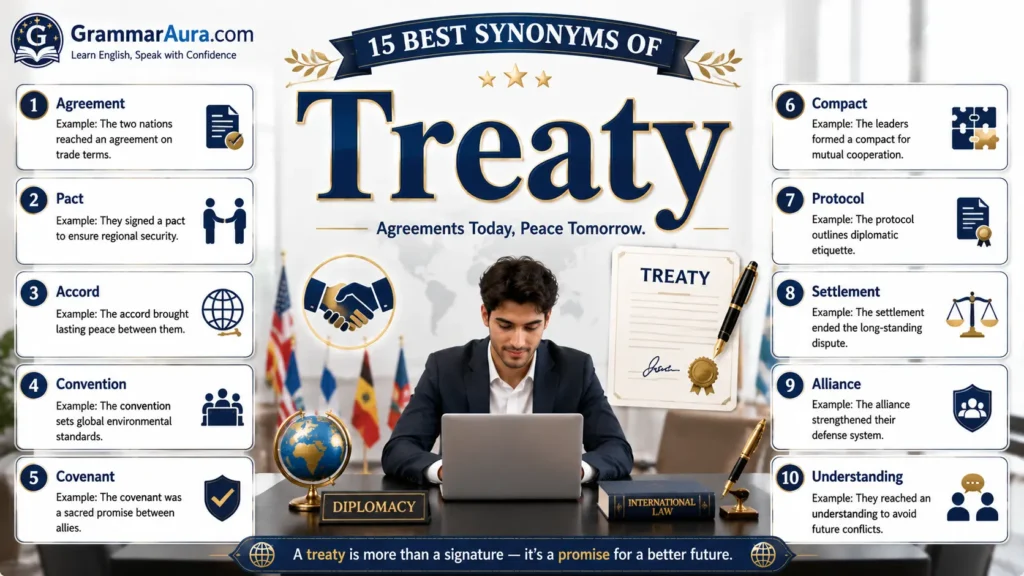

The 15 Best Synonyms of ‘Treaty’ helps explain how diplomatic writing changes meaning when choosing the right words in formal communication. When finding the right word in diplomacy and formal communication, it can completely change how respectful, clear, and meaningful your message feels.
The treaty represents agreement, cooperation, and trust between parties, and using synonyms helps you adjust tone in official writing. These alternatives will express international agreements in a thoughtful way while keeping clarity. Careful wording makes diplomatic communication more balanced, clear, and professional without losing meaning.
What Does “Treaty” Mean?
The word “treaty” refers to a formal, legally binding agreement between two or more countries or parties, usually related to peace, trade, or cooperation. In simple terms, a treaty is a signed international agreement that sets rules or commitments. The countries signed a peace treaty to end the conflict.
When to Use “Treaty”
You use “treaty” when:
- Discussing international relations
- Talking about peace agreements
- Describing formal government contracts
- Writing legal or historical content
- The nations agreed to a trade treaty.
Is It Professional/Polite to Say “Treaty”?
Yes, “treaty” is highly professional and legally precise. It is widely used in:
- International law
- Diplomacy
- Political science
- History writing
It is neutral, formal, and appropriate in official communication.
Pros and Cons of Using “Treaty”
Pros:
- Legally accurate
- Widely recognized in diplomacy
- Formal and professional
- Clear international meaning
Cons:
- Not suitable for casual speech
- Limited to formal/legal contexts
- Can feel technical
- Not flexible for informal writing
Treaty synonyms:
- Agreement
- Accord
- Pact
- Convention
- Protocol
- Accordance
- Settlement
- Covenant
- Compact
- Understanding
- Arrangement
- Settlement Agreement
- Charter
- Alliance
- Engagement
Agreement
Meaning:
A mutual understanding between parties.
Explanation:
A broad term for any shared decision or arrangement, including treaties.
Examples:
The countries reached a trade agreement. A peace agreement was signed.
Best Use:
General communication
Worst Use:
Strict legal precision
Tone:
Neutral, flexible
Accord
Meaning:
Formal agreement between parties.
Explanation:
Often used in diplomatic or political contexts as a synonym for treaty.
Examples:
The peace accord ended the war. Leaders signed an international accord.
Best Use:
Diplomacy
Worst Use:
Casual speech
Tone:
Formal, diplomatic
Pact
Meaning:
A formal agreement, often binding.
Explanation:
Usually used for agreements between nations or groups.
Examples:
The defense pact strengthened alliances. Nations signed a non-aggression pact.
Best Use:
Political context
Worst Use:
Informal conversation
Tone:
Strong, formal
Convention
Meaning:
Formal international agreement.
Explanation:
Often used in global law and environmental treaties.
Examples:
The climate convention was adopted globally. A human rights convention was signed.
Best Use:
International law
Worst Use:
Personal communication
Tone:
Formal, structured
Protocol
Meaning:
A set of rules or formal agreement procedures.
Explanation:
Used in diplomacy to describe formal agreements or standards.
Examples:
The protocol outlined diplomatic rules. The countries followed a peace protocol.
Best Use:
Legal/diplomatic context
Worst Use:
Casual use
Tone:
Technical, formal
Accordance
Meaning:
Agreement or harmony between parties.
Explanation:
Often used in legal phrasing rather than as a standalone noun.
Examples:
Actions were taken in accordance with the accord. Decisions aligned with the agreement.
Best Use:
Legal writing
Worst Use:
Everyday speech
Tone:
Formal, structured
Settlement
Meaning:
Resolution of a dispute.
Explanation:
Refers to agreements that end conflicts or legal disputes.
Examples:
The settlement resolved the border dispute. A financial settlement was reached.
Best Use:
Legal disputes
Worst Use:
Diplomatic treaties
Tone:
Practical, legal
Covenant
Meaning:
Solemn binding agreement.
Explanation:
Often used in legal, religious, or historical contexts.
Examples:
The covenant promised peace between nations. A historic covenant was signed.
Best Use:
Formal/historical writing
Worst Use:
Modern casual use
Tone:
Serious, traditional
Compact
Meaning:
Small formal agreement between parties.
Explanation:
Common in political or state-level agreements.
Examples:
The states entered a compact on water sharing. A regional compact was formed.
Best Use:
Political/legal context
Worst Use:
Casual conversation
Tone:
Formal, structured
Understanding
Meaning:
Mutual agreement or shared interpretation.
Explanation:
Less formal than a treaty, but still meaningful.
Examples:
The leaders reached an understanding. There was a mutual understanding between nations.
Best Use:
Diplomatic soft tone
Worst Use:
Legal documents
Tone:
Friendly, flexible
Arrangement
Meaning:
Planned agreement between parties.
Explanation:
A general term for organized agreements.
Examples:
An arrangement was made between countries. Trade arrangements were finalized.
Best Use:
Business contexts
Worst Use:
Legal treaties
Tone:
Neutral, practical
Settlement Agreement
Meaning:
Legal resolution document.
Explanation:
Formal agreement resolving disputes.
Examples:
A settlement agreement ended the lawsuit. Both parties signed a settlement agreement.
Best Use:
Law
Worst Use:
Diplomacy
Tone:
Legal, formal
Charter
Meaning:
Official document establishing rules or agreements.
Explanation:
Often used for organizations or alliances.
Examples:
The UN Charter defines global cooperation. A city charter was signed.
Best Use:
Institutional law
Worst Use:
Casual writing
Tone:
Formal, authoritative
Alliance
Meaning:
Partnership between parties for mutual benefit.
Explanation:
More strategic than treaty, focused on cooperation.
Examples:
The military alliance strengthened defense. Nations formed a trade alliance.
Best Use:
Political strategy
Worst Use:
Legal precision
Tone:
Strategic, formal
Engagement
Meaning:
Formal commitment or agreement.
Explanation:
Broader term for participation or agreement.
Examples:
The countries entered into an engagement on trade. Diplomatic engagements were signed.
Best Use:
Formal communication
Worst Use:
Legal specificity
Tone:
Neutral, diplomatic
Comparison Table of Top Alternatives
| Synonym | Type | Tone | Best Use |
| Agreement | General | Neutral | Everyday use |
| Accord | Diplomatic | Formal | Peace talks |
| Pact | Political | Strong | Alliances |
| Convention | Legal | Formal | International law |
| Protocol | Technical | Structured | Diplomatic rules |
| Settlement | Legal | Practical | Disputes |
| Covenant | Historical | Serious | Formal agreements |
| Compact | Political | Formal | State agreements |
| Understanding | Diplomatic | Soft | Negotiations |
| Charter | Institutional | Authoritative | Organizations |
Final Thoughts
Understanding the word “treaty” and its many synonyms helps you communicate ideas of agreement, cooperation, and diplomacy with greater precision and sensitivity. While “treaty” remains the most formal and legally recognized term, alternatives like “accord,” “pact,” and “convention” allow you to adjust tone depending on whether you want something more diplomatic, general, or context-specific in your writing.
At the end of the day, language in diplomacy is about clarity and intention. Choosing the right synonym helps you express international relationships, agreements, and resolutions in a way that feels both accurate and accessible. These variations give you the flexibility to communicate complex global ideas in a more natural, balanced, and reader-friendly way.
FAQs
What is the simplest synonym of “treaty”?
The simplest synonym of “treaty” is “agreement.” It is widely used in everyday language and easily understood. While less formal than “treaty,” it still conveys a mutual decision or arrangement between two or more parties in a clear and accessible way.
Is “treaty” only used between countries?
Yes, typically “treaty” is used for agreements between countries or sovereign states. It is a formal legal term in international law. It is rarely used for personal or business agreements unless the context is highly formal or symbolic.
What is the most formal synonym of “treaty”?
The most formal synonyms include “convention,” “protocol,” and “charter.” These are used in international law, diplomacy, and official documentation. They carry legal weight and are commonly recognized in global governance and institutional agreements.
What is the difference between “treaty” and “pact”?
A treaty is a legally binding international agreement, while a pact is often a more general or strategic agreement between parties. Pacts may be less formal but still politically significant, especially in defense or alliance contexts.
Can “agreement” replace “treaty”?
Yes, but not always precisely. “Agreement” is a broader and less formal term that can include treaties. However, in legal or diplomatic writing, “treaty” is preferred because it specifically refers to binding international commitments.
What is a diplomatic synonym for “treaty”?
Diplomatic synonyms include “accord,” “understanding,” and “convention.” These terms are commonly used in international relations and negotiations. They help describe cooperation between countries in a formal yet sometimes softer tone than “treaty.”
Is “protocol” the same as “treaty”?
Not exactly. A protocol is a set of rules or procedures that may support or modify a treaty. It can be part of a treaty framework, but it is not always a standalone agreement like a treaty itself.
What synonym of “treaty” is used in law?
In legal contexts, “convention,” “charter,” and “settlement agreement” are commonly used. These terms define structured legal arrangements and are often found in international law, organizational frameworks, and dispute resolution documents.
Can “treaty” be used in business writing?
Rarely. In business writing, terms like “agreement,” “arrangement,” or “contract” are more appropriate. “Treaty” is too formal and specifically tied to international relations rather than commercial or corporate contexts.
Why should I learn synonyms of “treaty”?
Learning synonyms of “treaty” helps you adjust tone and clarity in writing about diplomacy, law, or international relations. It allows you to choose between formal precision and simpler explanations, making your communication more flexible, professional, and reader-friendly.
