
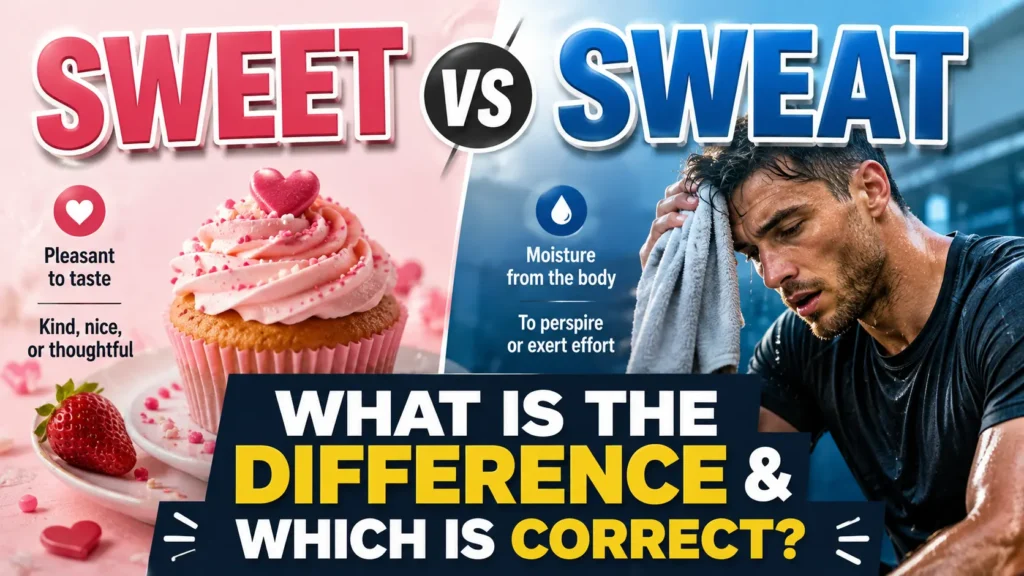

Many English learners confuse sweet and sweat because they look and sound somewhat similar. However, these words have completely different meanings, uses, and grammatical roles. Understanding the difference between sweet vs sweat will help you write, speak, and communicate more accurately in everyday conversations, school assignments, business writing, and professional communication.
Comparison Overview
Although sweet and sweat differ by only one letter, they describe entirely different things.
| Feature | Sweet | Sweat |
| Primary Meaning | Pleasant in taste or personality | Moisture produced by the body |
| Part of Speech | Adjective, noun | Noun, verb |
| Related To | Taste, kindness, affection | Exercise, heat, physical activity |
| Common Contexts | Food, compliments, emotions | Health, fitness, weather, biology |
| Example | This cake is sweet. | I sweat during exercise. |
Understanding this distinction helps you avoid one of the most common English vocabulary mistakes.
Definition of Sweet
Sweet is most commonly an adjective that describes something pleasant in taste, kind in personality, or enjoyable in nature.
It can also be used as a noun to refer to candy or desserts in British English.
Core Meaning
- Pleasantly sugary in taste.
- Kind, thoughtful, or lovable.
- Pleasing or delightful.
- Sometimes refers to desserts or candy.
Examples
- The mango is very sweet.
- She gave me a sweet smile.
- That was a sweet gesture.
- These cookies are too sweet.
- He has a sweet voice.
Definition of Sweat
Sweat is both a noun and a verb.
As a noun, it means the moisture your body produces to cool itself.
As a verb, it means to produce that moisture.
Core Meaning
- Moisture produced by the skin.
- To perspire because of heat, stress, or exercise.
- Sometimes used figuratively to describe hard work.
Examples
- My sweat soaked my shirt.
- Athletes sweat a lot.
- She began to sweat during the race.
- His forehead was covered with sweat.
- Don’t sweat the small stuff.
Main Differences Between Sweet and Sweat
| Category | Sweet | Sweat |
| Meaning | Pleasant, sugary, kind | Body moisture or perspiration |
| Grammar | Mainly adjective | Noun and verb |
| Used For | Food, emotions, compliments | Exercise, health, temperature |
| Related Topics | Taste, personality | Biology, fitness |
| Example | This tea is sweet. | I sweat after running. |
Key Differences
- Sweet describes qualities.
- Sweat refers to perspiration.
- Sweet is mainly descriptive.
- Sweat often describes an action or physical condition.
- They are never interchangeable.
Pronunciation Differences
Although similar, the pronunciation is different.
| Word | IPA | Sounds Like |
| Sweet | /swiːt/ | “sweet” with a long ee sound |
| Sweat | /swet/ | “swet” with a short e sound |
The vowel sound is the easiest way to distinguish them when speaking.
Common Expressions
Sweet
- Sweet dreams
- Sweet memories
- Sweet victory
- Sweet success
- Sweet smile
Sweat
- Break a sweat
- Cold sweat
- Sweat it out
- Blood, sweat, and tears
- Don’t sweat it
Grammar Guide
Parts of Speech
| Word | Part of Speech |
| Sweet | Adjective, noun |
| Sweat | Noun, verb |
How Each Term Is Used in Sentences
Sweet
Pattern:
Subject + be + sweet
Examples:
- The cake is sweet.
- She is sweet.
- This fruit tastes sweet.
- That song sounds sweet.
- The perfume smells sweet.
Sweat
Pattern (Verb):
Subject + sweat + because…
Examples:
- I sweat after running.
- We sweat in hot weather.
- They sweat during workouts.
Pattern (Noun):
Subject + has + sweat
Examples:
- His sweat covered his face.
- My sweat dripped onto the floor.
Common Mistakes Learners Make
Many learners accidentally replace one word with the other.
Incorrect:
- I am sweet after exercise.
Correct
- I am sweaty after exercise.
- I sweat after exercise.
Incorrect:
- This candy is sweat.
Correct:
- This candy is sweet.
Incorrect:
- She has a sweat personality.
Correct:
- She has a sweet personality.
Simple Rules to Remember
- Sweet = Sugar or kindness.
- Sweat = Perspiration.
- If talking about food, use sweet.
- If talking about exercise or heat, use sweat.
- Sweat can be a verb.
- Sweet usually describes something.
Quick Tips for Writing and Speaking
- Think of desserts when you hear sweet.
- Think of workouts when you hear sweat.
- Read your sentence aloud to check whether it refers to taste or perspiration.
- Remember that sweet usually describes, while sweat often shows an action or physical condition.
- Practice using both words in everyday sentences.
When to Use Each One
Use Sweet When
- Talking about sugary foods.
- Describing someone’s personality.
- Giving compliments.
- Talking about pleasant smells.
- Describing enjoyable experiences.
Examples:
- The strawberries are sweet.
- You are so sweet.
- That was a sweet gift.
- The flowers smell sweet.
- We shared a sweet moment.
Use Sweat When
- Discussing exercise.
- Talking about body temperature.
- Describing physical effort.
- Discussing health.
- Talking about hot weather.
Examples:
- I sweat during football practice.
- Sweat helps cool the body.
- His sweat soaked his shirt.
- They sweat while hiking.
- The heat made everyone sweat.
When NOT to Use Each One
Do not use sweet when discussing perspiration.
Incorrect:
- I sweet every morning.
Correct:
- I sweat every morning.
Do not use sweat when describing food.
Incorrect:
- This chocolate is sweat.
Correct:
- This chocolate is sweet.
Do not confuse sweet with sweaty.
Incorrect:
- I feel sweet after jogging.
Correct:
- I feel sweaty after jogging.
Which One to Use (Decision Guide)
Ask yourself these questions:
Are you talking about taste or kindness?
→ Use sweet.
Are you talking about perspiration or exercise?
→ Use sweat.
Does the sentence describe food or someone’s personality?
→ Choose sweet.
Does it describe body moisture or physical effort?
→ Choose sweat.
Real-World Practical Examples
Sweet Examples
- The teacher gave us a sweet compliment after the presentation.
- This orange juice is naturally sweet.
- Grandma baked sweet apple pie for dinner.
- The child wrote a sweet thank-you note.
- She has a sweet voice during online meetings.
Sweat Examples
- Students sweat during sports class.
- Engineers often sweat over difficult projects.
- I sweat whenever the weather becomes humid.
- The runner wiped sweat from his forehead.
- Factory workers sweat during long summer shifts.
Self-Assessment (Fill in the Blanks)
- I will use ______ when referring to delicious candy. The correct word is ______ because it describes taste.
- I will use ______ when referring to running in hot weather. The correct word is ______ because it relates to perspiration.
- I will use ______ when describing a kind person. The correct word is ______ because it describes personality.
- I will use ______ when talking about body moisture. The correct word is ______ because it refers to perspiration.
- I will use ______ when describing honey. The correct word is ______ because it refers to sugary taste.
- I will use ______ after a workout. The correct word is ______ because exercise causes perspiration.
- I will use ______ when complimenting a friend. The correct word is ______ because it expresses kindness.
- I will use ______ during a marathon. The correct word is ______ because runners perspire.
- I will use ______ for chocolate flavor. The correct word is ______ because it describes taste.
- I will use ______ when discussing physical exertion. The correct word is ______ because it refers to perspiration.
- I will use ______ for a thoughtful gift. The correct word is ______ because it describes kindness.
- I will use ______ while hiking on a hot day. The correct word is ______ because heat causes perspiration.
- I will use ______ to describe ripe peaches. The correct word is ______ because they taste sugary.
- I will use ______ after lifting heavy weights. The correct word is ______ because exercise produces perspiration.
- I will use ______ for a caring message. The correct word is ______ because it expresses affection.
- I will use ______ when talking about body cooling. The correct word is ______ because perspiration regulates temperature.
- I will use ______ for a dessert recipe. The correct word is ______ because desserts are often sugary.
- I will use ______ after playing soccer. The correct word is ______ because physical activity causes perspiration.
- I will use ______ to describe a gentle smile. The correct word is ______ because it expresses warmth.
- I will use ______ when discussing intense exercise. The correct word is ______ because the body perspires.
Answers
- Sweet
- Sweat
- Sweet
- Sweat
- Sweet
- Sweat
- Sweet
- Sweat
- Sweet
- Sweat
- Sweet
- Sweat
- Sweet
- Sweat
- Sweet
- Sweat
- Sweet
- Sweat
- Sweet
- Sweat
Conclusion
Understanding Sweet Vs Sweat is easier once you know that these two words have completely different meanings and grammatical functions. Sweet usually describes something pleasant, sugary, kind, or enjoyable, while sweat refers to the body’s natural perspiration or the act of producing it. Although they differ by just one letter, using the wrong word can change the meaning of an entire sentence. By learning their definitions, grammar rules, common mistakes, and real-life examples, you can confidently choose the correct word in everyday writing and conversation. Whether you’re describing delicious food, complimenting someone’s personality, or talking about exercise and physical activity, selecting the right term makes your English clearer and more accurate. Keep practicing these words in different contexts, and you’ll quickly remember when to use sweet and when to use sweat without hesitation.
FAQs
What is the difference between sweet and sweat?
Sweet describes something pleasant, sugary, kind, or enjoyable. Sweat refers to the moisture your body produces to cool itself or the act of perspiring. Although they look similar, they have different meanings, grammar, and uses in English.
Is sweet a noun or an adjective?
Sweet is most commonly used as an adjective to describe taste, personality, or pleasant qualities. In some varieties of English, especially British English, it can also be used as a noun to refer to candy or desserts.
Is sweat a noun or a verb?
Yes. Sweat works as both a noun and a verb. As a noun, it means perspiration. As a verb, it means to produce perspiration because of heat, exercise, stress, or physical effort.
Why do people confuse sweet and sweat?
People often confuse these words because they have similar spellings and somewhat similar pronunciation. However, their meanings are completely different. Remember that sweet relates to taste or kindness, while sweat relates to perspiration.
Can sweet describe a person’s personality?
Yes. Sweet is commonly used to describe someone who is kind, caring, thoughtful, or friendly. For example, “She is a sweet person” means she has a pleasant and gentle personality.
Can sweat be used figuratively?
Yes. Sweat is sometimes used figuratively to describe working very hard or feeling stressed. Expressions like “Don’t sweat it” or “Blood, sweat, and tears” are common examples in everyday English.
How can I remember the difference between sweet and sweat?
A simple trick is to connect sweet with sugar, desserts, and kindness. Associate sweat with exercise, heat, and perspiration. Thinking about these everyday situations makes choosing the correct word much easier.
Is it correct to say “I am sweet after exercising”?
No. After exercising, you should say “I am sweaty” or “I sweat after exercising.” Sweet describes taste or personality, not the condition of your body after physical activity.
Are sweet and sweat interchangeable?
No. These words cannot replace each other because they have unrelated meanings and different grammatical roles. Using one instead of the other creates incorrect or confusing sentences.
Which word should I use in everyday writing?
Choose sweet when talking about pleasant taste, kindness, or enjoyable experiences. Use sweat when discussing perspiration, exercise, hot weather, or physical effort. Always consider the context before selecting the correct word.
