
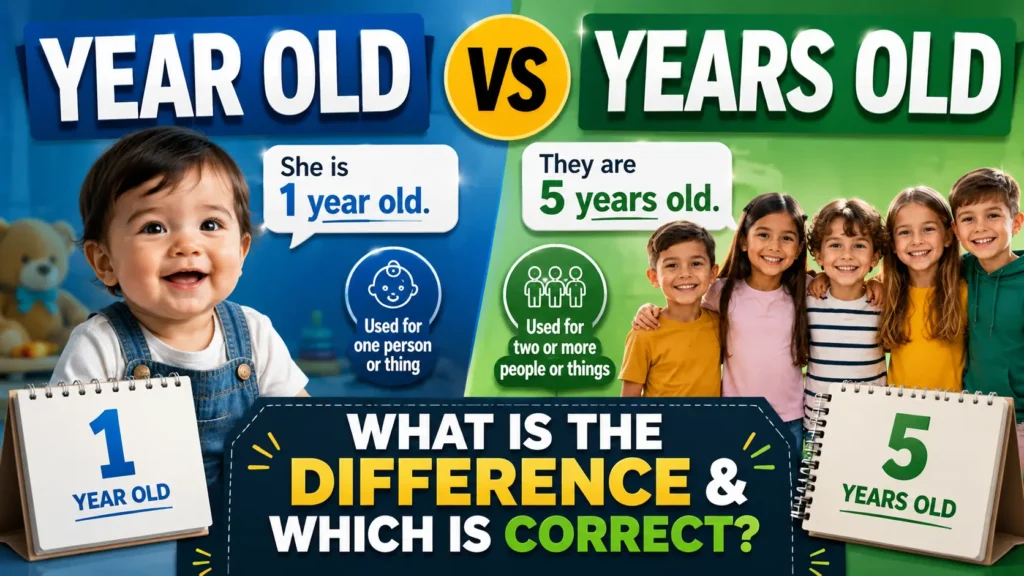

Many English learners get confused between year old and years old because both refer to age, but they are used in different grammatical situations. Understanding when to use each expression correctly will improve your writing, speaking, and overall grammar accuracy. This guide explains the differences in simple language with plenty of practical examples.
Comparison Overview
Although year old and years old both relate to age, they are not interchangeable.
- Year old is typically used as part of a compound adjective before a noun.
- Years old is used after a noun to state someone’s or something’s age.
Using the correct form depends entirely on where the phrase appears in a sentence and its grammatical function.
| Feature | Year Old | Years Old |
| Main purpose | Compound adjective | Age expression |
| Position | Before a noun | After a noun |
| Hyphenation | Usually hyphenated with numbers (e.g., 10-year-old) | No hyphen needed |
| Grammar role | Adjective | Predicate adjective |
| Example | A five-year-old child | The child is five years old. |
Definition of Year Old
Year old is used as part of a compound adjective that describes a person, animal, or thing before a noun.
It combines a number with year-old to describe age as an adjective.
Examples:
- A three-year-old boy
- A ten-year-old building
- A one-year-old puppy
Notice that year remains singular because it is part of a compound adjective.
Definition of Years Old
Years old is an age expression used after a noun to tell how old someone or something is.
It functions as a descriptive phrase rather than a compound adjective.
Examples:
- The boy is three years old.
- The building is ten years old.
- My dog is one year old.
In this pattern, years is plural whenever the number is greater than one.
Main Differences Between Year Old and Years Old
The biggest difference is grammatical position.
| Point | Year Old | Years Old |
| Used before a noun | Yes | No |
| Used after a noun | No | Yes |
| Acts as | Compound adjective | Predicate adjective |
| Singular or plural | “Year” stays singular | “Years” becomes plural when needed |
| Example | A six-year-old student | The student is six years old. |
Other important differences include:
- Year old modifies a noun directly.
- Years old describes the age after a linking verb such as is, was, or are.
- Year old normally includes hyphens.
- Years old does not require hyphens.
Compound Adjectives and Age Expressions
Age expressions follow one of two common sentence patterns.
Pattern 1: Before the noun
- A four-year-old child
- A twenty-year-old company
- An eight-year-old laptop
Pattern 2: After the noun
- The child is four years old.
- The company is twenty years old.
- The laptop is eight years old.
Both sentences express the same age, but the grammar changes.
Common Sentence Patterns
Compound adjective
Number + year-old + noun
Examples:
- A five-year-old girl
- A two-year-old horse
- A fifty-year-old tradition
Age statement
Subject + be verb + number + years old
Examples:
- The girl is five years old.
- The horse is two years old.
- The tradition is fifty years old.
Grammar Guide
Both expressions relate to age, but they perform different grammatical roles.
- Year old functions as an adjective.
- Years old functions as an age phrase following a linking verb.
How each term is used in sentences
Year Old
Pattern:
Number + year-old + noun
Examples:
- A seven-year-old student won the contest.
- We adopted a two-year-old cat.
- The museum displays a hundred-year-old painting.
Years Old
Pattern:
Subject + be verb + number + years old
Examples:
- The student is seven years old.
- The cat is two years old.
- The painting is one hundred years old.
Common mistakes learners make
Common mistakes include:
- ❌ A five years old boy.
- ✅ A five-year-old boy.
- ❌ He is five-year-old.
- ✅ He is five years old.
- ❌ A three years old dog.
- ✅ A three-year-old dog.
- ❌ The car is ten-year-old.
- ✅ The car is ten years old.
Simple rules to remember
- Use year-old before a noun.
- Use years old after the verb be.
- Keep year singular in compound adjectives.
- Use years after numbers greater than one in age statements.
- Use hyphens in compound adjectives.
Quick tips for writing and speaking
- Ask yourself whether the phrase comes before or after the noun.
- If it comes before the noun, use year-old.
- If it follows is, are, or was, use years old.
- Always include hyphens in compound adjectives.
- Read the sentence aloud to check whether it sounds natural.
When to Use Each One
Use year old when:
- Describing a noun before it appears.
- Writing headlines.
- Creating concise descriptions.
- Writing formal documents.
- Describing age as an adjective.
Use years old when:
- Stating someone’s age.
- Talking naturally in conversation.
- Writing complete sentences.
- Answering age-related questions.
- Describing how old something is.
When NOT to Use Each One
Do not use year old:
- After the verb is.
- Without hyphens in compound adjectives.
- As a standalone age statement.
Do not use years old:
- Before a noun.
- Inside compound adjectives.
- In phrases like five years old boy.
Which One to Use (Decision Guide)
Choose year old if:
- The phrase comes before a noun.
- It describes someone or something.
- It acts as an adjective.
Choose years old if:
- The phrase follows a linking verb.
- You are stating age directly.
- The age appears after the subject.
Quick decision:
- A five-year-old child ✅
- The child is five years old. ✅
Real-World Practical Examples
Year Old Examples
- A five-year-old student started reading novels.
- We rescued a two-year-old dog.
- The company hired a twenty-year-old intern.
- Scientists examined a million-year-old fossil.
- She bought a ten-year-old car.
Years Old Examples
- My daughter is five years old.
- The dog is two years old.
- Their business is twenty years old.
- This fossil is millions of years old.
- My laptop is four years old.
Self-Assessment (Fill in the Blanks)
- I will use ______ when referring to a child before the noun. The correct word is ______ because it forms a compound adjective.
- I will use ______ when stating someone’s age after “is.” The correct word is ______ because it follows the verb.
- A ______ student won the prize. The correct word is ______ because it modifies a noun.
- She is eight ______. The correct word is ______ because it states age.
- We adopted a three-______ puppy. The correct word is ______ because it comes before the noun.
- The puppy is three ______. The correct word is ______ because it follows the verb.
- A fifty-______ building attracts tourists. The correct word is ______ because it is an adjective.
- The building is fifty ______. The correct word is ______ because it expresses age.
- He bought a ten-______ bicycle. The correct word is ______ because it modifies the noun.
- The bicycle is ten ______. The correct word is ______ because it comes after the verb.
- A one-______ tree survived the storm. The correct word is ______ because it is before the noun.
- The tree is one ______. The correct word is ______ because it states age.
- A six-______ horse won the race. The correct word is ______ because it modifies a noun.
- The horse is six ______. The correct word is ______ because it follows the linking verb.
- We found a thousand-______ artifact. The correct word is ______ because it is a compound adjective.
- The artifact is a thousand ______. The correct word is ______ because it tells age.
- A nine-______ child solved the puzzle. The correct word is ______ because it comes before the noun.
- The child is nine ______. The correct word is ______ because it follows the verb.
- She met a four-______ athlete. The correct word is ______ because it modifies the noun.
- The athlete is four ______. The correct word is ______ because it states age.
Answers
- year-old, year-old
- years old, years old
- year-old, year-old
- years old, years old
- year-old, year-old
- years old, years old
- year-old, year-old
- years old, years old
- year-old, year-old
- years old, years old
- year-old, year-old
- year old, year old
- year-old, year-old
- years old, years old
- year-old, year-old
- years old, years old
- year-old, year-old
- years old, years old
- year-old, year-old
- years old, years old
Conclusion
Understanding the difference between Year Old Vs Years Old becomes much easier once you know their grammatical roles. Year-old is used as a compound adjective before a noun, while years old is used after a noun to state age. Although both expressions describe how old a person, animal, or object is, they cannot always replace one another. Choosing the correct form makes your writing clearer, more natural, and grammatically accurate. Whether you are writing essays, business documents, social media posts, or everyday conversations, applying these simple rules will help you communicate with confidence. Whenever you describe age before a noun, remember to use year-old with hyphens. When stating age after a subject and verb, choose years old instead. Keeping this distinction in mind will help you avoid common mistakes and improve both your spoken and written English.
FAQs
What is the difference between year old and years old?
The main difference is grammatical usage. Year-old is a compound adjective placed before a noun, while years old is an age expression used after a noun and a linking verb. Both describe age but are used in different sentence structures.
Is year old always hyphenated?
Yes. When year-old is used before a noun as a compound adjective, it should be hyphenated. For example, a five-year-old child is correct. The hyphens connect the words into one adjective that describes the noun.
When should I use years old?
Use years old after a subject and a linking verb like is, are, or was. For example, She is eight years old is the correct structure. This form states someone’s age rather than describing a noun.
Why does year stay singular in year-old?
In a compound adjective, the noun remains singular regardless of the number. That is why we write a ten-year-old building instead of a ten-years-old building. This follows a standard English grammar rule for compound modifiers.
Can I say five years old boy?
No. The correct expression is five-year-old boy because the phrase comes before the noun. If the age comes after the noun, you should write The boy is five years old. Mixing these structures creates a grammar error.
Is one year old different from one-year-old?
Yes. One-year-old is used before a noun, such as a one-year-old cat. One year old appears after a linking verb, as in The cat is one year old. The meaning is the same, but the sentence structure changes.
Are year old and years old interchangeable?
No. They describe age but serve different grammatical functions. Year-old modifies a noun, while years old follows a linking verb to state age. Using the correct form depends on where the phrase appears in the sentence.
Do these rules apply to objects as well as people?
Yes. The same grammar applies to people, animals, buildings, companies, vehicles, and other objects. For example, a twenty-year-old bridge and The bridge is twenty years old are both grammatically correct.
Is year old used in formal writing?
Yes. Year-old is commonly used in newspapers, academic writing, business documents, and professional communication. It creates concise and natural descriptions, making it a preferred choice when describing age before a noun.
How can I easily remember the correct usage?
A simple rule is to check the position of the phrase. If it comes before a noun, use year-old. If it follows the verb be to state age, use years old. Remembering this pattern will help you use both forms correctly every time.
