
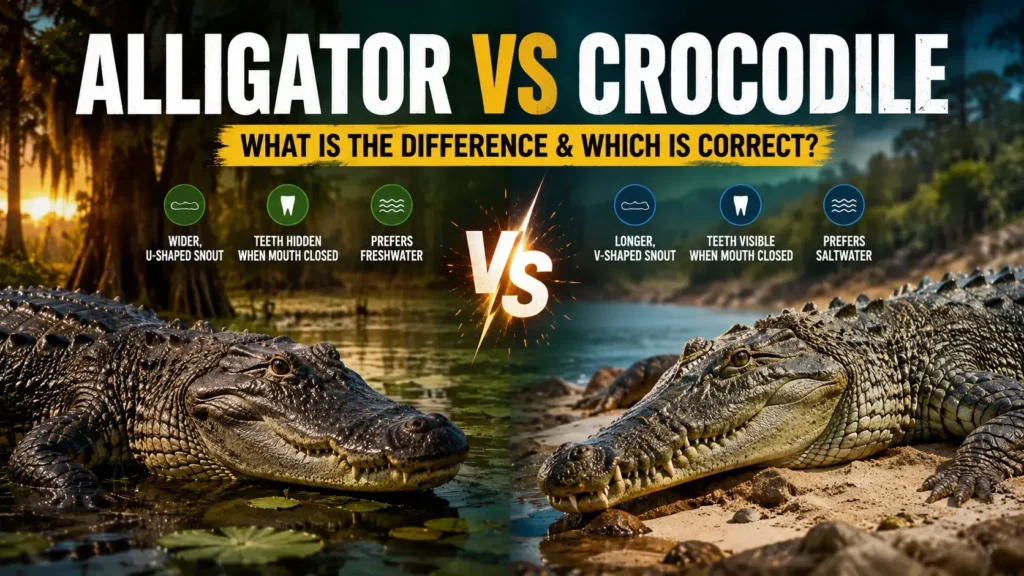

Alligators and crocodiles are often confused because they look similar and both belong to the reptile family. However, they have clear differences in appearance, habitat, and behavior. Understanding these differences helps you use the correct term in writing, speaking, and general knowledge contexts.
Comparison Overview
Alligators and crocodiles are large, semi-aquatic reptiles belonging to the order Crocodylia. While they share many traits, such as powerful jaws and scaly skin, they differ in snout shape, habitat, temperament, and geographical distribution. Knowing these differences makes it easier to identify and correctly refer to each animal.
Definition of Alligator
An alligator is a large reptile with a broad, U-shaped snout. It typically lives in freshwater environments such as rivers, lakes, and swamps. Alligators are mostly found in the southeastern United States and parts of China. They are generally less aggressive than crocodiles.
Definition of Crocodile
A crocodile is a large reptile with a narrow, V-shaped snout. It can live in both freshwater and saltwater environments. Crocodiles are found in Africa, Asia, Australia, and the Americas. They are known to be more aggressive and adaptable than alligators.
Main Differences Between Alligator and Crocodile
- Snout Shape: Alligators have a wide U-shaped snout, while crocodiles have a narrow V-shaped snout.
- Habitat: Alligators prefer freshwater; crocodiles can live in both freshwater and saltwater.
- Color: Alligators are darker (black or dark gray), while crocodiles are lighter (olive or brown).
- Teeth Visibility: In alligators, the upper teeth cover the lower teeth. In crocodiles, teeth from both jaws are visible.
- Behavior: Alligators are less aggressive; crocodiles are more aggressive and territorial.
- Location: Alligators are mainly in the USA and China; crocodiles are found worldwide in tropical regions.
Physical Appearance Comparison Table
| Feature | Alligator | Crocodile |
| Snout Shape | U-shaped (wide) | V-shaped (narrow) |
| Color | Dark (black/gray) | Light (brown/olive) |
| Teeth | Mostly hidden | Visible when closed |
| Size | Slightly smaller | Generally larger |
| Habitat | Freshwater | Fresh & saltwater |
Habitat and Behavior
Alligators prefer calm freshwater areas like swamps and rivers. They are more tolerant of cold weather. Crocodiles, on the other hand, thrive in warmer climates and can live in both rivers and coastal areas due to their salt glands.
Grammar Guide
How each term is used in sentences
- Use alligator when referring to the specific reptile found mainly in freshwater environments.
- Use crocodile when referring to the reptile found in broader environments, including saltwater.
Examples:
- The alligator rested quietly in the swamp.
- The crocodile swam near the riverbank.
Common mistakes learners make
- Using “crocodile” for all similar reptiles
- Confusing physical features like snout shape
- Assuming both animals live in the same environments
Simple rules to remember
- U-shape = Alligator
- V-shape = Crocodile
- Freshwater = Alligator
- Saltwater possible = Crocodile
Quick tips for writing and speaking
- Think of “A” in Alligator for “American freshwater”
- Think of “C” in Crocodile for “Coastal and worldwide”
- Use visual differences to recall names quickly
When to Use Each One
- Use alligator when talking about reptiles in the USA or freshwater swamps.
- Use crocodile when discussing reptiles in tropical regions or saltwater habitats.
When NOT to Use Each One
- Do not use alligator when referring to saltwater reptiles.
- Do not use crocodile for animals found only in American freshwater swamps unless you are sure.
Which One to Use (Decision Guide)
- If the reptile has a wide snout, choose alligator.
- If it has a narrow snout, choose crocodile.
- If the habitat is freshwater only, choose alligator.
- If the habitat includes saltwater, choose crocodile.
Real-World Practical Examples
Alligator Examples
- The alligator lives in Florida swamps.
- Scientists study the alligator’s behavior in freshwater lakes.
- The zoo has a large alligator exhibit.
- An alligator was spotted near the riverbank.
- The alligator remained calm in the warm water.
Crocodile Examples
- The crocodile is found in African rivers.
- A crocodile can survive in saltwater.
- The documentary showed a crocodile hunting.
- Crocodiles are more aggressive than alligators.
- The crocodile swam across the coastal lagoon.
Self-Assessment (Fill in the Blanks)
- I will use ______ when referring to a freshwater reptile in the USA.
- The correct word is ______ because it has a V-shaped snout.
- I will use ______ when talking about saltwater reptiles.
- The correct word is ______ because it is less aggressive.
- I will use ______ for reptiles in Africa.
- The correct word is ______ because of its wide snout.
- I will use ______ for reptiles found in Florida swamps.
- The correct word is ______ because it lives in coastal areas.
- I will use ______ for a darker-colored reptile.
- The correct word is ______ because it shows visible teeth.
- I will use ______ for a reptile in freshwater lakes.
- The correct word is ______ because it has a narrow snout.
- I will use ______ when describing a calm reptile.
- The correct word is ______ because it is more aggressive.
- I will use ______ for reptiles in China.
- The correct word is ______ because it lives worldwide.
- I will use ______ for reptiles in swamps.
- The correct word is ______ because it tolerates saltwater.
- I will use ______ when referring to a U-shaped snout reptile.
- The correct word is ______ because it is found in tropical regions.
Answers
- Alligator
- Crocodile
- Crocodile
- Alligator
- Crocodile
- Alligator
- Alligator
- Crocodile
- Alligator
- Crocodile
- Alligator
- Crocodile
- Alligator
- Crocodile
- Alligator
- Crocodile
- Alligator
- Crocodile
- Alligator
- Crocodile
Conclusion
In the end, understanding the difference between an alligator and a crocodile is easier than it first appears. While both are powerful reptiles with similar features, small details like snout shape, habitat, and behavior clearly set them apart. Alligators are calmer, freshwater animals with wide snouts, while crocodiles are more aggressive, adaptable, and found in a wider range of environments. By remembering these simple distinctions, you can confidently identify and use the correct term in conversation, writing, or study. Whether you’re learning for curiosity, education, or content creation, knowing the difference between alligator vs crocodile helps improve both accuracy and understanding in a practical and meaningful way.
FAQs
What is the main difference between an alligator and a crocodile?
The main difference lies in their snout shape, habitat, and behavior. Alligators have wide, U-shaped snouts and live mostly in freshwater, while crocodiles have narrow, V-shaped snouts and can live in both freshwater and saltwater. Crocodiles are also generally more aggressive than alligators.
Which is more dangerous, an alligator or a crocodile?
Crocodiles are considered more dangerous due to their aggressive nature and stronger territorial instincts. They are more likely to attack humans compared to alligators, which tend to avoid human interaction unless provoked or threatened in their natural habitat.
Where are alligators commonly found?
Alligators are primarily found in the southeastern United States and parts of China. They prefer freshwater environments such as swamps, rivers, lakes, and marshes, where they can stay partially submerged and regulate their body temperature effectively.
Where do crocodiles live?
Crocodiles are found in tropical regions across Africa, Asia, Australia, and the Americas. They can live in both freshwater and saltwater environments, including rivers, lakes, wetlands, and coastal areas, thanks to special glands that help them handle saltwater.
How can you identify an alligator easily?
You can identify an alligator by its broad, rounded snout and darker body color. When its mouth is closed, only the upper teeth are visible. These features make it easy to distinguish from crocodiles in most situations.
How can you recognize a crocodile quickly?
A crocodile can be recognized by its narrow, pointed snout and lighter color. When its mouth is closed, both upper and lower teeth are visible. This distinct feature helps differentiate it from an alligator.
Are alligators and crocodiles from the same family?
Alligators and crocodiles belong to the same order, Crocodylia, but they are from different families. Alligators belong to the family Alligatoridae, while crocodiles belong to Crocodylidae, which explains their physical and behavioral differences.
Can crocodiles live in saltwater but alligators cannot?
Yes, crocodiles can survive in saltwater because they have special salt glands that allow them to process excess salt. Alligators lack these glands, so they mainly stay in freshwater environments and rarely venture into salty water.
Which animal is bigger, alligator or crocodile?
Crocodiles are generally larger than alligators. Some species of crocodiles can grow significantly longer and heavier, making them one of the largest reptiles in the world, while alligators are slightly smaller in comparison.
Why do people confuse alligators and crocodiles?
People often confuse them because they look similar at first glance, with scaly bodies and strong jaws. However, differences in snout shape, teeth visibility, and habitat are key factors that help distinguish them when observed.
