
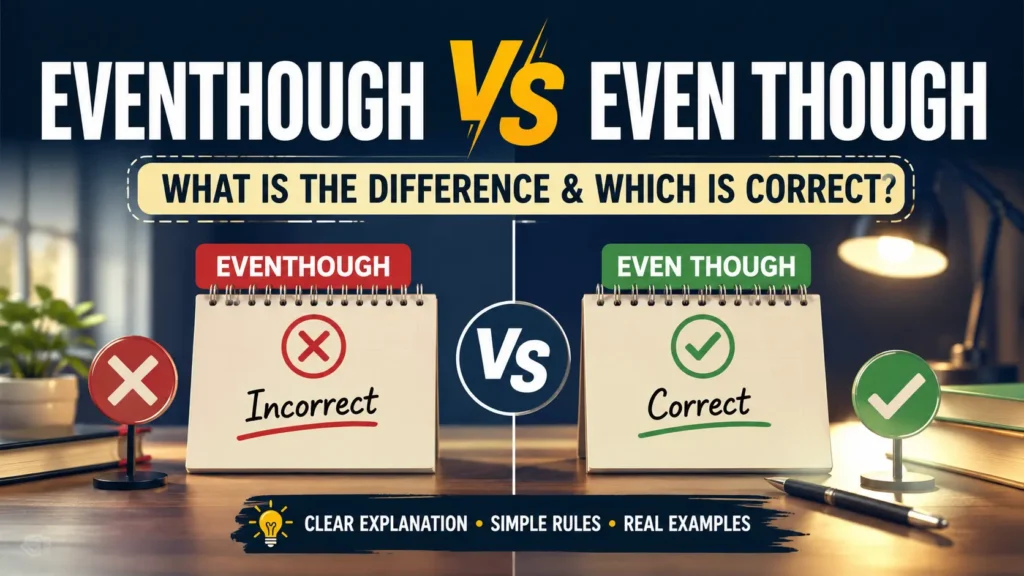

“Eventhough” and “even though” look almost identical, but only one is correct in standard English. This common spelling mistake happens because the two words sound like a single phrase when spoken. Understanding the difference is simple: even though is the correct two-word conjunction, while eventhough is an incorrect spelling. Let’s explore how to use it confidently.
Comparison Overview
The comparison between eventhough and even though is straightforward because these two forms do not have equal grammatical status.
Even though is the correct expression. It is a subordinating conjunction used to introduce a contrast or unexpected fact. It means something similar to although, despite the fact that, or in spite of the fact that.
Eventhough, written as one word, is not standard English. It is generally a spelling error caused by combining the words “even” and “though.”
For example:
- Correct: Even though it was raining, we went outside.
- Incorrect: Eventhough it was raining, we went outside.
The important rule is simple: Always write “even though” as two separate words.
| Form | Correct? | Word Type | Meaning | Example |
| Even though | Yes | Subordinating conjunction | Despite the fact that | Even though she was tired, she worked. |
| Eventhough | No | Incorrect spelling | — | Eventhough she was tired, she worked. |
Definition of Eventhough
Eventhough is not a standard English word. It is an incorrect spelling of the phrase even though.
People sometimes write “eventhough” because “even though” is frequently pronounced quickly in natural conversation. When spoken, the phrase can sound almost like one word, which may lead learners to combine it when writing.
However, standard written English requires the expression to remain separated:
even + though = even though
For example:
- Incorrect: Eventhough he studied hard, he failed the test.
- Correct: Even though he studied hard, he failed the test.
“Eventhough” should therefore not be treated as an alternative spelling. It does not have a separate meaning or grammatical function.
If you see eventhough in an essay, email, article, report, or other formal writing, it should normally be corrected to even though.
Definition of Even Though
Even though is a subordinating conjunction that introduces a statement that contrasts with the main clause.
It shows that something happened or is true despite another fact that might have suggested a different result.
For example:
Even though it was cold, we went swimming.
The sentence contains two contrasting ideas:
- It was cold.
- We went swimming anyway.
The phrase even though connects these ideas and emphasizes the contrast.
Other examples include:
- Even though she was nervous, she gave an excellent presentation.
- Even though the computer was old, it still worked well.
- Even though I was busy, I answered the phone.
- Even though the experiment was difficult, the researchers completed it.
Even though is grammatically correct in both everyday and formal English.
Main Differences Between Eventhough and Even Though
The biggest difference is that even though is correct, while eventhough is incorrect.
1. Spelling
Even though consists of two separate words.
Eventhough incorrectly combines them into one word.
- Correct: even though
- Incorrect: eventhough
2. Grammatical Status
Even though functions as a subordinating conjunction.
Eventhough has no recognized standard grammatical function because it is not a standard English word.
3. Meaning
Even though expresses contrast or concession.
For example:
Even though the road was crowded, we arrived on time.
The busy road could have caused a delay, but the expected result did not happen.
“Eventhough” has no independent meaning.
4. Formal Writing
In academic writing, professional communication, journalism, and other edited writing, use even though.
Never intentionally use eventhough as a spelling variation.
5. Pronunciation Can Cause Confusion
In fast speech, even though may sound connected. This can make learners believe it should be written as one word.
However, pronunciation does not determine whether words should be combined in writing.
Why Is “Eventhough” a Common Mistake?
The mistake usually comes from the way English sounds in connected speech.
When native and fluent speakers say:
Even though I was tired, I continued working.
The words may flow together naturally. A learner may hear the phrase as something resembling “eventhough.”
There is also a visual reason for the confusion. English contains many compound words, such as:
- although
- therefore
- however
- whenever
- wherever
Because although is already written as one word, learners may assume that even though can also be combined.
It cannot.
The correct spelling remains even though.
Grammar Guide
How Each Term Is Used in Sentences
Because eventhough is incorrect, it does not have a proper sentence pattern in standard English.
The correct structure is:
Even though + subject + verb, main clause.
Example:
Even though she was tired, she continued studying.
You can also place the main clause first:
Main clause + even though + subject + verb.
Example:
She continued studying even though she was tired.
Both structures are grammatically correct.
Another common pattern is:
Even though + subject + verb + main clause.
Examples:
- Even though the weather was bad, the flight departed.
- Even though he had little experience, he performed well.
- Even though the task was difficult, the team completed it.
When even though introduces the sentence, a comma is commonly placed between the dependent clause and the main clause.
Common Mistakes Learners Make
Mistake 1: Combining the words
Incorrect:
Eventhough I was busy, I helped him.
Correct:
Even though I was busy, I helped him.
Mistake 2: Treating “eventhough” as an alternative spelling
“Eventhough” is not a less formal version of “even though.” It is simply a spelling error.
Mistake 3: Confusing “even though” with “although”
Both can introduce contrast, but they are not always identical in emphasis.
Compare:
Although he was tired, he continued working.
Even though he was extremely tired, he continued working.
Even though often gives stronger emphasis to the contrast.
Mistake 4: Using “even though” without a clause
“Even though” normally introduces a clause containing a subject and verb.
Correct:
Even though she was tired, she continued working.
For a noun phrase rather than a clause, despite or despite may be more appropriate:
Despite her tiredness, she continued working.
Simple Rules to Remember
Remember these four rules:
- Even though is always written as two words.
- Eventhough is not standard English.
- Even though introduces a contrast or unexpected situation.
- Use even though before a clause containing a subject and verb.
A useful memory trick is:
Even + though = two words, not one.
Quick Tips for Writing and Speaking
- When writing, deliberately check whether you have separated even and though.
- Do not write eventhough, even if it sounds natural when spoken.
- Use even though when you want to emphasize a contrast.
- Use although when you want a slightly simpler alternative.
- Use despite or despite when followed by a noun, pronoun, or gerund phrase.
- In formal writing, proofread conjunctions carefully because spelling mistakes can affect credibility.
Even Though vs Although vs Despite
Although the main comparison is between eventhough and even though, understanding related expressions can make the rule easier.
| Expression | Correct? | What Follows It? | Example |
| Even though | Yes | Subject + verb | Even though he was tired, he worked. |
| Although | Yes | Subject + verb | Although he was tired, he worked. |
| Despite | Yes | Noun/gerund | Despite being tired, he worked. |
| In spite of | Yes | Noun/gerund | In spite of being tired, he worked. |
| Eventhough | No | — | Incorrect spelling |
This distinction is especially useful for English learners because these expressions all communicate some form of contrast.
When to Use Each One
When to Use Even Though
Use even though when you want to connect two contrasting ideas.
For unexpected results
Even though the store was crowded, we found a table.
For surprising actions
Even though she was nervous, she spoke confidently.
For difficult circumstances
Even though the project was challenging, the team finished it.
For personal situations
Even though I was tired, I went to the meeting.
For formal and academic writing
Even though the sample size was small, the results were significant.
The expression works in conversations, emails, essays, reports, articles, presentations, and many other contexts.
When to Use Eventhough
You should not use eventhough in standard English.
If you are tempted to write it, replace it with:
even though
For example:
- Incorrect: Eventhough the deadline was close, we remained calm.
- Correct: Even though the deadline was close, we remained calm.
When NOT to Use Each One
When Not to Use Eventhough
Do not use eventhough in:
- Academic essays
- Business emails
- Resumes
- Reports
- School assignments
- Articles
- Websites
- Professional documents
- Formal correspondence
- Standard English writing
There is no grammatical situation in standard English where eventhough should replace even though.
When Not to Use Even Though
Although even though is correct, you should avoid using it when the grammatical structure requires another expression.
For example, do not use even though directly before a noun when you actually need despite:
Incorrect: Even though the heavy rain, the game continued.
Better:
Despite the heavy rain, the game continued.
Or use a full clause:
Even though it was raining heavily, the game continued.
The key is to match the expression with the structure that follows it.
Which One to Use: Decision Guide
Choosing between these two forms is extremely easy.
Step 1: Are you expressing contrast?
If yes, you may need even though.
Even though the task was difficult, we completed it.
Step 2: Are you writing “eventhough”?
If yes, separate the words.
❌ Eventhough
✅ Even though
Step 3: Does a subject and verb follow?
If yes, even though can introduce the clause.
Even though he was late, he joined the meeting.
Step 4: Are you following it with a noun or noun phrase?
Consider despite or in spite of instead.
Despite the delay, the meeting continued.
Quick Decision Rule
Need a contrast + followed by a clause? → EVEN THOUGH
Thinking about “eventhough”? → Separate it into EVEN THOUGH
Real-World Practical Examples
Even Though Examples
Education
Even though the exam was difficult, Maya answered most of the questions.
This sentence contrasts the difficulty of the exam with Maya’s successful performance.
Daily Life
Even though I was tired after work, I cooked dinner for my family.
The speaker was tired but still completed the activity.
Science
Even though the temperature dropped, the reaction continued.
The sentence describes an unexpected scientific result.
Business
Even though sales declined in January, the company remained profitable.
The decline in sales contrasts with the company’s continued profitability.
Writing
Even though the first draft was rough, the writer developed it into a strong article.
The imperfect beginning contrasts with the successful final result.
Technology
Even though the laptop is several years old, it still runs the software smoothly.
The age of the laptop contrasts with its good performance.
Conversation
Even though you warned me, I forgot to bring my umbrella.
The warning should have prevented the problem, but the speaker forgot anyway.
Travel
Even though the airport was crowded, we reached the gate on time.
The crowded airport could have caused a delay, but it did not.
Eventhough Examples
There are no correct standard-English examples of “eventhough” because it is an incorrect spelling.
Instead, every example should be corrected to even though.
Incorrect
Eventhough the weather was cold, we went hiking.
Correct
Even though the weather was cold, we went hiking.
Incorrect
Eventhough she had little experience, she got the job.
Correct
Even though she had little experience, she got the job.
Incorrect
Eventhough the computer was slow, it completed the task.
Correct
Even though the computer was slow, it completed the task.
Incorrect
Eventhough he was nervous, he gave the presentation.
Correct
Even though he was nervous, he gave the presentation.
Incorrect
Eventhough the road was busy, we arrived early.
Correct
Even though the road was busy, we arrived early.
These examples demonstrate an important point: “eventhough” should not be used as a legitimate alternative to “even though.”
Self-Assessment: Fill in the Blanks
Test your understanding by completing each sentence with the correct form. Remember that the goal is to recognize both spelling and grammatical usage.
- I will use ______ when referring to a contrast between two clauses.
- The correct word is ______ because it is written as two separate words.
- ______ it was raining, the children continued playing outside.
- The correct word is ______ because it introduces a dependent clause.
- She attended the meeting ______ she was feeling unwell.
- I should write ______ rather than combining the two words.
- ______ the computer is old, it still performs well.
- The correct form is ______ because “eventhough” is not standard English.
- ______ he studied carefully, he found the question difficult.
- In formal writing, I should use ______ instead of “eventhough.”
- ______ the road was blocked, the emergency team reached the village.
- The correct expression is ______ because it shows contrast.
- ______ the project was expensive, the company approved it.
- I will avoid ______ because it is an incorrect spelling.
- ______ she was nervous, she delivered an excellent speech.
- The standard English form is ______, not “eventhough.”
- ______ the experiment was challenging, the researchers completed it.
- When writing an academic essay, I should choose ______.
- ______ I had very little time, I finished the assignment.
- The correct form is ______ because “even” and “though” remain separate words.
Answers
- even though — It introduces a contrast between two clauses.
- even though — The expression is always written as two words.
- Even though — It introduces the contrasting dependent clause.
- even though — It is a subordinating conjunction.
- even though — It connects her attendance with the contrasting fact that she felt unwell.
- even though — The two words must remain separate.
- Even though — The computer’s age contrasts with its continued performance.
- even though — “Eventhough” is not the standard spelling.
- Even though — The phrase introduces a contrast between studying and finding the question difficult.
- even though — It is the grammatically correct expression.
- Even though — The blocked road contrasts with the team’s successful arrival.
- even though — It signals an unexpected or contrasting situation.
- Even though — The high cost contrasts with the company’s decision to approve the project.
- eventhough — This is an incorrect spelling and should be avoided.
- Even though — Her nervousness contrasts with her successful presentation.
- even though — Standard English keeps the two words separate.
- Even though — The difficulty of the experiment contrasts with its successful completion.
- even though — It is appropriate for standard formal English when introducing a contrasting clause.
- Even though — Having little time contrasts with successfully finishing the assignment.
- even though — The phrase consists of two separate words.
Final Verdict
The difference between eventhough and even though is simple: even though is correct, while eventhough is incorrect.
Even though is a subordinating conjunction used to introduce a contrasting or unexpected fact. It normally connects a dependent clause with a main clause, as in: “Even though it was late, she continued working.”
By contrast, eventhough is not a standard English word. It is simply a common spelling mistake caused by writing the two words together.
The easiest rule to remember is: Always write “even though” as two words. If you are writing an essay, email, article, report, or professional document, use even though whenever you need to express contrast before a clause. Once you remember that even + though stays separate, this common English confusion becomes easy to avoid.
Conclusion
Understanding Eventhough vs Even Though is simple once you know the correct spelling and grammatical function. Even though is the standard and correct expression used to introduce a contrasting or unexpected idea, such as “Even though it was raining, we went outside.” On the other hand, eventhough is not a correct spelling in standard English and should be avoided in essays, emails, articles, academic work, and professional writing. The confusion often occurs because “even though” can sound like one word when spoken quickly. However, it should always remain two separate words in writing. If you need a simple rule to remember, think of even + though = even though. Using the correct form will make your writing clearer, more polished, and grammatically accurate. Whether you are writing casually or formally, choosing even though is the confident and correct choice.
FAQs
Is “eventhough” a correct word?
No, eventhough is not a standard English word. It is an incorrect spelling of even though. The correct expression always consists of two separate words. Use even though when introducing a contrasting idea or unexpected situation, such as “Even though she was tired, she finished her work.” This spelling is appropriate in both casual and formal writing.
Is “even though” correct in English?
Yes, even though is completely correct in standard English. It is a subordinating conjunction used to introduce a contrast or concession between ideas. For example, “Even though the weather was cold, we went outside.” It can be used in conversations, emails, academic writing, articles, reports, and other forms of communication.
What is the difference between eventhough and even though?
The main difference is correctness. Even though is the correct two-word expression, while eventhough is an incorrect spelling. Even though introduces a dependent clause that contrasts with the main clause. For example, “Even though he was busy, he helped me.” There is no separate meaning or grammatical function for “eventhough” in standard English.
Should I write “eventhough” or “even though”?
You should always write even though as two separate words. “Eventhough” is a common spelling mistake, often caused by the way the phrase sounds when spoken quickly. For example, write “Even though I was tired, I continued working,” not “Eventhough I was tired.” This rule applies to both formal and informal written English.
What does “even though” mean?
Even though means “although” or “although.” It introduces information that contrasts with what happens in the main clause. For example, “Even though it was raining, we went for a walk.” The rain might have prevented the walk, but the people went anyway. The phrase therefore highlights an unexpected or contrasting result.
Is “even though” one word or two words?
Even though is written as two words. The words “even” and “though” should remain separate whenever they are used together as this conjunction. Although they may sound connected in natural speech, their pronunciation does not change their written form. Remembering “even + though” can help prevent the common mistake of writing “eventhough.”
Can “even though” start a sentence?
Yes, even though can naturally begin a sentence. When it introduces a dependent clause at the beginning, the main clause usually follows after a comma. For example, “Even though the test was difficult, she passed.” It can also appear later in a sentence: “She passed even though the test was difficult.”
Is “even though” the same as “although”?
Even though and although are similar because both introduce contrast. However, even though can place stronger emphasis on the unexpected nature of the result. For example, “Although he was tired, he worked” and “Even though he was tired, he worked” have similar meanings, but the second version can emphasize the contrast more strongly.
Can I use “even though” in formal writing?
Yes, even though is appropriate for formal writing. You can use it in academic essays, professional reports, business communication, articles, and other carefully written content. It is a standard grammatical expression, not informal slang. If you are writing formally, simply make sure you use the correct two-word spelling rather than the incorrect form “eventhough.”
How can I remember the correct spelling of “even though”?
A simple way to remember the spelling is to think of even though as two separate words: even + though. Never combine them into “eventhough.” You can also remember that the phrase works like although, but unlike “although,” it is not written as one word. This quick rule helps prevent spelling mistakes.
