
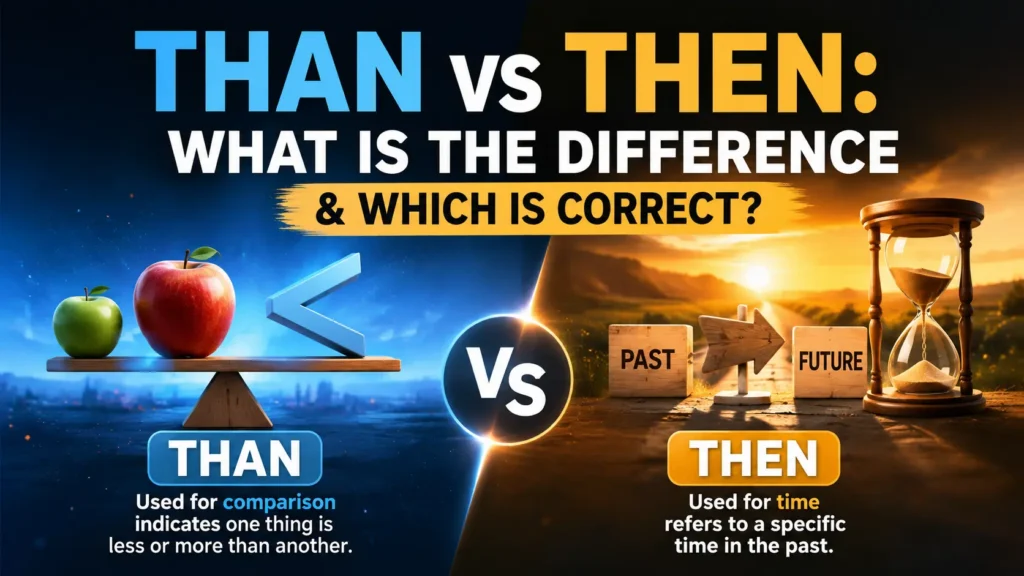

“Than” and “then” look and sound similar, but they have completely different meanings and grammatical functions. Than is mainly used for comparisons, while then usually refers to time, sequence, or a result. Understanding this small but important difference can help you avoid common spelling and grammar mistakes in emails, essays, conversations, and everyday writing.
Comparison Overview
Than and then are two commonly confused English words. Their similar spelling often causes writers and speakers to mix them up, but they serve different purposes.
Than is primarily used when comparing two or more people, things, actions, qualities, or amounts.
- My car is faster than yours.
- She is taller than her sister.
- This book is more interesting than the last one.
Then, on the other hand, commonly relates to time, order, sequence, or consequence.
- We finished dinner and then watched a movie.
- I lived in London then.
- If you study hard, then you can pass the exam.
A simple way to remember the distinction is:
Than = comparison
Then = time, sequence, or result
| Word | Main Function | Meaning | Example |
| Than | Comparison | Used to compare things | She is older than me. |
| Then | Time/sequence | At that time or next | We ate, then left. |
| Then | Result | In that case | If you’re ready, then let’s begin. |
Definition of Than
Than is a conjunction or preposition commonly used to introduce the second part of a comparison.
It appears after comparative words such as:
- better
- worse
- bigger
- smaller
- faster
- slower
- older
- younger
- more
- less
- fewer
For example:
- This laptop is cheaper than that one.
- Maria runs faster than I do.
- I have more work than yesterday.
- He is less nervous than before.
The main purpose of than is to show a difference or comparison between two things.
Than in Comparisons
The most common structure is:
comparative adjective/adverb + than + person or thing
Examples:
- This test is easier than the previous one.
- Ali speaks more clearly than his brother.
- Summer is hotter than spring.
You can also use than after nouns and pronouns in comparisons:
- I have more books than you.
- She has fewer problems than I do.
- They spent more money than we expected.
Is Than a Verb or Noun?
No. Than is not normally used as a verb or noun. It functions mainly as a conjunction or preposition in comparisons.
For example:
- Correct: She is taller than me.
- Correct: She is taller than I am.
The word connects the two parts of the comparison.
Definition of Then
Then is an adverb with several related meanings. It commonly refers to a particular time, the next event in a sequence, or a result that follows from a condition.
Examples:
- I was living in New York then.
- First, wash the vegetables; then cut them.
- If you agree, then we can proceed.
Unlike than, then is not normally used to compare two things.
Then for Time
Then can mean “at that time.”
- I was much younger then.
- She lived in Paris then.
- Things were different then.
It can also refer to a future or expected time:
- Finish your homework, and then you can play.
- We will discuss the budget then.
Then for Sequence
Then is frequently used to show that one action happens after another.
Common pattern:
First → next → then → finally
For example:
- First, open the application.
- Then, enter your password.
- Then, click the login button.
- Finally, select your account.
Then for Results
Then can also introduce a consequence or result, especially after an “if” clause.
- If you’re tired, then take a break.
- If the weather improves, then we will go outside.
- If you finish early, then you can leave.
In these sentences, then has a meaning similar to “in that case.”
Main Differences Between Than and Then
The biggest difference between than and then is their function.
Than compares. Then relates to time, sequence, or consequence.
| Feature | Than | Then |
| Primary purpose | Comparison | Time or sequence |
| Common meaning | In comparison with | At that time / next |
| Grammatical role | Conjunction or preposition | Adverb |
| Used with comparatives? | Yes | No |
| Used to show sequence? | No | Yes |
| Used to describe a past time? | No | Yes |
| Used for conditional results? | No | Yes |
| Example | Better than before | Finish this then start that |
Compare With “Than”
Use than when one thing is being compared with another.
- My phone is newer than yours.
- This route is shorter than the other one.
- She is more experienced than him.
The comparison may involve:
- size
- age
- quality
- quantity
- speed
- cost
- ability
- preference
- performance
Sequence With “Then”
Use then when explaining what happens next.
- We had lunch and then went shopping.
- Read the instructions and then answer the questions.
- She finished her work and then called her manager.
Time With “Then”
Use then to refer to a particular time.
- I didn’t understand it then.
- We were living abroad then.
- Life was very different then.
Conditional Results With “Then”
Use then when showing what will happen as a result of a condition.
- If you need help, then call me.
- If the price is too high, then choose another option.
Why Are Than and Then So Commonly Confused?
The confusion exists mainly because the words are visually and phonetically similar.
They differ by only one letter:
- Than
- Then
However, their meanings are entirely different.
Another reason for confusion is fast writing and typing. People may type then automatically when they mean than, especially in informal messages.
For example:
- Incorrect: My car is faster then yours.
- Correct: My car is faster than yours.
The reverse mistake can also happen:
- Incorrect: First finish your work, than take a break.
- Correct: First finish your work, then take a break.
Grammar Guide
Understanding the grammatical role of each word makes the difference easier to remember.
How Each Term Is Used in Sentences
Common Patterns With Than
Comparative adjective + than
- This house is larger than ours.
- Sarah is younger than me.
More/less + adjective + than
- This option is more affordable than that one.
- The new system is less complicated than the old one.
More/fewer/less + noun + than
- I have more experience than he does.
- We need fewer employees than before.
- She has less time than I do.
Verb + more/less + than
- He talks more than I expected.
- They spend less than we do.
Common Patterns With Then
Action + then + action
- Wash your hands, then eat.
- Finish the report, then send it.
First + action + then + action
- First, choose a topic; then, create an outline.
If + condition + then + result
- If you agree, then we can continue.
- If it rains, then the match may be canceled.
Past time + then
- I didn’t know that then.
- We lived there then.
Common Mistakes Learners Make
Mistake 1: Using “Then” in a Comparison
Incorrect:
- This phone is better then mine.
Correct:
- This phone is better than mine.
Why? Better introduces a comparison, so than is required.
Mistake 2: Using “Than” for Sequence
Incorrect:
- Finish your homework, than go to bed.
Correct:
- Finish your homework, then go to bed.
Why? The sentence describes what happens next, so then is correct.
Mistake 3: Confusing “Then” With “Than” in Questions
Incorrect:
- Which is better, tea then coffee?
Correct:
- Which is better, tea than coffee?
More naturally:
- Which is better, tea or coffee?
When a comparison uses “better,” than is the comparison word, but some sentence structures use or instead.
Mistake 4: Using “Than” for a Past Time
Incorrect:
- I was very young than.
Correct:
- I was very young then.
Here, then means “at that time.”
Simple Rules to Remember
Use these four rules:
- Than = comparison.
- Then = time.
- Then = next in a sequence.
- Then = result or consequence in some conditional sentences.
A quick memory trick is:
ThAn = compArison
The A in “than” can remind you of “comparison.”
For then, think about time or what happens next.
Quick Tips for Writing and Speaking
When you’re unsure, ask yourself what the sentence is doing.
Is it comparing two things?
Use than.
- He is taller than me.
Is it explaining what happens next?
Use then.
- He ate dinner and then left.
Is it referring to a particular time?
Use then.
- I didn’t know that then.
Is it showing a result after a condition?
Use then.
- If that’s true, then we should investigate.
Reading the entire sentence instead of focusing only on the similar spelling can usually reveal the correct choice.
Than vs Then in Different Contexts
The distinction remains the same across different types of writing.
Education
- This exercise is easier than the previous one.
- First, read the chapter; then answer the questions.
Business
- Our new plan is more efficient than the old one.
- We will review the proposal and then make a decision.
Technology
- This processor is faster than the previous model.
- Install the software and then restart your computer.
Science
- Water is denser than oil.
- Heat the solution and then measure its temperature.
Everyday Conversation
- Your house is closer than mine.
- I’ll finish dinner and then call you.
The context changes, but the grammar rule does not.
When to Use Each One
When to Use Than
Use than when:
- Comparing two people.
- Comparing two objects.
- Comparing quantities.
- Comparing qualities.
- Comparing actions.
- Following comparative adjectives.
- Following words such as “more,” “less,” “fewer,” “better,” or “worse.”
Examples:
- She is smarter than her brother.
- This route is longer than the other one.
- I have more work than yesterday.
- This solution is better than the first one.
When to Use Then
Use then when:
- Referring to a past or future time.
- Showing the next step.
- Showing chronological order.
- Explaining what happens after something else.
- Expressing a result or consequence.
Examples:
- I lived there then.
- Finish this, then start the next task.
- First, check the settings; then restart the device.
- If you’re ready, then let’s begin.
When NOT to Use Each One
When Not to Use Than
Do not use than merely because two events happen one after another.
Incorrect:
- Eat breakfast than go to work.
Correct:
- Eat breakfast then go to work.
Do not use than to mean “at that time.”
Incorrect:
- I was living there than.
Correct:
- I was living there then.
When Not to Use Then
Do not use then after a comparative expression simply because it sounds similar to than.
Incorrect:
- My new laptop is faster then my old one.
Correct:
- My new laptop is faster than my old one.
Do not use then to introduce the second part of an ordinary comparison.
Incorrect:
- She is more confident then her colleague.
Correct:
- She is more confident than her colleague.
Than vs Then in Common Expressions
Certain phrases can make the distinction easier to recognize.
Common Expressions With Than
- better than
- worse than
- more than
- less than
- fewer than
- rather than
- other than
- sooner than
- greater than
- smaller than
Examples:
- I would rather walk than drive.
- She earns more than I do.
- This result is better than expected.
Common Expressions With Then
- back then
- until then
- by then
- just then
- and then
- first, then
- if…then
- now and then
- now and then
Examples:
- We were friends back then.
- I’ll wait until then.
- By then, they had already left.
- She arrived just then.
- Now and then, I visit my hometown.
Which One to Use (Decision Guide)
Use this quick decision process whenever you are confused.
Step 1: Is the sentence making a comparison?
If yes, choose than.
- This book is better than that one.
Step 2: Is the sentence talking about time?
If yes, choose then.
- I was busy then.
Step 3: Is the sentence showing what happens next?
If yes, choose then.
- Finish your work, then relax.
Step 4: Is the sentence showing a conditional result?
If yes, then it may be appropriate.
- If you agree, then we can proceed.
Quick Decision Table
| Question | Correct Word |
| Am I comparing two things? | Than |
| Am I talking about a past time? | Then |
| Am I showing the next action? | Then |
| Am I showing chronological order? | Then |
| Am I following “better”? | Than |
| Am I following “more”? | Than |
| Am I following “less”? | Than |
| Am I describing what happens next? | Then |
| Am I expressing “in that case”? | Then |
Real-World Practical Examples
Than Examples
- Education: This year’s exam was harder than last year’s.
- Daily Life: My new apartment is closer to work than my old one.
- Science: Iron is heavier than aluminum.
- Business: The new strategy is more effective than the previous one.
- Technology: This computer runs faster than my old laptop.
- Writing: Her explanation was clearer than mine.
- Conversation: I would rather stay home than go out tonight.
- Shopping: This jacket is cheaper than the blue one.
- Sports: The second team played better than the first team.
- Travel: The train is usually faster than the bus.
Then Examples
- Education: Read the instructions and then complete the exercise.
- Daily Life: I had breakfast and then went to work.
- Science: Mix the chemicals and then observe the reaction.
- Business: We will review the proposal and then contact the client.
- Technology: Download the application and then create an account.
- Writing: First, introduce the topic; then, explain the main argument.
- Conversation: I’ll call you then.
- History: Life was very different then.
- Travel: We visited the museum and then returned to the hotel.
- Instructions: Press the button and then wait for the screen to load.
Than vs Then: Side-by-Side Examples
Seeing the words in contrasting sentences can make their difference even clearer.
- She is older than me.
- She arrived then.
In the first sentence, than compares age. In the second, then refers to a time.
- This option is better than the other one.
- Choose this option, then continue.
The first sentence compares two options. The second sentence describes the next action.
- I have more experience than he does.
- I had less experience then.
The first sentence makes a comparison. The second refers to a previous time.
Self-Assessment (Fill in the Blanks)
Complete each sentence with than or then.
- My new phone is faster ______ my old phone.
- Finish your homework, ______ you can watch television.
- She is more experienced ______ her colleague.
- I lived in that city ______.
- This book is more interesting ______ the first one.
- First, open the document; ______ click “Edit.”
- He earns more money ______ I do.
- We were much younger ______.
- The blue car is cheaper ______ the red one.
- If you are ready, ______ we can begin.
- This problem is easier ______ the previous one.
- She finished her meeting and ______ went home.
- I would rather walk ______ wait for the bus.
- Things were different ______.
- Your answer is better ______ mine.
- First, save the file and ______ close the program.
- The new system is more reliable ______ the old system.
- We visited the museum and ______ had lunch.
- He is taller ______ his brother.
- If it rains, ______ we will stay inside.
Answers
- Than — The sentence compares the speed of two phones.
- Then — It shows the next action after finishing homework.
- Than — “More experienced” creates a comparison.
- Then — It refers to a particular time in the past.
- Than — “More interesting” requires than for the comparison.
- Then — It introduces the next step in a sequence.
- Than — “More money” compares two amounts.
- Then — It refers to an earlier time.
- Than — “Cheaper” compares the prices of two cars.
- Then — It introduces the result of the condition.
- Than — “Easier” is a comparative adjective.
- Then — It shows what happened after the meeting.
- Than — “Rather” is commonly followed by than when presenting a preference between alternatives.
- Then — It means “at that time.”
- Than — “Better” is a comparative word.
- Then — It identifies the next action.
- Than — “More reliable” introduces a comparison.
- Then — It shows the next event after visiting the museum.
- Than — “Taller” compares the height of two people.
- Then — It introduces the consequence of the condition.
Final Verdict
Than and then are both correct English words, but they cannot normally be used interchangeably. The key is understanding what you want the sentence to express.
Use than when you are comparing people, objects, actions, qualities, quantities, or ideas. It commonly follows comparative words such as better, worse, faster, slower, more, less, fewer, older, and younger.
Use then when you are talking about time, sequence, or a result. It can mean “at that time,” “next,” or “in that case.”
The easiest rule to remember is:
Than = comparison.
Then = time, sequence, or result.
So, write “My car is faster than yours” but “I ate dinner and then went home.” Once you connect than with comparison and then with time or sequence, this common grammar confusion becomes much easier to avoid.
Conclusion
Understanding Than vs Then becomes much easier when you focus on what each word means and how it functions in a sentence. Than is used mainly for comparisons, especially after words such as better, faster, more, less, and older. Then is used to talk about time, sequence, or a result, such as when describing what happens next or referring to a particular moment.
The simplest rule to remember is “than = comparison” and “then = time or sequence.” For example, you would say, “This book is better than that one,” but “Finish the book and then write a summary.” Keeping this distinction in mind can help you avoid one of the most common English word-choice mistakes. Whether you are writing an email, school assignment, article, or everyday message, choosing than and then correctly will make your writing clearer, more accurate, and more professional.
FAQs
What is the main difference between Than and Then?
Than is primarily used to make comparisons, while then usually refers to time, sequence, or a result. For example, “She is taller than me” compares two people. In contrast, “She finished work and then went home” describes the order of two events. Their similar spelling makes them easy to confuse.
When should I use Than?
Use than when comparing two or more people, objects, qualities, quantities, or actions. It commonly follows comparative words such as better, worse, faster, slower, older, younger, more, and less. For example, “This computer is faster than my old one.” If the sentence expresses a comparison, than is usually the correct choice.
When should I use Then?
Use then when referring to a particular time, describing what happens next, or showing a consequence. For example, “I lived there then” refers to a past time, while “Finish your work and then take a break” shows sequence. In conditional sentences, then can also mean “in that case.”
Is than used for comparisons?
Yes. Than is the standard word used to introduce the second part of many comparisons. You can use it after comparative adjectives, adverbs, and expressions involving quantity. Examples include “better than,” “faster than,” “more expensive than,” and “less difficult than.” Remembering “than = comparison” is an effective way to avoid mistakes.
Is then used for time?
Yes. Then can refer to a specific time, especially a time in the past or a time already mentioned. For example, “I was living in London then” means “I was living in London at that time.” Then can also describe a future point, as in “We can discuss it then.”
Can Than and Then be used interchangeably?
No. Than and then have different meanings and grammatical functions, so they generally cannot replace each other. Use than for comparisons and then for time, sequence, or consequences. Writing “better then” instead of “better than,” for example, changes a grammatically correct comparison into an error.
What is an easy way to remember Than vs Then?
A useful memory trick is “than = comparison” and “then = time or next.” If you are comparing two things, choose than. If you are describing when something happened or what happens afterward, choose then. This simple association works well in both everyday conversation and formal writing.
Which is correct: “better than” or “better then”?
The correct expression is “better than.” The word better is comparative, so it requires than when introducing the thing being compared. For example, “This solution is better than the previous one.” Then would be incorrect because the sentence is making a comparison rather than describing time or sequence.
Which is correct: “first then” or “first than”?
The correct phrase is “first, then.” Then shows what happens after the first step. For example, “First, read the instructions; then complete the exercise.” Than would be incorrect because the sentence is describing a sequence rather than comparing two things.
Why do people confuse Than and Then?
People often confuse than and then because the words look and sound very similar. They differ by only one letter, and fast typing can make the mistake even more common. However, their functions are different. Remembering that than signals comparison while then signals time, sequence, or consequence makes the distinction much easier.
