
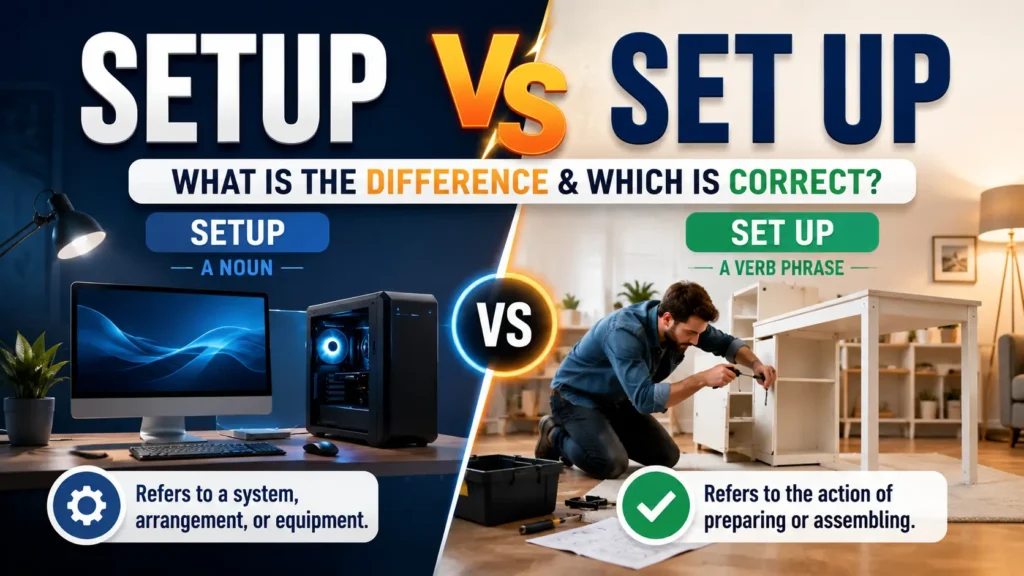

Setup vs set up is a common English grammar confusion because the two forms look almost identical but perform different jobs. Setup is usually a noun describing an arrangement, configuration, or preparation, while set up is a verb meaning to arrange, establish, or prepare something. Knowing this simple distinction helps you write clearer emails, instructions, essays, and everyday messages.
Comparison Overview
The difference between setup and set up mainly comes down to grammar and function.
Although both expressions relate to arranging or preparing something, they aren’t interchangeable in a sentence.
- Setup = usually a noun.
- Set up = a phrasal verb.
- Setup names an arrangement, configuration, or preparation.
- Set up describes the action of arranging, preparing, installing, or establishing something.
- You can often test the difference by asking, “Am I naming a thing or describing an action?”
For example:
The setup took an hour.
Here, setup names the arrangement or preparation.
We need to set up the equipment.
Here, set up describes the action of preparing the equipment.
Major dictionaries support this distinction. Merriam-Webster lists setup as a noun and set up as a verb, while Cambridge defines setup as an arrangement or the process that prepares an arrangement.
| Feature | Setup | Set up |
| Main grammatical role | Noun | Verb |
| Basic meaning | Arrangement or configuration | Arrange or prepare |
| Number of words | One | Two |
| Example | The setup is simple. | Please set up the system. |
| Can take a direct object? | No, not as a noun | Yes, often |
| Refers to an action? | Usually no | Yes |
| Refers to an arrangement? | Yes | No, it performs the action |
The easiest rule is:
You set something up, but you have a setup.
Definition of Setup
Setup is generally a noun that refers to an arrangement, configuration, preparation, or the way something has been organized.
Merriam-Webster defines setup as, among other things, the preparation and adjustment of a machine, or the assembly and arrangement of equipment needed for an operation. Cambridge similarly defines it as an arrangement that allows something to happen or the process of preparing that arrangement.
What Does Setup Mean?
The noun setup can describe several related ideas:
- An arrangement of equipment.
- A configuration of technology.
- The organization of a room.
- The preparation for an event.
- The structure of a system.
- A particular situation or arrangement.
- A planned situation designed for a purpose.
- In some contexts, a trick or deliberately arranged situation.
For example:
The office setup is comfortable.
The word setup refers to the overall arrangement of the office.
Another example:
My new computer setup includes two monitors.
Here, setup means the complete arrangement of the computer equipment.
Setup as a Noun
Because setup is a noun, it can appear in positions where nouns normally appear.
Subject:
The setup looks professional.
Object:
I like your setup.
After a determiner:
This setup works well.
After an adjective:
We have a simple setup.
Plural:
The company tested several different setups.
This noun usage is especially common in technology, business, photography, gaming, science, education, and event planning.
Definition of Set Up
Set up is a phrasal verb. It means to arrange, prepare, assemble, establish, install, or put something into a particular position or condition.
Merriam-Webster lists several meanings for set up, including assembling equipment, putting a machine into readiness, creating accounts, establishing organizations, and arranging situations.
What Does Set Up Mean?
The verb set up can mean:
- To assemble something.
- To prepare something for use.
- To arrange equipment.
- To establish a business or organization.
- To create an account.
- To organize an event.
- To install something.
- To place something in position.
- To arrange a meeting.
- To create a situation.
For example:
We need to set up the projector.
Here, set up describes an action.
Another example:
They set up a new business.
Here, set up means established.
Set Up as a Verb
Because set up is a verb, it changes according to tense and subject.
Present:
I set up the equipment every morning.
Third person singular:
She sets up the classroom.
Past:
We set up the system yesterday.
Present participle:
They are setting up the stage.
Notice something important: even though the tense changes, the basic spelling remains separated.
- set up
- sets up
- set up
- setting up
You don’t normally write setup when you’re using the expression as the verb.
Main Differences Between Setup and Set Up
The most important difference is noun versus verb.
Setup Names the Arrangement
Use setup when you’re talking about the arrangement itself.
The setup is ready.
You’re naming the arrangement.
Your office setup looks excellent.
Again, you’re talking about the arrangement.
Set Up Describes the Action
Use set up when someone performs the action of arranging or preparing something.
Please set up the projector.
Someone needs to act.
We will set up the chairs before the meeting.
The phrase describes what someone will do.
Setup Can Describe a Finished Result
Consider:
The computer setup is impressive.
The sentence describes the resulting arrangement.
Compare that with:
I need to set up my computer.
This sentence describes the action required to create that arrangement.
Set Up Can Mean Establish
The verb isn’t limited to physical objects.
They set up a new company.
She set up an online store.
We set up a meeting.
The school set up a scholarship program.
In each case, set up means to establish or arrange something.
Setup Can Describe a System
The noun frequently appears in technical and professional contexts.
The network setup is complicated.
Our studio setup includes three cameras.
The laboratory setup requires careful calibration.
In these examples, setup refers to the arrangement or configuration.
Setup Vs Set Up in Different Contexts
The distinction becomes easier when you see how these words behave in different fields.
Technology
Technology provides some of the clearest examples.
I need to set up my new laptop.
Here, set up is an action.
My laptop setup has two external monitors.
Here, setup describes the arrangement.
Business
The same rule applies to organizations and meetings.
We need to set up a meeting.
The meeting setup was efficient.
The first sentence describes an action; the second describes an arrangement.
Events
The staff will set up the tables.
The table setup looked elegant.
Photography
The photographer will set up the lights.
The lighting setup was perfect.
Education
The teacher set up the experiment.
The laboratory setup included five stations.
Gaming
I want to set up my new gaming computer.
His gaming setup has a large monitor and mechanical keyboard.
This noun-versus-verb distinction remains consistent across these contexts.
Setup Vs Set Up in American and British English
There is an additional spelling detail worth knowing.
In American English, the noun is generally written as setup.
In British English, you may also encounter the noun written as set-up.
Merriam-Webster specifically notes that the noun is usually a solid compound, setup, in American English and often set-up in British English. The verb set up, however, is normally written as two words in both varieties.
So you may encounter:
- American English: setup — noun
- British English: setup or set-up — noun, depending on style
- American English: set up — verb
- British English: set up — verb
For most general-purpose writing, especially when following American English conventions, setup for the noun and set up for the verb provide the clearest distinction.
Grammar Guide
Understanding the grammar behind these expressions makes the difference much easier to remember.
How Each Term Is Used in Sentences
Setup as a noun
The basic pattern is:
Determiner + setup
The setup is ready.
Adjective + setup
We have a professional setup.
Possessive + setup
Her setup is impressive.
Plural noun
The technicians tested several setups.
You can also use setup after prepositions:
We discussed the setup of the laboratory.
He was happy with the setup.
Set up as a verb
A common pattern is:
Subject + set up + object
I set up the computer.
Another pattern is:
Subject + set up + object + for someone
She set up the account for me.
You can also separate the verb and particle when the object is a pronoun:
Please set it up.
Not:
Please set up it.
With a noun object, both positions can sometimes occur:
Set up the printer.
Set the printer up.
However, with a pronoun, the separation is required:
Set it up.
Common Mistakes Learners Make
Mistake: “I will setup the computer.”
This uses the noun where a verb is required.
Correct:
I will set up the computer.
Mistake: “The setup of the office was completed yesterday.”
This sentence is actually correct because setup functions as a noun.
Mistake: “Please complete the set up.”
In many contexts, if you’re naming the arrangement or preparation, use:
Please complete the setup.
Mistake: “We need to setup a meeting.”
Correct:
We need to set up a meeting.
Mistake: “The team will setup the equipment.”
Correct:
The team will set up the equipment.
Mistake: “I like how you set up.”
This can be grammatically correct when set up is being used as a verb, but if you’re referring to the arrangement, you probably mean:
I like your setup.
Simple Rules to Remember
Here are the easiest rules:
Rule 1: Action = set up
We will set up the room.
Rule 2: Arrangement = setup
The room setup looks great.
Rule 3: You can “set something up.”
I will set the printer up.
Rule 4: You can “have a setup.”
I have a new office setup.
Rule 5: “Setting” always uses the verb form.
We are setting up the equipment.
Never:
We are setting setup the equipment.
Quick Tips for Writing and Speaking
- If you can replace the word with arrangement, choose setup.
- If you can replace it with arrange, choose set up.
- If someone acts, use set up.
- If you’re naming the result or configuration, use setup.
- In instructions, set up is usually the form you need.
- In phrases such as computer setup, office setup, and camera setup, use the noun setup.
- Remember: You set up a setup.
- Don’t rely only on pronunciation because both forms sound essentially the same.
- Look at the grammatical job the expression performs in the sentence.
When to Use Each One
Use “Setup” When You Mean an Arrangement
Choose setup when you’re referring to the way something is organized or configured.
The studio setup is impressive.
The network setup needs improvement.
I like the current desk setup.
Use “Setup” When You Mean Preparation as a Noun
You can also use the noun for the preparation or arrangement process.
The setup took three hours.
Computer setup can sometimes be complicated.
The event setup starts at noon.
Use “Set Up” When You Mean Arrange Something
We need to set up the chairs.
Use “Set Up” When You Mean Establish Something
They set up a new company.
Use “Set Up” When You Mean Prepare Equipment
Please set up the camera before the presentation.
Use “Set Up” When You Mean Create an Account
I need to set up an account.
Use “Set Up” When You Mean Arrange a Meeting
Let’s set up a meeting for Friday.
Merriam-Webster includes establishing accounts, schools, businesses, and other arrangements among the meanings of the verb set up.
When NOT to Use Each One
Don’t Use “Setup” as the Main Verb
Avoid:
I will setup the printer.
Use:
I will set up the printer.
Don’t Use “Set Up” as the Noun in Standard American English
Avoid:
I like your set up.
Use:
I like your setup.
In British English, set-up can occur as a noun, but set up remains the standard verb form.
Don’t Confuse an Action With Its Result
Compare:
We need to set up the equipment.
with:
The equipment setup is complicated.
The first sentence describes the action. The second describes the arrangement.
Don’t Automatically Join the Words
Not every occurrence of set and up should become setup.
We need to set up a meeting.
The verb requires two words.
Which One to Use (Decision Guide)
Use this quick decision process.
Ask: Is It an Action?
If yes, use set up.
Can you set up the projector?
Ask: Is It an Arrangement?
If yes, use setup.
The projector setup is simple.
Ask: Can You Replace It With “Arrange”?
If yes, use set up.
We need to arrange the room.
Therefore:
We need to set up the room.
Ask: Can You Replace It With “Arrangement”?
If yes, use setup.
The arrangement is unusual.
Therefore:
The setup is unusual.
Quick Decision Chart
| If you mean… | Use |
| Arrange something | set up |
| Prepare something | set up |
| Establish something | set up |
| Install something | set up |
| Create an account | set up |
| Organize a meeting | set up |
| Arrangement | setup |
| Configuration | setup |
| Organization | setup |
| Prepared system | setup |
| Equipment arrangement | setup |
| Overall situation | setup |
Real-World Practical Examples
Setup Examples
- Education: The classroom setup allows students to work in small groups.
- Daily life: I like the new furniture setup in the living room.
- Science: The laboratory setup includes sensors, cables, and monitoring equipment.
- Business: Our office setup supports both individual and team work.
- Writing: The story’s opening setup introduces the main conflict.
- Technology: My computer setup includes two monitors and a docking station.
- Photography: The lighting setup created a softer image.
- Gaming: His gaming setup includes a high-resolution display.
- Conversation: “That’s a nice setup you have here.”
- Events: The wedding setup looked elegant.
Set Up Examples
- Education: The teacher will set up the science experiment.
- Daily life: I need to set up my new desk.
- Science: Researchers set up the equipment before collecting data.
- Business: The company plans to set up a new branch.
- Writing: The first chapter sets up the conflict for the rest of the novel.
- Technology: Please set up the software before using it.
- Photography: We need to set up the lights before the guests arrive.
- Gaming: I’m going to set up my new console tonight.
- Conversation: “Can you set up a meeting with the manager?”
- Events: The staff will set up the chairs before noon.
Self-Assessment (Fill in the Blanks)
Complete each sentence with setup or set up.
- I need to ______ my new computer before work begins.
- The office ______ includes several standing desks.
- Can you ______ the projector for the presentation?
- We were impressed by the laboratory ______.
- The company plans to ______ a new training center.
- Her gaming ______ includes three monitors.
- The staff will ______ the tables before the guests arrive.
- The camera ______ produced excellent results.
- I need help with the initial ______ of the software.
- They want to ______ an online account.
- The classroom ______ encourages group discussion.
- Please ______ the microphone before the event.
- His home office ______ is simple but effective.
- The technician will ______ the network equipment.
- The event ______ took most of the morning.
- We should ______ a meeting with the client.
- The experimental ______ requires careful monitoring.
- She helped me ______ my new phone.
- The current desk ______ gives me more workspace.
- The organization plans to ______ a scholarship program.
Answers
- set up — It describes the action of preparing the computer.
- setup — It refers to the arrangement of the office.
- set up — It describes the action of preparing the projector.
- setup — It names the laboratory arrangement.
- set up — It means establish or create.
- setup — It refers to the arrangement of gaming equipment.
- set up — It describes the action of arranging the tables.
- setup — It refers to the arrangement of the camera equipment.
- setup — It functions as a noun referring to preparation.
- set up — It means create or establish an account.
- setup — It names the classroom arrangement.
- set up — It describes the action of preparing the microphone.
- setup — It refers to the arrangement of the home office.
- set up — It describes the technician’s action.
- setup — It refers to the preparation or arrangement for the event.
- set up — It means arrange a meeting.
- setup — It describes the arrangement of the experiment.
- set up — It describes the action of preparing the phone.
- setup — It refers to the desk arrangement.
- set up — It means establish or create the program.
Final Verdict
The difference between setup and set up is simple once you identify their grammatical roles. Setup is generally a noun that refers to an arrangement, configuration, preparation, or situation. Set up is a verb that means to arrange, prepare, establish, install, or create something.
The easiest rule to remember is:
You set something up, but you have a setup.
For example:
I need to set up my computer.
My computer setup is excellent.
So, when you’re describing an action, choose set up. When you’re naming an arrangement or configuration, choose setup. This distinction works across technology, business, education, science, events, writing, and everyday conversation. Merriam-Webster and Cambridge both support the core noun-versus-verb distinction.
Conclusion
Understanding Setup Vs Set Up becomes much easier once you remember their grammatical roles. Setup is usually a noun or adjective that describes an arrangement, configuration, or prepared system. For example, you might talk about your desk setup or a setup process. Set up, on the other hand, is a verb phrase that means to arrange, organize, install, or establish something. You might set up a computer, set up an account, or set up a meeting.
The simplest way to remember the difference is to look at what the word is doing in the sentence. If you’re naming an arrangement, setup is often correct. If you’re describing an action, choose set up. Once you recognize this pattern, choosing between setup and set up becomes quick and natural. With regular practice, you’ll avoid this common grammar mistake and write with greater confidence.
FAQs
What is the difference between setup and set up?
Setup is generally a noun or adjective referring to an arrangement, configuration, or system. Set up is a verb phrase describing the action of arranging, installing, organizing, or establishing something. For example, “The office setup is convenient” uses setup as a noun, while “I will set up the office” uses set up as a verb.
Is setup one word or two words?
Setup is one word when it functions as a noun or adjective. For example, “Your gaming setup looks impressive” uses the one-word form. When you’re describing an action, use set up as two words. For example, “Please set up the equipment before the event.” The correct form depends on its grammatical function in the sentence.
Is set up a verb?
Yes, set up is a verb phrase. It means to arrange, prepare, install, organize, or establish something. For example, “She will set up the new computer tomorrow.” Because it describes an action, it normally appears as two separate words when used as a verb.
When should I use setup?
Use setup when you’re referring to an arrangement, configuration, system, or prepared environment. For example, “The conference room has a simple setup.” It can also work as an adjective in expressions such as “setup instructions.” If you can treat the word as a thing or description rather than an action, setup is usually appropriate.
When should I use set up?
Use set up when you’re describing the action of preparing, arranging, installing, or establishing something. For example, “We need to set up the projector before the presentation.” A useful test is to replace the phrase with another action verb such as “arrange” or “prepare.” If that works, set up is likely the correct choice.
Is setup a noun or a verb?
Setup is primarily used as a noun and can also function as an adjective before another noun. It is not normally used as the standard verb form. For example, “The setup took an hour” uses setup as a noun. For the action, write “They set up the equipment,” using two words.
Can setup be used as an adjective?
Yes, setup can be used as an adjective when it modifies a noun, particularly in compound expressions. For example, “setup instructions” refers to instructions for preparing or configuring something. In many cases, however, wording varies by style guide and context. The key distinction remains that setup is not the standard form when it functions as the verb itself.
Which is correct: “I will setup” or “I will set up”?
The correct form is “I will set up.” Here, the phrase follows the auxiliary verb “will” and functions as an action verb. For example, “I will set up the meeting tomorrow.” Writing “I will setup” is incorrect in standard English because setup is normally a noun or adjective, not the verb form.
Which is correct: “The setup is ready” or “The set up is ready”?
“The setup is ready” is correct when you mean an arrangement, configuration, or prepared system. For example, “The computer setup is ready.” Since setup acts as a noun in this sentence, it appears as one word. The two-word form set up is used when describing an action, such as “They set up the computer.”
How can I remember the difference between setup and set up?
A simple trick is to think “setup is a thing, set up is an action.” If you’re naming an arrangement or configuration, use setup. If you’re describing someone arranging or preparing something, use set up. For example, “I like your setup” names an arrangement, while “I’ll set up the equipment” describes an action.
