
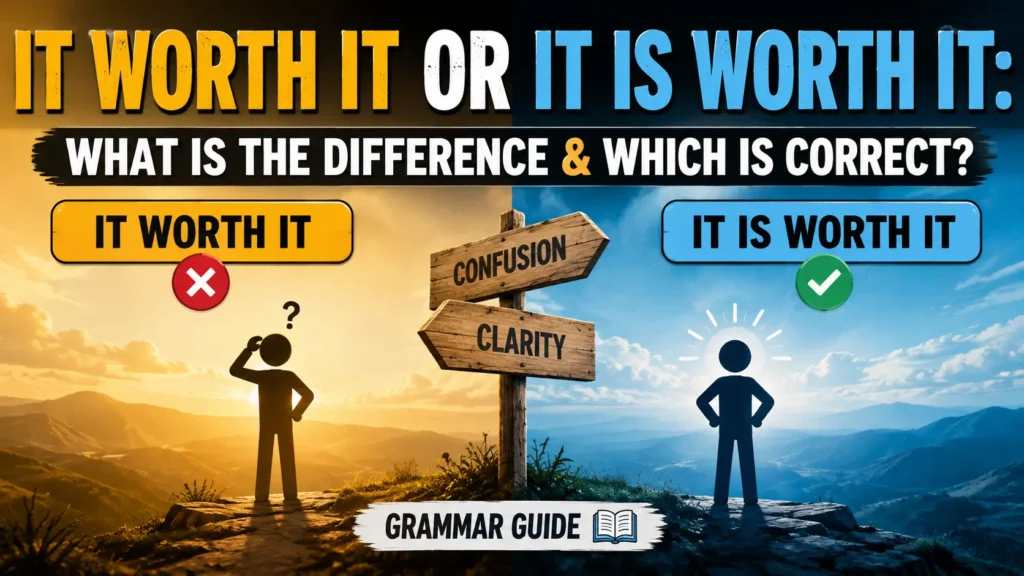

“It worth it” and “it is worth it” may look like two versions of the same phrase, but only one is grammatically complete in standard English. The confusion usually comes from dropping the verb is in casual speech or writing. Learning when to use the complete expression will help you sound clearer and more natural in English.
Comparison Overview
The expressions “it worth it” and “it is worth it” are not equal in standard English.
The correct complete expression is:
“It is worth it.”
The shortened form:
“It worth it.”
is generally grammatically incorrect in standard English.
The problem is simple: worth is not functioning as the main verb in the expression. The sentence needs a linking verb, is, before the adjective worth.
Compare:
❌ “It worth it.”
✅ “It is worth it.”
You can also use the contraction:
✅ “It’s worth it.”
This is extremely common in everyday English.
The expression worth it means that something is valuable, useful, beneficial, or deserving of the time, money, effort, or difficulty involved.
| Expression | Correct? | Explanation |
| It worth it | ❌ Generally incorrect | Missing the verb is |
| It is worth it | ✅ Correct | Complete grammatical structure |
| It’s worth it | ✅ Correct | Contraction of “it is” |
| Is it worth it? | ✅ Correct | Correct question form |
| It was worth it | ✅ Correct | Correct past-tense form |
| It will be worth it | ✅ Correct | Correct future form |
So, if you’re choosing between the two expressions, “it is worth it” is the correct standard form.
Definition of It Worth It
“It worth it” is an incomplete and generally incorrect sentence in standard English.
The main problem is the missing form of the verb be.
English sentences usually require a properly conjugated verb. In:
“It is worth it.”
the word is connects the subject it with the complement worth it.
Without is, the sentence becomes:
❌ “It worth it.”
The phrase may occasionally appear in informal online writing, speech transcriptions, learner errors, or contexts where words have been accidentally omitted. However, it shouldn’t be used in careful standard English.
Why “It Worth It” Sounds Wrong
Consider the structure:
It + is + worth + it
Each part has a role:
- It = subject
- is = linking verb
- worth = adjective
- it = complement referring to the thing being evaluated
Remove is, and the sentence loses its required verb:
❌ It worth it.
This is why “it worth it” is not the standard grammatical form.
Definition of It Is Worth It
“It is worth it” is a complete and grammatically correct expression meaning that something is valuable enough to justify the cost, effort, time, risk, or difficulty involved.
For example:
“The course is expensive, but it is worth it.”
This means the benefits of the course justify its cost.
You can also use the contraction:
“The course is expensive, but it’s worth it.”
Both forms are correct.
What Does “Worth It” Mean?
The expression can refer to many kinds of value.
Something may be worth it because it provides:
- Money or financial value
- Personal satisfaction
- Educational benefits
- Professional opportunities
- Better results
- Convenience
- Enjoyment
- Long-term benefits
- Improved skills
- A meaningful experience
For example:
“The journey was exhausting, but it was worth it.”
The speaker means the experience or result justified the effort.
Main Differences Between It Worth It and It Is Worth It
The difference is primarily grammatical completeness.
“It Worth It” Is Missing a Verb
English requires a suitable verb in this construction.
❌ “It worth it.”
There is no properly conjugated verb.
“It Is Worth It” Is Grammatically Complete
✅ “It is worth it.”
Here, is functions as the linking verb.
The structure is:
Subject + linking verb + complement
It + is + worth it.
“It’s Worth It” Is Also Correct
In conversational English, you will often hear:
“It’s worth it.”
It’s is the contraction of it is.
Therefore:
“It is worth it.”
and:
“It’s worth it.”
have the same basic meaning.
The Difference in Formality
It is worth it is slightly more formal and explicit.
It’s worth it is more conversational and natural in everyday speech.
Neither is grammatically wrong.
Why “Worth” Needs “Is” in This Sentence
One of the biggest reasons learners make this mistake is that worth can behave differently from ordinary adjectives.
For example:
“It is useful.”
“It is expensive.”
“It is difficult.”
Similarly:
“It is worth it.”
The linking verb is connects it to the description that follows.
Although worth has some unusual grammatical properties, in the construction be worth, the verb be is essential.
That’s why you should remember:
It is worth it.
not:
❌ It worth it.
Grammar Guide
It is worth it is a grammatical construction containing a subject, a form of be, and the expression worth it.
How Each Term Is Used in Sentences
It Is Worth It
The basic structure is:
It + is + worth + it
“It is worth it.”
You can expand the sentence:
“The extra cost is worth it.”
“The long wait is worth it.”
“The extra effort is worth it.”
You can also place a reason or condition around it:
“Although the trip is expensive, it is worth it.”
It’s Worth It
The contraction follows the same grammatical structure:
It’s + worth + it
“It’s worth it.”
“It’s definitely worth it.”
“I think it’s worth it.”
This form is especially natural in conversation.
Is It Worth It?
For questions, invert the subject and verb:
Is + it + worth + it?
“Is it worth it?”
You can add more information:
“Is it worth it to buy the premium version?”
“Is it worth it to wait?”
“Is the extra cost worth it?”
It Was Worth It
For past situations:
“It was worth it.”
Example:
“The trip took ten hours, but it was worth it.”
It Will Be Worth It
For future situations:
“It will be worth it.”
Example:
“Keep practicing. It will be worth it.”
Common Mistakes Learners Make
Mistake 1: Leaving Out “Is”
❌ “It worth it.”
✅ “It is worth it.”
This is the most important error to avoid.
Mistake 2: Saying “It Is Worth”
Sometimes learners stop after worth.
❌ “The price is worth.”
Usually, you need to specify what the price is worth or use worth it:
✅ “The price is worth it.”
or:
✅ “The course is worth the money.”
Mistake 3: Confusing “Worth It” With “Worthwhile”
Both can express value, but their grammar differs.
“The trip is worth it.”
“The trip is worthwhile.”
Don’t automatically substitute one structure for the other.
Mistake 4: Confusing “Worth It” With “Worth Of”
The correct expression is:
“It is worth the money.”
not:
❌ “It is worth of the money.”
Simple Rules to Remember
Remember these rules:
- It worth it → incorrect in standard English.
- It is worth it → correct.
- It’s worth it → correct contraction.
- Is it worth it? → correct question.
- It was worth it → correct past form.
- It will be worth it → correct future form.
- Use be + worth when describing value.
Quick Tips for Writing and Speaking
If you’re writing formally, use:
“It is worth it.”
If you’re speaking naturally, use:
“It’s worth it.”
If you’re asking a question:
“Is it worth it?”
If you’re talking about the past:
“It was worth it.”
If you’re talking about the future:
“It will be worth it.”
The easiest pattern to memorize is:
is + worth it
Once you remember that combination, the error becomes much easier to avoid.
When to Use Each One
Use “It Is Worth It”
Use it is worth it when you want to say that an experience, purchase, decision, effort, or sacrifice provides enough value to justify what you invested.
Examples:
“The training is difficult, but it is worth it.”
“The extra money is worth it.”
“The wait is worth it.”
“Learning another language is worth it.”
Use “It’s Worth It”
Use it’s worth it in conversational or informal writing.
“Trust me, it’s worth it.”
“The restaurant is expensive, but it’s worth it.”
“Give it a try. It’s worth it.”
Use “It Was Worth It”
Use this when discussing something that already happened.
“The long journey was worth it.”
Use “It Will Be Worth It”
Use this for future situations.
“The hard work will be worth it.”
When NOT to Use Each One
Do Not Use “It Worth It” in Standard English
Avoid:
❌ “It worth it.”
Instead, use:
✅ “It is worth it.”
or:
✅ “It’s worth it.”
Don’t Drop “Is” Because the Sentence Sounds Short
Some learners may think that because worth it already expresses the idea of value, the verb isn’t necessary.
But English still needs the linking verb:
“It is worth it.”
The word is isn’t optional.
Don’t Use “It Is Worth It” When You Need a More Specific Object
Sometimes you need to say exactly what something is worth.
For example:
“The painting is worth $5,000.”
“The course is worth the money.”
“The experience is worth the effort.”
In these sentences, worth is followed by the specific value rather than simply it.
Is “It Worth It” Ever Acceptable?
In standard English, “it worth it” is generally not acceptable as a complete sentence.
You may encounter it online because of:
- Typing errors
- Missing words
- Informal posts
- Non-native English
- Speech-to-text mistakes
- Search queries
- Deliberately shortened language
But seeing a phrase online doesn’t make it grammatically standard.
For formal writing, academic work, professional communication, and polished content, use:
It is worth it.
or:
It’s worth it.
“Worth It” vs “Worthwhile”
These expressions are related but grammatically different.
Worth It
“The experience was worth it.”
Here, worth it evaluates whether something justified the effort, cost, or difficulty.
Worthwhile
“The experience was worthwhile.”
Worthwhile is an adjective meaning valuable or beneficial enough to justify the effort.
Both can be correct:
“The course is worth it.”
“The course is worthwhile.”
However, don’t write:
❌ “The course worth it.”
The verb is is still required.
Which One to Use (Decision Guide)
Choosing the correct form is easy once you identify the grammatical structure.
| What you want to say | Correct form |
| Present value | It is worth it. |
| Conversational present | It’s worth it. |
| Ask about value | Is it worth it? |
| Past value | It was worth it. |
| Future value | It will be worth it. |
| Incorrect shortened form | ❌ It worth it. |
If You’re Making a Statement
Use:
It is worth it.
or:
It’s worth it.
If You’re Asking a Question
Use:
Is it worth it?
If You’re Talking About the Past
Use:
It was worth it.
If You’re Talking About the Future
Use:
It will be worth it.
If You’re Writing Formally
Prefer:
It is worth it.
If You’re Speaking Casually
Use:
It’s worth it.
Real-World Practical Examples
It Worth It Examples
Because “it worth it” is not a standard grammatical construction, these examples show incorrect usage and their corrected versions.
Education
❌ “It worth it to study every day.”
✅ “It is worth it to study every day.”
Daily Life
❌ “The long drive worth it.”
✅ “The long drive is worth it.”
Business
❌ “The investment worth it.”
✅ “The investment is worth it.”
Technology
❌ “The upgrade worth it.”
✅ “The upgrade is worth it.”
Conversation
❌ “Trust me, it worth it.”
✅ “Trust me, it’s worth it.”
Writing
❌ “The effort worth it in the end.”
✅ “The effort is worth it in the end.”
The lesson in every example is the same: add the appropriate form of “be.”
It Is Worth It Examples
Education
“Studying for the exam is difficult, but it is worth it.”
The effort produces a valuable result.
Daily Life
“The extra hour of sleep is worth it.”
The benefit justifies the choice.
Business
“The additional training is expensive, but it is worth it.”
The benefits justify the cost.
Technology
“The premium software is costly, but it is worth it for our team.”
The software provides enough value to justify its price.
Travel
“The long flight was exhausting, but it was worth it.”
The experience justified the difficulty.
Writing
“Editing the article carefully is time-consuming, but it is worth it.”
The improved quality justifies the effort.
Conversation
“Should I wait for the next sale?”
“Yes, I think it’s worth it.”
This is a natural conversational use.
Self-Assessment (Fill in the Blanks)
Complete each sentence with the correct form: it worth it, it is worth it, it’s worth it, or another appropriate form where necessary.
- I will use ______ when making a grammatically complete statement about present value.
- I will use ______ when speaking casually about whether something provides enough benefit.
- I will use ______ when asking whether a purchase is valuable enough to justify its cost.
- I will use ______ when describing something that justified an effort in the past.
- I will use ______ when referring to a future benefit.
- I will use ______ rather than “it worth it” in standard English.
- I will use ______ when writing a formal sentence about the value of an experience.
- I will use ______ when saying, “Trust me, ______.”
- I will use ______ when saying that a difficult journey justified the effort afterward.
- I will use ______ when asking, “Is this expensive course valuable enough?”
- I will use ______ when explaining that daily practice provides enough benefit to justify the effort.
- I will use ______ when correcting the sentence “It worth it.”
- I will use ______ when talking about an investment that is currently beneficial.
- I will use ______ when describing a future result that will justify today’s hard work.
- I will use ______ when writing a professional email and avoiding contractions.
- I will use ______ when speaking naturally with a friend about a restaurant.
- I will use ______ when discussing whether a long wait justified a previous decision.
- I will use ______ when explaining that the course is valuable enough to justify its price.
- I will use ______ when asking whether something is worth the time required.
- I will use ______ because “it worth it” is missing a necessary linking verb.
Answers
- It is worth it — it is the complete standard form for a present statement.
- It’s worth it — this contraction is natural in casual conversation.
- Is it worth it? — this is the correct question structure.
- It was worth it — “was” expresses past value.
- It will be worth it — “will be” expresses future value.
- It is worth it — standard English requires the linking verb “is.”
- It is worth it — the full form works well in formal writing.
- It’s worth it — “it’s” is the contraction of “it is.”
- It was worth it — the sentence refers to a completed past experience.
- Is it worth it? — this asks whether something provides enough value.
- It is worth it — the phrase describes present value or benefit.
- It is worth it — adding “is” makes the construction grammatically complete.
- It is worth it — the investment is being evaluated in the present.
- It will be worth it — the value is expected in the future.
- It is worth it — the full form is appropriate for formal writing.
- It’s worth it — the contraction sounds natural in casual conversation.
- It was worth it — the decision and its result occurred in the past.
- It is worth it — this expresses that the course justifies its price.
- Is it worth it? — this is the correct question form.
- It is worth it — the original phrase is missing the necessary verb “is.”
Final Verdict
When comparing “it worth it” and “it is worth it,” the answer is straightforward: “it is worth it” is the grammatically correct standard form. The phrase “it worth it” is missing the linking verb is, so it should not be used in polished English.
You can also use “it’s worth it,” which is simply the contraction of “it is worth it” and is extremely natural in everyday speech and informal writing. For questions, use “Is it worth it?” For past situations, say “It was worth it,” and for future situations, use “It will be worth it.”
The easiest rule is to remember be + worth it. Once you recognize that structure, you can confidently use the phrase in conversations, essays, professional writing, reviews, and everyday English. When in doubt, choose “It is worth it.”
Conclusion
Choosing between “It Worth It” and “It Is Worth It” becomes much easier once you understand the basic grammar behind the phrase. In standard English, “It is worth it” is the grammatically complete form because the sentence needs the linking verb “is.” In everyday conversation, you’ll also commonly hear the contraction “It’s worth it,” which is equally correct and natural.
The phrase “It worth it” is generally incorrect when used as a complete sentence because it leaves out the necessary verb. Whether you’re writing an email, creating an article, speaking with someone, or answering a question, “It is worth it” is the safest choice. Once you recognize this simple pattern, you can use the expression confidently and naturally in both formal and casual situations.
FAQs
Is “It Worth It” grammatically correct?
No, “It worth it” is generally not grammatically correct as a complete sentence in standard English. The phrase needs the linking verb “is” before “worth.” Therefore, the correct form is “It is worth it.” In casual speech and writing, you can also use “It’s worth it,” which is simply the contraction of “it is.”
Is “It Is Worth It” correct English?
Yes, “It is worth it” is completely correct English. It means that something has enough value, benefit, or usefulness to justify the time, money, effort, or difficulty involved. For example, you might say, “The course is expensive, but it is worth it.” The phrase works naturally in both spoken and written English.
Is “It’s worth it” the same as “It is worth it”?
Yes. “It’s worth it” and “It is worth it” have the same meaning. The difference is mainly in style and formality. “It’s worth it” sounds more conversational and is common in everyday speech, while “It is worth it” can sound slightly more formal or emphatic. Both forms are grammatically correct.
Why is “It Worth It” incorrect?
“It worth it” is incorrect because the sentence is missing the verb “is.” The word “worth” functions as an adjective in this structure, so it needs a linking verb. Compare “It worth it” with “It is worth it.” The second sentence contains the complete grammatical structure needed to express the idea clearly.
Should I say “It is worth it” or “It’s worth it”?
Both are correct, so your choice depends on the situation. Use “It’s worth it” for natural conversation, casual messages, and friendly writing. Choose “It is worth it” when you want a more formal, deliberate, or emphatic tone. The meaning remains essentially the same in both versions.
Can I use “It is worth it” in formal writing?
Yes, “It is worth it” is appropriate in formal writing when the context calls for that meaning. However, whether the phrase itself fits depends on your subject and audience. In academic or professional writing, you may sometimes prefer a more specific expression, such as “The benefits justify the cost” or “The investment provides sufficient value.”
What does “It is worth it” mean?
“It is worth it” means that something provides enough benefit or value to justify what you must spend, experience, or sacrifice to obtain it. The “cost” could involve money, time, effort, inconvenience, or difficulty. For example, “The long trip was exhausting, but it was worth it” means the positive result justified the effort.
Is “It’s worth it” informal?
“It’s worth it” is conversational and natural, but it isn’t grammatically incorrect or unsuitable for every type of writing. Contractions are common in modern English, especially in friendly and general-purpose communication. For highly formal writing, you may prefer “It is worth it” simply because avoiding contractions can create a more formal tone.
Which is correct: “It worth it” or “It is worth it”?
The correct standard-English expression is “It is worth it.” You can also shorten it to “It’s worth it.” The version “It worth it” is missing the verb “is,” making it grammatically incomplete as a standalone sentence. Remembering the simple pattern subject + linking verb + adjective can help you avoid this common mistake.
How can I remember the correct form?
A simple way to remember the correct form is to ask whether your sentence contains a verb after “it.” In “It is worth it,” the word “is” connects the subject “it” with the adjective “worth.” You can also remember that “It’s” means “it is,” so “It’s worth it” is another correct option.
