
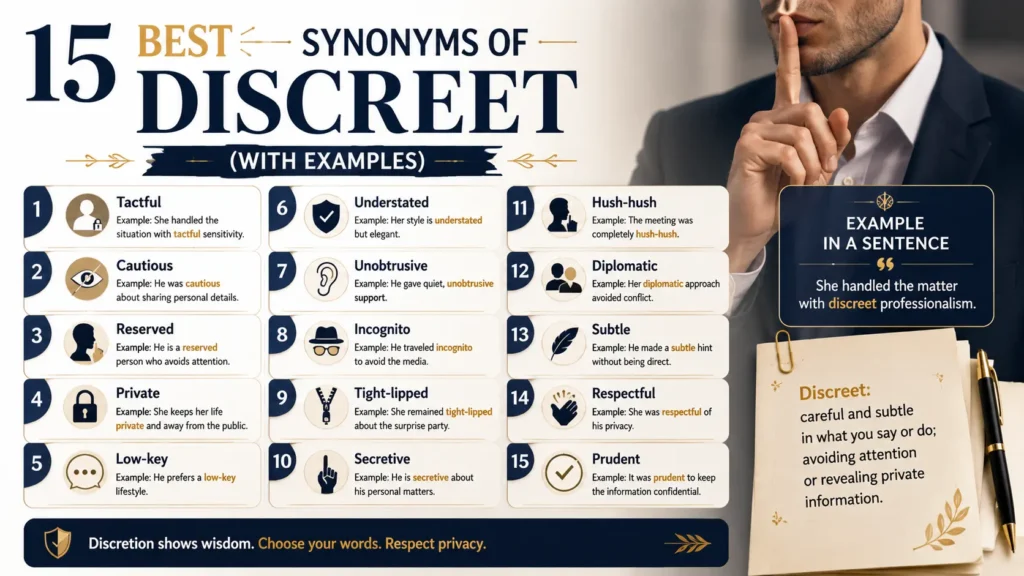

15 Best Synonyms of “Discreet” helps you describe careful, respectful, and tactful behavior with greater clarity and precision. Choosing the right alternative makes it easier to express trust, sensitivity, and emotional intelligence in both personal and professional communication.
Finding the right word to describe someone discreetly can make your writing more thoughtful and meaningful. The following synonyms and related expressions will help you communicate qualities such as confidentiality, respect, good judgment, and quiet understanding naturally and expressively. From experience, using precise language makes it easier to describe considerate behavior without sounding overly direct or harsh, helping your message feel more balanced, respectful, and engaging.
What Does “Discreet” Mean?
The word discreet describes someone careful about what they say or do, especially in order to avoid causing embarrassment, offense, or revealing private information.
In simple terms, discreet means being careful, tactful, and respectful of privacy or sensitive situations.
When to Use “Discreet”
You can use “discreet” when talking about:
- Keeping information private or confidential
- Handling sensitive situations carefully
- Polite and thoughtful communication
- Professional or social etiquette
It is commonly used in both formal and everyday contexts.
Is It Professional or Polite to Say “Discreet”?
Yes, “discreet” is a highly professional and polite word. It is widely used in business, healthcare, law, and personal communication, where confidentiality and tact are important. It is considered respectful and appropriate in most contexts.
Pros and Cons of Using “Discreet”
Pros:
- Professionally appropriate
- Clearly conveys confidentiality
- Respectful and polite tone
- Works in formal and informal settings
Cons:
- Can sound slightly formal in casual speech
- May lack emotional warmth
- Sometimes confused with “discrete” (different meaning)
Discreet Synonyms:
- Tactful
- Careful
- Reserved
- Confidential
- Prudent
- Subtle
- Diplomatic
- Guarded
- Circumspect
- Low-key
- Private
- Respectful
- Sensitive
- Polished
- Silent Professional
Tactful
Meaning:
Careful not to offend others.
Explanation:
Shows sensitivity in communication.
Example:
“She gave a tactful response to the question.”
Best Use:
Social communication
Worst Use:
Technical writing
Tone:
Polite, considerate
Careful
Meaning:
Acting with caution.
Explanation:
Avoids mistakes or harm.
Example:
“He was careful with the information.”
Best Use:
General use
Worst Use:
Formal writing
Tone:
Neutral, simple
Reserved
Meaning:
Quiet and restrained.
Explanation:
Keeps thoughts private.
Example:
“She is reserved in meetings.”
Best Use:
Personality description
Worst Use:
Legal writing
Tone:
Calm, quiet
Confidential
Meaning:
Meant to be kept private.
Explanation:
Focuses on secrecy and trust.
Example:
“This is confidential information.”
Best Use:
Professional settings
Worst Use:
Casual speech
Tone:
Formal, strict
Prudent
Meaning:
Wise and careful.
Explanation:
Shows good judgment.
Example:
“It was prudent to stay silent.”
Best Use:
Formal writing
Worst Use:
Casual talk
Tone:
Thoughtful, wise
Subtle
Meaning:
Not obvious or direct.
Explanation:
Handles things indirectly.
Example:
“She made a subtle suggestion.”
Best Use:
Communication strategies
Worst Use:
Legal documents
Tone:
Gentle, refined
Diplomatic
Meaning:
Skilled in handling people politely.
Explanation:
Avoids conflict through tact.
Example:
“He was diplomatic during the debate.”
Best Use:
Politics, HR
Worst Use:
Informal speech
Tone:
Professional, smooth
Guarded
Meaning:
Careful about sharing information.
Explanation:
Protects personal thoughts.
Example:
“She gave a guarded response.”
Best Use:
Personality analysis
Worst Use:
Friendly conversation
Tone:
Reserved, cautious
Circumspect
Meaning:
Cautious before acting or speaking.
Explanation:
Carefully considers consequences.
Example:
“He was circumspect in his reply.”
Best Use:
Formal writing
Worst Use:
Casual speech
Tone:
Formal, thoughtful
Low-key
Meaning:
Subtle and not attention-seeking.
Explanation:
Keeps things quiet and simple.
Example:
“She kept it low-key.”
Best Use:
Informal speech
Worst Use:
Professional writing
Tone:
Casual, relaxed
Private
Meaning:
Not shared publicly.
Explanation:
Focuses on personal confidentiality.
Example:
“He keeps his life private.”
Best Use:
Everyday speech
Worst Use:
Formal nuance
Tone:
Simple, neutral
Respectful
Meaning:
Showing consideration for others.
Explanation:
Mindful of feelings and boundaries.
Example:
“She was respectful in her tone.”
Best Use:
Communication
Worst Use:
Technical contexts
Tone:
Warm, polite
Sensitive
Meaning:
Aware of feelings and situations.
Explanation:
Handles emotions carefully.
Example:
“He sensitively handled the topic.”
Best Use:
Emotional contexts
Worst Use:
Legal writing
Tone:
Caring, gentle
Polished
Meaning:
Smooth and refined behavior.
Explanation:
Careful and professional presentation.
Example:
“She gave a polished response.”
Best Use:
Professional settings
Worst Use:
Emotional description
Tone:
Elegant, formal
Silent Professional
Meaning:
One who works quietly and carefully.
Explanation:
Modern descriptive phrase.
Example:
“He is a silent professional in negotiations.”
Best Use:
Workplace description
Worst Use:
Academic writing
Tone:
Modern, respectful
Comparison Table of Top Alternatives
| Synonym | Meaning Focus | Tone | Best Use Case |
| Tactful | Careful speech | Polite | Social communication |
| Confidential | Private information | Formal | Business, law |
| Diplomatic | Conflict handling | Professional | Politics, HR |
| Reserved | Quiet personality | Calm | Personality description |
| Prudent | Wise caution | Formal | Decision-making |
| Subtle | Indirect expression | Gentle | Communication strategies |
| Circumspect | Careful judgment | Formal | Academic writing |
| Guarded | Protective behavior | Cautious | Psychological context |
| Sensitive | Emotional awareness | Caring | Emotional discussions |
| Private | Personal secrecy | Neutral | Everyday conversation |
Final Thoughts
Understanding different ways to express discretion helps you communicate with greater sensitivity, respect, and emotional awareness. While simple words like careful, private, or reserved are easy to use in everyday conversation, they may not always capture the deeper sense of tact and thoughtful behavior that “discreet” implies in more meaningful contexts.
On the other hand, more refined alternatives like diplomatic, circumspect, or prudent allow you to express careful judgment and professionalism with clarity. Choosing the right synonym depends on your situation—whether you are describing personality, handling sensitive information, or communicating in a formal environment. The right word always strengthens trust and understanding.
FAQs
What is the simplest synonym of “discreet”?
The simplest synonym of “discreet” is “careful.” It reflects cautious behavior and thoughtful communication. While it is more general, it works well in everyday speech when describing someone who avoids mistakes or handles situations gently.
Is “discreet” a formal word?
Yes, “discreet is a formal and professional word used in business, healthcare, law, and personal communication. It describes careful behavior, especially when handling private or sensitive matters where tact is important.
What is the difference between discreet and discrete?
“Discreet” means careful and tactful, while “discrete” means separate or distinct. They are homophones but have completely different meanings and should not be confused in writing or speech.
Can I use “private” instead of discreet?
Sometimes, “private” can replace “discreet,” especially when referring to confidentiality. However, “private” focuses on secrecy, while “discreet” emphasizes careful behavior and tact in communication or actions.
What is a professional synonym for discreet?
Professional synonyms include “diplomatic,” “circumspect,” and “prudent.” These words are commonly used in formal communication to describe careful judgment and respectful handling of sensitive situations.
Is “tactful” the same as discreet?
Not exactly. “Tactful” refers to careful communication that avoids offense, while “discreet” focuses more on privacy and careful behavior. However, both words are closely related and often overlap in meaning.
When should I avoid using “discreet”?
You should avoid “discreet” in very casual or simple conversations if a more basic word like “careful” is clearer. However, it is generally safe and appropriate in most formal and informal contexts.
What is the difference between discreet and reserved?
“Discreet” refers to careful behavior in handling situations or information, while “reserved” describes a quiet or introverted personality. A reserved person may also be discreet, but the meanings are not identical.
Is “diplomatic” a synonym of discreet?
Yes, “diplomatic” can be a synonym of “discreet” in situations involving communication and conflict handling. It emphasizes tact, politeness, and careful wording to avoid disagreements or offense.
How do I choose the best synonym for discreet?
To choose the best synonym for discreet, consider context and tone. Use “careful” for general use, “private” for confidentiality, and “diplomatic or circumspect” for formal communication. Matching the situation ensures clarity and respect.
