
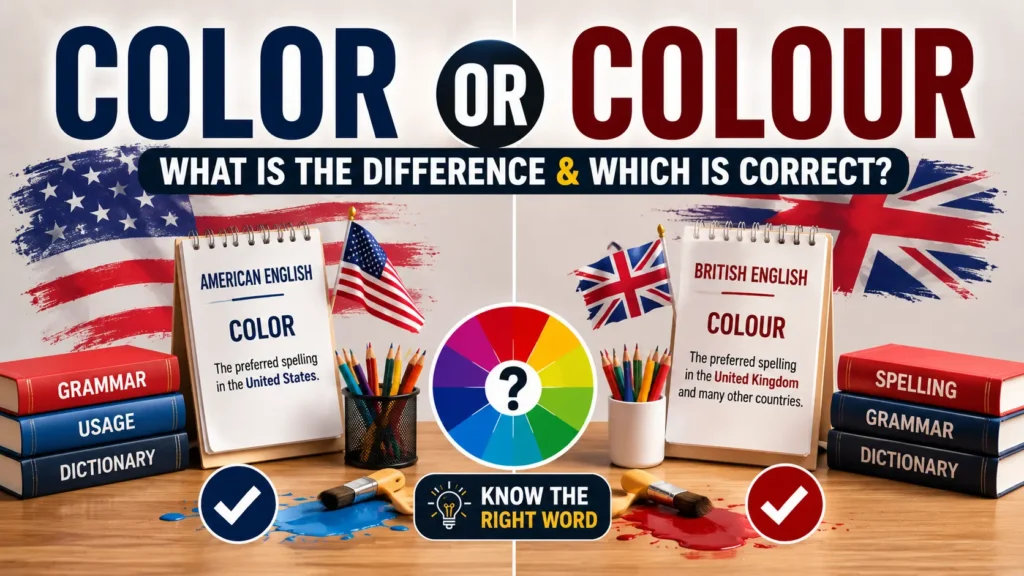

Color and colour have the same meaning, but they reflect different spelling conventions. Color is the standard spelling in American English, while colour is preferred in British English and many other English-speaking countries. Understanding this regional difference helps writers choose the correct form for their audience, location, publication style, or educational requirements.
Comparison Overview
Color and colour are two spellings of the same English word. Both refer to the visual characteristic produced when light interacts with an object and perceived by the eye.
The main difference is regional spelling, not meaning or pronunciation.
| Feature | Color | Colour |
| Meaning | The visual quality of an object | The visual quality of an object |
| Spelling | American English | British English |
| Common in | United States | United Kingdom |
| Also used in | Canada in some contexts, international American-style writing | UK, Australia, New Zealand, and many other regions |
| Pronunciation | Same | Same |
| Part of speech | Noun and verb | Noun and verb |
| Correct? | Yes | Yes |
For example:
What is your favorite color?
What is your favourite colour?
Both sentences are correct. The spelling simply reflects different varieties of English.
Definition of Color
Color is the American English spelling of the word describing the visual appearance or characteristic of something based on how it reflects, absorbs, or emits light.
It can refer to shades such as:
- red
- blue
- green
- yellow
- purple
- orange
- black
- white
For example:
Blue is my favorite color.
As a verb, color can mean to add or change the color of something:
She used crayons to color the picture.
The spelling color is particularly standard in American English.
Definition of Colour
Colour is the British English spelling of the same word.
It has the same meaning and grammatical functions as color. It can describe the visual appearance of something or refer to the act of adding color.
For example:
Blue is my favourite colour.
As a verb:
The children used pencils to colour the drawing.
The spelling colour is standard in British English and is also commonly used in countries and writing systems influenced by British English.
Main Differences Between Color and Colour
The biggest difference between color and colour is spelling.
Regional Difference
Color is associated primarily with American English.
What color is your car?
Colour is associated primarily with British English.
What colour is your car?
The words mean the same thing.
Meaning Difference
There is no difference in meaning between the two spellings.
Both can refer to:
- the appearance of an object
- a particular shade
- artistic use of color
- visual characteristics
- symbolic meanings
- adding pigment to something
Pronunciation Difference
In standard usage, color and colour are pronounced the same way.
The extra u in colour affects spelling, not the usual pronunciation.
Spelling Difference
The difference can be summarized simply:
American English: color
British English: colour
This pattern also appears in several related words:
| American English | British English |
| color | colour |
| colorful | colourful |
| coloring | colouring |
| colored | coloured |
| discolor | discolour |
Color or Colour in American English
American English generally uses color without the u.
Examples include:
My favorite color is green.
The artist used bright colors.
Please select a color for the background.
The autumn colors were beautiful.
American dictionaries, style guides, schools, businesses, and publications generally use color as the standard spelling.
Color or Colour in British English
British English generally uses colour with the u.
Examples include:
My favourite colour is green.
The artist used bright colours.
Please select a colour for the background.
The autumn colours were beautiful.
If your writing follows British English conventions, colour is normally the appropriate choice.
Color or Colour in Other English-Speaking Countries
English spelling varies around the world.
Australia
Australian English generally follows British spelling, so colour is preferred.
Her favourite colour is purple.
New Zealand
New Zealand English also generally uses colour.
Which colour would you like?
Canada
Canadian English can be more mixed. Colour is commonly used, although Canadian English has also adopted some American spellings in particular contexts.
What colour is the flag?
When writing for a Canadian audience, it is best to follow the style guide or publication’s established spelling conventions.
Grammar Guide
Both color and colour have the same grammatical functions. The choice between them depends on the variety of English you are using.
How Each Term Is Used in Sentences
Both words can function as nouns.
American English:
The color of the wall is beautiful.
British English:
The colour of the wall is beautiful.
Both can also function as verbs.
American English:
Please color the picture carefully.
British English:
Please colour the picture carefully.
The grammatical role does not change. Only the spelling changes.
Common Mistakes Learners Make
A common mistake is mixing American and British spelling in the same piece of writing without a reason.
For example, an article might use:
favorite, color, centre, organise
This creates an inconsistent spelling style.
A more consistent American English version would be:
favorite, color, center, organize
A British English version would generally use:
favourite, colour, centre, organise
Another mistake is assuming that one spelling is universally correct. Both color and colour are correct; the appropriate choice depends on the English variety and audience.
Simple Rules to Remember
Remember these simple rules:
- Use color for American English.
- Use colour for British English.
- Both words have the same meaning.
- Both words can function as nouns and verbs.
- The pronunciation is generally the same.
- Keep your spelling consistent throughout a document.
- Follow your employer, school, publisher, or style guide when one is specified.
A quick memory trick is:
US English = color
UK English = colour
Quick Tips for Writing and Speaking
Before choosing the spelling, consider your audience.
If you are writing for an American website, use color.
If you are writing for a British audience, use colour.
For formal documents, academic assignments, business materials, and professional publications, consistency matters more than choosing one spelling universally.
Also remember that this difference is not usually noticeable in speech, because the two forms are pronounced alike. The distinction mainly matters in written English.
When to Use Each One
When to Use “Color”
Use color when following American English spelling conventions.
Common situations include:
- American school assignments
- US-based websites
- American business documents
- US publications
- American software interfaces
- Content written primarily for US readers
Examples:
Choose a background color.
The color of the logo needs to change.
When to Use “Colour”
Use colour when following British English spelling conventions.
Common situations include:
- British school assignments
- UK publications
- British business writing
- Australian English
- New Zealand English
- Writing that follows British spelling conventions
Examples:
Choose a background colour.
The colour of the logo needs to change.
When NOT to Use Each One
When Not to Use “Color”
Avoid color when your document is specifically required to follow British English spelling.
For example, if a British institution asks you to use British spelling, write:
favourite colour
rather than:
favorite color
The American spelling is not inherently wrong, but it may be inconsistent with the required style.
When Not to Use “Colour”
Avoid colour when you are specifically required to use American English.
For example, an American publication may expect:
favorite color
rather than:
favourite colour
Again, colour is not grammatically wrong. It simply belongs to a different spelling convention.
Color vs Colour in Related Words
The spelling difference extends beyond the basic word.
American English
- color
- colored
- coloring
- colorful
- discolor
British English
- colour
- coloured
- colouring
- colourful
- discolour
For example:
The artist created a colorful design.
British English:
The artist created a colourful design.
The same regional spelling pattern continues throughout related forms.
Color vs Colour in Technology and Design
The choice can also depend on the language setting of software or the intended audience.
American-designed software and documentation often use color:
Change the background color.
British English interfaces or documentation may use colour:
Change the background colour.
Designers, developers, and content writers should therefore check the project’s language conventions before choosing one spelling.
Color vs Colour in Academic Writing
Academic writing should follow the spelling convention required by the institution, professor, journal, or publication.
For an American academic audience:
The color spectrum was analyzed.
For a British academic audience:
The colour spectrum was analyzed.
Neither spelling is inherently more formal. The important point is consistency and adherence to the appropriate style guide.
Which One to Use (Decision Guide)
Choosing between color and colour is easy when you identify your audience.
Choose “Color” If:
- You are writing in American English.
- Your audience is primarily in the United States.
- Your publication uses American spelling.
- Your style guide specifies American English.
Choose “Colour” If:
- You are writing in British English.
- Your audience is primarily in the United Kingdom.
- Your publication follows British spelling.
- Your style guide specifies British English.
Quick Decision Table
| Situation | Recommended spelling |
| American English | Color |
| British English | Colour |
| Australian English | Colour |
| New Zealand English | Colour |
| US publication | Color |
| UK publication | Colour |
| British-style academic writing | Colour |
| American-style academic writing | Color |
Real-World Practical Examples
Color Examples
- Education: The teacher asked students to identify the color of each object.
- Daily Life: The color of my new jacket is dark blue.
- Science: Scientists observed a change in the color of the solution.
- Business: The company changed the color of its logo.
- Technology: Select a text color from the settings menu.
- Writing: The author uses color to create a vivid atmosphere.
- Conversation: “What color is your new car?”
Colour Examples
- Education: The teacher asked students to identify the colour of each object.
- Daily Life: The colour of my new jacket is dark blue.
- Science: Scientists observed a change in the colour of the solution.
- Business: The company changed the colour of its logo.
- Technology: Select a text colour from the settings menu.
- Writing: The author uses colour to create a vivid atmosphere.
- Conversation: “What colour is your new car?”
Self-Assessment (Fill in the Blanks)
Choose color or colour based on the English variety indicated.
- In American English, the standard spelling is ______.
- In British English, the standard spelling is ______.
- A US website should generally use ______.
- A British publication would generally use ______.
- The two words have the same ______.
- Australian English generally prefers ______.
- The American spelling does not include the letter ______ after “col.”
- The British spelling contains the letter ______ after “col.”
- “What is your favorite ______?” is standard American English.
- “What is your favourite ______?” is standard British English.
- In American English, use “______ful.”
- In British English, use “______ful.”
- In US writing, use “______ing.”
- In British writing, use “______ing.”
- Both spellings can function as a noun and a ______.
- The two spellings are generally pronounced the ______.
- A UK school assignment would usually prefer ______.
- A US school assignment would usually prefer ______.
- If a style guide specifies British English, choose ______.
- If a style guide specifies American English, choose ______.
Answers
- color — This is the standard American English spelling.
- colour — This is the standard British English spelling.
- color — US writing generally follows American spelling.
- colour — British publications generally follow British spelling.
- meaning — Both forms describe the same visual characteristic.
- colour — Australian English generally follows British spelling conventions.
- u — American English spells the word “color.”
- u — British English spells the word “colour.”
- color — “Favorite” and “color” are standard American spellings.
- colour — “Favourite” and “colour” are standard British spellings.
- color — American English uses “colorful.”
- colour — British English uses “colourful.”
- color — American English uses “coloring.”
- colour — British English uses “colouring.”
- verb — Both forms can function as nouns and verbs.
- same — The spelling differs, but pronunciation is generally the same.
- colour — British educational writing generally uses British spelling.
- color — American educational writing generally uses American spelling.
- colour — This follows the specified British convention.
- color — This follows the specified American convention.
Final Verdict
Color and colour are both correct spellings of the same word. The difference is primarily regional rather than grammatical or semantic. Color is the standard spelling in American English, while colour is standard in British English and is also commonly used in Australian and New Zealand English.
Neither form is more correct in every situation. The best choice depends on your audience, location, publication, school, employer, or required style guide. If you are writing for an American audience, choose color. If you are following British English conventions, choose colour.
The most important rule is consistency. Once you choose an English variety, maintain its spelling throughout your article or document. That simple approach will make your writing look polished, professional, and appropriate for your intended readers.
Conclusion
Understanding color or colour is mainly about recognizing the spelling conventions of different English varieties. Both words have the same meaning, pronunciation, and grammatical function. Color is the standard spelling in American English, while colour is preferred in British English and is also widely used in Australian and New Zealand English. Neither spelling is universally more correct; the right choice depends on your audience and the style of English you are following.
If you are writing for readers in the United States, choose color and related forms such as “colorful” and “coloring.” If you are following British English, use colour, “colourful,” and “colouring.” Most importantly, keep your spelling consistent throughout your article, assignment, website, or professional document. Once you know which English variety you are using, choosing between color and colour becomes straightforward and helps your writing appear clear, polished, and professional.
FAQs
Is “color” or “colour” correct?
Both color and colour are correct. Color is the standard spelling in American English, while colour is the standard spelling in British English. The two words have the same meaning and are generally pronounced the same way. Your choice should depend on the English variety, audience, publication, school, or style guide you are following.
What is the difference between color and colour?
The main difference between color and colour is spelling rather than meaning. Color is used in American English, while colour is used in British English and several other varieties influenced by British spelling. Both words describe the visual appearance of something and can function as either a noun or a verb.
Is “color” American or British English?
Color is the standard American English spelling. American publications, schools, websites, and businesses generally use “color” without the letter u. For example, an American writer would normally say, “What is your favorite color?” British English generally uses the spelling colour instead.
Is “colour” American or British English?
Colour is the standard British English spelling. It is also commonly used in Australian and New Zealand English. For example, a British writer would typically write, “What is your favourite colour?” The extra u is a spelling difference and does not change the word’s meaning or usual pronunciation.
Which is correct, “favorite color” or “favourite colour”?
Both expressions are correct, but they belong to different spelling systems. Favorite color follows American English, while favourite colour follows British English. If your article or document targets American readers, use the American form. For British readers, use the British form. Consistency is more important than choosing one universally.
Do color and colour have the same meaning?
Yes. Color and colour have the same basic meaning. Both refer to the visual characteristic of an object, such as red, blue, green, or yellow. They can also describe the use of color in art and design. The difference is primarily regional spelling, not meaning or grammatical function.
Is “colour” used in Australia?
Yes. Colour is commonly used in Australian English. Australian spelling generally follows many British English conventions, so Australian writers typically use colour, favourite, and similar forms. However, English varieties can have individual differences, so professional writers should follow the spelling conventions required by their organization or publication.
Should I use color or colour in an article?
Choose the spelling based on your target audience and the English variety your article follows. Use color for American English and colour for British English. If your website has an established language style, follow it consistently. Avoid switching between the two forms unless you are intentionally discussing regional spelling differences.
Are color and colour pronounced differently?
No, they are generally pronounced the same way in standard English. The difference is visible in writing rather than normally heard in speech. Color and colour represent the same word and meaning. The extra u in the British spelling does not normally create a different pronunciation.
How can I remember color versus colour?
A simple way to remember the distinction is to associate color with American English and colour with British English. Think of the extra u in colour as part of the traditional British spelling pattern. Most importantly, identify your audience first, then use the appropriate spelling consistently throughout your writing.
