
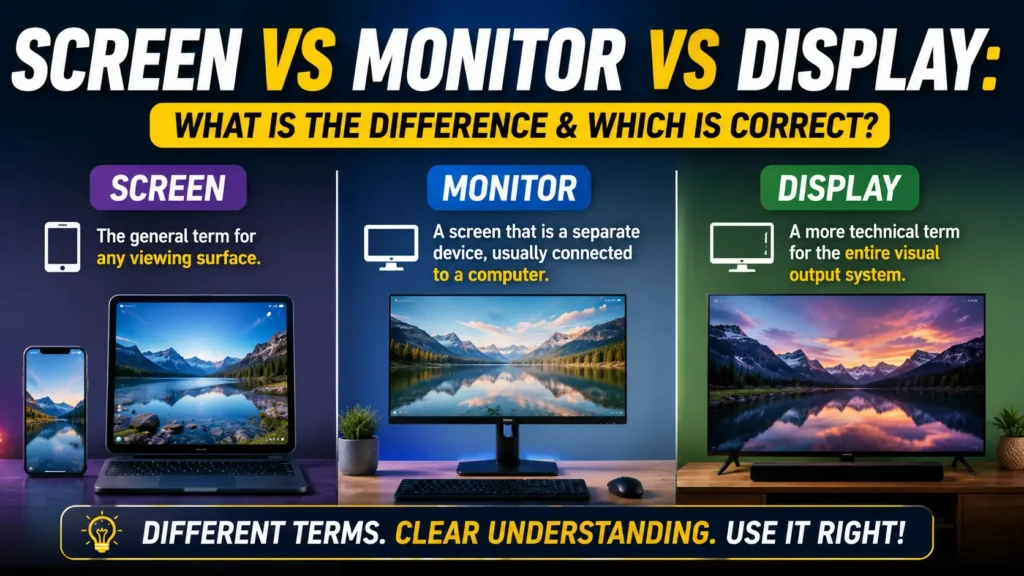

Many people use the words screen, monitor, and display interchangeably, but they do not always mean the same thing. Understanding the differences helps you communicate more accurately, especially when talking about computers, TVs, smartphones, and other digital devices. This guide explains each term in simple language with practical examples and grammar tips.
Comparison Overview
Although screen, monitor, and display are closely related, they refer to different aspects of visual technology.
| Feature | Screen | Monitor | Display |
| Meaning | The physical surface that shows images | A complete output device connected to a computer | The technology or visual output that presents information |
| Type | Physical component | Hardware device | General technical term |
| Common Usage | Phones, TVs, laptops, monitors | Desktop computers | Electronics, technology, engineering |
| Refers To | Viewing surface | Entire device | Image-producing system or output |
| Part or Whole? | Usually part of a device | Complete device | Can refer to hardware or visual output |
While the three words overlap in everyday conversation, professionals often use them more precisely.
Definition of Screen
A screen is the flat surface where images, videos, or text appear. It is the part you actually look at when using an electronic device.
The word “screen” originally referred to something that separates or protects. In modern technology, it commonly means the visible surface that displays information.
Examples include:
- Smartphone screen
- Laptop screen
- Television screen
- Tablet screen
- Touchscreen
The screen is usually one component of a larger electronic device.
Definition of Monitor
A monitor is a complete electronic output device that connects to a computer or other equipment to display visual information.
Unlike a screen, a monitor includes:
- The display panel
- Internal electronics
- Power supply
- Input ports
- External casing
A desktop computer monitor is an example of a complete hardware device.
Definition of Display
A display is the technology or system used to present visual information. It can refer to the image itself, the screen technology, or the visual output of an electronic device.
The term is broader than both “screen” and “monitor.”
Examples include:
- OLED display
- LCD display
- Digital display
- Electronic display
- Vehicle dashboard display
Manufacturers frequently use “display” in product specifications.
Main Differences Between Screen, Monitor, and Display
| Aspect | Screen | Monitor | Display |
| Definition | Viewing surface | Complete hardware device | Visual output or display technology |
| Physical Object | Yes | Yes | Sometimes |
| Includes Electronics | Usually No | Yes | Depends on context |
| Used for Computers | Yes | Yes | Yes |
| Used for Phones | Yes | Rarely | Yes |
| Technical Meaning | Surface | Device | Visual technology |
| Everyday Usage | Very common | Common | Common in technical language |
Key Differences
- A screen is the part you look at.
- A monitor is the entire display device.
- A display refers to the technology or visual presentation itself.
For example:
- Your desktop has a monitor.
- The monitor contains a screen.
- The monitor uses an LCD.
Screen vs Monitor vs Display in Technology
Understanding the technology context makes the differences clearer.
Screen
The visible glass or panel.
Example:
- My phone screen is cracked.
Monitor
The complete external display hardware.
Example:
- I bought a new 27-inch monitor.
Display
The image technology or output system.
Example:
This laptop has a high-resolution OLED display.
Screen vs Monitor vs Display in Everyday Conversation
In casual speech, people often mix these words.
Examples:
- Look at the screen.
- Turn on the monitor.
- The display looks amazing.
Although all three may refer to similar things, choosing the most accurate word improves communication.
Comparison Table
| Situation | Best Word |
| Phone glass | Screen |
| Computer hardware | Monitor |
| Screen technology | Display |
| Product specifications | Display |
| Broken viewing surface | Screen |
| External computer device | Monitor |
| Image quality discussion | Display |
Grammar Guide
All three words are countable nouns.
| Word | Part of Speech |
| Screen | Noun |
| Monitor | Noun |
| Display | Noun (also Verb) |
Unlike screen and monitor, display can also be used as a verb.
Examples:
Noun:
- The display is very bright.
Verb:
- The monitor displays information.
- The phone can display notifications.
How Each Term Is Used in Sentences
Screen
Pattern:
Subject + screen + verb
Examples:
- The screen is clean.
- My screen cracked yesterday.
- This screen supports touch.
Monitor
Pattern:
Subject + monitor + verb
Examples:
- The monitor is large.
- I replaced my monitor.
- This monitor supports 4K resolution.
Display
As a noun:
- The display is colorful.
- The display uses OLED technology.
As a verb:
- The device displays maps.
- The software displays charts.
Common Mistakes Learners Make
Mistake 1
Incorrect:
The monitor on my phone is broken.
Correct:
The screen on my phone is broken.
Mistake 2
Incorrect:
My display is sitting on the desk.
Better:
My monitor is sitting on the desk.
Mistake 3
Incorrect:
The screen displays OLED technology.
Better:
The display uses OLED technology.
Mistake 4
Confusing display (noun) with display (verb).
Correct:
- The display is bright.
- The phone displays notifications.
Simple Rules to Remember
- Screen = the surface you look at.
- Monitor = the complete computer display device.
- Display = the visual technology or output.
- Phones have screens.
- Desktop computers often use monitors.
- Manufacturers usually describe displays.
Quick Tips for Writing and Speaking
- Use screen for visible surfaces.
- Use monitor when discussing desktop computer hardware.
- Use display in technical writing and product descriptions.
- Remember that display can be both a noun and a verb.
- Choose the word based on what you actually mean.
When to Use Each One
Use Screen When
- Talking about a phone.
- Talking about a laptop.
- Referring to broken glass.
- Discussing touchscreens.
- Describing viewing surfaces.
Use Monitor When
- Talking about desktop computers.
- Buying computer hardware.
- Comparing monitor sizes.
- Discussing office equipment.
- Referring to external display devices.
Use Display When
- Writing technical documentation.
- Reading product specifications.
- Discussing display technology.
- Talking about image quality.
- Describing visual output.
When NOT to Use Each One
Do Not Use Screen
- When referring to the entire desktop monitor hardware.
- When discussing display technologies like OLED or LCD.
Do Not Use Monitor
- For smartphone viewing surfaces.
- For tablet glass.
- For television screens in most casual conversations.
Do Not Use Display
- When you specifically mean cracked glass.
- When referring only to an external computer monitor unless discussing its display technology.
Which One to Use (Decision Guide)
Use this simple guide:
- Are you talking about the visible surface? → Screen
- Are you talking about the complete desktop hardware? → Monitor
- Are you talking about visual technology or image output? → Display
- Are you reading technical specifications? → Display
- Are you discussing physical damage on a phone? → Screen
Real-World Practical Examples
Screen Examples
- The phone screen cracked after it fell.
- My laptop screen is too dim.
- The teacher projected the lesson onto a large screen.
- Clean your screen with a microfiber cloth.
- I spend too much time looking at a screen.
Monitor Examples
- I bought a new gaming monitor.
- The office replaced every monitor.
- My monitor supports a 144Hz refresh rate.
- Connect the monitor using an HDMI cable.
- The designer uses two monitors.
Display Examples
- This phone has an AMOLED display.
- The dashboard display shows fuel levels.
- The smartwatch display is easy to read.
- The software displays customer information.
- The museum has an interactive digital display.
Self-Assessment (Fill in the Blanks)
- I will use ______ when referring to the glass surface of my smartphone. The correct word is ______ because it refers to the viewing surface.
- I will use ______ when buying a desktop computer output device. The correct word is ______ because it is the complete hardware.
- I will use ______ when discussing OLED technology. The correct word is ______ because it refers to visual technology.
- I dropped my phone and the ______ cracked. The correct word is ______ because only the viewing surface was damaged.
- My office installed a new ______ on every desk. The correct word is ______ because each desk received a complete device.
- The laptop features a high-quality ______. The correct word is ______ because the sentence discusses display technology.
- I cleaned my laptop ______ with a soft cloth. The correct word is ______ because I cleaned the viewing surface.
- The software will ______ graphs automatically. The correct word is ______ because it is used as a verb.
- The external computer ______ has USB-C ports. The correct word is ______ because it refers to the entire device.
- This tablet has a bright ______. The correct word is ______ because it refers to the visual panel.
- My teacher pointed at the classroom ______ during the presentation. The correct word is ______ because it is the viewing surface.
- The product advertisement highlights its Retina ______. The correct word is ______ because it describes screen technology.
- The computer ______ stopped working yesterday. The correct word is ______ because it is the hardware.
- The device can ______ weather information instantly. The correct word is ______ because it is a verb.
- Avoid scratching the phone ______. The correct word is ______ because it is the visible surface.
- The engineer tested the LCD ______. The correct word is ______ because it refers to technology.
- My new ______ is 32 inches wide. The correct word is ______ because it is a desktop display device.
- The smartwatch ______ is easy to read outdoors. The correct word is ______ because it refers to the visual panel.
- The software can ______ customer data on demand. The correct word is ______ because it functions as a verb.
- The movie played on a giant cinema ______. The correct word is ______ because it refers to the projection surface.
Answers
- Screen
- Monitor
- Display
- Screen
- Monitor
- Display
- Screen
- Display
- Monitor
- Display
- Screen
- Display
- Monitor
- Display
- Screen
- Display
- Monitor
- Display
- Display
- Screen
Conclusion
Understanding the difference between Screen Vs Monitor Vs Display makes it much easier to use the right term in everyday conversations, technical discussions, and professional writing. While these words are often used interchangeably, each has its own meaning and purpose. A screen is the surface where you view content, a monitor is the complete display device commonly connected to a computer, and a display is the broader term that describes the technology or system that presents visual information. Knowing these distinctions helps you communicate more clearly when buying electronics, reading product specifications, troubleshooting devices, or learning about technology. Whether you are a student, professional, gamer, or casual user, choosing the correct word improves accuracy and reduces confusion. By remembering the simple differences explained in this guide, you can confidently decide when to use screen, monitor, or display in any situation.
FAQs
What is the difference between a screen and a monitor?
A screen is the physical surface where images and text appear, while a monitor is the complete electronic device that contains the screen along with internal components, ports, and a power supply. In simple terms, every monitor has a screen, but not every screen is a monitor.
Is a display the same as a screen?
Not exactly. A screen is the surface you look at, whereas a display is a broader term that can refer to the visual output, display technology, or the system that presents information. In everyday conversation, people often use them interchangeably.
Can I use screen, monitor, and display interchangeably?
In casual conversations, many people do use these words interchangeably. However, in technical writing or professional discussions, it is better to use the correct term because each one has a slightly different meaning and context.
Why do manufacturers use the word display instead of screen?
Manufacturers often use the word display because it refers to the technology behind the visual output, such as LCD, OLED, or AMOLED. This makes it more suitable for describing product specifications and image quality than simply using the word screen.
Is a laptop screen called a monitor?
Generally, no. The viewing surface of a laptop is called a screen, while the entire laptop includes many other components. The term monitor is usually reserved for standalone display devices connected to desktop computers or other systems.
What does display mean in technology?
In technology, a display refers to the system or technology that presents visual information. It can describe the display panel itself, the image output, or technologies such as LCD, LED, OLED, and AMOLED used in electronic devices.
Which word should I use for a smartphone?
For smartphones, screen is the most natural and commonly used term when referring to the viewing surface. If you are discussing the technology, such as OLED or AMOLED, then display is the more accurate choice.
Can display be used as a verb?
Yes. Unlike screen and monitor, display can also function as a verb. For example, you can say, “The application displays the results instantly,” where it means to show or present information on a screen.
Which term is best for computer hardware?
When referring to the complete external device connected to a desktop computer, monitor is the correct term. It includes the screen, electronic components, ports, and casing, making it more than just the viewing surface.
Why is it important to know the difference between screen, monitor, and display?
Knowing the difference helps you communicate more accurately, understand product descriptions, and avoid confusion when discussing technology. It is especially useful for students, professionals, shoppers, and anyone interested in computers or electronic devices.
