
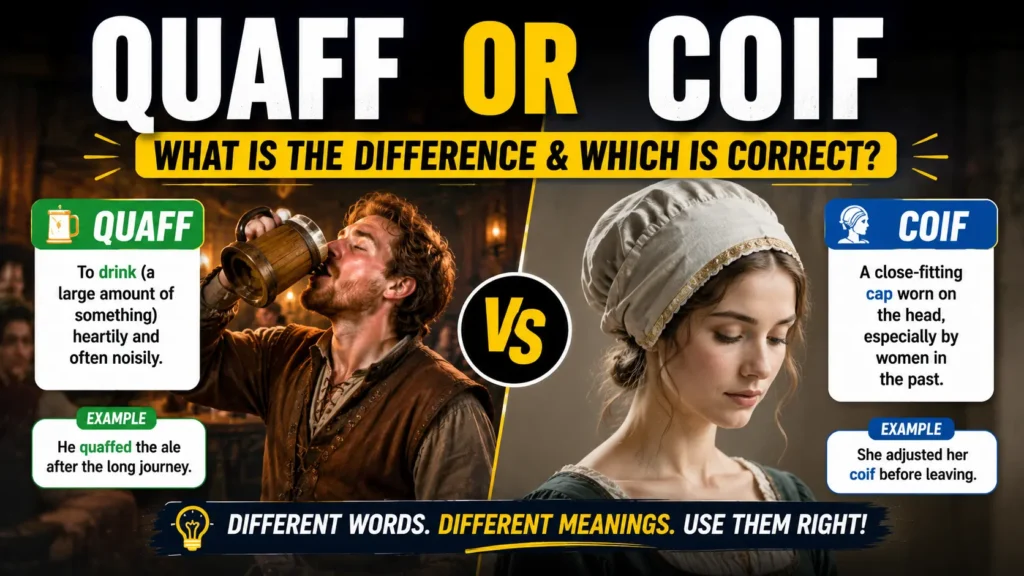

Many English words look or sound similar but have completely different meanings. Quaff and coif are a perfect example. Although they are occasionally confused because of their pronunciation and spelling, they refer to entirely different actions and objects. Understanding their meanings, grammar, and proper usage will help you communicate more accurately in both writing and conversation.
Comparison Overview
Quaff and coif are both English words, but they belong to different contexts and carry unrelated meanings.
- Quaff is mainly used as a verb meaning to drink a beverage deeply or heartily.
- Coif can be used as both a noun and a verb. As a noun, it refers to a close-fitting cap or a hairstyle. As a verb, it means to arrange or style someone’s hair.
Although these words may sound somewhat alike, substituting one for the other completely changes the meaning of a sentence.
| Feature | Quaff | Coif |
| Primary Meaning | Drink deeply | Style hair or a close-fitting cap |
| Part of Speech | Verb (mainly) | Noun and Verb |
| Common Context | Food and drinks | Hairstyles, fashion, history |
| Related To | Drinking | Hair or headwear |
| Modern Usage | Literary and formal | Fashion and hairstyling |
Definition of Quaff
Quaff is a verb that means to drink a liquid enthusiastically, deeply, or in large amounts. It often appears in literary writing or descriptions of celebrations, parties, or historical settings.
Unlike the ordinary verb drink, quaff adds the idea of enjoying or consuming a beverage with enthusiasm.
Key Characteristics
- Refers to drinking beverages.
- Usually describes hearty or eager drinking.
- Often found in literature and storytelling.
- Commonly used with drinks such as ale, wine, beer, or juice.
Example:
- The travelers quaffed fresh water after crossing the desert.
- He quaffed a glass of cold lemonade on a hot afternoon.
Definition of Coif
Coif has two grammatical functions.
As a noun, it refers to a close-fitting cap worn historically or a carefully arranged hairstyle.
As a verb, coif means to style or arrange someone’s hair neatly.
Today, the verb form is more commonly associated with hairstyling.
Key Characteristics
- Can be both a noun and a verb.
- Associated with hairstyles and fashion.
- May also refer to historical head coverings.
- Frequently appears in beauty and fashion writing.
Example:
- The stylist coiffed her hair before the ceremony.
- The queen wore an elegant coif beneath her crown.
Main Differences Between Quaff and Coif
Although both words are legitimate English vocabulary, they have completely different meanings and grammatical uses.
| Aspect | Quaff | Coif |
| Meaning | Drink deeply | Style hair or a hairstyle |
| Category | Action involving beverages | Hair or headwear |
| Part of Speech | Verb | Noun and Verb |
| Common Objects | Water, beer, juice, wine | Hair, cap |
| Typical Setting | Dining, celebrations, literature | Fashion, salons, history |
The easiest way to distinguish them is to remember their subjects.
- If someone is drinking, use quaff.
- If someone is styling hair or referring to a hairstyle or cap, use coif.
Origin and Historical Background
Quaff
The word quaff has existed for centuries and traditionally referred to drinking alcoholic beverages enthusiastically. Today it can describe drinking any beverage deeply or eagerly.
Coif
Coif originally referred to a close-fitting cap worn during medieval times. Over time, it also became associated with hairstyles, leading to its modern verb meaning “to arrange hair.”
Common Contexts Where These Words Appear
Quaff
You may encounter quaff in:
- Literature
- Historical novels
- Food blogs
- Beverage reviews
- Fantasy stories
Coif
You may encounter coif in:
- Fashion magazines
- Beauty blogs
- Hair salon advertisements
- Historical articles
- Costume descriptions
Grammar Guide
Parts of Speech
| Word | Part of Speech |
| Quaff | Verb |
| Coif | Noun and Verb |
Verb Forms
| Base Verb | Past Tense | Past Participle | Present Participle |
| Quaff | Quaffed | Quaffed | Quaffing |
| Coif | Coiffed | Coiffed | Coiffing |
How Each Term Is Used in Sentences
Quaff
Pattern:
Subject + quaff + beverage
Examples:
- They quaffed lemonade after the game.
- She quaffs herbal tea every evening.
- We quaffed fresh coconut water.
Coif
Pattern:
Subject + coif + hair
Examples:
- The stylist coiffed the bride’s hair.
- She carefully coiffed her curls.
- They coiffed the actor before filming.
As a noun:
- Her elegant coif impressed everyone.
- The knight wore a protective coif.
Common Mistakes Learners Make
Mistake 1
❌ She quaffed her hair.
✅ She coiffed her hair.
Mistake 2
❌ He coiffed a glass of wine.
✅ He quaffed a glass of wine.
Mistake 3
Using coif when referring to drinking.
Remember that coif never means drinking.
Simple Rules to Remember
- Quaff = Drink.
- Coif = Hair.
- Quaff is mainly a verb.
- Coif can be both a noun and a verb.
- Drinks are quaffed.
- Hair is coiffed.
Quick Tips for Writing and Speaking
- Replace quaff with drink if you’re unsure of the meaning.
- Replace coif with style hair to test whether it fits.
- Use quaff mostly in descriptive or literary writing.
- Use coif when discussing hairstyles or historical clothing.
When to Use Each One
Use Quaff When
- Talking about drinking beverages.
- Writing stories involving feasts.
- Describing enthusiastic drinking.
- Writing literary descriptions.
- Discussing celebrations.
Examples:
- The guests quaffed sparkling cider.
- Pirates quaffed ale.
- She quaffed iced tea after work.
Use Coif When
- Talking about hairstyles.
- Referring to salon services.
- Describing historical clothing.
- Discussing fashion.
- Mentioning hair arrangements.
Examples:
- The stylist coiffed the model’s hair.
- Her coif matched the vintage dress.
- The actor’s coif looked elegant.
When NOT to Use Each One
Do not use quaff when discussing:
- Hairstyles
- Haircuts
- Fashion
- Caps
- Hair salons
Do not use coif when discussing:
- Drinking
- Beverages
- Restaurants
- Juice
- Coffee
- Water
Which One to Use (Decision Guide)
Ask yourself these simple questions.
Are you talking about drinking a beverage?
→ Use Quaff.
Are you talking about hair or hairstyles?
→ Use Coif.
Is the sentence about a cap or historical headwear?
→ Use Coif.
Is someone enthusiastically drinking?
→ Use Quaff.
Real-World Practical Examples
Quaff Examples
- Education: The students quaffed water after the sports event.
- Daily Life: She quaffed a smoothie before leaving for work.
- Business: Executives quaffed coffee during the morning meeting.
- Technology: Gamers quaffed energy drinks during the tournament.
- Conversation: We quaffed lemonade while relaxing outside.
Coif Examples
- Fashion: The designer admired the model’s elegant coif.
- Daily Life: She coiffed her hair before attending dinner.
- Entertainment: The makeup team coiffed every actor.
- History: The medieval woman wore a linen coif.
- Business: The salon specializes in beautifully coiffed hairstyles.
Self-Assessment (Fill in the Blanks)
- I will use ______ when referring to drinking juice quickly. The correct word is ______ because it describes enthusiastic drinking.
- I will use ______ when referring to styling someone’s hair. The correct word is ______ because it relates to hairstyling.
- I will use ______ when referring to a medieval cap. The correct word is ______ because it is a historical head covering.
- I will use ______ when referring to enjoying a cold beverage. The correct word is ______ because it means to drink deeply.
- I will use ______ when referring to arranging curls. The correct word is ______ because it refers to hair.
- I will use ______ when referring to wine at a banquet. The correct word is ______ because it describes drinking.
- I will use ______ when referring to salon work. The correct word is ______ because salons style hair.
- I will use ______ when referring to water after exercise. The correct word is ______ because people drink water.
- I will use ______ when referring to a hairstyle. The correct word is ______ because it can mean a hairstyle.
- I will use ______ when referring to beer during a celebration. The correct word is ______ because it involves drinking.
- I will use ______ when referring to neatly arranged hair. The correct word is ______ because it relates to grooming.
- I will use ______ when referring to lemonade at a picnic. The correct word is ______ because it describes drinking.
- I will use ______ when referring to historical clothing. The correct word is ______ because it includes a close-fitting cap.
- I will use ______ when referring to coffee at work. The correct word is ______ because people drink coffee.
- I will use ______ when referring to hairstyling before a wedding. The correct word is ______ because hair is being arranged.
- I will use ______ when referring to drinking tea. The correct word is ______ because tea is consumed.
- I will use ______ when referring to an elegant hairstyle. The correct word is ______ because it refers to hair.
- I will use ______ when referring to drinking milk. The correct word is ______ because it involves beverages.
- I will use ______ when referring to a beauty salon. The correct word is ______ because salons coif hair.
- I will use ______ when referring to drinking fresh juice after a workout. The correct word is ______ because it means to drink heartily.
Answers
- Quaff
- Coif
- Coif
- Quaff
- Coif
- Quaff
- Coif
- Quaff
- Coif
- Quaff
- Coif
- Quaff
- Coif
- Quaff
- Coif
- Quaff
- Coif
- Quaff
- Coif
- Quaff
Conclusion
Understanding the difference between quaff or coif helps readers avoid confusion between two uncommon but interesting English words. While they may look and sound slightly similar, their meanings are completely different. Quaff relates to drinking a beverage deeply or enthusiastically, while coif connects to hairstyles, grooming, and historical headwear. Knowing when to use each word improves accuracy in writing, conversations, and vocabulary development. Whether you are describing a celebration with people quaffing drinks or a stylist creating a beautiful coif, choosing the correct term makes your message clearer. These words show how English contains many unique terms with specific purposes. By remembering that quaff is connected to drinks and coif is connected to hair, you can confidently use both words in the right context.
FAQs
What is the main difference between quaff and coif?
Quaff and coif have different meanings and uses. Quaff is a verb that means to drink something heartily or deeply, usually a beverage. Coif can refer to a hairstyle, a close-fitting cap, or the action of styling hair. They are unrelated words despite their similar appearance and pronunciation.
Is quaff a verb or a noun?
Quaff is mainly used as a verb in modern English. It describes the action of drinking a beverage with enthusiasm or enjoyment. For example, someone may quaff a glass of water after exercise or quaff wine during a celebration. It is rarely used as a noun.
What does coif mean in English?
Coif has two meanings. As a noun, it refers to a close-fitting cap or a carefully arranged hairstyle. As a verb, it means to style or arrange someone’s hair. The word is often used in fashion, beauty, and historical contexts where appearance or headwear is being described.
Can quaff and coif be used interchangeably?
No, quaff and coif cannot be used interchangeably because they describe completely different things. Quaff relates to drinking liquids, while coif relates to hair styling or head coverings. Replacing one with the other would create an incorrect sentence and change the intended meaning.
How do you remember the difference between quaff and coif?
A simple way to remember the difference is to connect quaff with beverages and coif with hair. Think of quaff as something you do with a drink, while coif is something related to your hairstyle. This association makes it easier to choose the correct word when writing or speaking.
Is coif still commonly used today?
Coif is still used today, especially in discussions about hairstyles, fashion, and historical clothing. The verb form appears in beauty-related writing, while the noun form is often found in historical descriptions. Although it is not an everyday word for many speakers, it remains a valid English term.
What are some examples of quaff in sentences?
Examples of quaff include sentences like “The guests quaffed refreshing drinks at the party” or “The travelers quaffed water after their journey.” The word is usually used when describing someone drinking eagerly, often adding a sense of enjoyment, celebration, or strong appreciation for the beverage.
What are some examples of coif in sentences?
Examples of coif include “The stylist coiffed her hair before the event” and “The actress wore an elegant coif.” These sentences show that coif is connected to arranging hair or describing a hairstyle. It may also refer to traditional caps worn in earlier historical periods.
Why do people confuse quaff and coif?
People often confuse quaff and coif because their spelling and sounds are similar. However, their meanings come from different areas of language. One focuses on drinking, while the other focuses on hair and headwear. Learning their definitions and examples helps prevent this common vocabulary mistake.
Which word should I use: quaff or coif?
Choose quaff when you are talking about drinking a liquid, especially enthusiastically or descriptively. Choose coif when you are discussing hairstyles, hair arrangement, or certain types of head coverings. The correct choice depends entirely on whether the topic involves beverages or appearance.
