
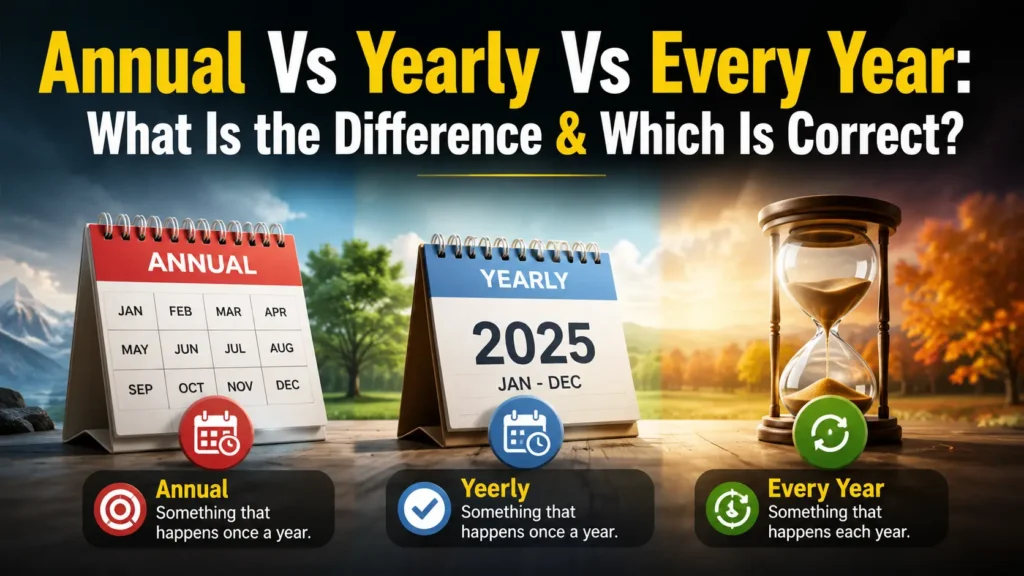

The terms annual, yearly, and every year all refer to something that happens once each year, but they are not always used in the same way. Their differences mainly involve grammar, style, and context. Understanding when to use each expression helps you write and speak more naturally in both formal and everyday English.
Comparison Overview
Although annual, yearly, and every year all describe events or actions that occur once every twelve months, they have different grammatical roles and levels of formality.
- Annual is more formal and is commonly used as an adjective.
- Yearly is slightly less formal and can function as both an adjective and an adverb.
- Every year is an adverbial phrase used in everyday conversation to describe repeated yearly actions.
Choosing the correct term depends on whether you need an adjective, an adverb, or a natural conversational expression.
| Feature | Annual | Yearly | Every Year |
| Part of Speech | Adjective (sometimes noun) | Adjective and Adverb | Adverbial Phrase |
| Formality | Formal | Neutral | Informal to Neutral |
| Describes | Nouns | Nouns or Verbs | Verbs and Actions |
| Common Usage | Reports, events, business | General writing | Everyday conversation |
| Means | Once a year | Once a year | Once each year |
Definition of Annual
Annual is an adjective that describes something happening once every year or lasting for one year. It is widely used in formal writing, business, education, finance, and official documents.
Examples include:
- Annual meeting
- Annual report
- Annual festival
- Annual budget
- Annual subscription
As a noun, annual can also refer to a publication issued once a year.
Example:
- The school published its annual.
Definition of Yearly
Yearly means happening once every year. It can function as both an adjective and an adverb.
As an adjective:
- A yearly inspection
- A yearly payment
As an adverb:
- The event occurs yearly.
- We travel yearly.
Compared to annual, yearly sounds slightly less formal and is common in everyday writing.
Definition of Every Year
Every year is an adverbial phrase that describes an action repeated once each year.
Unlike annual and yearly, it does not describe nouns directly. Instead, it modifies verbs.
Examples:
- We visit our grandparents every year.
- The flowers bloom every year.
- They organize the event every year.
It is one of the most natural expressions in spoken English.
Main Differences Between Annual, Yearly, and Every Year
| Aspect | Annual | Yearly | Every Year |
| Grammar | Mainly adjective | Adjective and adverb | Adverbial phrase |
| Formality | Formal | Neutral | Informal to neutral |
| Describes | Nouns | Nouns and actions | Actions only |
| Common in Business | Yes | Sometimes | Rarely |
| Common in Conversation | Less | Yes | Very common |
Key Differences
- Annual is usually used before nouns.
- Yearly can describe nouns or actions.
- Every year describes when an action happens.
- Annual sounds more formal than yearly.
- Every year is the most conversational option.
Annual vs Yearly vs Every Year in Professional Writing
Formal documents usually prefer annual.
Examples:
- Annual financial report
- Annual conference
- Annual performance review
General writing often uses yearly.
Examples:
- Yearly expenses
- Yearly maintenance
Casual speech is typically uses every year.
Examples:
- We go camping every year.
- The family gathers every year.
Comparison Table
| Situation | Best Choice |
| Business report | Annual |
| Official event | Annual |
| Casual conversation | Every year |
| General writing | Yearly |
| Financial statement | Annual |
| Habit or routine | Every year |
| Recurring activity | Yearly or Every year |
Grammar Guide
The three expressions have different grammatical roles.
| Term | Part of Speech |
| Annual | Adjective (occasionally noun) |
| Yearly | Adjective and Adverb |
| Every Year | Adverbial Phrase |
How Each Term Is Used in Sentences
Annual (Adjective)
Pattern:
Annual + noun
Examples:
- The company released its annual report.
- We attended the annual conference.
- The annual budget was approved.
Yearly (Adjective)
Pattern:
Yearly + noun
Examples:
- A yearly inspection is required.
- They receive a yearly bonus.
- The yearly schedule has changed.
Yearly (Adverb)
Pattern:
Verb + yearly
Examples:
- Membership renews yearly.
- The magazine is published yearly.
- The award is presented yearly.
Every Year (Adverbial Phrase)
Pattern:
Verb + every year
Examples:
- We travel every year.
- She visits us every year.
- The school holds a sports day every year.
Common Mistakes Learners Make
Mistake 1
Incorrect:
Annual happens in July.
Correct:
The annual event happens in July.
Mistake 2
Incorrect:
We annual visit our grandparents.
Correct:
We visit our grandparents every year.
Mistake 3
Incorrect:
Every year report
Correct:
Annual report
or
Yearly report
Mistake 4
Using annual after a verb.
Incorrect:
The event occurs annual.
Correct:
The event occurs yearly.
or
The event occurs every year.
Simple Rules to Remember
- Use annual before nouns.
- Use yearly before nouns or after verbs.
- Use every year after verbs.
- Official documents usually prefer annual.
- Everyday speech usually prefers every year.
Quick Tips for Writing and Speaking
- Choose annual for formal writing.
- Choose yearly for neutral writing.
- Choose every year in conversations.
- Remember that every year never directly modifies a noun.
- If unsure in casual English, every year is usually the safest choice.
When to Use Each One
Use Annual When
- Writing business reports
- Discussing company events
- Referring to official meetings
- Describing yearly publications
- Writing formal documents
Use Yearly When
- Writing general articles
- Describing recurring expenses
- Talking about yearly schedules
- Explaining repeated events
- Using either adjective or adverb forms
Use Every Year When
- Speaking naturally
- Describing habits
- Discussing traditions
- Talking about vacations
- Explaining recurring personal activities
When NOT to Use Each One
Do Not Use Annual
- After action verbs.
Incorrect:
The event occurs annual.
Correct:
The event occurs yearly.
or
The event occurs every year.
Do Not Use Yearly
- If a formal business document specifically prefers annual.
- When a more conversational phrase is needed.
Do Not Use Every Year
- Before nouns.
Incorrect:
Every year report
Correct:
Annual report
or
Yearly report
Which One to Use (Decision Guide)
Use this simple guide:
- Are you describing a formal noun? → Annual
- Are you writing neutral English? → Yearly
- Are you talking naturally about repeated actions? → Every year
- Is it a business document? → Annual
- Is it casual conversation? → Every year
Real-World Practical Examples
Annual Examples
- The company released its annual report.
- Our school hosts an annual sports day.
- The annual budget was approved.
- Scientists attended the annual conference.
- The museum organizes an annual exhibition.
Yearly Examples
- We receive a yearly salary review.
- The yearly inspection is mandatory.
- Membership renews yearly.
- The award is presented yearly.
- The yearly maintenance keeps the machine efficient.
Every Year Examples
- We celebrate the festival every year.
- She visits her grandparents every year.
- The trees bloom every year.
- They organize a family reunion every year.
- Students participate in the competition every year.
Self-Assessment (Fill in the Blanks)
- I will use ______ when referring to a formal company report. The correct word is ______ because it modifies a noun.
- I will use ______ when describing a recurring family vacation. The correct word is ______ because it modifies an action.
- I will use ______ when talking about an official conference. The correct word is ______ because it is formal.
- I will use ______ when saying we travel once each year. The correct word is ______ because it follows the verb.
- I will use ______ when describing a recurring inspection. The correct word is ______ because it can modify a noun.
- I will use ______ when discussing a business budget. The correct word is ______ because formal writing prefers it.
- I will use ______ when talking casually about birthdays. The correct word is ______ because it sounds natural.
- I will use ______ before the word “meeting.” The correct word is ______ because it functions as an adjective.
- I will use ______ after the verb “occurs.” The correct word is ______ because it functions as an adverb.
- I will use ______ when describing a recurring payment in general writing. The correct word is ______ because it is neutral.
- I will use ______ for an official school celebration. The correct word is ______ because it is commonly used in formal contexts.
- I will use ______ when explaining a yearly family tradition. The correct word is ______ because it modifies the action.
- I will use ______ before the noun “subscription.” The correct word is ______ because it directly describes the noun.
- I will use ______ after the verb “renews.” The correct word is ______ because it works naturally as an adverb.
- I will use ______ when talking about a company review document. The correct word is ______ because it is standard business English.
- I will use ______ when discussing maintenance in everyday writing. The correct word is ______ because it fits neutral style.
- I will use ______ when describing something people do regularly once a year. The correct word is ______ because it expresses repeated actions.
- I will use ______ before the noun “festival.” The correct word is ______ because it modifies the event.
- I will use ______ after the verb “visit.” The correct word is ______ because it tells how often the action happens.
- I will use ______ when writing an official financial statement. The correct word is ______ because it is the preferred formal term.
Answers
- Annual
- Every year
- Annual
- Every year
- Yearly
- Annual
- Every year
- Annual
- Yearly
- Yearly
- Annual
- Every year
- Annual
- Yearly
- Annual
- Yearly
- Every year
- Annual
- Every year
- Annual
Conclusion
Understanding the difference between Annual Vs Yearly Vs Every Year can make your English more accurate, natural, and confident. Although all three expressions refer to something that happens once every twelve months, they are used differently depending on grammar and context. Annual is the best choice for formal writing and official documents because it usually functions as an adjective before a noun. Yearly is more flexible since it can work as both an adjective and an adverb in general writing. Every year is the most natural option for everyday conversations because it describes how often an action happens. By learning these simple distinctions, you can avoid common mistakes and choose the most suitable expression for business, education, professional communication, or casual speech. Whenever you are unsure, think about whether you are describing a noun, modifying a verb, or simply talking about a recurring event, and selecting the correct term will become much easier.
FAQs
Is annual the same as yearly?
Annual and yearly both mean something happens once every year, but they are not always used in the same way. Annual is more common in formal writing and usually describes nouns, while yearly is slightly less formal and can function as both an adjective and an adverb depending on the sentence.
Which is more formal, annual or yearly?
Annual is generally considered more formal than yearly. It is widely used in business reports, legal documents, academic writing, and official announcements. Yearly is still correct but is more common in general writing and everyday English where a less formal tone is appropriate.
Can I use every year instead of annual?
Sometimes, yes. If you are describing an action, every year works well. However, if you are modifying a noun, annual is usually the better choice. For example, say annual meeting but we meet every year because the grammar is different.
Is every year an adjective?
No. Every year is an adverbial phrase, not an adjective. It tells how often an action happens and modifies a verb. It does not directly describe a noun, which is why phrases like every year report are grammatically incorrect.
Can yearly be used as both an adjective and an adverb?
Yes. Yearly is flexible because it works in both roles. As an adjective, it describes a noun, such as yearly subscription. As an adverb, it modifies a verb, as in the event is held yearly.
Why do businesses prefer the word annual?
Businesses often choose annual because it sounds more formal and professional. Terms such as annual report, annual budget, and annual meeting have become standard expressions in corporate, financial, and legal communication, making them clearer and more consistent.
Should I say annual meeting or yearly meeting?
Both are grammatically correct, but annual meeting is much more common and sounds more professional. It is the preferred phrase in business, education, and organizations because it follows standard English usage for official recurring events.
Is every year better for speaking?
Yes. Every year is very common in everyday conversations because it sounds natural and easy to understand. Native English speakers often use it when talking about traditions, vacations, celebrations, or habits that happen once each year.
Can annual be used after a verb?
Generally, no. Annual usually functions as an adjective before a noun. After a verb, it is more natural to use yearly or every year. For example, say The event occurs yearly or The event happens every year.
How do I choose between annual, yearly, and every year?
Choose annual for formal documents and before nouns, yearly for neutral writing when you need either an adjective or an adverb, and every year when describing recurring actions in natural conversation. Thinking about grammar and context will help you make the right choice.
